

A competing behavior pathway is the bridge between a finished FBA and a behavior plan that actually fits the student. Many teams complete a careful assessment, write a summary statement, and then fill the plan with general strategies like “praise good behavior” and “use reminders.” A month later, nothing has changed, because the plan never addressed why the behavior happens.
This guide walks you through a five-step process for building the pathway and turning it into function-based strategies. You will start from the FBA summary, map the problem pathway, add desired and replacement behaviors, choose strategies for each part, and then write and monitor the plan with your team.
Examples are fictional. Adapt to the student’s goals and agreed supports. This is guidance, not a diagnosis.
At a glance
- Begin with a clear FBA summary statement, not a list of incidents.
- Map setting event, antecedent, problem behavior, consequence, and function.
- Add a long-term desired behavior and a short-term replacement that meets the same function.
- Choose strategies for every part of the pathway, not only consequences.
- Monitor the replacement behavior as closely as the problem behavior.
1. Start the competing behavior pathway from the FBA summary
First, gather the results of the functional behavior assessment. A competing behavior pathway does not replace the FBA. Instead, it organizes what the FBA found so the team can plan from it.
The most useful starting point is the summary statement, sometimes called the final summary of behavior. It usually describes when the behavior happens, what it looks like, what follows it, and the likely function. If your FBA does not end with a statement like this, write one together before going further.
Consider a fictional example. Maya is in grade 6. The team’s FBA, which included observations, ABC data, and interviews, ends with this summary:
| Part | Maya’s summary |
|---|---|
| Setting event | Short sleep the night before |
| Antecedent | Asked to read aloud in front of the class |
| Problem behavior | Tears up her worksheet and puts her head down |
| Consequence | Sent to the hallway, reading skipped |
| Likely function | Escape from reading aloud |
Next, check that every part is observable and supported by data. “Maya hates reading” is an opinion. “Asked to read aloud in front of the class” is an antecedent the team saw many times. Clear wording here makes every later step easier.
Finally, confirm the hypothesis with the team. A competing behavior pathway built on a weak guess will produce a weak plan, so take a few minutes to agree before you draw anything.
2. Map the problem pathway
Now draw the top line of the pathway. It runs from left to right: setting event, antecedent, problem behavior, consequence, and function. Seeing these boxes in a row makes the logic of the behavior visible to everyone at the table.
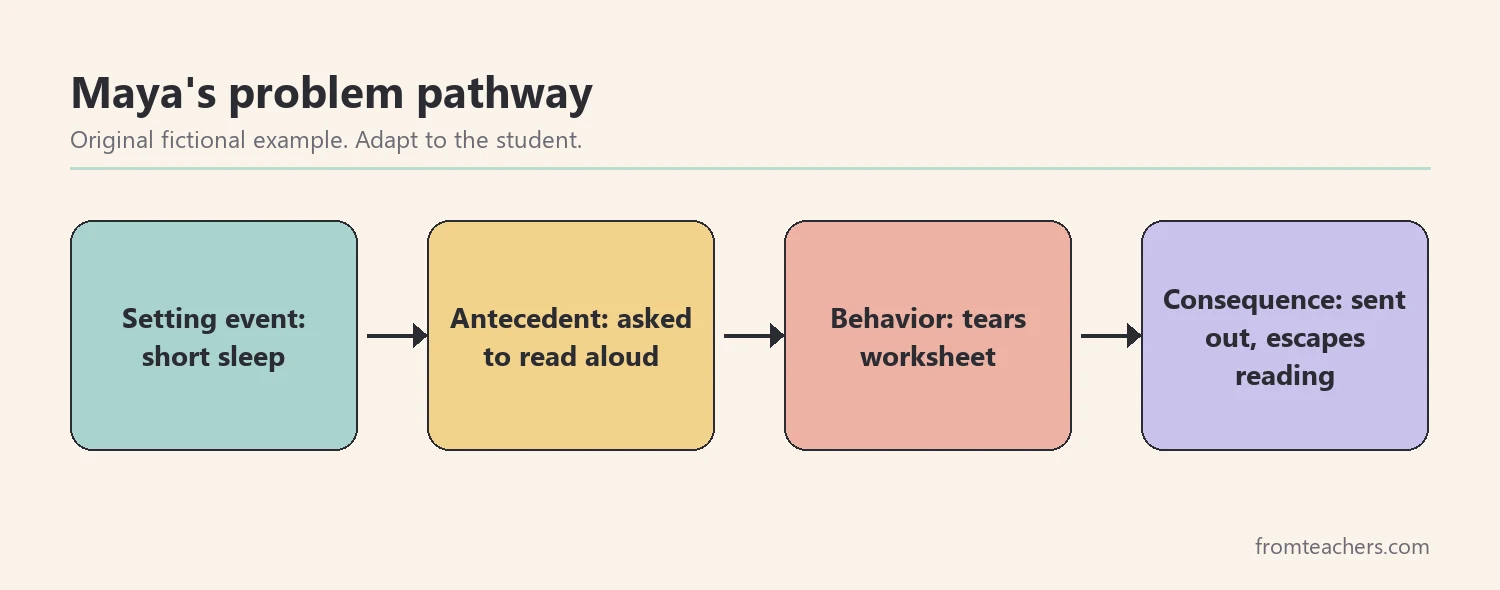
Read the pathway out loud as a sentence. For Maya: “When she has slept poorly and is asked to read aloud, she tears up her worksheet, and she is sent to the hallway, so she escapes reading aloud.” If the sentence sounds confusing, one of the boxes probably needs clearer wording.
Then, look closely at the consequence box. It is often the hardest one for adults to accept, because it includes what the adults do. In Maya’s case, sending her to the hallway gives her exactly what the behavior is working for. That is not a criticism of anyone. It is simply the information the plan needs.
In addition, note how strong the pattern is. The FBA data showed that most of Maya’s incidents happened during read-aloud activities, and fewer happened during silent reading. Patterns like this help you decide where prevention will matter most.
Many teams use a printed or fillable template for this step, because a fixed layout keeps the discussion focused. A fillable competing behavior pathway and BIP planning tool gives you the diagram and guided sections that follow directly from an FBA summary.
Running the pathway meeting
Building a competing behavior pathway works best as a short, focused meeting. Invite the adults who know the student in the problem setting, plus the person who led the FBA. Families add useful detail about setting events, so include them when you can.
Next, keep the conversation on the boxes. When someone shares a story, ask which box it belongs in. This habit stops the meeting from turning into a list of hard days and keeps everyone working toward a plan.
Finally, write the completed pathway where everyone can see it, such as on a whiteboard or a shared form. A visible competing behavior pathway helps the team notice gaps, for example a setting event nobody has planned for.
3. Add desired and replacement behaviors to the competing behavior pathway
Next, add the two lines that give the competing behavior pathway its name. Above the problem behavior, write the desired behavior: what you would ultimately like the student to do in that situation. Below it, write the replacement behavior: a more acceptable action that meets the same function.
The difference matters. By contrast, the desired behavior is the long-term goal, and it often leads to a different outcome, such as praise or completed work. The replacement behavior is a short-term bridge. It gives the student a better way to get what the problem behavior was getting, so the problem behavior is no longer needed.
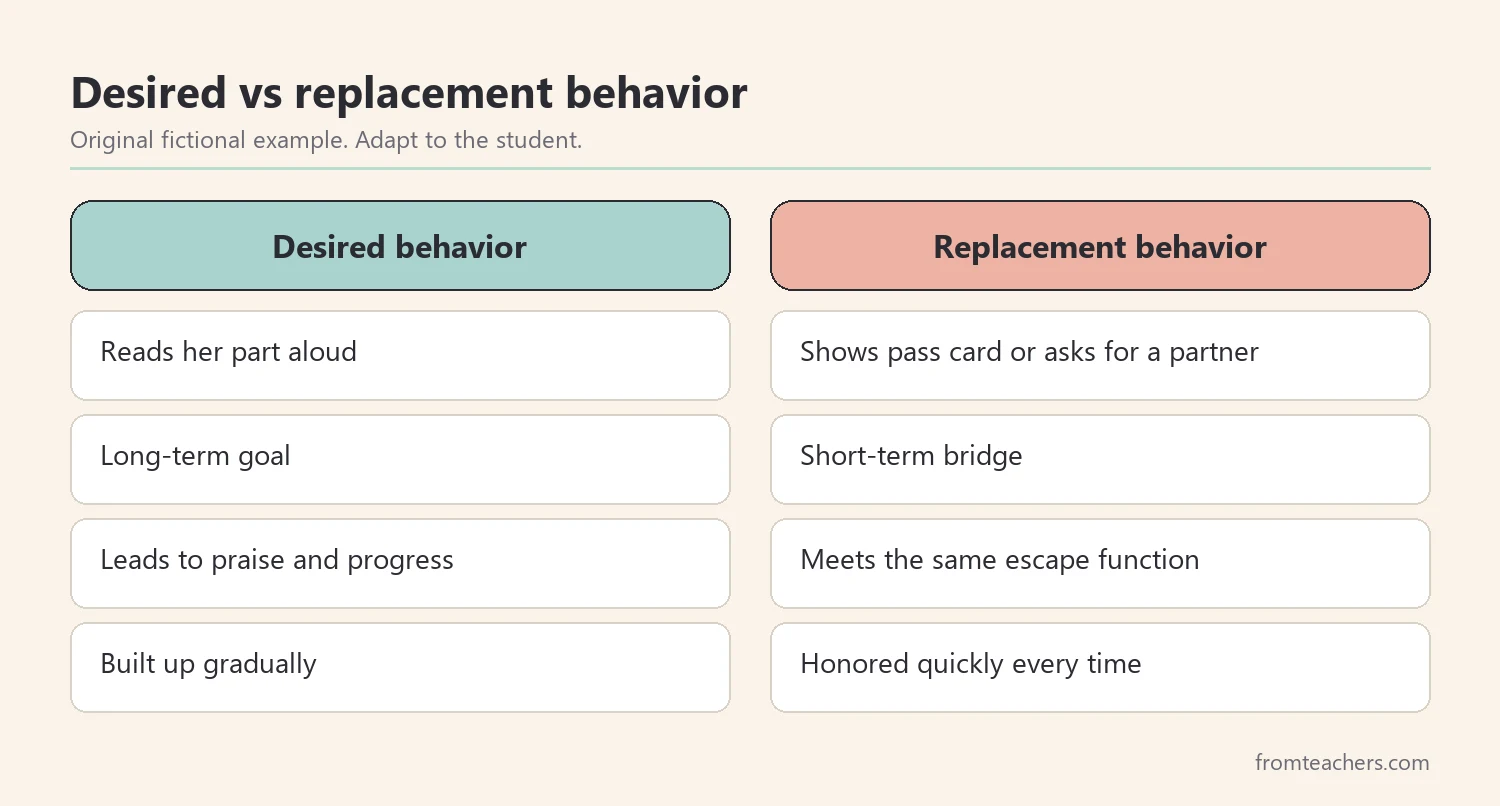
For Maya, the team writes:
- Desired behavior: reads her part aloud with the group.
- Replacement behavior: shows a “pass” card to skip reading once, or asks to read with a partner.
- Function met: brief escape from reading aloud alone.
Then, check the replacement against three questions. Does it meet the same function? Is it easier for the student than the problem behavior? Will adults honor it quickly and consistently? If the answer to any question is no, the student will likely keep using the old behavior.
Also, remember that the replacement is not the end point. Over time, the team will make reading aloud easier and more rewarding, so Maya moves toward the desired behavior.
4. Choose function-based strategies for each part
With the full competing behavior pathway in front of you, choose strategies for each box. This is where the pathway pays off. Instead of a general list, every strategy connects to a specific part of the behavior’s logic.
Work from left to right. For setting events, ask how to reduce or neutralize their effect. With antecedents, ask how to prevent or change the trigger. For behaviors, ask what to teach and how to prompt it. With consequences, ask how to reinforce the replacement and desired behaviors while reducing reinforcement of the problem behavior.
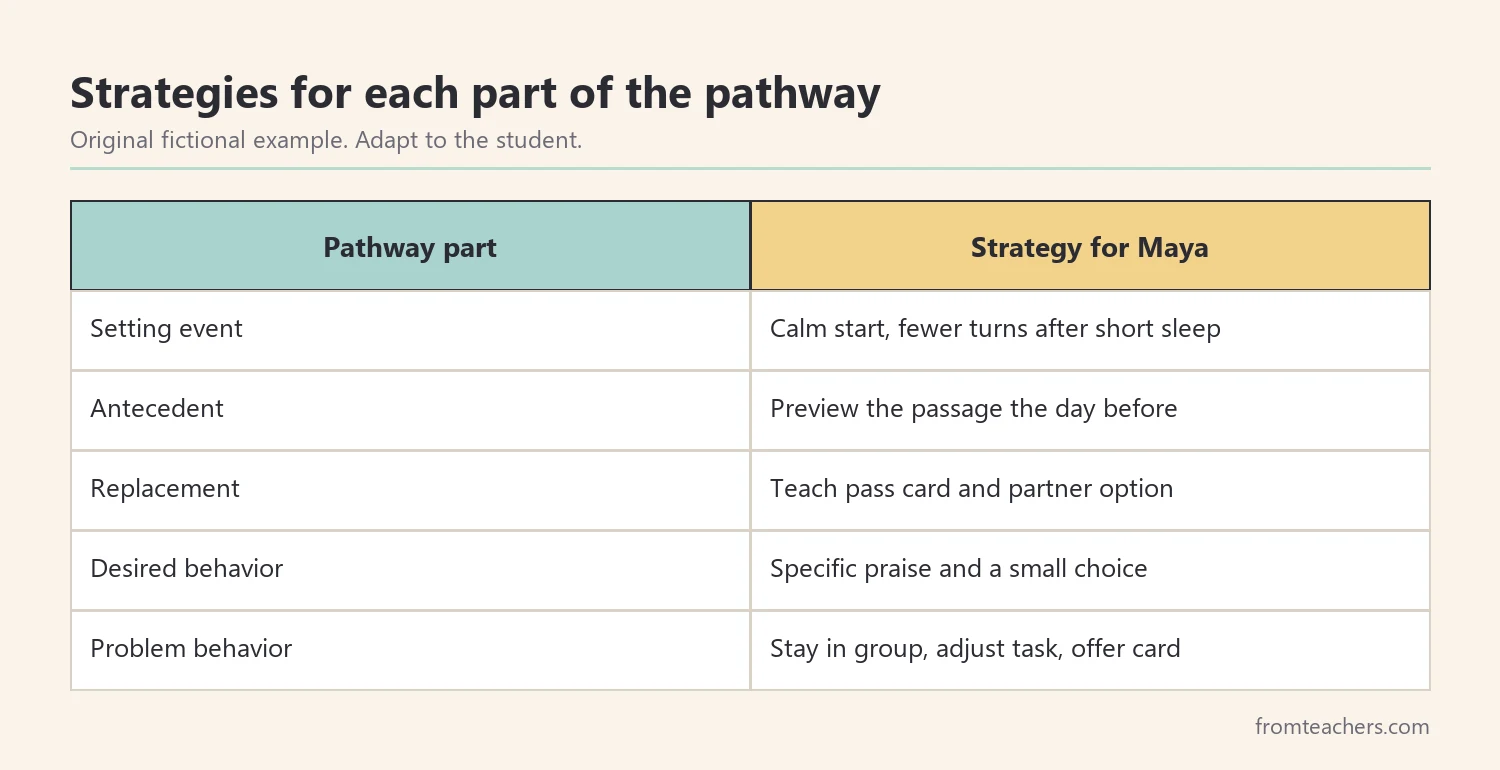
For Maya, the strategies look like this. On days when her family reports a short night, the teacher offers a calm start and fewer read-aloud turns. Before group reading, Maya previews her passage the day before. The team teaches her to use the pass card and the partner option through short practice sessions. When she uses the card, the teacher honors it right away. When she reads aloud, even a short part, she receives specific praise and a small choice afterward.
At the same time, the team changes what happens after the problem behavior. Instead of sending Maya to the hallway, the teacher calmly offers the pass card and keeps her in the group. The reading task is adjusted, not removed entirely. This reduces the payoff of the old behavior.
In addition, plan how to prompt the replacement behavior in the moment. Early on, the teacher places the pass card on Maya’s desk before read-aloud starts and points to it quietly if she looks tense. Over time, the prompt fades so Maya uses the card on her own. A competing behavior pathway is only useful if the replacement is easy to reach when it is needed.
Finally, keep the list realistic. Three to six well-chosen strategies are usually easier to carry out than a long list nobody remembers.
5. Write the plan and monitor the competing behavior pathway
Now transfer the strategies into the behavior intervention plan. For each one, write who does it, when, and how. A strategy without a named adult and a clear time often fades within a few weeks.
Then, decide what to measure. Track the problem behavior, but also track the replacement behavior. If the replacement is being used more often while the problem behavior drops, the plan is working as intended. If neither changes, look again at the pathway.
Here is Maya’s data over four weeks of read-aloud lessons:
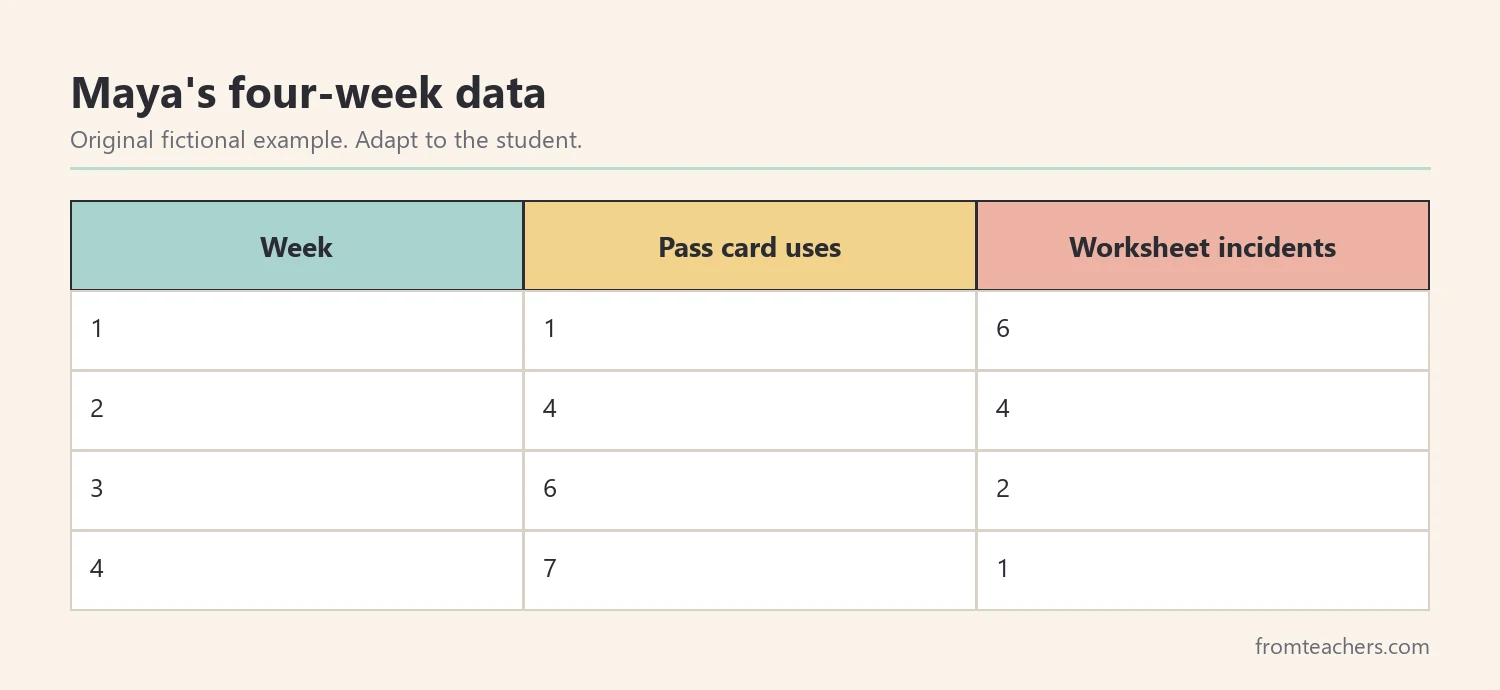
In week 1, Maya uses the pass card once and tears a worksheet six times. By week 2, she uses the card four times with four incidents. In week 3, she uses it six times with two incidents. By week 4, she uses the card seven times and has one incident. The team also notes that she read a short part aloud twice in week 4.
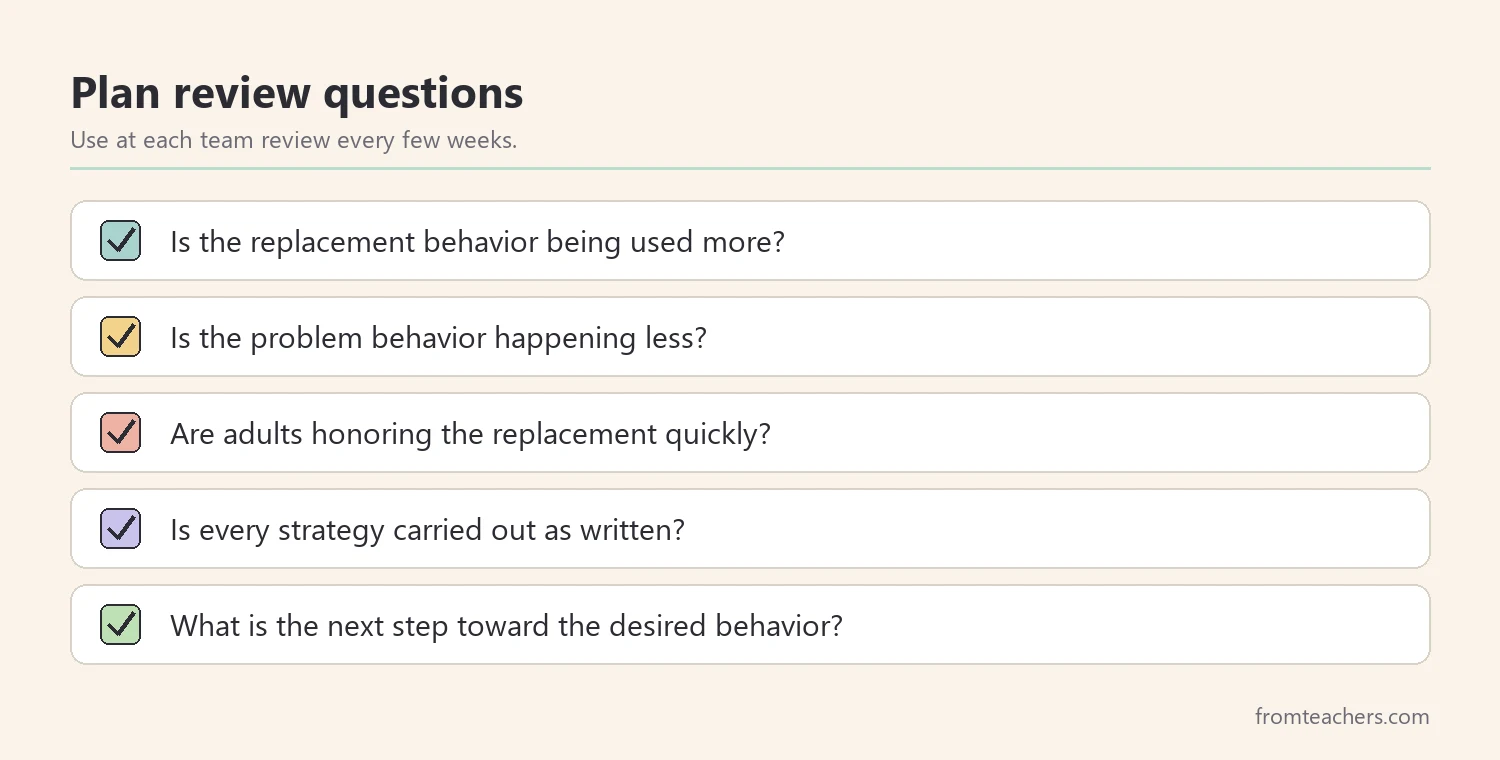
Next, schedule reviews. Many teams meet every few weeks to look at the data and adjust. As the problem behavior fades, the plan can shift toward the desired behavior, for example by reducing pass cards gradually and increasing partner reading.
Also, keep the family involved. Share the pathway in plain language. Families can often help with setting events, such as sleep, and can reinforce the same skills at home.
Common mistakes and how to avoid them
- Skipping the summary statement. Fix: write a clear statement from the FBA before drawing the pathway.
- Choosing a replacement that meets a different function. Fix: make sure the replacement gets the student the same outcome as the problem behavior.
- Making the replacement harder than the problem behavior. Fix: choose a simple, fast action and teach it directly.
- Planning only consequences. Fix: add strategies for setting events, antecedents, and teaching.
- Keeping the old payoff in place. Fix: change what happens after the problem behavior so it no longer works as well.
- Measuring only the problem behavior. Fix: track the replacement and desired behaviors too.
Questions teachers and parents ask about the competing behavior pathway
Who should complete a competing behavior pathway?
Usually, the team that completed the FBA, often led by a behavior specialist, school psychologist, or BCBA. Teachers, paraprofessionals, and families add important details about the student and the setting.
What is the difference between a replacement behavior and a desired behavior?
A replacement behavior meets the same function as the problem behavior in a more acceptable way. A desired behavior is the long-term goal, which may lead to a different outcome. The replacement is a bridge toward the desired behavior.
Can a competing behavior pathway work without an FBA?
It needs a reliable hypothesis about function, which normally comes from an FBA. Without that, the team may choose strategies that target the wrong function. If no FBA exists, gathering data first is the safer route.
How many strategies should a behavior plan include?
There is no fixed number, but many teams find three to six strategies easier to use consistently. Each should connect to a specific part of the pathway and name who will carry it out.
How can families support the competing behavior pathway at home?
Families can share information about setting events, such as sleep or changes at home. They can also encourage the same replacement skill, for example asking for a short break in a calm way.
Related reading: Moving Beyond Shame and Behavior Charts: Positive Alternatives for Effective Classroom Management, Understanding Demand Avoidance and School Refusal: Strategies for PDA-Style Profiles, and Addressing Challenges in Special Education: Practical Strategies for Educators.
A companion resource for the competing behavior pathway:
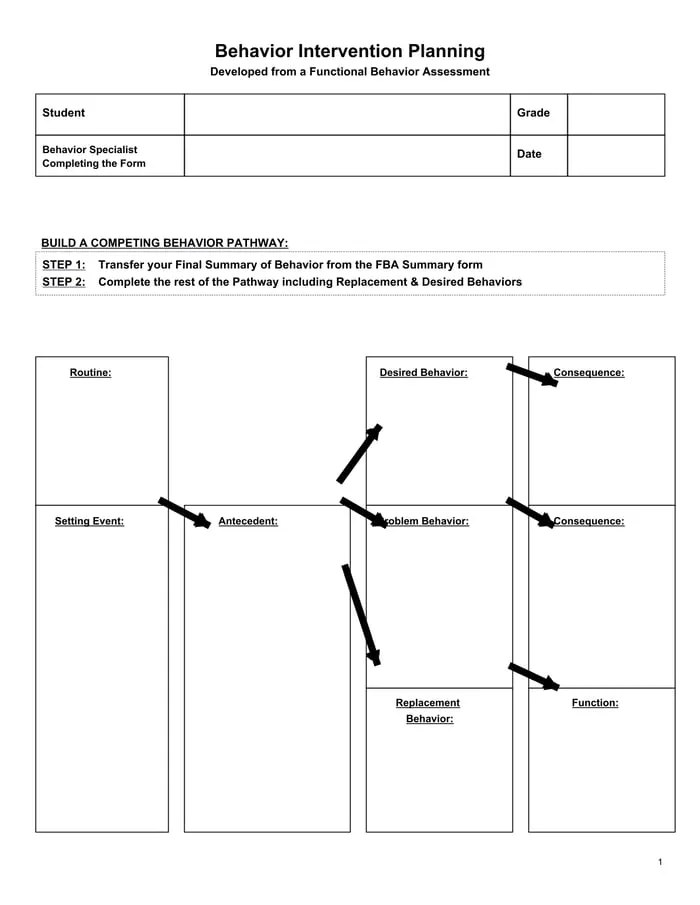
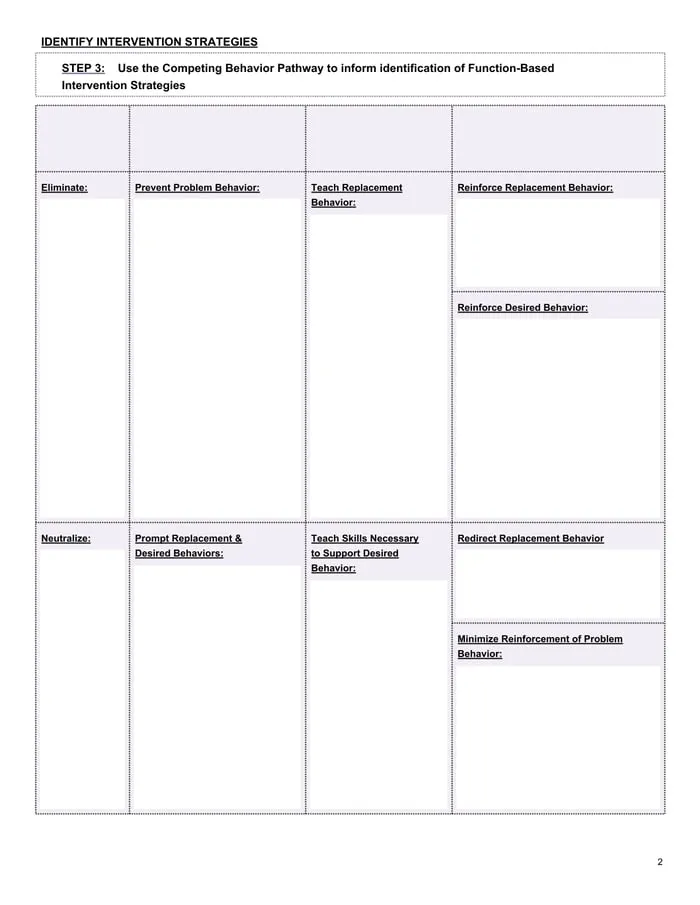
Behavior Intervention Planning (BIP) with Competing Pathway: a fillable PDF tool that follows an FBA summary, with a competing behavior pathway diagram, guided steps for completing it, and function-based strategy sections for preventing, teaching, and reinforcing behaviors.
Sources and scope
- IRIS Center, Vanderbilt University: free modules on functional behavioral assessment and behavior planning.
- Center on PBIS: resources on positive behavior support and function-based interventions in schools.
- IDEA, U.S. Department of Education: the law behind special education services, including behavior supports in IEPs.
- What Works Clearinghouse: reviews of research on education practices.
This guide covers how teams can use a competing behavior pathway to plan function-based supports. It does not replace a full FBA, legal guidance, or the judgment of qualified behavior professionals on the student’s team.
Key takeaways
- A competing behavior pathway turns an FBA summary into a clear plan.
- Map setting event, antecedent, behavior, consequence, and function in order.
- Pick a replacement behavior that meets the same function and is easy to use.
- Choose strategies for every part of the pathway.
- Track both the replacement and the problem behavior and review often.










Leave a Comment