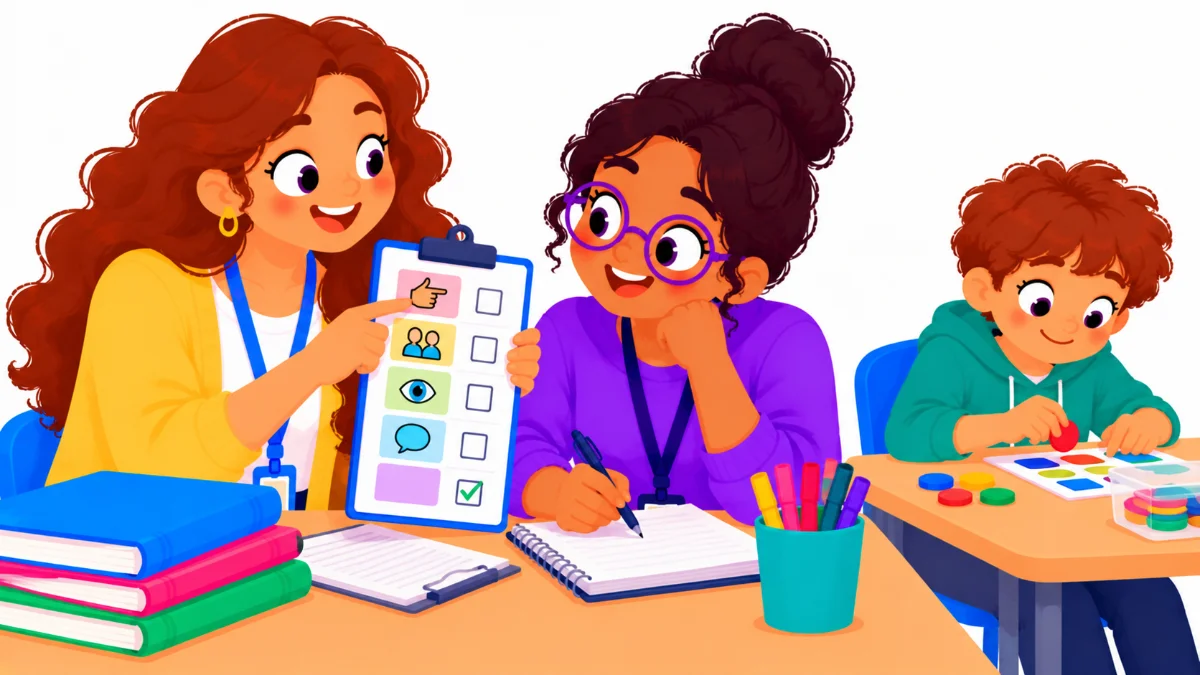

Paraprofessional training is often the difference between an aide who waits for directions and one who confidently supports students all day. Picture a busy special education classroom: the lead teacher is running a small group, a student needs help starting work, and the paraprofessional is unsure whether to step in, prompt, or wait. A few minutes of clear training could have answered that question in advance.
After reading this guide, you will be able to define the paraprofessional’s role, teach a simple prompting routine, agree on behavior support language, coach with short observations and feedback, and review progress together. The steps work for a new aide in September or a veteran who joins a new classroom midyear.
Examples are fictional. Adapt to the student’s goals and agreed supports. This is guidance, not a diagnosis.
At a glance
- Start with clear roles: who leads, who supports, and when.
- Teach one shared prompting routine, from least to most help.
- Agree on the same calm words for behavior support.
- Coach with short observations and specific, balanced feedback.
- Review together every few weeks and adjust one thing at a time.
1. Define roles before paraprofessional training begins
First, write down what the paraprofessional does during each part of the day. Many problems come from unclear roles rather than weak skills. When an aide does not know whether to lead, support, or observe, they tend to either hover or step back too far.
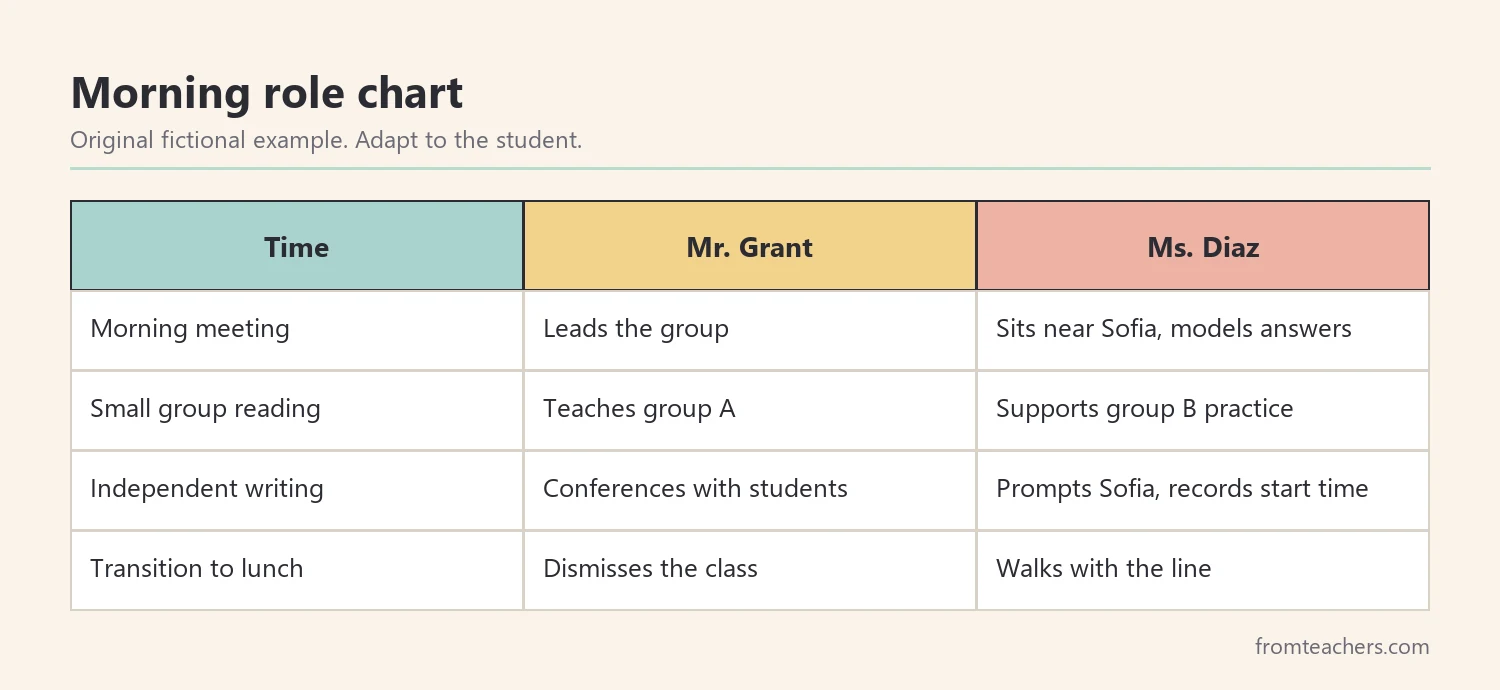
A simple role chart solves much of this. For each block of the schedule, list what the lead teacher does and what the paraprofessional does. Include which students the aide supports and what data, if any, they collect.
Next, clarify boundaries. Paraprofessionals work under the direction of the teacher, and planning, assessment decisions, and IEP goals stay with the teacher and the team. Being clear about this protects everyone and helps the aide feel confident inside their role.
It also helps to share key student information early. The aide does not need every detail of every file, but they do need to know each student’s main goals, agreed supports, and any safety or health notes. A one-page summary per student, reviewed together, is usually enough to start.
Worked example: Ms. Diaz and Sofia, grade 3
Mr. Grant teaches a grade 3 resource room. Ms. Diaz, a new paraprofessional, supports several students, including Sofia, who needs help starting independent writing. Together, they build a role chart for the morning.
| Time | Mr. Grant | Ms. Diaz |
|---|---|---|
| Morning meeting | Leads the group | Sits near Sofia, models answers |
| Small group reading | Teaches group A | Supports group B practice |
| Independent writing | Conferences with students | Prompts Sofia to start, records start time |
| Transition to lunch | Dismisses the class | Walks with the line |
As a result, Ms. Diaz knows exactly where to be and what to do in each block, and Mr. Grant knows what support is happening without checking constantly.
Finally, schedule a short weekly check-in. Even ten minutes on the same day each week gives both adults a set time to plan, ask questions, and solve small problems before they grow. Without that time, communication tends to happen in rushed hallway moments.
2. Teach a shared prompting routine
Prompting is one of the most important skills in paraprofessional training. Without a shared routine, adults often jump straight to doing the task for the student. Over time, that can build dependence instead of independence.
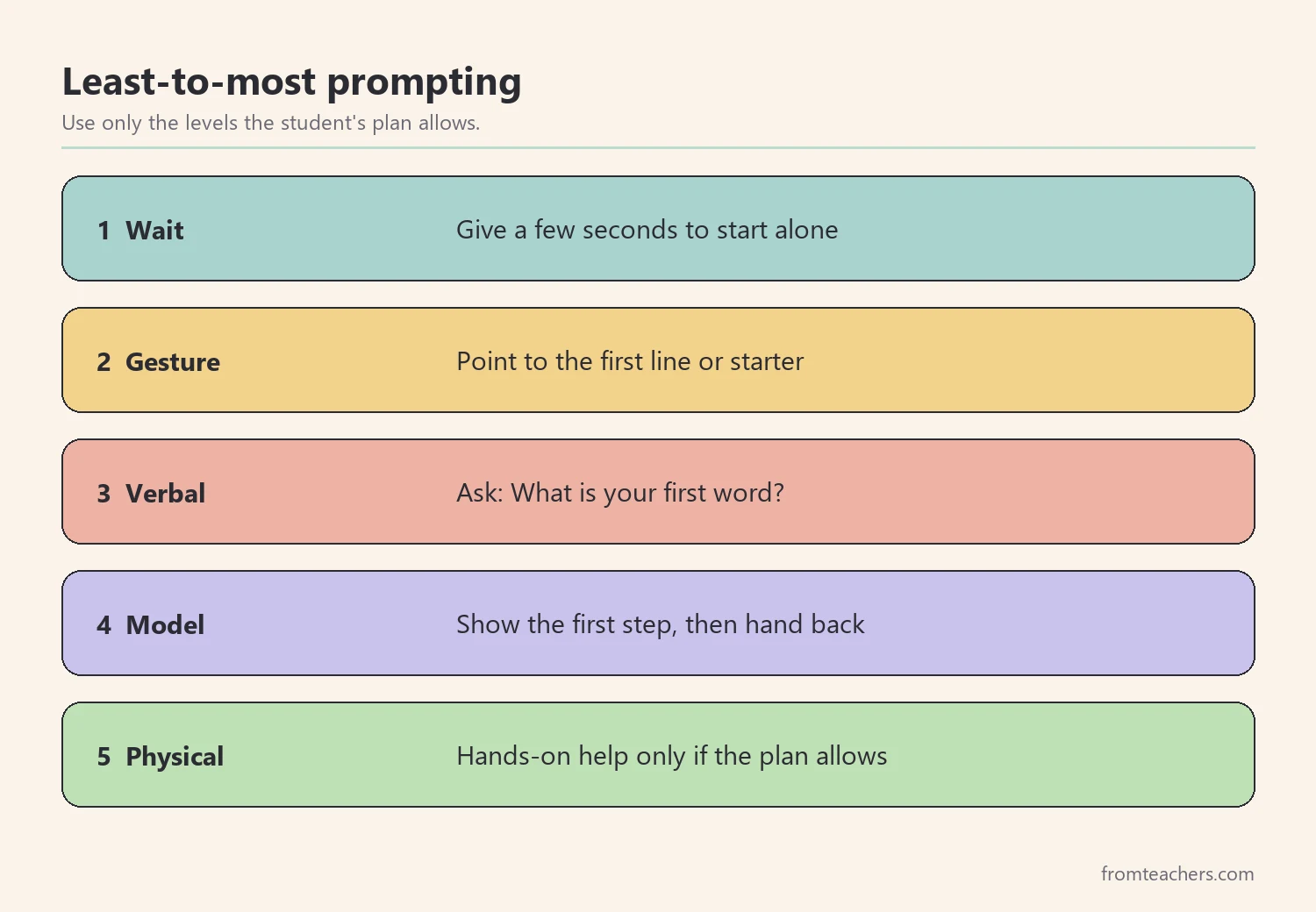
A common approach is a least-to-most prompt sequence. The adult starts with the smallest amount of help and adds more only if needed. For example: wait a few seconds, then give a gestural prompt, then a verbal prompt, then a model, and finally hands-on help if the plan allows it.
Moreover, agree on what each level looks like in your room. “Gestural prompt” might mean pointing to the first line on the page. “Verbal prompt” might mean “What is your first word?” When both adults use the same steps, the student receives consistent support.
Just as important, teach when to stop prompting. Once the student starts, the adult steps back and lets them work. Hovering after the student begins can quietly turn into another prompt. Many teams agree on a simple rule: once the student is working, move away and check back in a few minutes.
Additionally, connect each prompt level to the student’s plan. Some students should never receive hands-on help for certain tasks, while others have specific prompts listed in their supports. The teacher confirms which levels are appropriate for each student before the aide uses the routine.
Practicing with Sofia
Mr. Grant models the routine with Sofia while Ms. Diaz watches. He waits five seconds, then points to the sentence starter on her desk. Sofia begins writing. Afterward, Ms. Diaz tries the routine while Mr. Grant observes. She waits, points, and then says, “What is your first word?” when Sofia still has not started.
A guide that lays out paraprofessional strategy tables with practices and the reasons they work can help teachers explain routines like this clearly and consistently.
3. Build paraprofessional training around behavior support
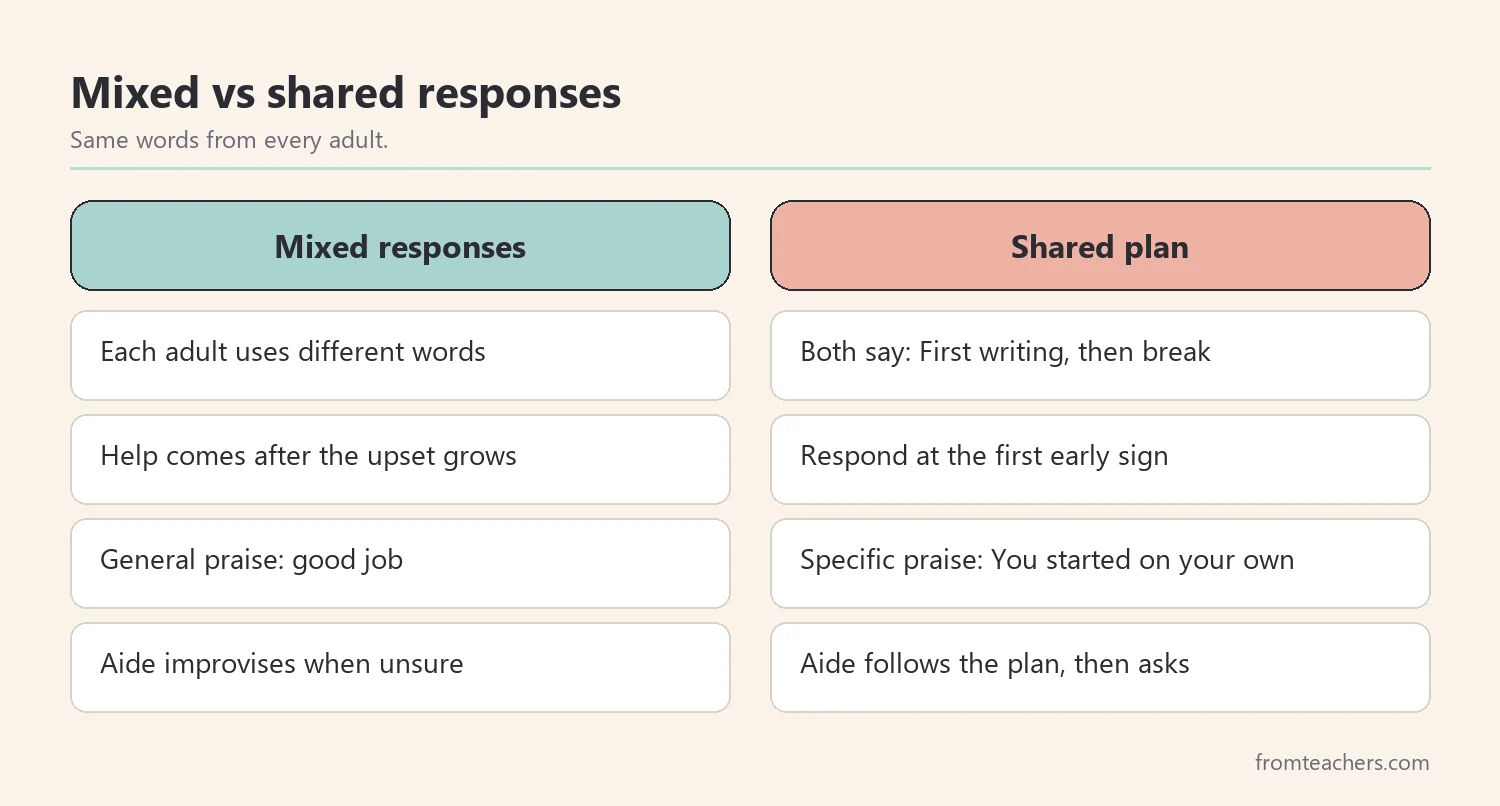
Behavior moments test any classroom team. When adults respond differently, students get mixed messages. For that reason, paraprofessional training should include a short, shared plan for common situations.
Start by helping the aide look for triggers. What happens right before a hard moment? Often, it is a difficult task, a noisy transition, or a change in routine. Understanding the likely cause helps adults respond calmly and early, instead of reacting late.
Then, agree on the same words. For example, both adults might say, “First writing, then break,” with a picture card. They might also agree to praise specific actions, such as “You wrote your first sentence.” Consistent, positive language builds trust and predictability.
Finally, make sure the paraprofessional knows any behavior plan that is already in place. If a student has a formal plan, the aide should follow it exactly and bring questions to the teacher rather than improvising.
Relationships matter here too. Students respond better to adults they trust. Encourage the paraprofessional to notice and name small successes, learn students’ interests, and greet them warmly each day. These moments make hard moments easier to handle later.
A shared language card
Mr. Grant and Ms. Diaz write a small card for Sofia’s writing block:
- Early sign: Sofia puts her head down.
- First response: point to the sentence starter and wait.
- Words: “First writing, then break.”
- Praise: “You started on your own.”
- If upset continues: offer the agreed break space and tell Mr. Grant.
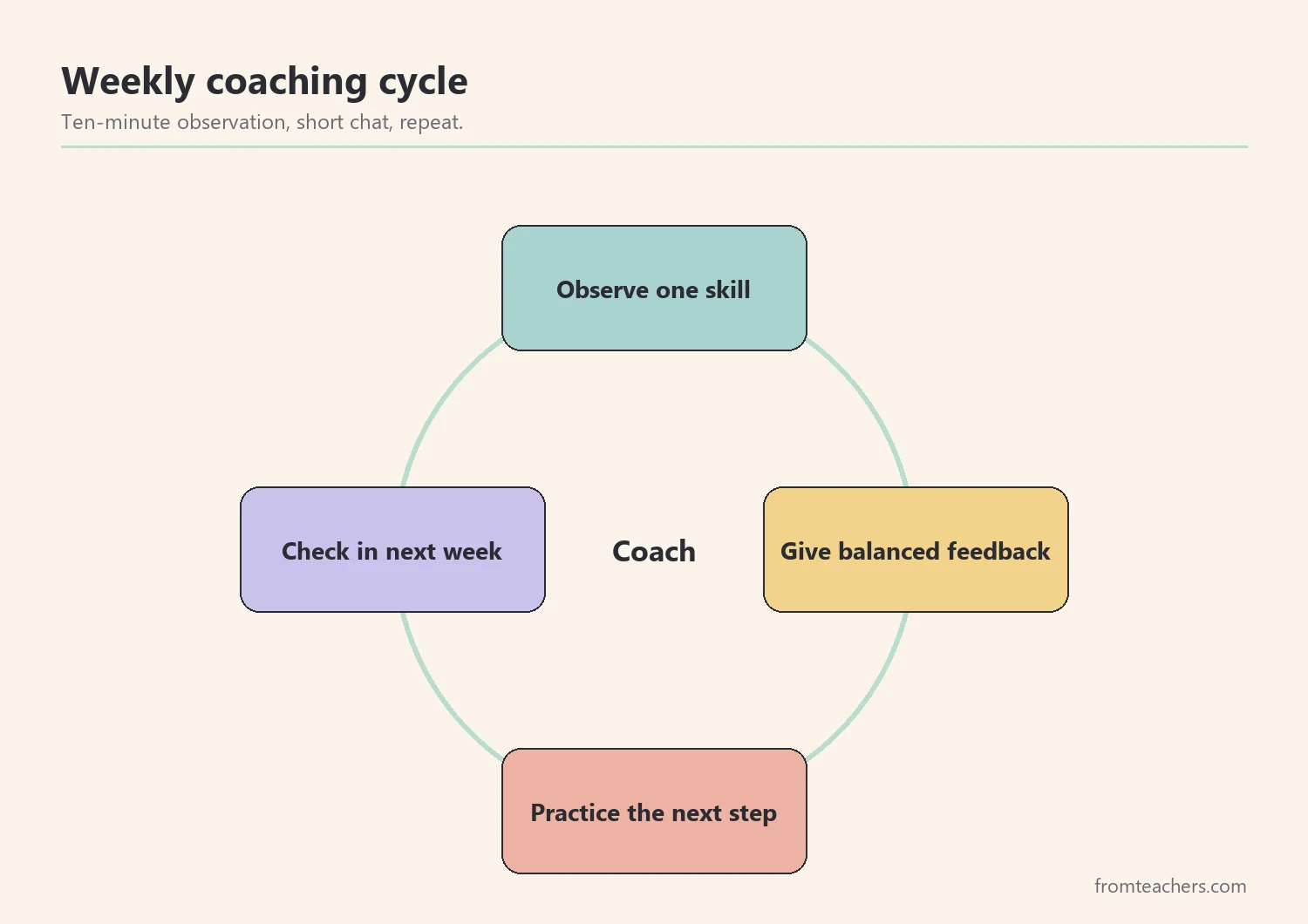
4. Coach with observation and feedback
Training is not a single meeting. Skills grow through short observations and specific feedback. A ten-minute observation once a week is often more useful than a long session once a term.
During the observation, focus on one skill, such as the prompting routine. Note what went well and one thing to adjust. Afterward, meet for a few minutes, ideally the same day.
Use balanced feedback. Begin with a specific strength, then give one clear suggestion, and end by agreeing on a next step. For example: “You waited five seconds before prompting, and Sofia started on her own twice. Next time, try pointing before speaking.”
Also, invite the paraprofessional’s view. Aides often notice patterns teachers miss, such as which seat helps a student focus or what time of day is hardest. Their input makes the coaching a two-way conversation. In fact, many of the best classroom adjustments start with a quiet observation from the adult who sits beside the student every day.
Keep a short coaching log so progress is visible. It does not need to be formal. A few words for the focus, the strength, and the next step are enough to show growth across the weeks and to guide the next observation.
When a skill is new, model it first. Mr. Grant shows the routine with a student, then watches Ms. Diaz try it, then gives feedback. This simple pattern of showing, practicing, and discussing works for nearly every classroom skill.
Ms. Diaz’s coaching log
| Week | Focus | Strength | Next step |
|---|---|---|---|
| 1 | Prompting | Waited before helping | Point before speaking |
| 2 | Prompting | Used gesture first | Record start time |
| 3 | Behavior words | Used shared phrase | Praise specific action |
5. Review paraprofessional training together
Every few weeks, set aside time to review. Look at how students are doing and how the team is working. In addition, ask the paraprofessional what feels easy now and what still feels unclear.
Use simple data where you have it. For Sofia, Ms. Diaz recorded how long it took her to start writing. In week one, Sofia started within three minutes on two of five days. By week three, she started within three minutes on four of five days, with mostly gestural prompts.
| Week | Started within 3 min | Main prompt |
|---|---|---|
| 1 | 2 of 5 days | Verbal |
| 2 | 3 of 5 days | Gestural |
| 3 | 4 of 5 days | Gestural |
Then, decide on one change. Mr. Grant and Ms. Diaz agree to try fading the gestural prompt by waiting a little longer before pointing. They will review again in three weeks.
Look beyond one student as well. Ask whether the role chart still matches the schedule, whether any routines feel rushed, and whether the aide needs training on a new skill, such as supporting a student with a communication device. Updating the plan regularly keeps the training useful as the year changes.
Finally, recognize the paraprofessional’s contribution. Naming specific progress, such as “Sofia is starting on her own more often because of your consistent prompting,” builds confidence and a strong working partnership.
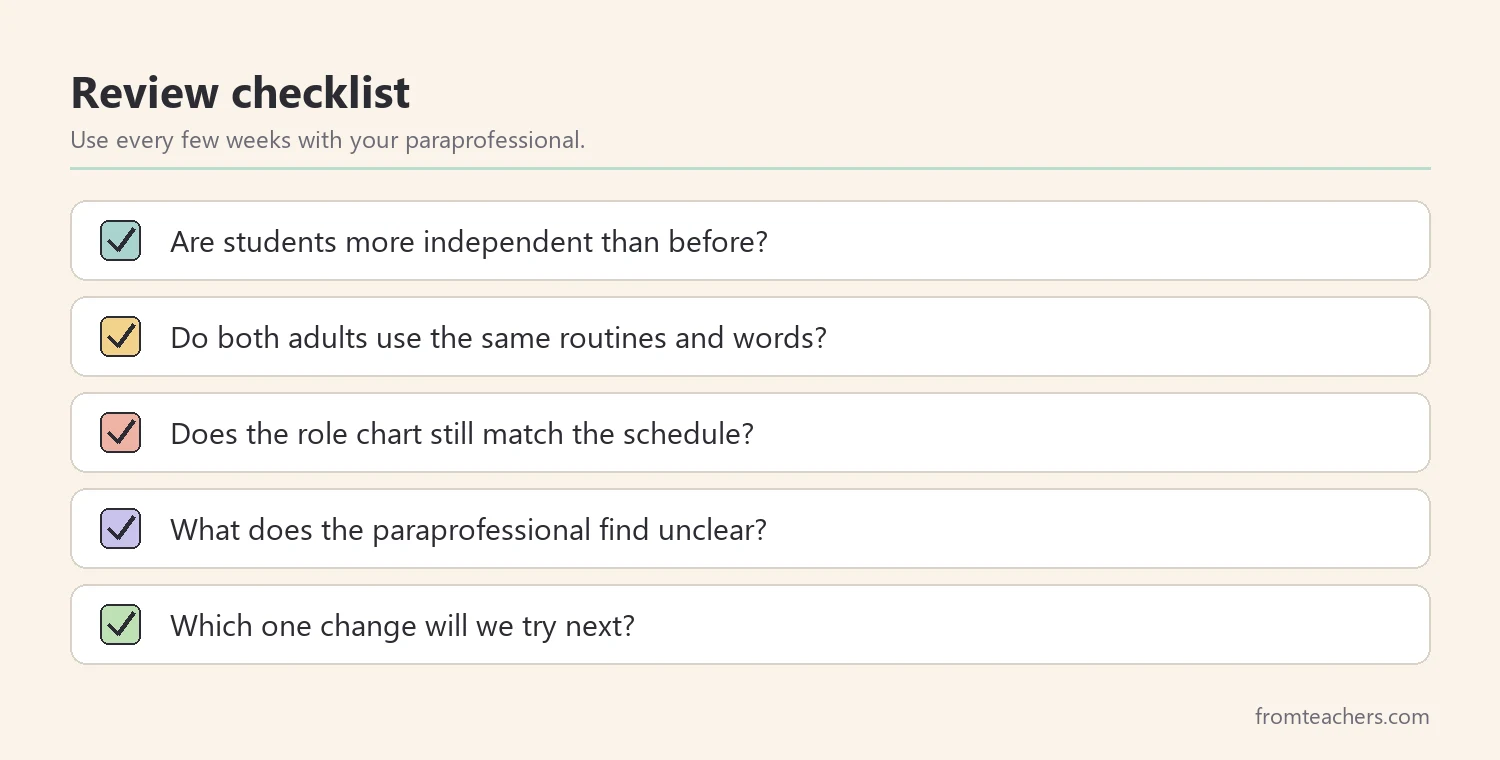
Over time, the same five steps can support a whole team of paraprofessionals. Each new aide starts with a role chart, learns the shared routines, and joins the coaching cycle. As a result, students experience the same calm, consistent support no matter which adult is beside them.
Common mistakes and how to avoid them
- Assuming the role is obvious. Fix: write a role chart for each block of the day.
- Helping too fast. Fix: teach a least-to-most prompting routine with a short wait first.
- Different adults, different words. Fix: agree on shared phrases and a language card.
- One-time training only. Fix: schedule short, regular observations and feedback.
- Feedback that is only critical. Fix: start with a specific strength and give one next step.
Questions teachers and parents ask about paraprofessional training
How much time does paraprofessional training take?
A short start-up meeting plus brief weekly coaching is a realistic plan for many classrooms. Ten-minute observations and five-minute feedback chats add up over time. Consistency matters more than long sessions.
Who should lead the training?
Usually the lead teacher, with support from specialists or administrators when available. Your school or district may also offer formal training. Classroom coaching then helps apply it to specific students.
What if the paraprofessional has more experience than the teacher?
That happens often and can be a strength. Ask about what has worked for them, then agree together on shared routines for this classroom. Respect and clear roles make the partnership work.
Should parents know about the paraprofessional’s role?
Yes, in general terms. Families benefit from knowing who supports their child and how. Specific plans and concerns should still come through the teacher and the team.
How do we know the training is working?
Look at both student progress and adult consistency. If students are becoming more independent and adults use the same routines, the training is working. If not, adjust one piece and review again.
Related reading: Special Education Strategies: 10 Powerful Ways Teachers Can Succeed, Moving Beyond Shame and Behavior Charts: Positive Alternatives for Effective Classroom Management, and Addressing Challenges in Special Education: Practical Strategies for Educators.
A companion resource for paraprofessional training:
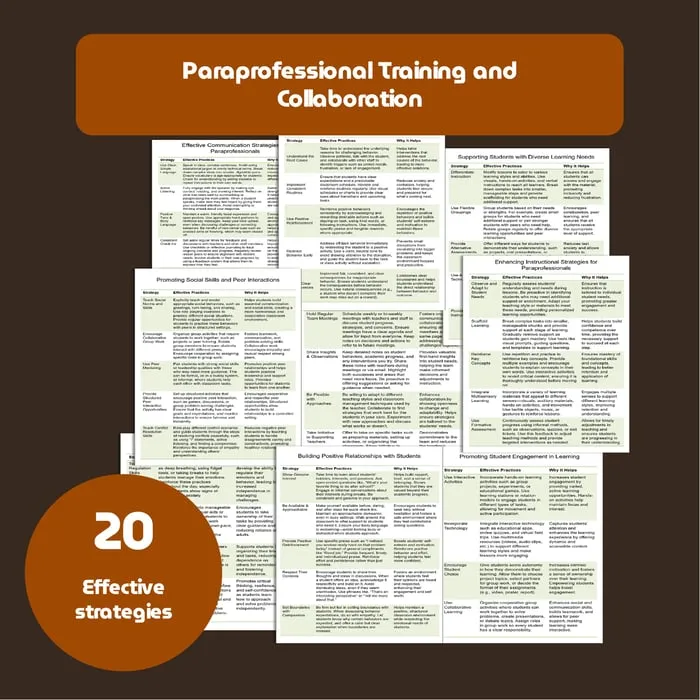
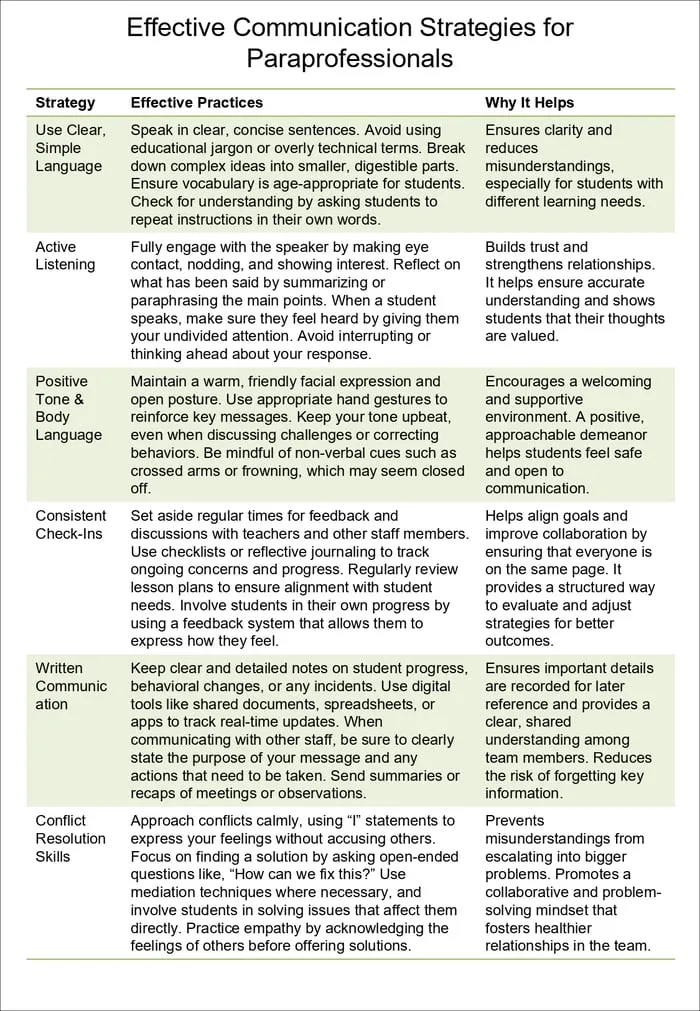
Paraprofessional Training Guide: 20 Strategies: twenty strategy tables that pair each strategy with effective practices and the reason it works, covering communication, behavior, diverse learning needs, instructional support, and building positive relationships with students.
Sources and scope
- IRIS Center, Vanderbilt University: free modules on evidence-based practices, including working with paraprofessionals.
- IDEA, U.S. Department of Education: the law behind special education services and IEPs.
- Council for Exceptional Children: a professional organization for special educators, with standards and resources.
- National Education Association: resources for educators, including education support professionals.
This guide covers practical, classroom-level training and coaching for paraprofessionals. It does not cover hiring, certification requirements, or district policy, which vary by state and district.
Key takeaways
- Paraprofessional training starts with clear, written roles.
- Teach a shared least-to-most prompting routine.
- Use the same calm words for behavior support.
- Coach with short observations and balanced feedback.
- Review progress together and adjust one thing at a time.






Leave a Comment