

Strengths-based student observation starts with a simple shift: you watch a learner to find out what is working, not only what is going wrong. Picture a third grader who wanders during independent reading but spends twenty quiet minutes sorting the class library by series. Most notes would record the wandering. Few would record the sorting, even though it shows focus, organization, and a real love of books.
After reading this guide, you will be able to plan short observations, look across six areas of a student’s life at school, ask three guiding questions in each area, and turn what you notice into practical next steps. You will also see one complete fictional example from start to finish.
Examples are fictional. Adapt to the student’s goals and agreed supports. This is guidance, not a diagnosis.
At a glance
- Strengths-based student observation looks at skills and interests as carefully as it looks at challenges.
- Six areas give a full picture: passions, culture and community, communication, sensory needs, personal care, and organization.
- Three questions keep notes useful: what you see, what effect it has, and what could help.
- Neutral, specific language makes notes fair and easy to share with families.
- Every observation should end with at least one strategy that builds on a strength.
1. Plan short, focused strengths-based student observation sessions
Good strengths-based student observation begins before you pick up a pen. First, decide why you are observing. Maybe a student is new, maybe a team meeting is coming, or maybe a plan simply is not working. Your reason shapes where and when you watch.
Next, choose settings that show different sides of the student. A structured lesson, an open work time, a transition, and a social time such as lunch or recess will each reveal something new. One setting alone rarely gives a fair picture.
Then, keep sessions short. Ten to fifteen minutes of focused watching is usually more useful than an hour of distracted notes. Plan three or four sessions across different days so that one bad morning does not define the student.
Finally, tell the people involved. Colleagues and families should know you are observing and why. In addition, explain that the goal is to understand the student better, not to judge anyone.
Worked example: planning for Maya
Maya is a fictional third grader. Her teacher, Ms. Lopez, notices that Maya often leaves her seat during independent reading and rarely finishes written tasks. A team meeting is three weeks away. Ms. Lopez plans four observation sessions of 15 minutes each, for a total of 60 minutes.
| Session | Setting | Minutes |
|---|---|---|
| 1 | Independent reading | 15 |
| 2 | Math centers | 15 |
| 3 | Lunch line and transition | 15 |
| 4 | Art class | 15 |
Because the settings vary, Ms. Lopez will see Maya when tasks are quiet, active, social, and creative. That spread matters more than the total time.
2. Look across six areas in strengths-based student observation
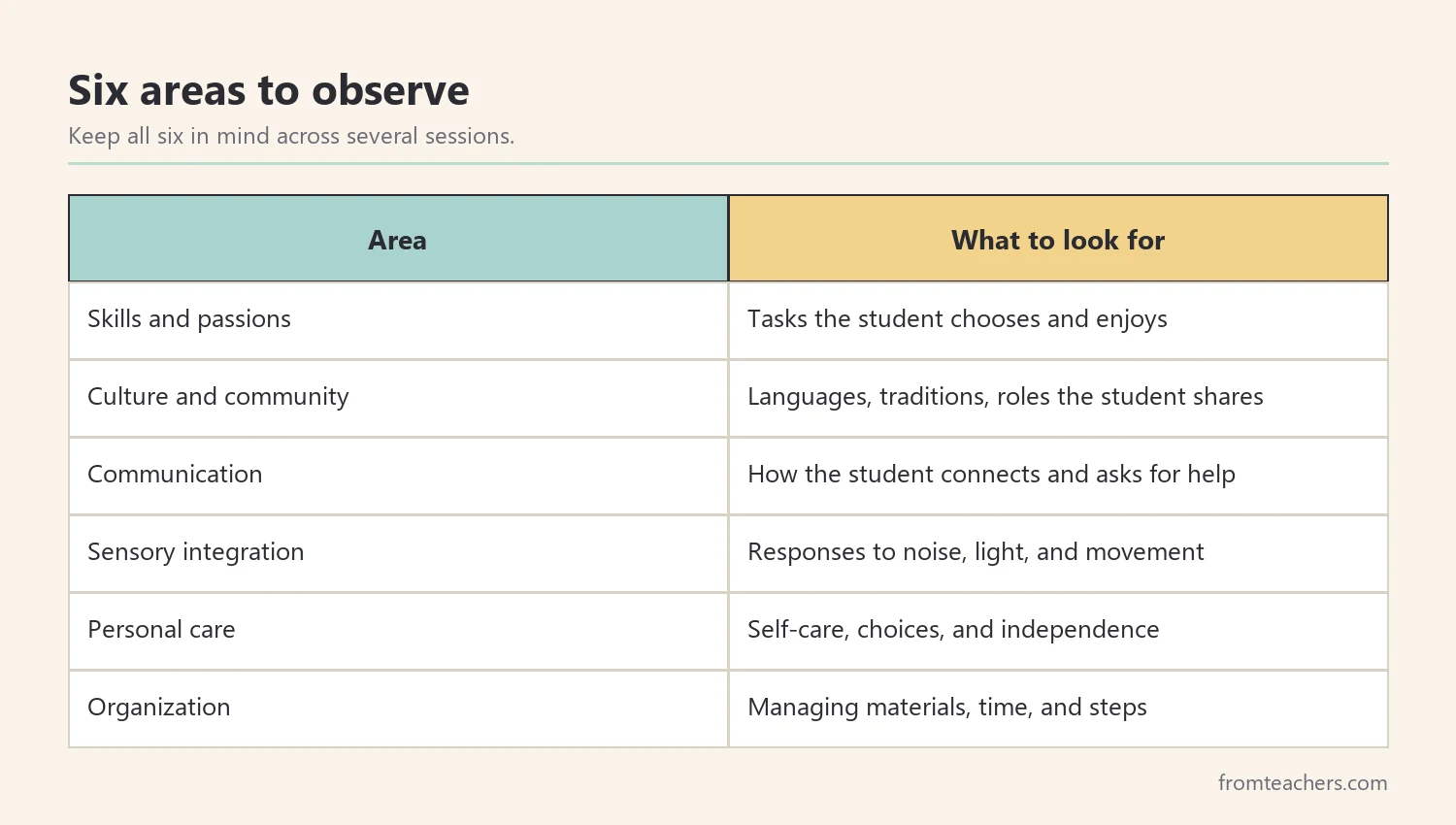
Many observation forms track only on-task behavior. However, a student is much more than their attention span. A strengths-based student observation looks across six connected areas.
- Skills and passions: what the student enjoys, chooses, and does well.
- Ties to culture and community: languages, traditions, family roles, and community activities the student brings.
- Interpersonal and communication abilities: how the student connects, asks for help, and expresses ideas.
- Sensory integration: how the student responds to noise, light, movement, and touch.
- Personal care and autonomy: self-care, choices, and independence in daily routines.
- Organizational and planning abilities: how the student manages materials, time, and steps.
You do not need to fill every area in every session. Instead, keep all six in mind and jot what appears naturally. Over three or four sessions, most areas will fill in.
For Maya, Ms. Lopez notices several strengths she had missed. During math centers, Maya explains a sorting rule to a partner. In art, she works for the full 15 minutes on a detailed drawing. At lunch, she helps a younger student find the right line. Meanwhile, she covers her ears when the cafeteria gets loud.
Each of these notes belongs to a different area. Together, they describe a student who is creative, helpful, and organized when a task interests her, and who may find noise draining.
3. Ask three guiding questions in each area
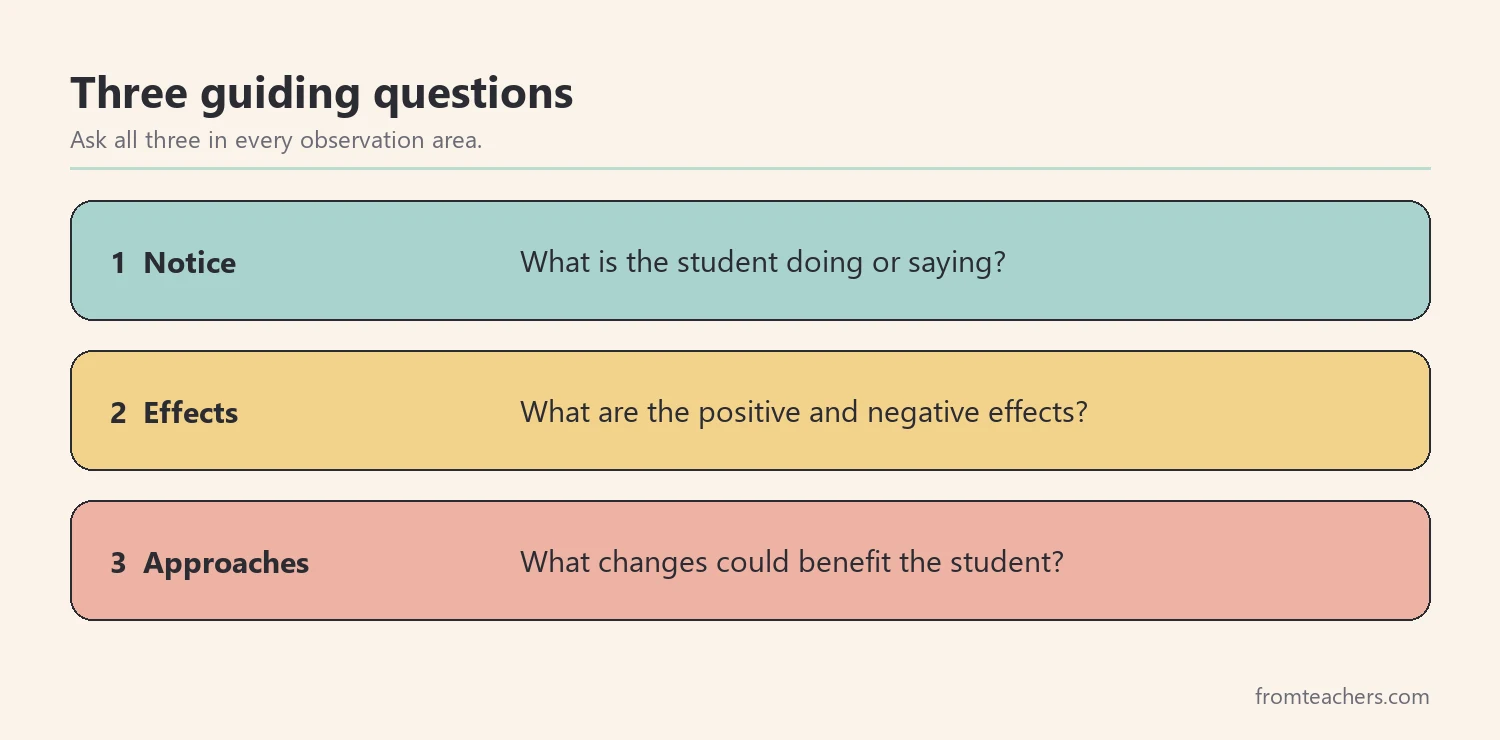
Raw notes from strengths-based student observation can drift into opinion. To keep them useful, ask the same three questions in every area.
- What do I notice the student doing or saying? Record actions and words, not guesses about feelings.
- What are the positive and negative effects on the student and others? A behavior can help in one way and cost in another.
- What approaches or changes could benefit the student? Write at least one idea, even a small one.
The second question is where strengths-based thinking does its quiet work. For instance, Maya leaving her seat during reading has a negative effect: she reads less. Yet the observation also shows that she heads to the class library and sorts books by series. That effect is positive: the shelves stay organized and other students find books faster.
So the third question becomes more creative. Rather than only “keep Maya seated,” Ms. Lopez can ask how Maya’s love of sorting could pull her into reading. One idea is to let Maya choose a series she has sorted and read the first book with a peer.
For strengths-based student observation, a printed planner with these three questions under each area keeps sessions consistent. The Strategy Planner for Diverse Learners strengths-based observation form lays out all six areas with the three guiding questions, so you can write directly into a ready structure.
4. Record strengths-based student observation notes in neutral language
The words you choose in strengths-based student observation shape how others see a student. Notes are often read by families, new teachers, and specialists, sometimes years later. Therefore, write what you saw in plain, specific terms.
Compare two notes about the same moment. “Maya was off task and wandered” tells the reader very little and sounds like a judgment. “Maya left her seat after 4 minutes of reading and sorted 12 books by series for 9 minutes” tells the reader exactly what happened and hints at a skill.
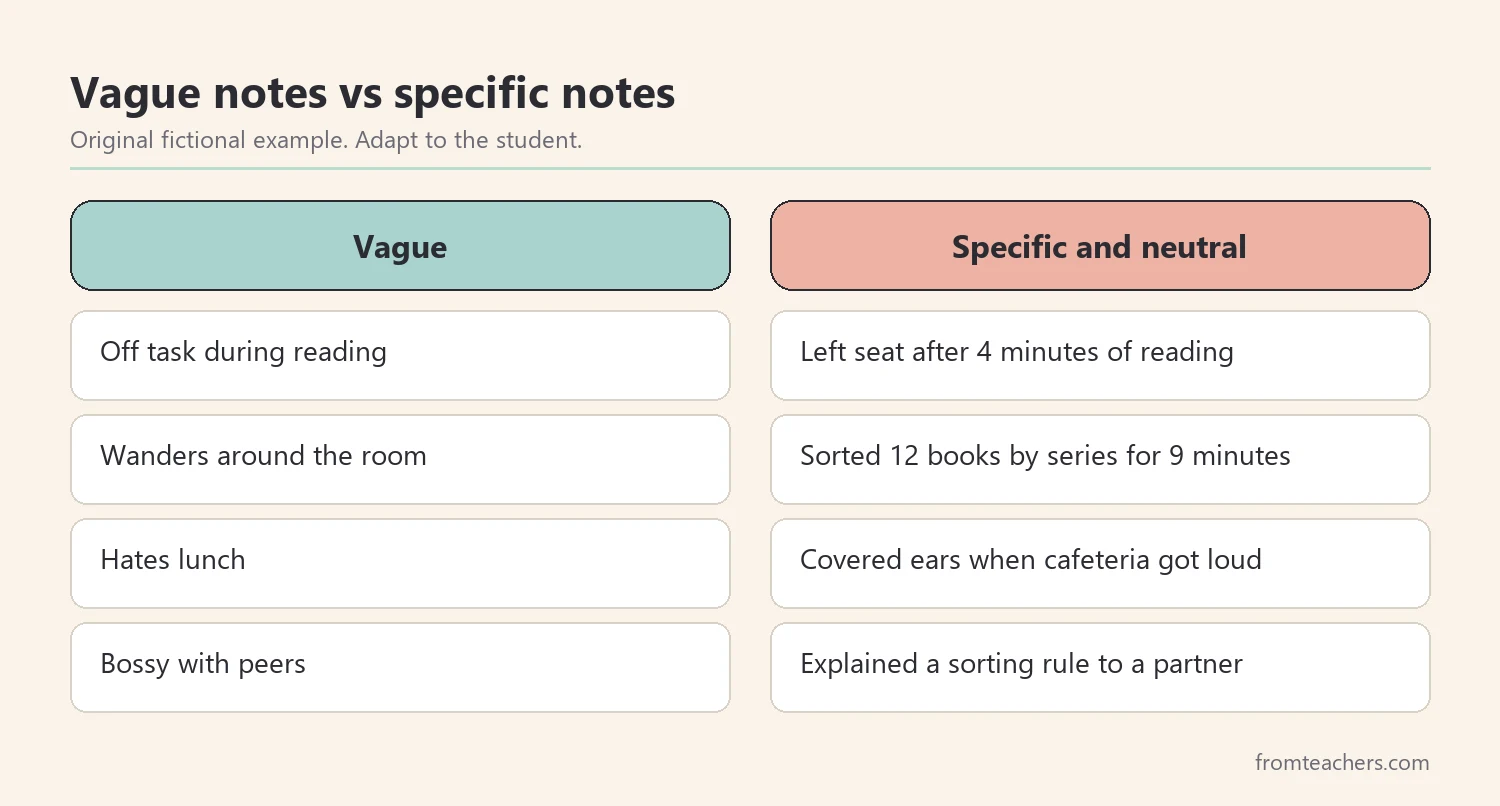
A few habits help keep language fair:
- Use verbs that describe actions: points, builds, asks, leaves, sorts.
- Add numbers when you can: minutes, counts, or how many prompts.
- Note the setting and what happened just before.
- Avoid labels such as lazy, defiant, or unmotivated.
- Write strengths with the same detail as challenges.
In addition, separate what you observed from what you think it means. A simple way is to write observations on the left and your thoughts on the right, or to mark interpretations with a small “I wonder” phrase. For example: “Maya covered her ears when the cafeteria noise rose. I wonder whether noise makes lunch tiring for her.”
This habit matters most in the culture and community area. Avoid guessing about a family’s background or values. Instead, record what the student shares, such as “Maya said she helps her grandmother cook on Sundays,” and ask the family if you want to learn more.
5. Turn strengths-based student observation notes into strategies
Strengths-based student observation only helps a student if it changes what adults do. After your sessions, read through all six areas and look for patterns. Then match each challenge with a strength that could support it.
For Maya, Ms. Lopez gathers her four sessions into a short summary. She counts what she saw so the numbers are clear and easy to check.
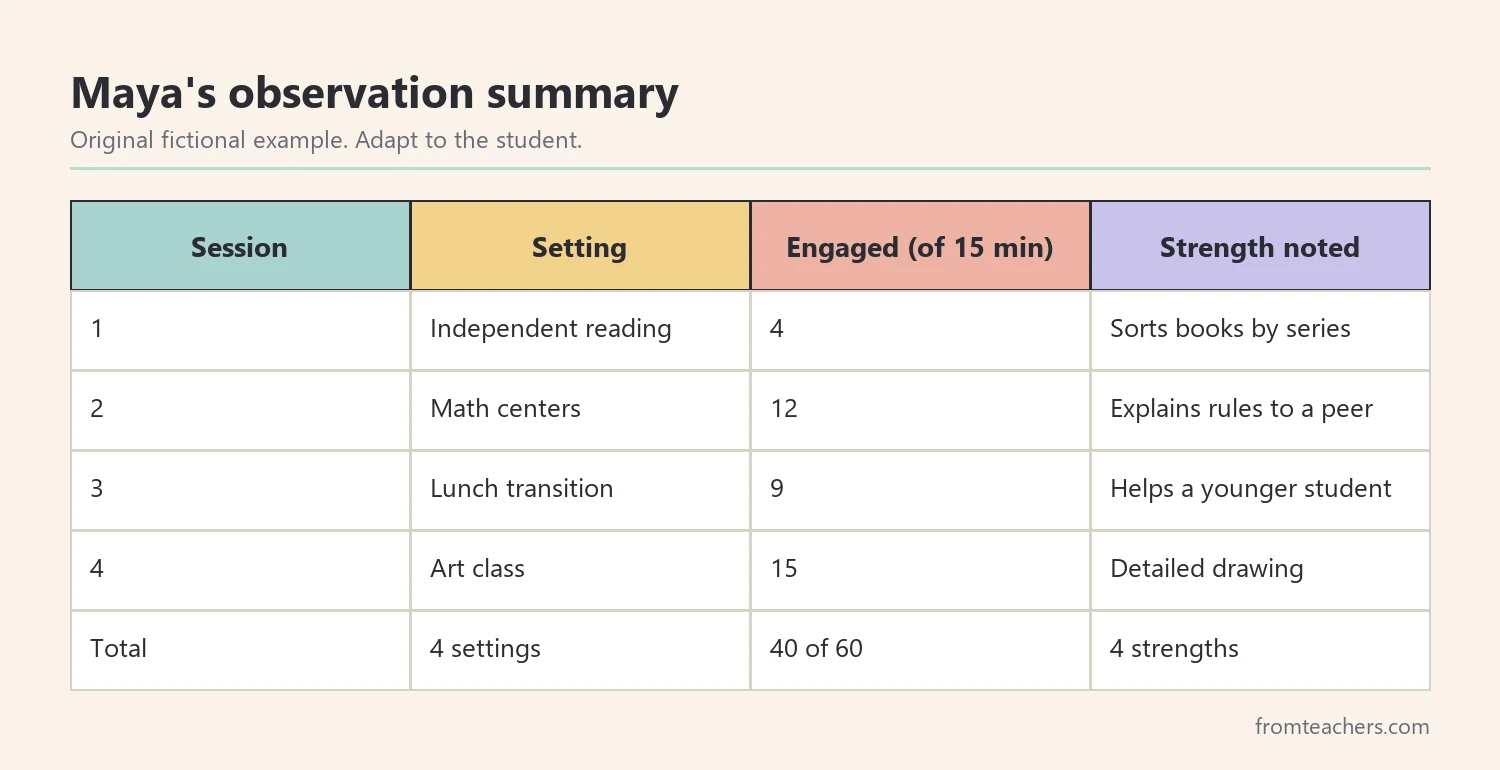
Across 60 observed minutes, Maya was engaged for 40 minutes: 4 in reading, 12 in math centers, 9 in the lunch transition, and 15 in art. The lowest number is in independent reading, and the highest is in art. That pattern points to a clear question: how can reading look more like the tasks where Maya thrives?
From there, Ms. Lopez writes three strategies:
| Strength noticed | Challenge | Strategy |
|---|---|---|
| Sorts books by series | Short reading stamina | Maya picks a series she sorted and reads with a peer |
| Detailed drawing | Rarely finishes writing | Sketch first, then label and add sentences |
| Helps younger students | Tires in loud spaces | Lunch helper role at a quieter table |
Notice that none of these strategies ignore the challenge. Each one simply starts from something Maya already does well. As a result, the plan feels less like a correction and more like an invitation.
Keep the list short. Two or three strategies that adults actually use are worth more than ten that sit in a folder.
6. Share findings with families and review over time
Families know their children in ways school staff cannot. Sharing a summary from strengths-based student observation often opens a warmer conversation than a list of concerns. Start with the strengths, then name one or two challenges, and then ask what the family sees at home.
For example, Ms. Lopez might say: “Maya spent the whole art session on one detailed drawing, and she helped a younger student at lunch. We also noticed loud spaces seem hard for her. What do you see at home?” Then she listens and adds the family’s ideas to the notes.
After that, set a date to look again. Strengths-based student observation works best as a cycle rather than a one-time event. Observe, describe, plan, and review, then repeat with what you have learned.
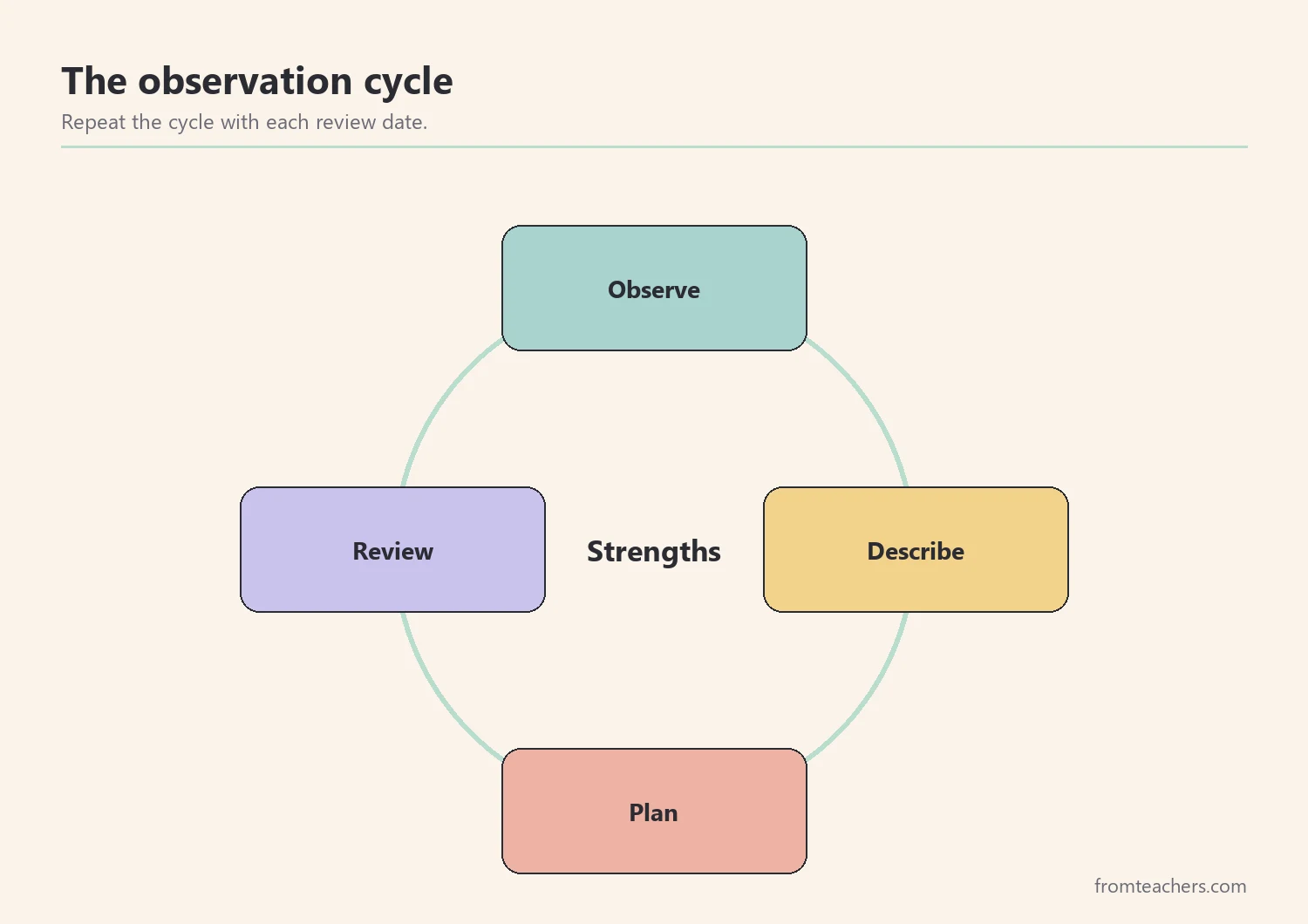
Four weeks later, Ms. Lopez observes Maya’s reading block again for 15 minutes. With a chosen series and a reading partner, Maya stays engaged for 11 of those minutes, up from 4. The strategy seems to help, so the team keeps it and adds a new goal for writing.
Notes from strengths-based student observation can also support formal planning. When a student has or may need an IEP or support plan, a clear record of strengths gives the team concrete material for the present levels section and for choosing supports.
Common mistakes and how to avoid them
- Observing only when things go wrong. Fix: schedule sessions in calm, preferred settings too, so strengths have a chance to appear.
- Listing strengths that are too vague. “Nice kid” is not a strength you can plan with. Fix: name the action, such as “explains a sorting rule to a partner.”
- Mixing facts and opinions. Fix: record what you see first, then add interpretations as clearly marked wonderings.
- Guessing about culture. Fix: record only what the student or family shares, and ask rather than assume.
- Stopping at the notes. Fix: end every observation with at least one strategy and a review date.
- Observing once. Fix: use three or four short sessions in different settings before drawing conclusions.
Questions teachers and parents ask about strengths-based student observation
Is strengths-based student observation only for students with disabilities?
No. It works for any learner, including students who are new, quiet, gifted, or simply hard to read. Special education teams use it often because it gives a fuller picture before planning supports.
How long should one observation take?
Ten to fifteen minutes is usually enough for one session. Plan three or four sessions in different settings, so you see the student in more than one kind of moment.
Can parents use this approach at home?
Yes. Parents can watch homework time, play, chores, or family outings with the same six areas and three questions. Sharing these notes with teachers often helps both sides understand the child better.
What if I struggle to find any strengths?
Look smaller and look elsewhere. Strengths-based student observation often finds skills in places adults rarely watch, such as hallways, clubs, or the bus line. Notice what the student chooses during free time, who they help, or what they talk about with energy. In addition, ask the family and other staff what they see.
Does this replace formal assessment?
No. Strengths-based student observation is an informal tool. It adds useful context to formal evaluations and team planning, but it does not diagnose or replace assessments by qualified professionals.
Related reading: The Power of Data Tracking in Special Education, How Parents and Teachers Can Team Up for Special Education Success, and Bridging Gaps in Special Education: Practical Strategies for Teachers.
A companion resource for strengths-based student observation:
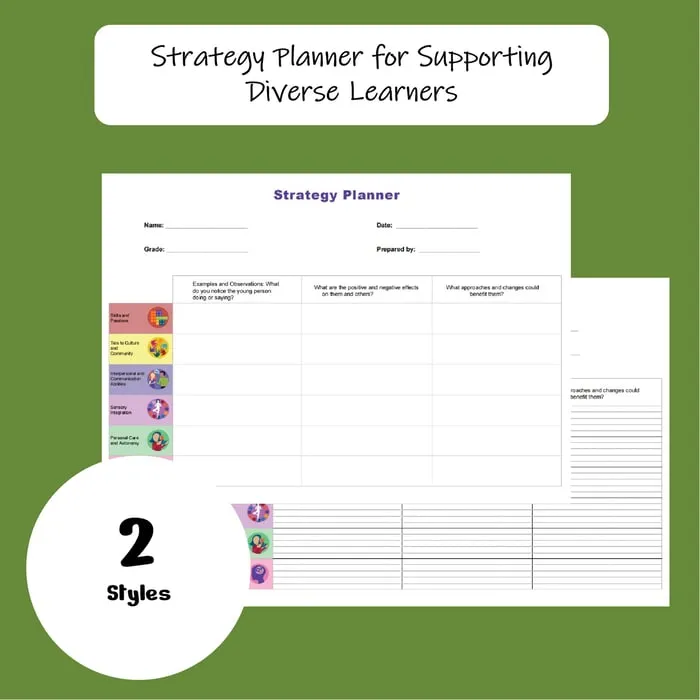
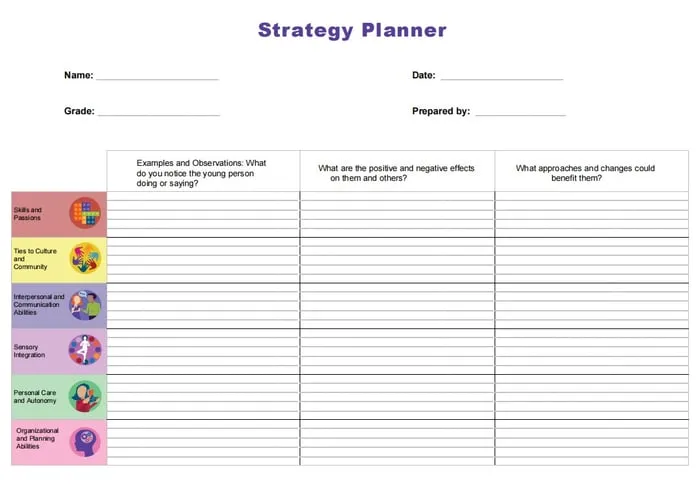
Strategy Planner for Diverse Learners: a strengths-based observation form with six color coded areas, three guiding questions in each, and two layouts, one with lined space and one with a minimal grid.
Sources and scope
- U.S. Department of Education, IDEA website: official information on the Individuals with Disabilities Education Act and individualized planning.
- IRIS Center, Vanderbilt University: free modules on assessment, data collection, and supporting diverse learners.
- Understood.org: articles for families and teachers on learning and thinking differences.
- CAST: the organization behind Universal Design for Learning, a framework for planning around learner variability.
This guide covers informal, classroom-based observation for planning supports. It does not cover formal evaluation, eligibility decisions, or clinical assessment.
Key takeaways
- Plan strengths-based student observation as three or four short sessions in varied settings before drawing conclusions.
- Watch six areas, not just on-task behavior.
- Ask what you notice, what effect it has, and what could help.
- Write specific, neutral notes with numbers where possible.
- Build every strategy on a real strength, then review and repeat.










Leave a Comment