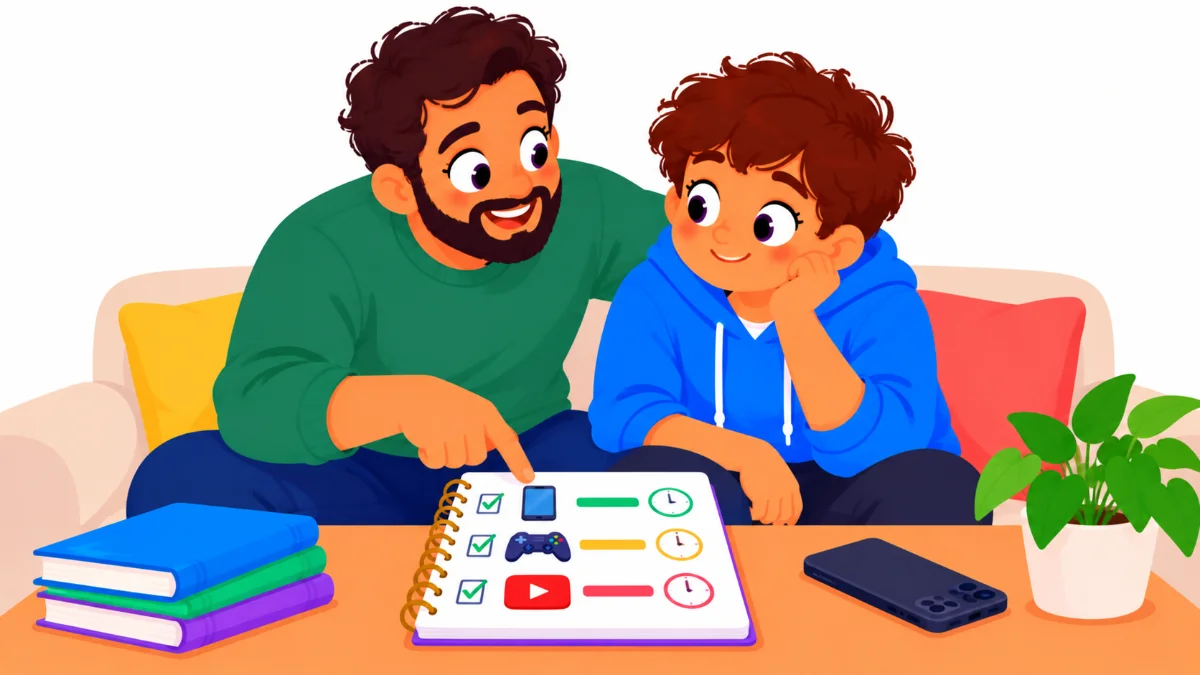

Neurodivergent teens screen time can turn an ordinary evening into a standoff. Picture a fifteen-year-old who sits down “for ten minutes” after school and looks up three hours later, hungry, wired, and furious when someone asks for the phone. The argument that follows is loud, and afterward everyone feels worse, including the teen.
This guide offers a calmer path. You will learn how to see what actually happens around screens, agree on limits together, plan transitions, respond to a meltdown after screen time, and talk honestly about social media and sleep. By the end, you will have a small plan built around support, not willpower alone.
Examples are fictional. Adapt to the teen’s needs and the family’s values. This is guidance, not a diagnosis.
At a glance
- Hyperfocus and overstimulation are common, so observe before setting rules.
- Limits work better when the teen helps design them.
- Planned transitions prevent many after-screen meltdowns.
- During a meltdown, safety and calm come first; talk comes later.
- Honest talks about social media and sleep build trust over time.
1. Observe neurodivergent teens screen time patterns first
Before changing any rules, watch what really happens. Many neurodivergent teens, including autistic teens and teens with ADHD, experience hyperfocus. A game or video feed can hold their attention so completely that time seems to vanish. In addition, bright, fast content can leave some teens overstimulated, and that energy often spills out when the screen goes off.
For about a week, keep a short, private log. Note when screens start, roughly how long they last, what the teen is doing, and how the transition off goes. Also note sleep, meals, and mood. Keep it neutral and avoid commenting on the log in the moment. The aim is to understand neurodivergent teens screen time as it really happens at home, not as it looks during an argument.
Meet Jordan, a fictional fifteen-year-old with ADHD. His parent’s log showed a clear pattern. Weekend gaming went fairly smoothly, but school nights were hard. Jordan scrolled short videos in bed, often past midnight, and mornings were tense. The hardest moments came when someone took the phone without warning.
That small observation shifted the family’s focus. The problem was not neurodivergent teens screen time in general. Instead, it was late-night scrolling and sudden endings. As a result, the family could target two specific moments rather than fighting about every minute online.
Also, notice what screens give the teen. For many neurodivergent teens, games and online groups offer real connection, interest, and rest. Recognizing that helps the conversation start from respect instead of blame.
2. Agree on neurodivergent teens screen time limits together
Rules handed down without discussion often lead to power struggles. By contrast, limits the teen helps create are easier to accept and follow. So invite the teen into the planning, and be honest about what you are worried about.
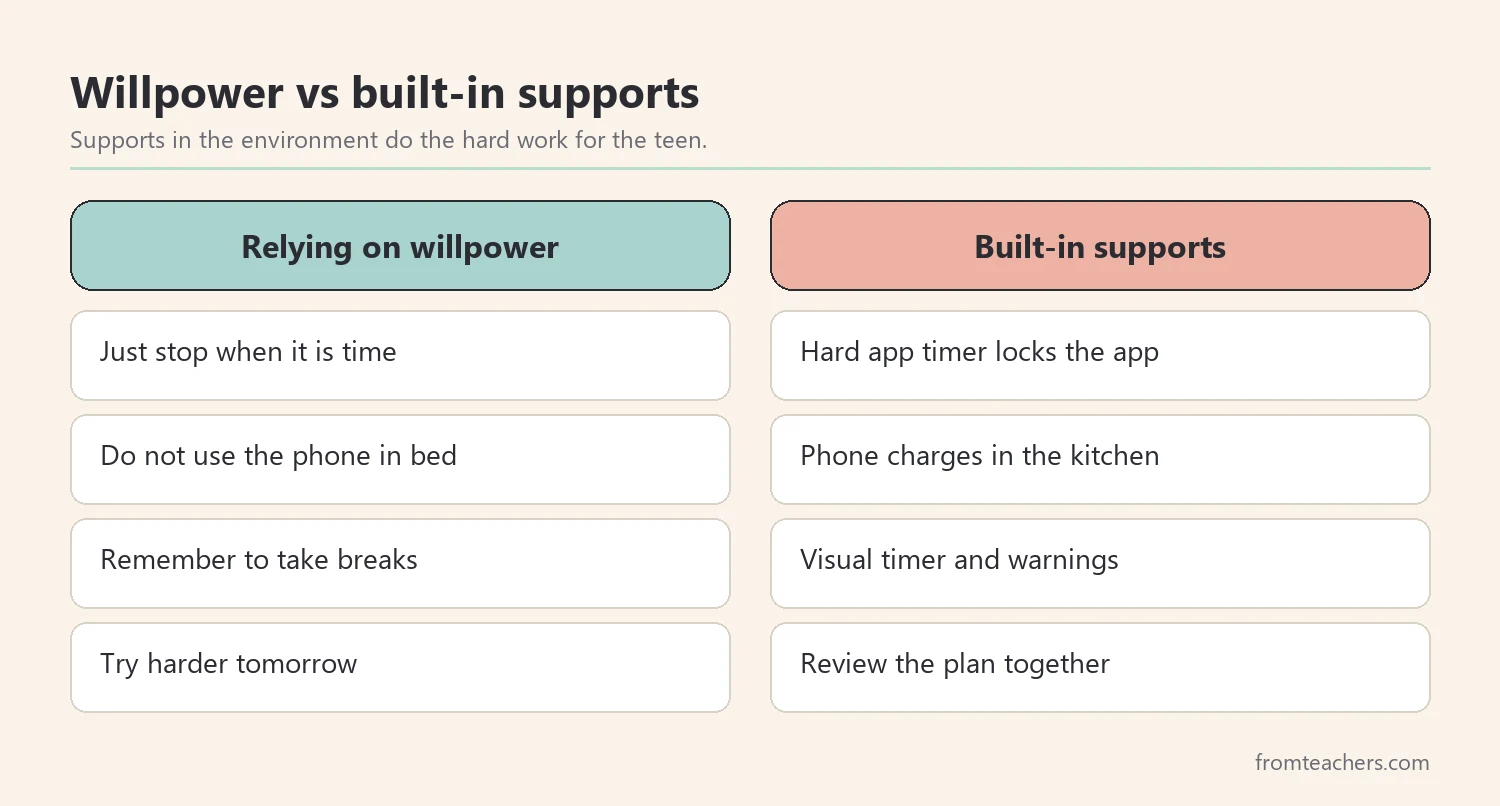
Start with your shared goals. Most teens agree that they want to feel less tired, argue less, and still have time for the things they enjoy. Then choose a few concrete supports. Effective options often take willpower out of the equation:
- Phone-free zones. For example, the dinner table and the bedroom at night.
- Hard app timers. Built-in limits that lock an app after an agreed time, rather than a reminder the teen can dismiss.
- A charging spot. Phones charge outside the bedroom at a set time on school nights.
- Protected interests. Agreed time for the games or groups that matter most to the teen.
Jordan and his parent agreed on three things. On school nights, his phone would charge in the kitchen from 10:30 p.m. Short-video apps would have a hard one-hour daily timer. And weekend gaming time with friends would stay protected, because it mattered most to him.
Write the agreement down and keep it short. A one-page agreement about neurodivergent teens screen time is easier to remember than a long list of rules. Also, agree on when you will review it, such as every two weeks. Knowing the plan can change makes it easier for a teen to try it.
3. Plan the transition off screens
Many conflicts happen at the moment a screen ends. A teen in hyperfocus may not notice time passing, and a sudden stop can feel jarring. Therefore, the transition deserves its own plan.
A predictable sequence helps the brain shift gears. Use warnings, a clear stopping point, and something to move toward.
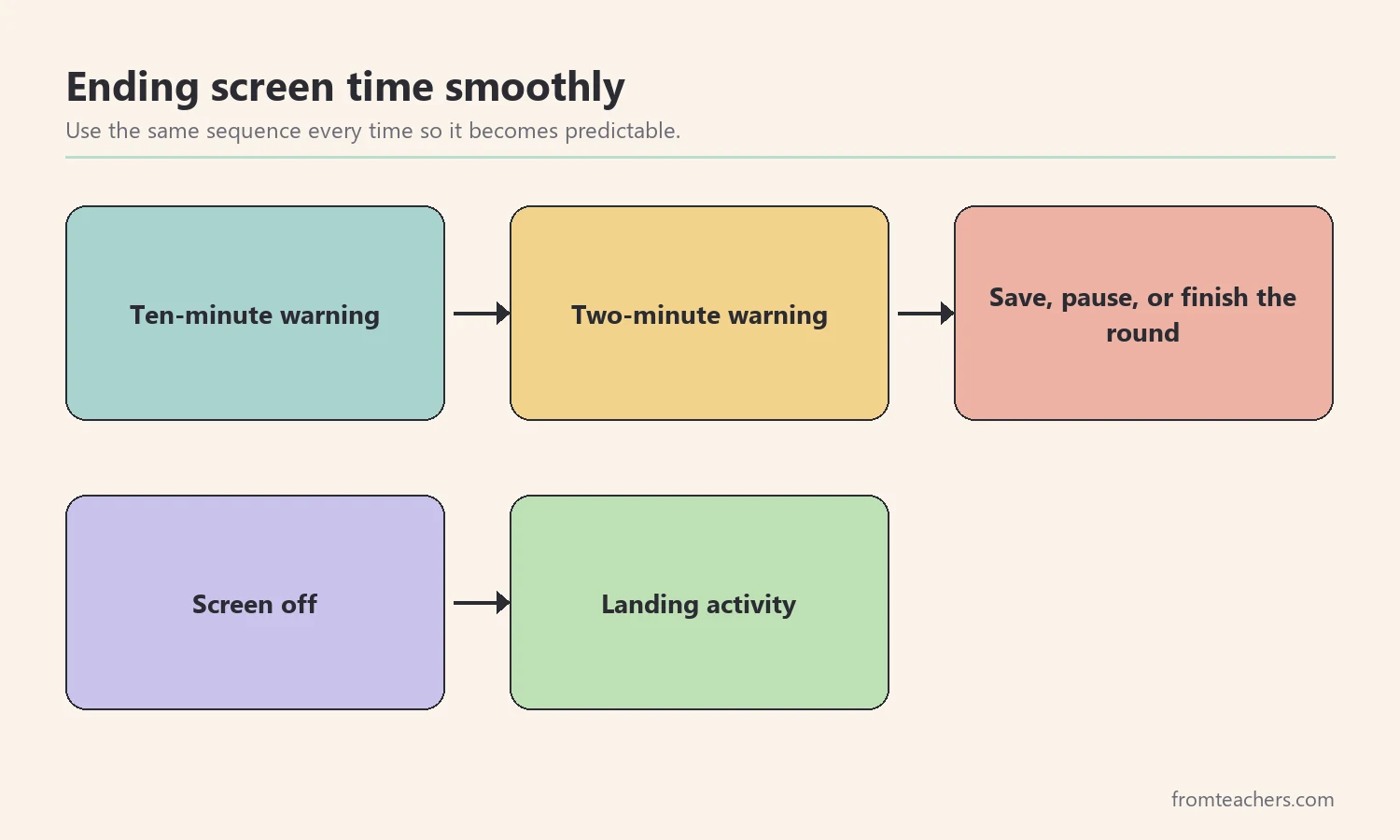
Also, practice the sequence on a calm day first. Run through the warnings during a low-stakes moment, such as a short video before dinner, so the routine feels familiar before it is tested at bedtime. Many families find that neurodivergent teens screen time goes more smoothly once the steps are predictable and the teen knows exactly what comes next.
The “landing activity” is important. It is a simple next step that is easy to start, such as a snack, a shower, music without a screen, or a short walk with the dog. Rather than “Put it away,” the message becomes “Time to move to the next thing.”
For games, agree on natural stopping points. Many games cannot be paused mid-match, so “finish this round” works better than a timer that cuts off in the middle. In addition, a visual timer in the room helps teens who struggle to sense time passing.
A clear, written plan makes this easier for the whole family. For instance, this guide to social media and screen time for neurodivergent teens uses short Issue, Step, and Purpose tables for real moments like hyperfocus, overstimulation, and the meltdown that can follow screen time.
4. Respond calmly to a meltdown after screen time
Even with good planning, a meltdown can still happen. A meltdown is not a choice to misbehave. It is often a sign that the teen’s nervous system is overloaded. Consequently, the adult’s first job is to help things settle, not to win the argument.
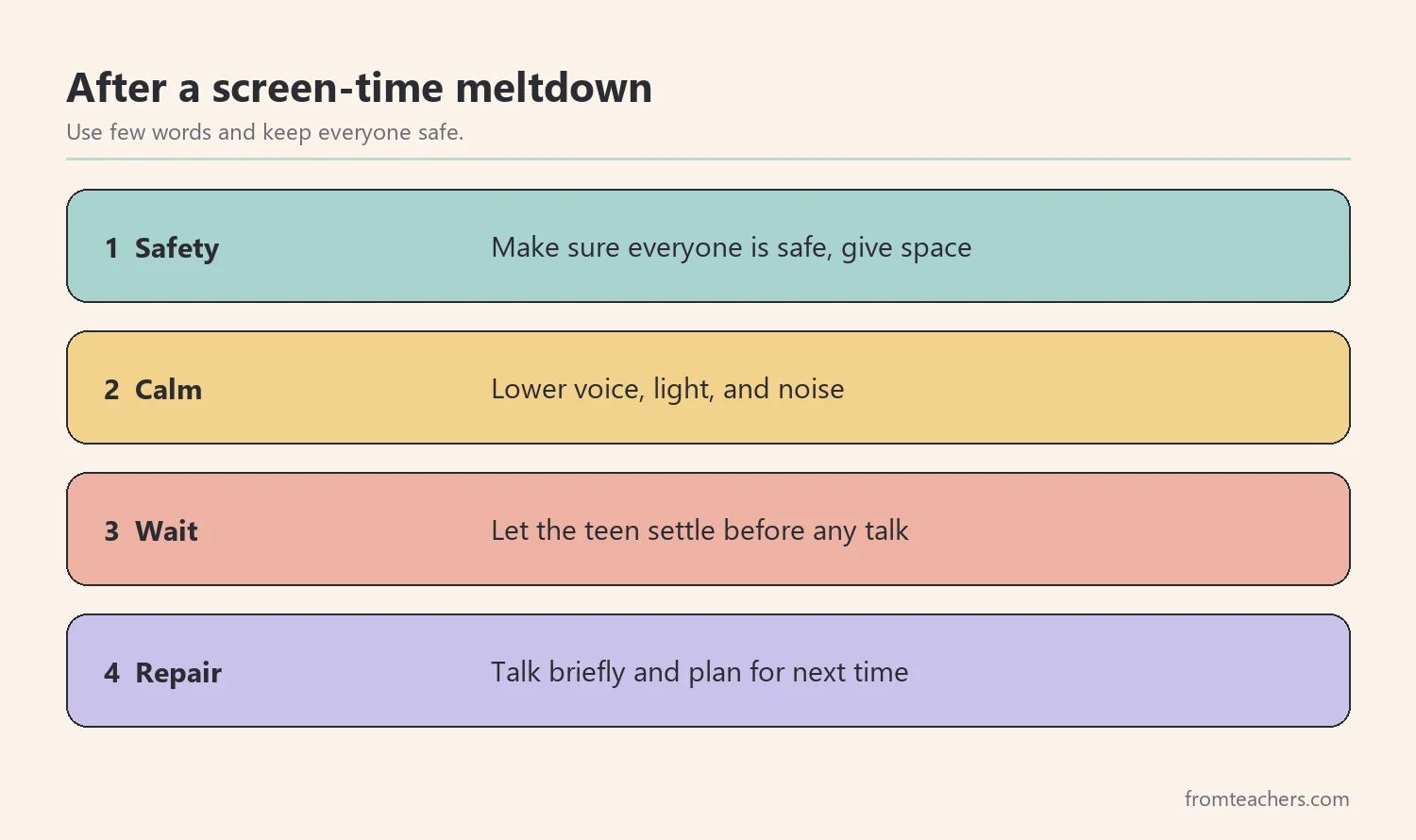
During the meltdown, keep words to a minimum. Lower your voice, reduce noise and light if possible, and give space. Make sure everyone is safe. Siblings may need to move to another room for a while. Avoid lectures, threats, or new consequences in the heat of the moment, because the teen cannot process them yet.
Once the teen is calm, which may take a while, talk briefly about what happened. Ask what felt hard and what might help next time. Keep it about problem-solving, not blame.
When Jordan had a meltdown after his parent took his phone at bedtime, the family used this approach. Later that evening, they talked. Jordan said the sudden grab felt unfair. Together they agreed on the ten-minute warning and the kitchen charging spot, which removed the grab entirely.
In addition, look back at the log after a meltdown. Was there a warning? Was the teen already tired or hungry? Did the content leave them overstimulated? These details often explain why a plan for neurodivergent teens screen time worked one night and not the next, and they point to one small change rather than a whole new set of rules.
Notably, repair matters as much as prevention. A simple “That was hard for both of us. Let’s figure it out” shows the teen that the relationship is safe, even after a rough moment. That trust makes the next conversation about neurodivergent teens screen time easier.
5. Talk about social media, sleep, and responsibility
Social media brings its own challenges. Teens may struggle with comparison, online conflict, or content that is upsetting. Neurodivergent teens can also find social cues online confusing, just as they sometimes do in person. So keep talking, and keep it two-way.
Ask open questions: “What do you like about this app? What bothers you?” Listen more than you speak. Teens often share more when the conversation happens side by side, such as in the car or while cooking, rather than face to face across a table. Conversations about neurodivergent teens screen time go better when they feel like problem-solving with an ally, not an interview. Also, share clear safety basics, such as privacy settings and what to do if someone online makes them uncomfortable.
Sleep is often the most important piece of neurodivergent teens screen time. Late-night scrolling can cut into rest, and tired teens may have a harder time with focus and mood. Rather than lecturing, help the teen notice the link. For example, a simple, honest sleep log can show patterns the teen can see for themselves.
Jordan’s family tracked two things for four weeks: school nights the phone was charging in the kitchen by 10:30, and hard transitions off screens.
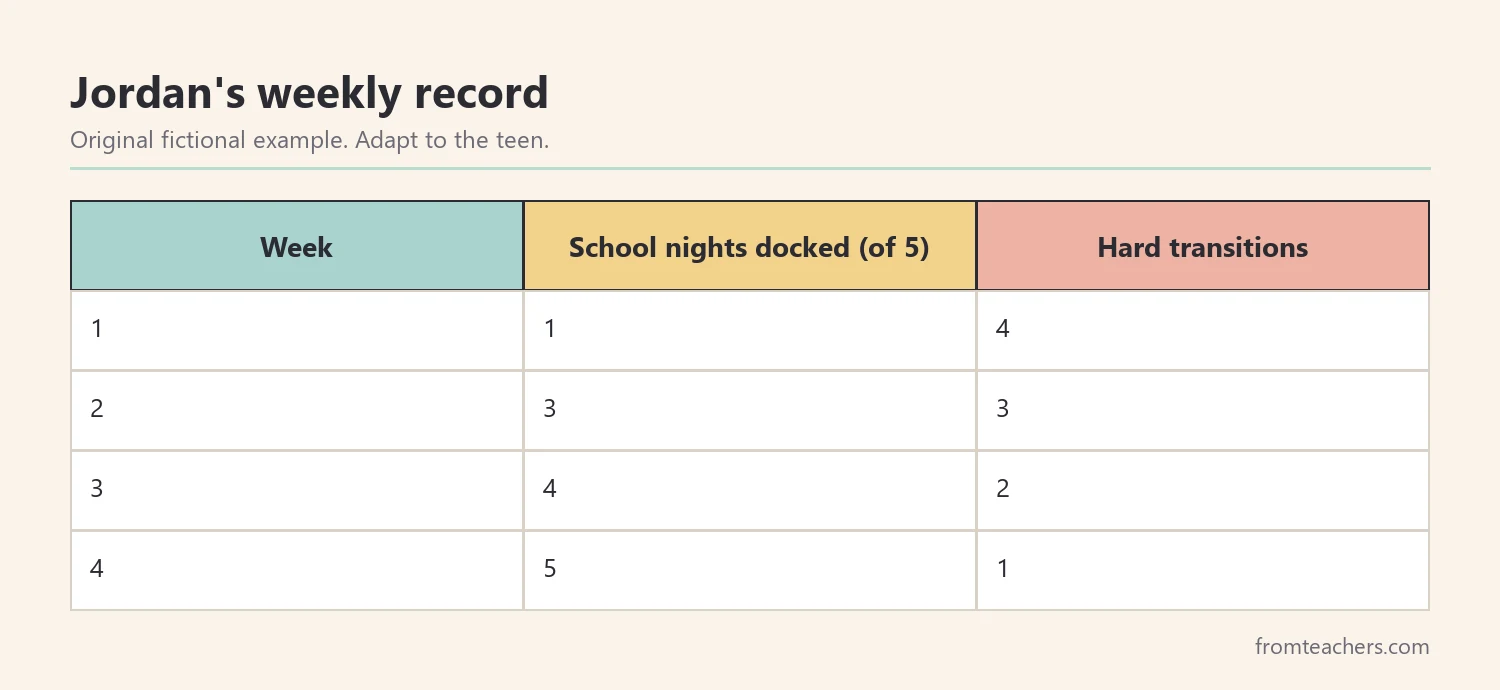
In week 1, the phone was docked on 1 of 5 school nights, and there were 4 hard transitions. By week 4, it was docked on all 5 school nights, and there was 1 hard transition. Jordan also said mornings felt easier. Because he could see the change himself, he was more willing to keep the plan. His parent also stopped checking the phone at night, since the charging spot did that job, which removed another source of conflict around neurodivergent teens screen time.
Finally, talk about responsibility without shame. When a late night leads to a hard morning, frame it as cause and effect, not as a character flaw: “You were up late, so today feels tough. What could help tonight?” That language respects the teen and keeps the focus on next steps.
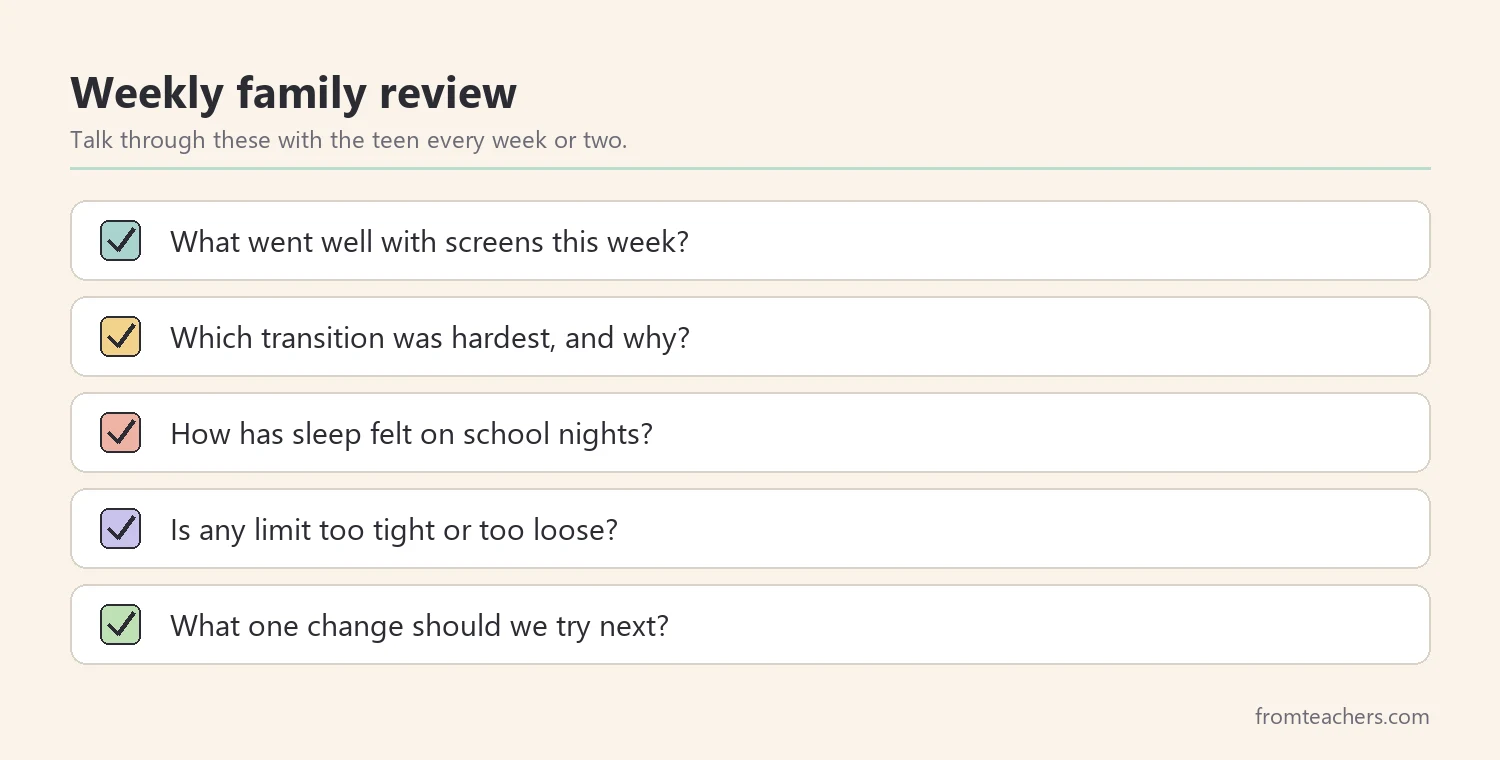
Over time, the goal is for the teen to take more ownership. Gradually, they may set their own timers, choose their own landing activities, and suggest changes to the plan. That shift is the real sign that a plan for neurodivergent teens screen time is working: the teen is building skills they can carry into adulthood, rather than simply following rules made by others.
Common mistakes and how to avoid them
- Taking the phone without warning. Fix: use a predictable warning and a clear stopping point.
- Relying on willpower. Fix: use hard timers, charging spots, and phone-free zones.
- Arguing during a meltdown. Fix: help everyone calm down first, then talk later.
- Banning all screens. Fix: protect the online activities that give the teen connection and rest.
- Making rules alone. Fix: plan limits with the teen and review them together.
- Shaming over lost sleep. Fix: talk about cause and effect, then plan for tonight.
Questions teachers and parents ask about neurodivergent teens screen time
How much screen time is right for a neurodivergent teen?
There is no single number that fits every teen. It helps to look at what screens are doing: whether sleep, school, movement, and relationships are getting enough space. A plan built around those priorities is usually more useful than a strict hour count.
Why does my teen have a meltdown when screen time ends?
Many teens are deep in hyperfocus or overstimulated when the screen stops, and a sudden ending can overwhelm them. Warnings, natural stopping points, and a landing activity often reduce these moments.
Should we take the phone away as a consequence?
Removing the phone as punishment for neurodivergent teens screen time problems often increases conflict and can damage trust. Instead, agreed limits and built-in supports tend to work better. If changes are needed, discuss them when everyone is calm.
How can teachers support healthy neurodivergent teens screen time habits?
Teachers can support neurodivergent teens screen time habits by using clear transition warnings for classroom devices, offering predictable stopping points, and sharing strategies that work at school with families. Consistent language between home and school helps teens follow routines.
When should we seek outside help?
Consider talking with a doctor, counselor, or the teen’s care team if screen use seems linked to serious sleep problems, withdrawal, distress, or safety concerns. They can help look at the bigger picture.
Related reading: Understanding Autism ADHD Meltdowns: Signs and Support Strategies, Managing Sensory Overload: Practical Strategies for Autism and ADHD, and ADHD in Children: A Guide to Effective Classroom and Home Support.
A companion resource for neurodivergent teens screen time:
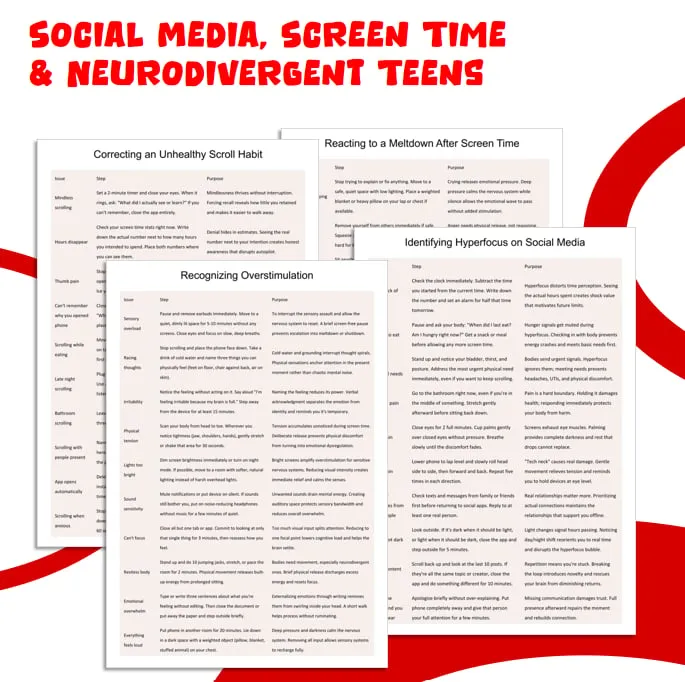
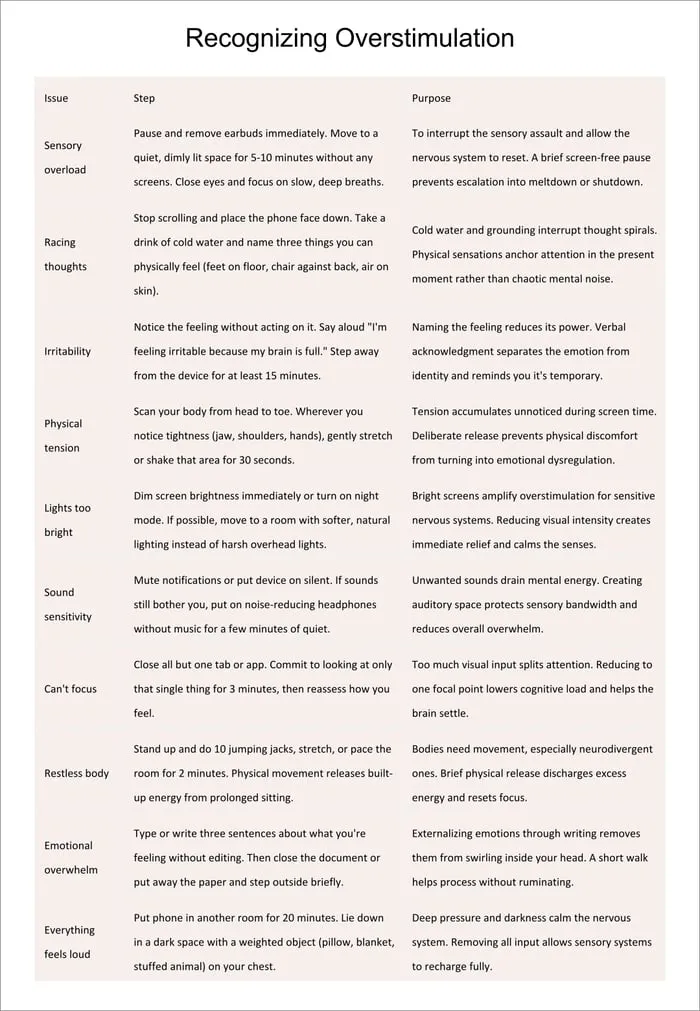
Social Media, Screen Time and Neurodivergent Teens: 12 pages of Issue, Step, and Purpose tables covering hyperfocus on social media, overstimulation, and meltdowns after screen time, plus low-pressure habits like phone-free zones, hard app timers, and honest sleep tracking.
Sources and scope
- HealthyChildren.org, American Academy of Pediatrics: parent information on media use, sleep, and teen health.
- Understood.org: practical articles for families on ADHD, learning differences, and daily routines.
- CHADD: information and support for families of children and teens with ADHD.
- Autism Society of America: resources for autistic people and their families.
This guide covers everyday family and classroom strategies for screens, transitions, and social media. It does not cover diagnosis, treatment, or clinical advice about sleep or mental health, which belong to qualified professionals.
Key takeaways
- Observe neurodivergent teens screen time patterns before changing rules.
- Build limits with the teen and use supports that do not rely on willpower.
- Plan transitions with warnings, stopping points, and a landing activity.
- During a meltdown, calm and safety come first; problem-solve later.
- Keep talking about social media and sleep, and review the plan together.










Leave a Comment