

SPED acronyms can make a first IEP meeting feel like a conversation in a different language. Picture a new paraprofessional sitting at the table while the team talks about the IEP, the FBA, the BIP, ESY, and LRE. Everyone nods. She writes the letters down and hopes to look them up later, but by then the discussion has moved on.
This guide gives you five steps to learn SPED acronyms quickly and use them well: start with the core terms, group them by topic, prepare before meetings, explain them in plain words, and build a shared glossary with your team. It works for new teachers, paraprofessionals, and parents.
Examples are fictional. Adapt to the student’s goals and agreed supports. This is guidance, not a diagnosis.
At a glance
- A small set of core terms appears in almost every meeting.
- Grouping acronyms by topic makes them easier to remember.
- A ten-minute check before each meeting prevents confusion.
- Say the plain meaning out loud, especially with families.
- A shared team glossary helps new staff and parents catch up fast.
1. Start with the core SPED acronyms
First, do not try to learn every term at once. Special education uses dozens of abbreviations, but a small set comes up again and again. Learning those first gives you enough to follow most conversations.
For example, start with five. IEP stands for Individualized Education Program, the student’s written plan. IDEA is the Individuals with Disabilities Education Act, the federal law behind special education in the United States. FAPE means Free Appropriate Public Education. LRE means Least Restrictive Environment. BIP stands for Behavior Intervention Plan.
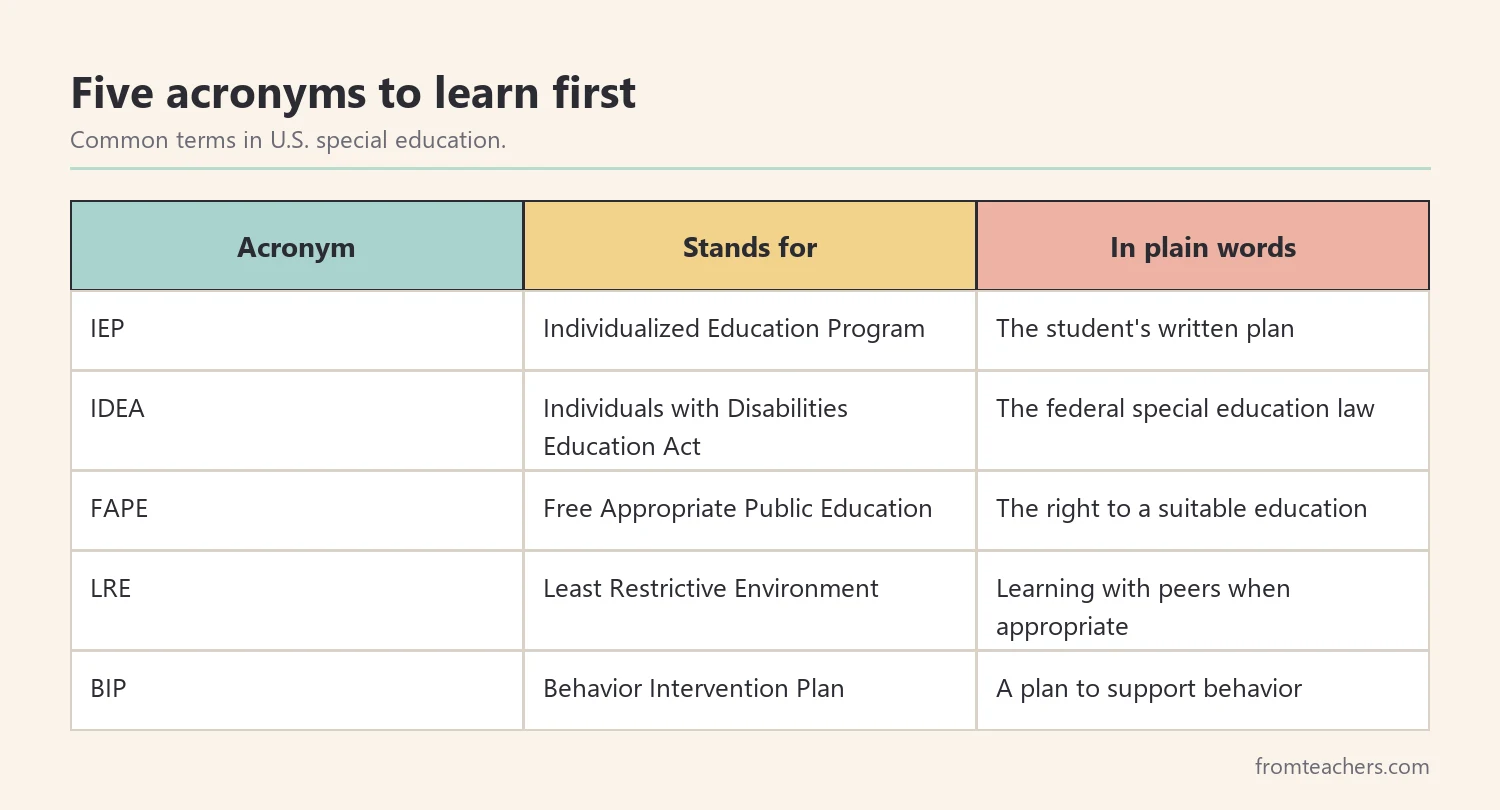
Next, learn the plain meaning, not only the full name. Knowing that FAPE stands for Free Appropriate Public Education is useful. Knowing that it means a student has the right to an education that fits their needs is what helps you understand the conversation.
Also, keep a small reference nearby. A one-page list on your desk or in your planner means you can check SPED acronyms in seconds. Over time, you will need it less, but it is a calm backup in busy moments.
In addition, notice which terms your school uses most. Some districts use local abbreviations or slightly different terms. Ask a colleague which SPED acronyms appear most often in your building.
Worked example. Ms. Lane is a fictional new paraprofessional in a grade 4 classroom. In her first week, she writes down every acronym she hears. She counts 20 different ones. She decides to start with the five core SPED acronyms her teacher says most often.
2. Group SPED acronyms by topic
Next, organize the list. However, a long alphabetical list is hard to remember. Grouping SPED acronyms by topic helps your brain file each term in a meaningful place.
For example, you might use four groups. Plans and programs include IEP, IFSP (Individualized Family Service Plan), BIP, and ESY (Extended School Year). Assessment includes FBA (Functional Behavior Assessment) and MDT (Multidisciplinary Team). Support staff include SLP (Speech-Language Pathologist), OT (Occupational Therapist), and PT (Physical Therapist). Law and rights include IDEA, FAPE, and LRE.
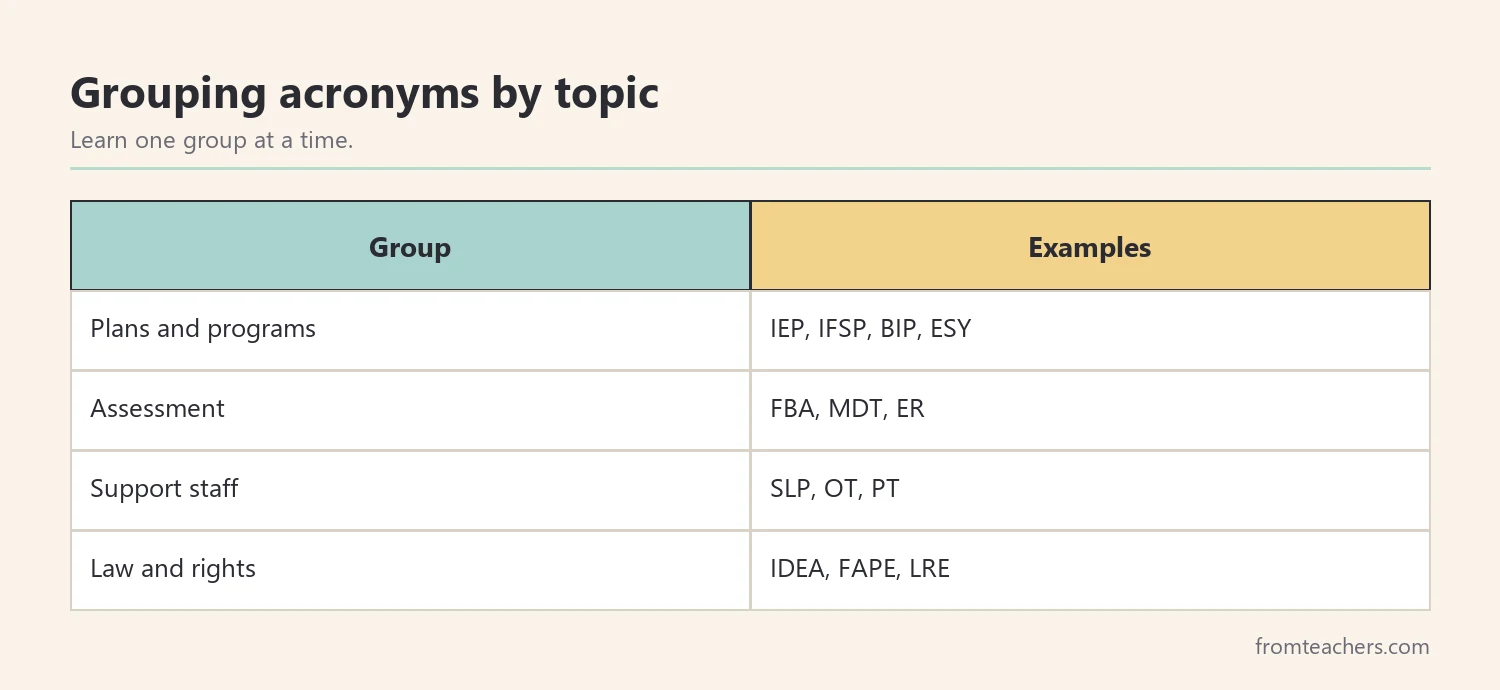
Then, learn one group at a time. Spend a few days on each. When you hear a new acronym, ask, “Which group does this belong to?” Even if you do not know the term yet, the group gives you a clue about its meaning.
Also, connect each term to a real moment. If your student sees the SLP on Tuesdays, link “SLP” to that picture. Personal connections make terms stick faster than memorizing letters.
A reference built this way saves time. The SPED acronyms reference guide poster gathers the most common special education acronyms on one page, grouped by topic, so new teachers, paraprofessionals, and parents can follow the conversation.
Worked example. Ms. Lane sorts her 20 acronyms into four groups on an index card. She keeps the card in her lanyard pocket. When the OT visits, she checks the “Support staff” group and remembers what the role does.
3. Prepare SPED acronyms before every meeting
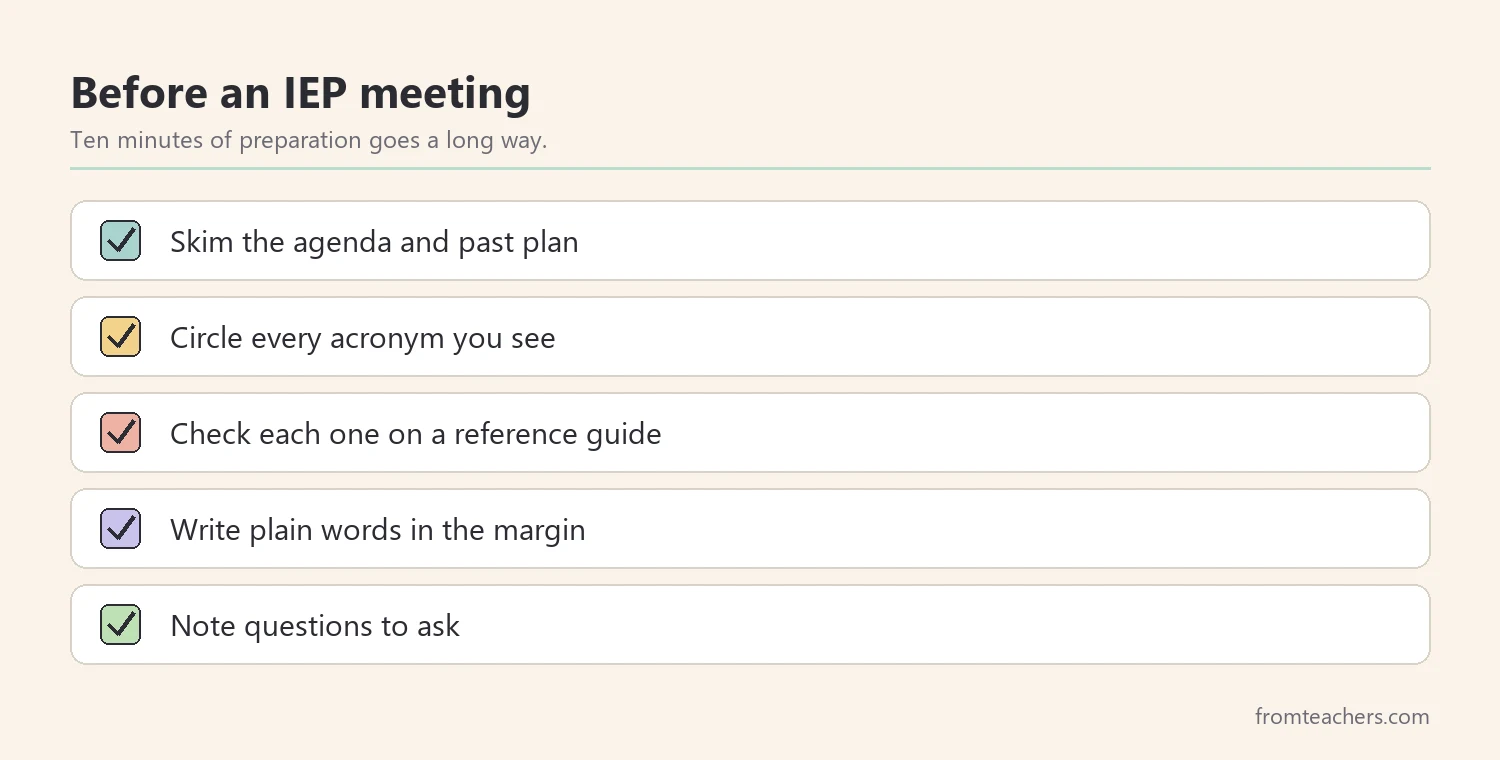
Next, build a short routine before IEP meetings. Ten minutes of preparation can change how much you understand. You do not need to study the whole plan. Instead, focus on the terms that will come up.
First, skim the agenda and the current plan if you have access. Circle every acronym you see. Then check each one on your reference guide and write the plain meaning in the margin. Finally, note any questions you want to ask.
Also, think about your role. A paraprofessional may be asked about daily observations. A general education teacher may be asked about classroom progress. Knowing the SPED acronyms linked to your part of the meeting helps you speak with confidence.
In addition, parents can use the same routine. Families often receive meeting notices and draft documents ahead of time. Circling unfamiliar terms and bringing a short question list helps parents take part as equal members of the team.
Meanwhile, keep the reference guide in your meeting folder. If a new term comes up, check it quietly or ask. Nobody expects you to know every term from memory.
Worked example. Before her first IEP meeting, Ms. Lane reads the agenda and circles six SPED acronyms. She knows four. She looks up PLEP and ESY on her reference sheet and writes “where he is now” and “summer services” in the margin.
4. Explain acronyms in plain words
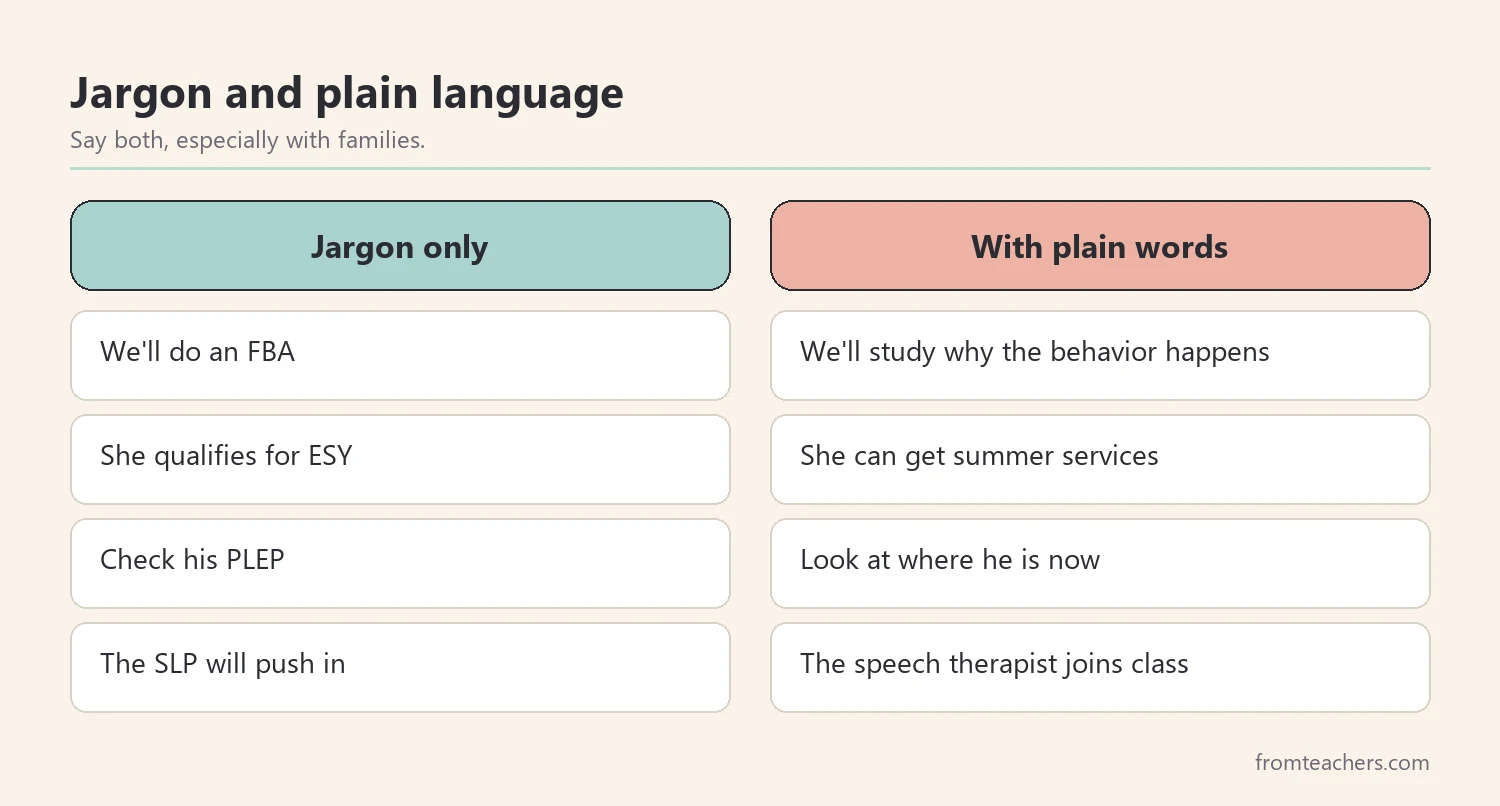
Next, use plain language out loud. Even experienced staff can forget that families and new team members may not know every term. Saying the plain meaning alongside an acronym keeps everyone in the conversation.
For example, instead of “We’ll do an FBA,” say “We’ll do a functional behavior assessment, which means we’ll study why the behavior happens.” Instead of “She qualifies for ESY,” say “She can get extended school year services over the summer.”
Also, make asking normal. If you are leading a meeting, say at the start, “We use a lot of acronyms. Please stop us anytime.” This simple invitation makes it easier for families and new staff to ask without embarrassment.
In addition, if you are the one who does not know, ask. A short question like “Can you tell me what ITP means?” is professional and helpful. Often, someone else at the table was wondering too.
Then, write plain meanings in notes and emails. When you send a summary after a meeting, spell out each acronym the first time it appears. This small habit makes SPED acronyms less of a barrier for everyone who reads the notes later.
Worked example. During the meeting, the team mentions an ITP. Ms. Lane asks what it means. The case manager explains that it is an Individual Transition Plan. Afterward, the student’s father thanks her because he had the same question.
5. Build a shared glossary of SPED acronyms
Finally, share what you learn. A team glossary helps every new paraprofessional, substitute, and parent catch up faster. It can be a printed poster in the staff room, a page in the parent handbook, or a sheet in each meeting folder.
First, start with the most common terms. Then add local terms your district uses. Group them by topic, and include the plain meaning next to each. Keep it to one or two pages so people actually use it.
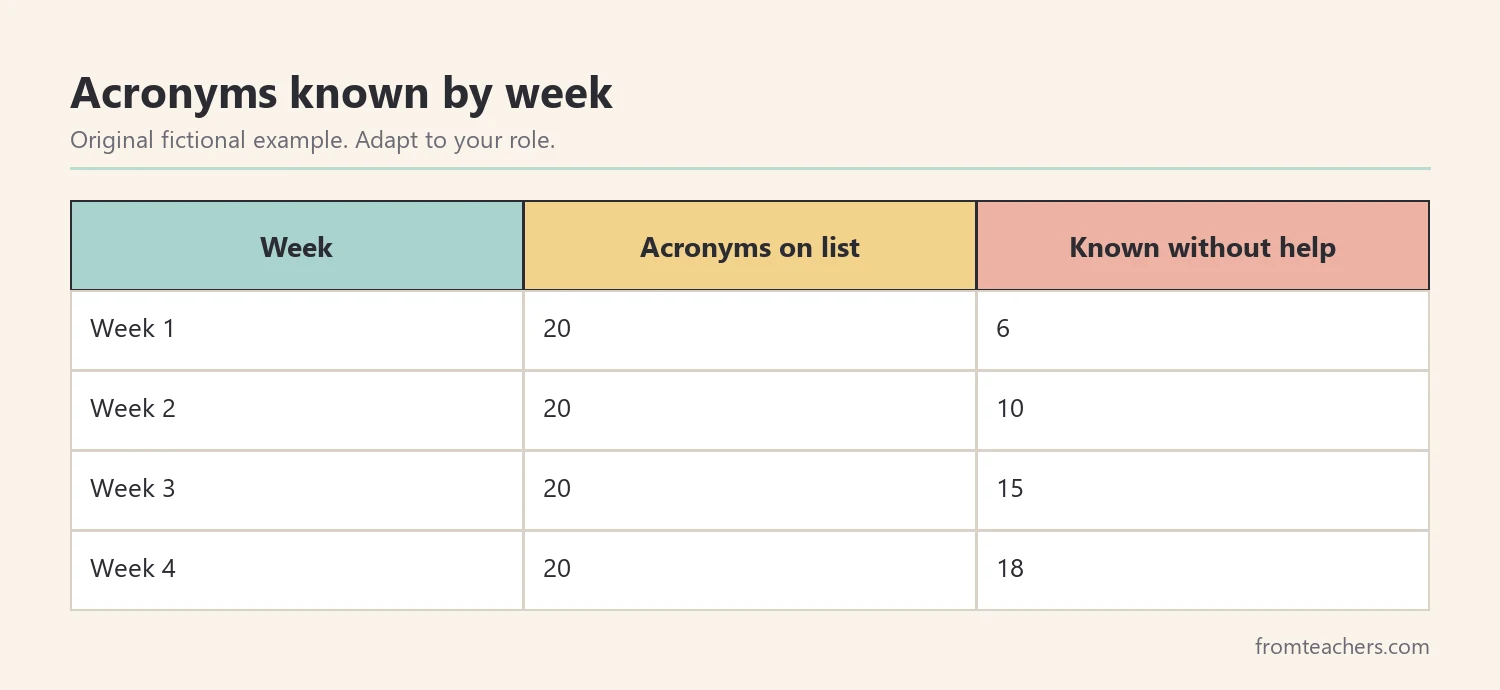
Also, review your own progress. Every week, check how many terms on your list you know without looking. This quick self-check shows you which groups need more attention.
In addition, update the glossary each year. Laws, programs, and local terms can change. A quick review at the start of the school year keeps the list accurate.
Then, offer it to families. A clear list of SPED acronyms with plain meanings can make IEP meetings feel more welcoming. Families who understand the language can take part more fully in decisions about their child.
Worked example. Ms. Lane checks her list every Friday. In week 1, she knows 6 of 20 SPED acronyms without help. By week 2, she knows 10. In week 3, 15. By week 4, she knows 18 of 20. She shares her grouped card with the next new paraprofessional on her team.
Quick practice ideas that fit a busy week
Learning terms does not need long study sessions. Instead, use small moments. Read three terms from your card while you wait for the copier. Quiz yourself on one topic group during lunch. Short, frequent practice usually works better than one long session.
Also, try teaching the terms to someone else. Explaining FAPE or LRE to a colleague or family member forces you to use plain words, which is the best test of real understanding.
In addition, use the documents you already handle. When you file a progress report or read a schedule of services, pause at each acronym and say its meaning to yourself. Real documents give you real practice with the SPED acronyms you will actually meet.
Finally, keep a short “new terms” list. When you hear an unfamiliar acronym, write it down and check it later the same day. Small, steady additions turn a confusing list into a familiar one within a few weeks.
A note for parents
Parents are full members of the IEP team. If acronyms make a meeting hard to follow, you have every right to ask for plain explanations. Bring a reference sheet, write questions in advance, and ask the team to spell out terms in written notes.
Also, you can ask for a short pre-meeting call. Many teachers are happy to walk through the agenda and the main terms ahead of time. This makes the meeting itself calmer and more productive.
Common mistakes and how to avoid them
- Trying to learn every term at once. It leads to overload. Fix: start with five core terms.
- Memorizing letters without meaning. The term does not help in context. Fix: learn the plain meaning too.
- Staying silent in meetings. Confusion grows. Fix: ask when you do not know a term.
- Using jargon with families. Parents feel left out. Fix: say the plain meaning every time.
- Keeping knowledge to yourself. New staff start from zero. Fix: build a shared team glossary.
- Never updating the list. Terms change. Fix: review the glossary every school year.
Questions teachers and parents ask about SPED acronyms
What does SPED stand for?
SPED is a common short form for special education. It refers to specially designed instruction and services for students with disabilities, provided under laws such as IDEA in the United States.
What is the difference between an IEP and a 504 plan?
An IEP is a plan for students who qualify for special education under IDEA. A 504 plan comes from a different law, Section 504 of the Rehabilitation Act, and usually focuses on accommodations. Your school team can explain which applies to a student.
Are SPED acronyms the same in every state?
Many core terms, such as IEP, IDEA, FAPE, and LRE, are used nationally. However, some states and districts use their own local abbreviations. Ask your school which terms are specific to your area.
How can paraprofessionals learn the terms quickly?
Start with core terms, group the rest by topic, and keep a reference sheet nearby. Prepare before meetings and ask questions. Weekly self-checks help terms stick.
Is it okay to ask what an acronym means during a meeting?
Yes. Asking is professional and helps everyone. Teams that welcome questions usually have clearer, more productive meetings.
Related reading: Special Education: A Complete Guide for Parents and Educators, Accommodations vs Modifications in Special Education: The Difference Explained, and How Parents and Teachers Can Team Up for Special Education Success.
A companion resource for SPED acronyms:
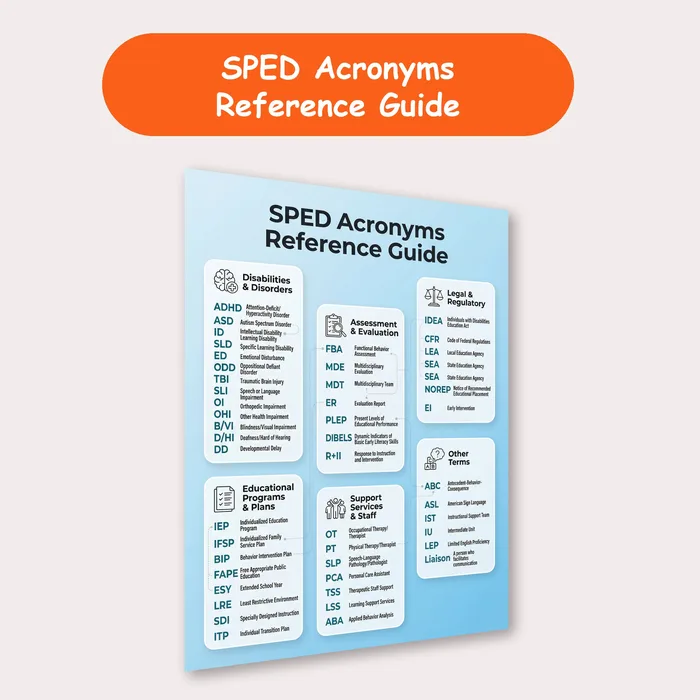
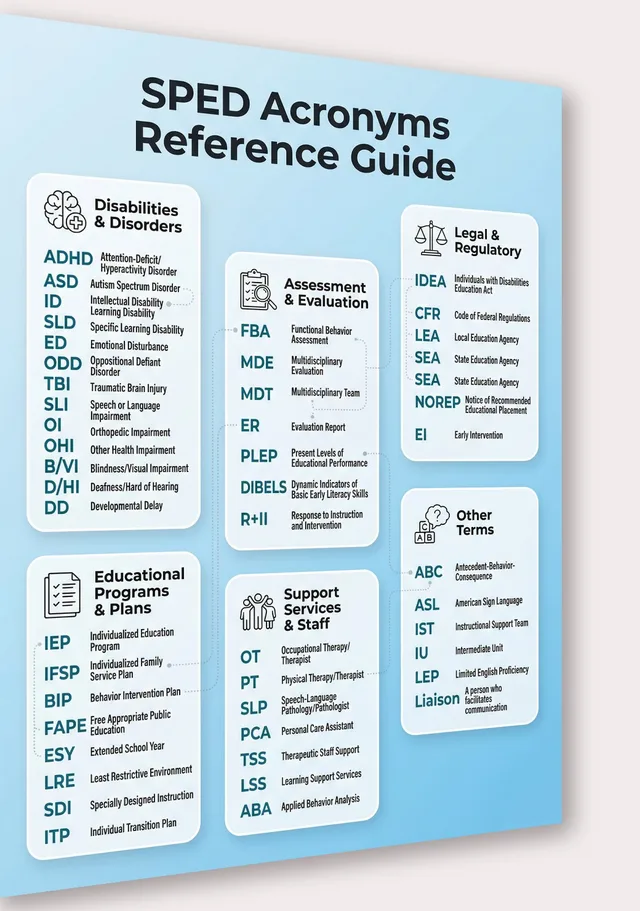
SPED Acronyms Reference Guide Poster: a one-page reference that gathers the most common special education acronyms in one place, grouped by topic, for new teachers, paraprofessionals, and parents.
Sources and scope
- IDEA, U.S. Department of Education: the official site for the Individuals with Disabilities Education Act.
- Center for Parent Information and Resources: family-friendly explanations of special education terms and processes.
- IRIS Center, Vanderbilt University: free modules on IEPs and special education practice.
- Understood.org: plain-language information for families on IEPs and 504 plans.
This guide covers learning and explaining common U.S. special education acronyms. It does not give legal advice, and local terms or procedures may differ by state and district.
Key takeaways
- Learn five core SPED acronyms first, with plain meanings.
- Group terms by topic and learn one group at a time.
- Prepare before meetings by circling and checking terms.
- Say plain words aloud and make asking normal.
- Share a team glossary and update it every year.










Leave a Comment