

Time management strategies for students with ADHD work best when they make time visible, break work into pieces, and show the student how long things really take. Picture a grade 7 student named Jordan at 8:30 on a Sunday night. A science project due Monday has been “almost started” for a week, and Jordan honestly believed it would take twenty minutes.
This list ranks seven practical strategies by how easy they are to start tomorrow, with the fewest new materials. By the end, you will know which strategy to try first, how each one looks at school and at home, and how to measure whether it is helping.
Examples are fictional. Adapt to the student’s goals and agreed supports, such as an IEP or 504 plan. This is guidance, not a diagnosis or medical advice.
At a glance
- Make time visible with estimates, timers and calendars.
- Start with a planning sheet that compares estimated and actual time.
- Break tasks into steps of 10 to 20 minutes.
- Plan backward from due dates with a buffer day.
- Track a few simple measures and fade support slowly.
How we ranked these strategies
We did not invent effectiveness scores. Instead, we ordered the strategies using two plain criteria: how quickly a teacher or parent can start, and how little extra material is needed. Strategies near the top need a pencil, a sheet, or a timer. Strategies lower down need more setup, such as a shared calendar system.
Many students with ADHD find it hard to estimate time, start tasks, and keep track of deadlines. These are executive function skills, and they can be practiced with structure and support. Therefore, the list focuses on outside supports that make time concrete.
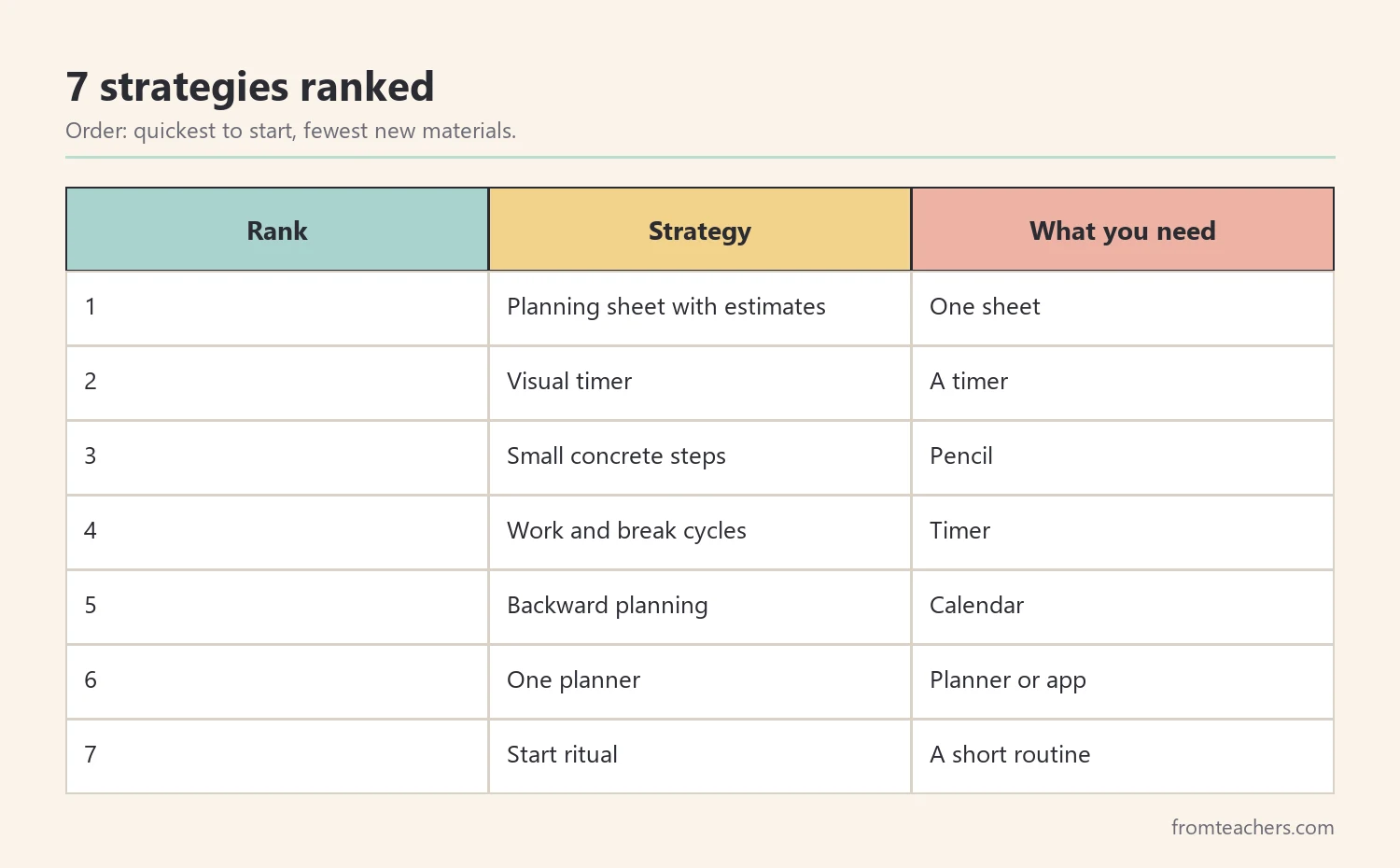
1. Plan each task with time estimates and a reality check (best first step)
Many students underestimate how long tasks take. A planning sheet that asks for an estimate, then records the actual time, turns that gap into something the student can see and learn from.
The executive functioning sheet for student task planning and self-monitoring is built around this idea. It has a space to define the task and break it into up to five steps with time estimates, a time management section with start time, end time, actual time taken, and whether the student stayed on schedule, a materials checklist, and a self-monitoring and reflection section.
Why it works: it combines planning, time awareness, and reflection on one page.
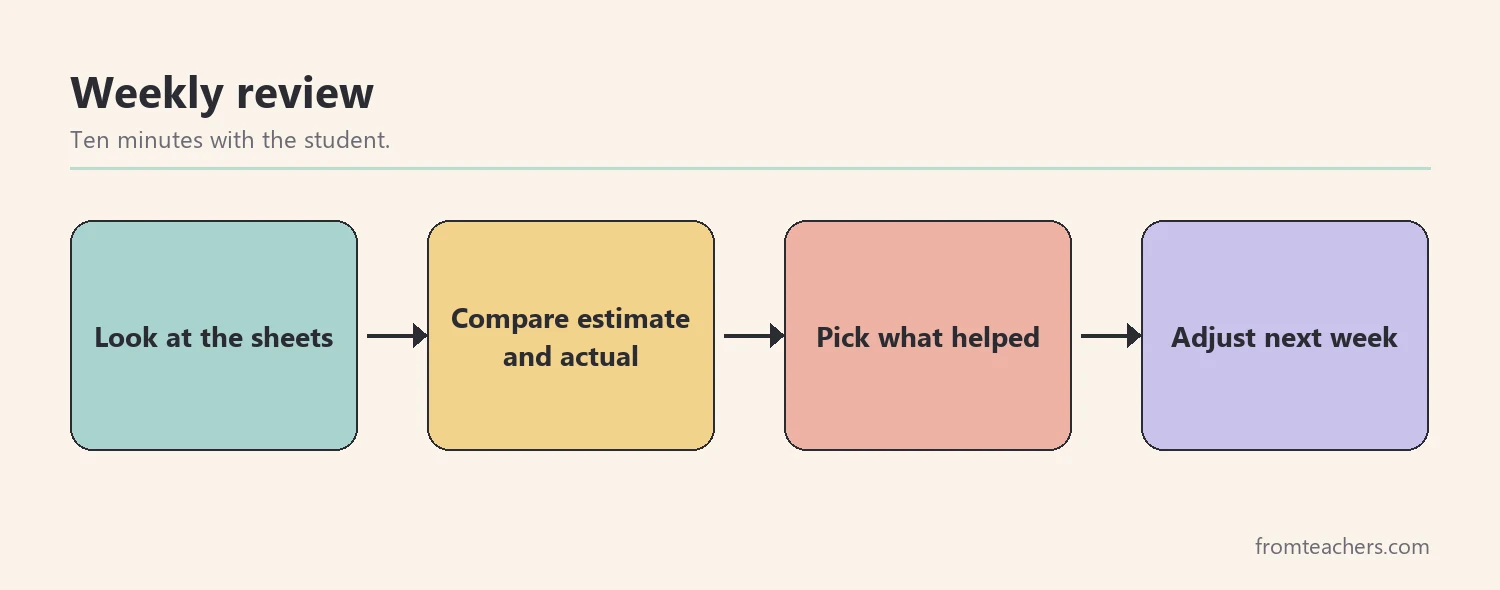
How to use it: use it for one homework task a day at first. Afterward, compare the estimate with the actual time and ask, “What surprised you?”
Example: Jordan estimated 20 minutes for the science poster. Using the sheet, the first two steps alone took 35 minutes. That surprise led to a better plan for the rest of the week.
2. Use a visual timer
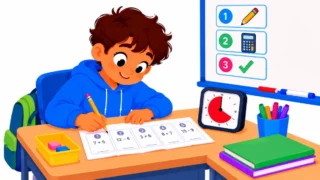
Time is invisible, which makes it hard to manage. A visual timer shows time passing, for example as a shrinking colored disk.
Why it works: the student can see how much time is left at a glance, without doing mental math.
How to use it: set the timer for one step from the planning sheet, not for the whole task. Place it where the student can see it without picking it up.
Example: Jordan set a 15-minute timer for “find three facts.” Seeing the red disk shrink helped him stay with the task. When the timer ended, he checked off the step and set it again for the next one.
3. Break big tasks into small, concrete steps
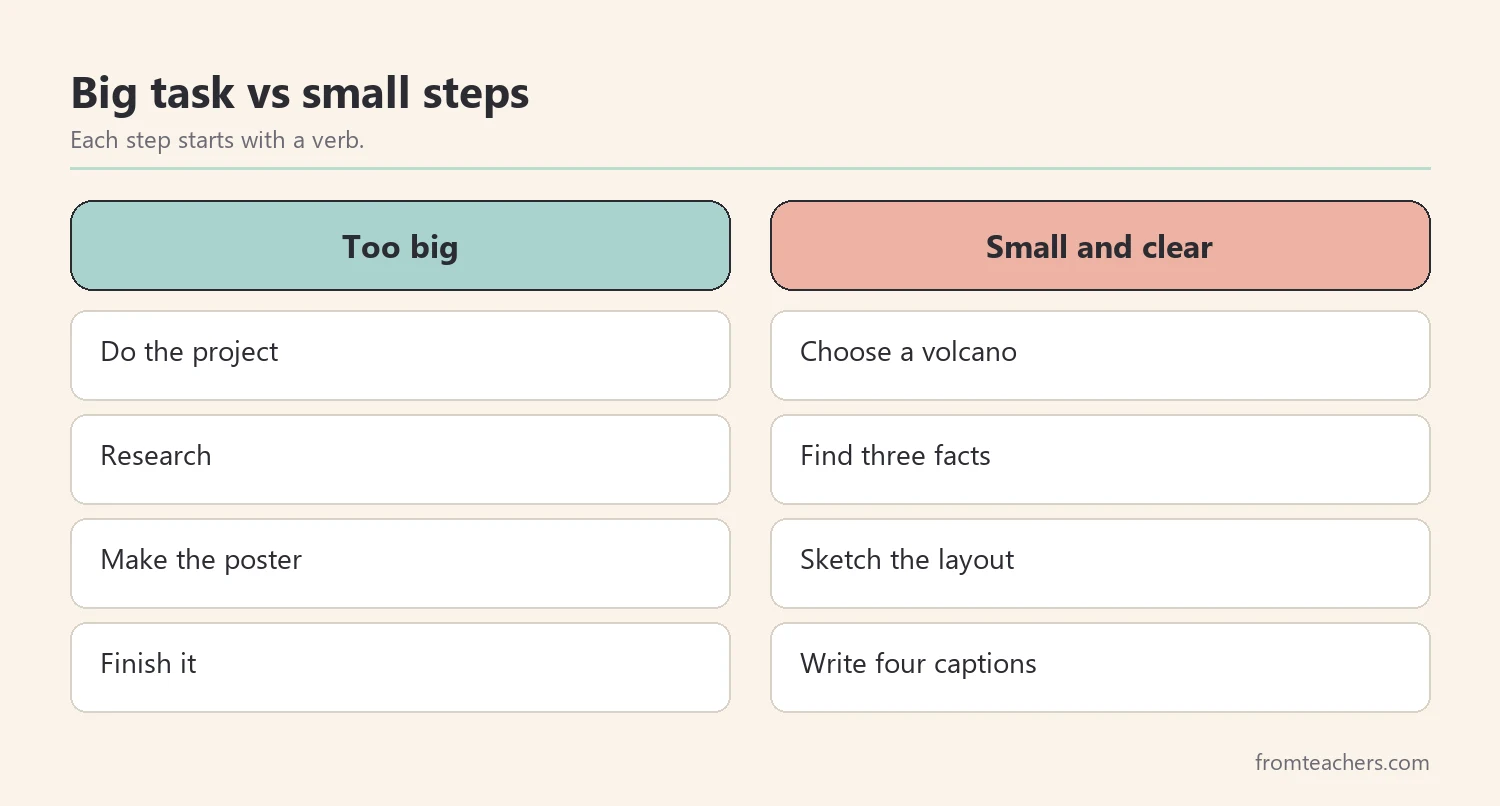
“Do the project” is not a step. “Choose three facts about volcanoes” is. Small, clear steps reduce the overwhelm that often leads to avoidance.
Why it works: each step has a clear finish line, which gives a sense of progress.
How to use it: write steps that start with a verb and can be done in 10 to 20 minutes. If a step feels too big, split it again.
Example: Jordan’s project became: choose a volcano, find three facts, sketch the layout, draw the diagram, and write captions. Five steps felt possible in a way “the project” did not.
4. Alternate short work periods and short breaks
Many students with ADHD work better in short bursts with planned breaks than in one long session.
Why it works: a known break ahead makes it easier to start and keep going.
How to use it: try 15 minutes of work and 5 minutes of break, then adjust. Choose breaks that are easy to end, such as stretching or a drink of water, rather than video games.
Example: Jordan worked in 15-minute blocks with 5-minute movement breaks. After four blocks, the hardest parts of the project were done.
5. Plan backward from the due date
Long-term assignments are especially hard because the due date feels far away until it is suddenly tomorrow. Backward planning puts each step on a specific day.
Why it works: it turns one distant deadline into several near ones.
How to use it: start at the due date and work back, placing one step on each day. Leave one buffer day for surprises.
Example: For his next project, Jordan and his teacher planned five steps across eight days, with one buffer day. He finished a day early.
6. Keep one planner or calendar
Assignments scattered across notebooks, apps, and sticky notes get lost. One trusted place for all deadlines reduces surprises.
Why it works: the student, family, and teachers can check the same place.
How to use it: choose one format, paper or digital, and build a two-minute routine to update it at the end of each school day. A teacher check at first helps the habit form.
Example: Jordan’s case manager checked his planner every Friday for a month. After that, he checked it with a parent on Sunday evenings.
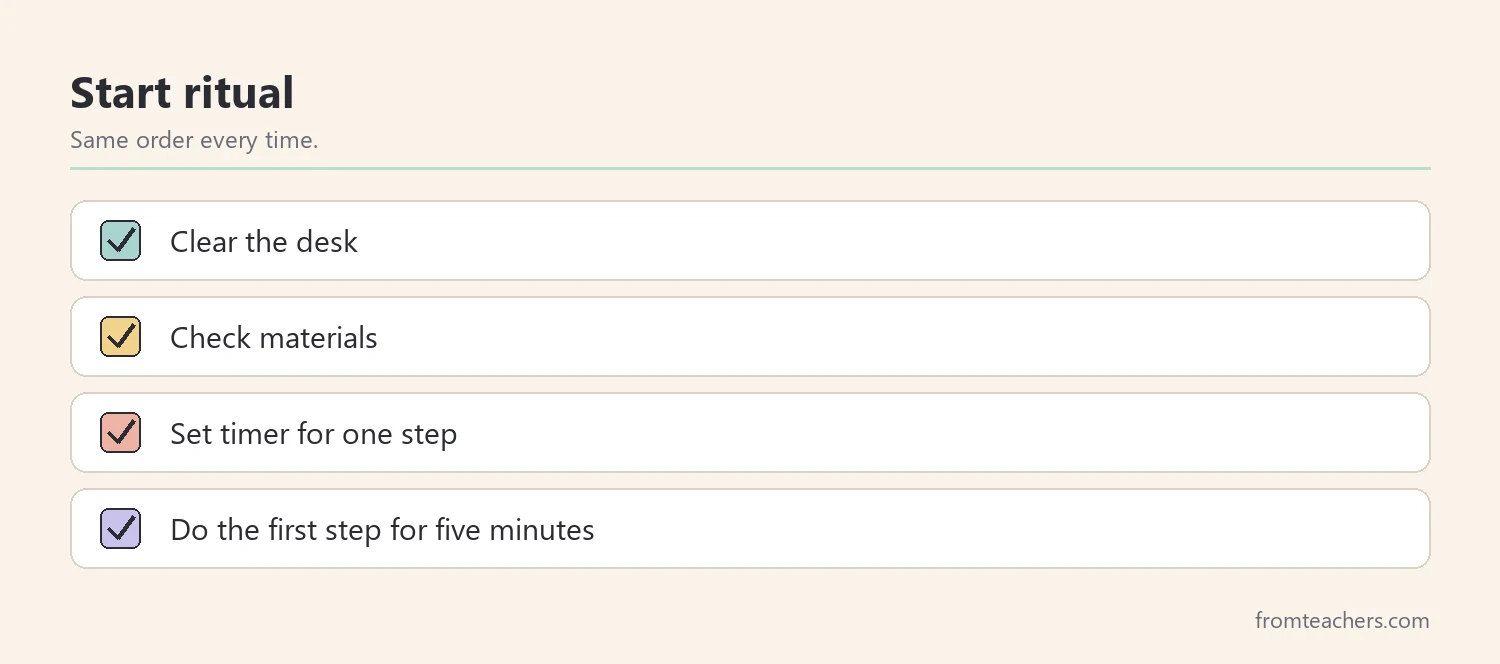
7. Create a start ritual
Starting is often the hardest part. A short, repeated start ritual reduces the decision load.
Why it works: the same small actions each time signal “work starts now.”
How to use it: for example: clear the desk, check materials, set the timer, and do the first step for just five minutes.
Example: Jordan’s ritual was: water bottle, materials checklist, timer, first step. Within two weeks, he started homework with fewer reminders.
Measuring whether time management strategies for students with ADHD are working
Strategies only help if they change something you can see. Pick two or three simple measures, such as how close estimates are to actual time, how many tasks were started without a reminder, and how many assignments were turned in on time.
Here is Jordan’s record over four weeks. The planning sheet started in week one, and backward planning started in week three.
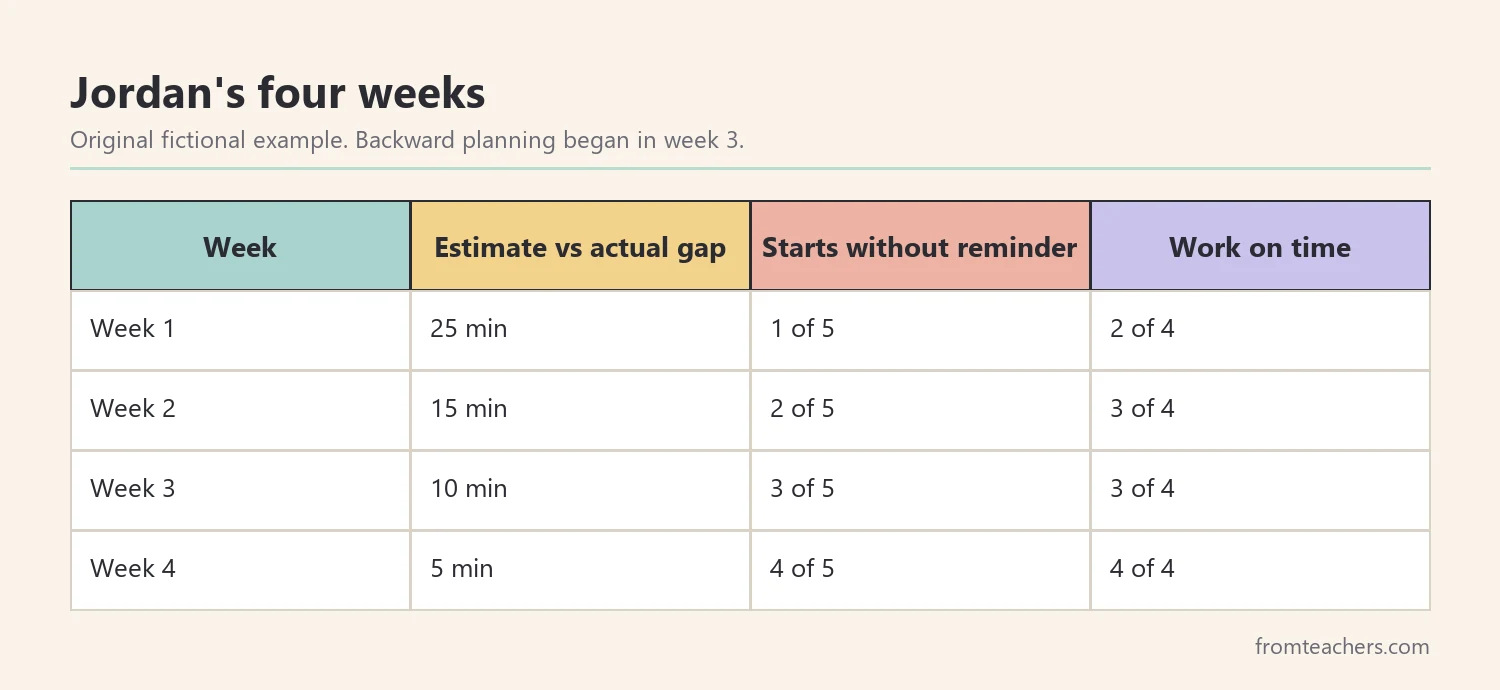
The pattern was encouraging. Estimates got closer to reality, starts without reminders increased, and on-time work rose. As a result, Jordan’s team decided to keep the planning sheet and slowly reduce adult check-ins.
Keep the measures light. A tally on the planning sheet or a sticky note on the planner is enough. If a measure takes more than a minute a day to record, it will probably be dropped within a week, so simplify it. In addition, look at trends over several weeks rather than single days, because one hard day after a sports game or a poor night of sleep can look like a setback when it is not.
Also, involve the student in the review. Asking “Which strategy helped most this week?” builds self-awareness, which is the long-term goal.
School and home working together
These supports are strongest when school and home use the same tools. If the planning sheet is used in class, use it for homework too. If the student has a visual timer at school, provide one at home.
In addition, share small wins. A short note such as “Jordan started his math independently three times this week” helps families notice progress and keep routines going.
Moreover, plan for the hardest times of day. For many students, late afternoon homework comes after a long day of effort at school. A snack, a short movement break, and a quiet workspace before starting can make the first step easier. Some families also find that a regular homework start time, posted on the fridge, removes daily negotiation.
It also helps to agree on what adults will say. A neutral prompt like “What does your sheet say is next?” points the student back to the tool instead of starting an argument. Over time, the student begins to ask that question independently.
Finally, remember that these are supports, not tests of willpower. Students with ADHD often know what they need to do. Structured tools help them do it more often.
Common mistakes and how to avoid them
- Timing the whole task. A 60-minute timer feels endless. Fix: time one small step at a time.
- Skipping the reflection. Without comparing estimate and actual time, the lesson is lost. Fix: ask one reflection question each time.
- Too many systems at once. Fix: start with one strategy and add another after two weeks.
- Breaks that are hard to end. Fix: choose short, movement-based breaks.
- Removing support too fast. Fix: fade adult check-ins gradually, based on data.
Questions teachers and parents ask about time management strategies for students with ADHD
Which strategy should we try first?
Start with a planning sheet that includes time estimates and actual time. It is quick to begin and gives useful information about where time goes.
Do these strategies replace medical treatment?
No. These are educational supports. Decisions about medical treatment belong to the family and their healthcare providers.
Can these strategies be written into an IEP or 504 plan?
Supports such as planners, check-ins, and chunked assignments are often discussed by IEP and 504 teams. Talk with your team about what fits the student.
How long until we see change?
It varies. Many families and teachers watch a few simple measures for several weeks before deciding whether a strategy is helping.
What if the student refuses to use the tools?
Involve the student in choosing tools, keep them simple, and focus on one at a time. Ownership often improves when students see their own data improving.
Related reading: Effective ADHD Classroom Strategies to Support Student Success, ADHD in Children: A Guide to Effective Classroom and Home Support, and 5 Practical Teaching Tips to Boost Classroom Focus and Learning.
You may also need: Daily Reflection Journal for Students SEL Check In and Goal Setting Sheet.
A companion resource for time management strategies for students with ADHD:
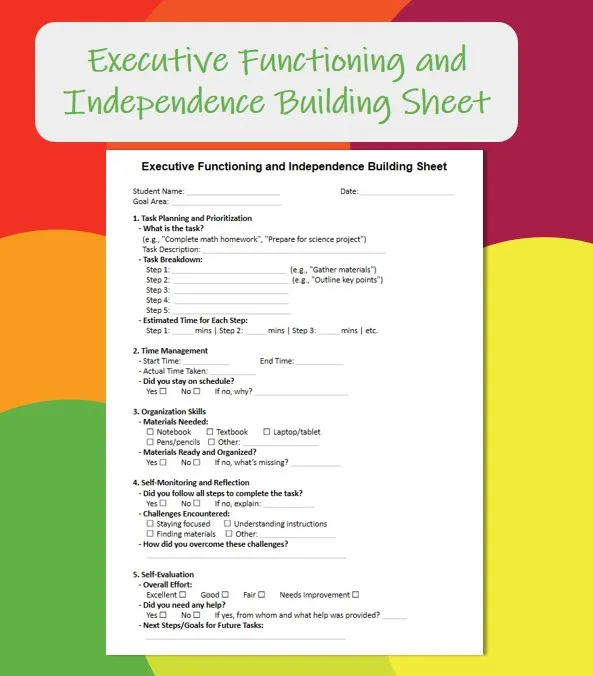
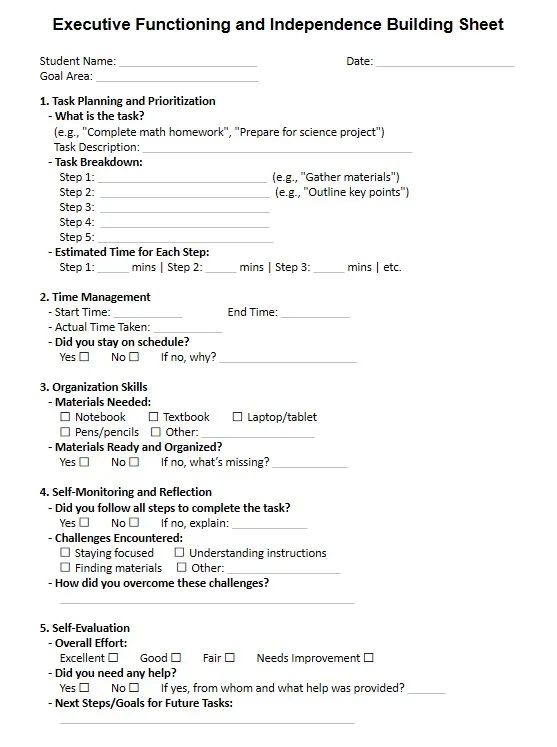
Executive Functioning Sheet Student Task Planning and Self-Monitoring Tool: a one-page sheet with task planning and up to five steps with time estimates, a time management section with start, end and actual time, an organization and materials checklist, and self-monitoring and reflection questions.
Sources and scope
- CHADD: information on ADHD for families and educators, including school strategies.
- Understood.org: practical guidance on executive function and ADHD at school and home.
- IRIS Center, Vanderbilt University: free modules for educators on supporting students with disabilities.
- National Institute of Mental Health: general information about ADHD.
This list covers practical time management supports for school and home. It does not cover diagnosis or medical treatment of ADHD, which belong to qualified healthcare professionals.
Key takeaways
- The best supports make time visible and concrete.
- Start with a planning sheet that compares estimated and actual time.
- Use timers for single steps and plan backward from due dates.
- Keep one planner and a short start ritual.
- Track a few measures and fade support gradually.








Leave a Comment