

Emotional regulation for ADHD often matters most in the two minutes after something goes wrong. Picture a third grader who loses a board game, shoves the pieces off the table, and then cannot settle for the rest of the morning. He is not choosing chaos. His feelings arrived faster than his brakes, and nobody had taught him what to do next.
This guide to emotional regulation for ADHD walks you through six practical steps: spot the pattern, teach a daily check-in, build a toolkit, practice a reset routine, coach helpful thinking, and track progress. By the end, you will have a small, repeatable plan that works in a classroom or at home.
Examples are fictional. Adapt to the student’s goals and agreed supports. This is guidance, not a diagnosis.
At a glance
- Start by noticing when big feelings happen, not by guessing why.
- A short daily check-in gives the child words before the hard moment arrives.
- Offer a small menu of movement, sensory, and grounding tools, then practice them when calm.
- Teach one reset routine and use the same steps every time.
- Track a few simple numbers and review them with the family every few weeks.
1. Notice the pattern behind emotional regulation for ADHD
First, slow down before you pick a strategy. Emotional regulation for ADHD is easier to support when you know which moments are hardest. Many children with ADHD feel emotions quickly and intensely, and they may struggle to pause before reacting. That does not mean every outburst has the same cause.
Next, keep short notes for one or two weeks. For each big-feeling moment, write the time, the activity, what happened just before, and what helped the child recover. A sticky note or a simple notebook page is enough. You are looking for repeats, not a perfect record.
Meet Leo, a fictional student in grade 3. His teacher, Ms. Rivera, noted every big-feeling moment for two weeks. She found that most of them happened during transitions and competitive games, and very few during read-aloud time.
| Moment | What came before | What helped |
|---|---|---|
| Recess to math | Game ended suddenly | Two-minute warning |
| Partner game | Lost a round | Wall pushes, then talk |
| Writing block | Blank page, long task | First sentence modeled |
| Pickup line | Noise and waiting | Holding a heavy bag |
Then, separate the feeling from the behavior. “Shoved the game pieces” is a behavior. “Frustrated after losing” is the feeling underneath. Your plan will teach skills for the feeling, while the adults adjust the situations that keep triggering it.
Finally, choose one or two target moments to start with. For Leo, Ms. Rivera picked the end of recess and partner games. Starting small keeps the plan realistic for the adults and fair for the child.
2. Teach a daily emotional check-in
For emotional regulation for ADHD, a check-in gives the child a vocabulary for feelings before the hard moment comes. Without words, a child can only show the feeling through behavior. With a few simple labels, the child can start to say it instead.
The traffic light system works well for younger students. Green means calm and ready. Yellow means something is building, such as worry, silliness, or irritation. Red means the feeling is too big to learn right now. Older students may prefer a feelings chart with faces or an emotion wheel with more precise words.
Keep the routine short and predictable. Here is a simple sequence you can run at arrival and after lunch:
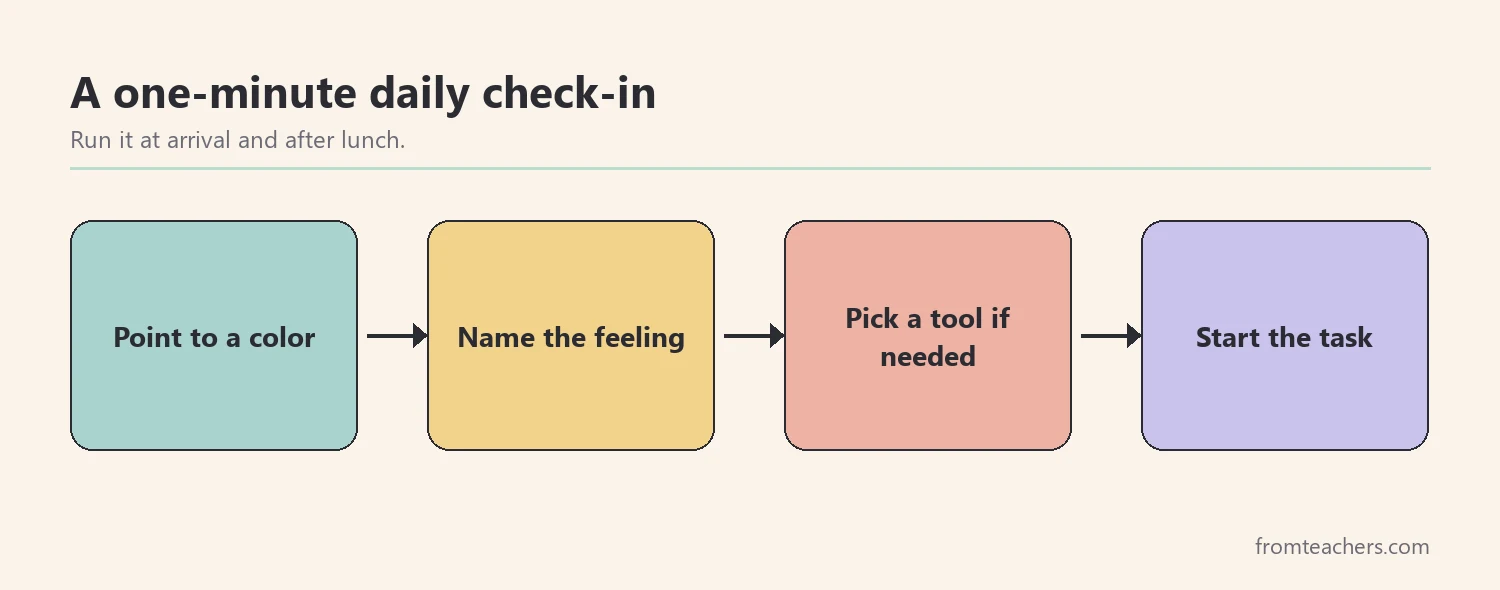
For example, Leo points to yellow after lunch and says, “Grumpy, because I didn’t get the swing.” Ms. Rivera answers, “Thanks for telling me. Want ten wall pushes before math?” The whole exchange takes less than a minute. Importantly, she does not argue with the feeling or try to talk him out of it.
Mood journaling can add depth for older children. A few lines at the end of the day, or a quick drawing, helps them see patterns in their own feelings. Over time, many students start predicting their own yellow moments, which is a real step toward self-regulation.
At home, parents can use the same colors at breakfast or after school. Shared language between home and school makes emotional regulation for ADHD feel consistent rather than like two different rule sets.
3. Build a toolkit of emotional regulation for ADHD strategies
Next, give the child a small menu of tools. A toolkit for emotional regulation for ADHD works best when it includes different kinds of strategies, because the body, the senses, and the thinking brain each need different help. Three or four tools are plenty to start.
Movement strategies use the body to burn off energy. Animal walks, wall pushes, and short bursts on a mini trampoline are common choices. Sensory strategies calm or organize the senses, such as a quiet sensory corner, bubble breathing, or heavy work like carrying books. Grounding strategies bring attention back to the present, such as the 5-4-3-2-1 senses game or slow belly breathing.
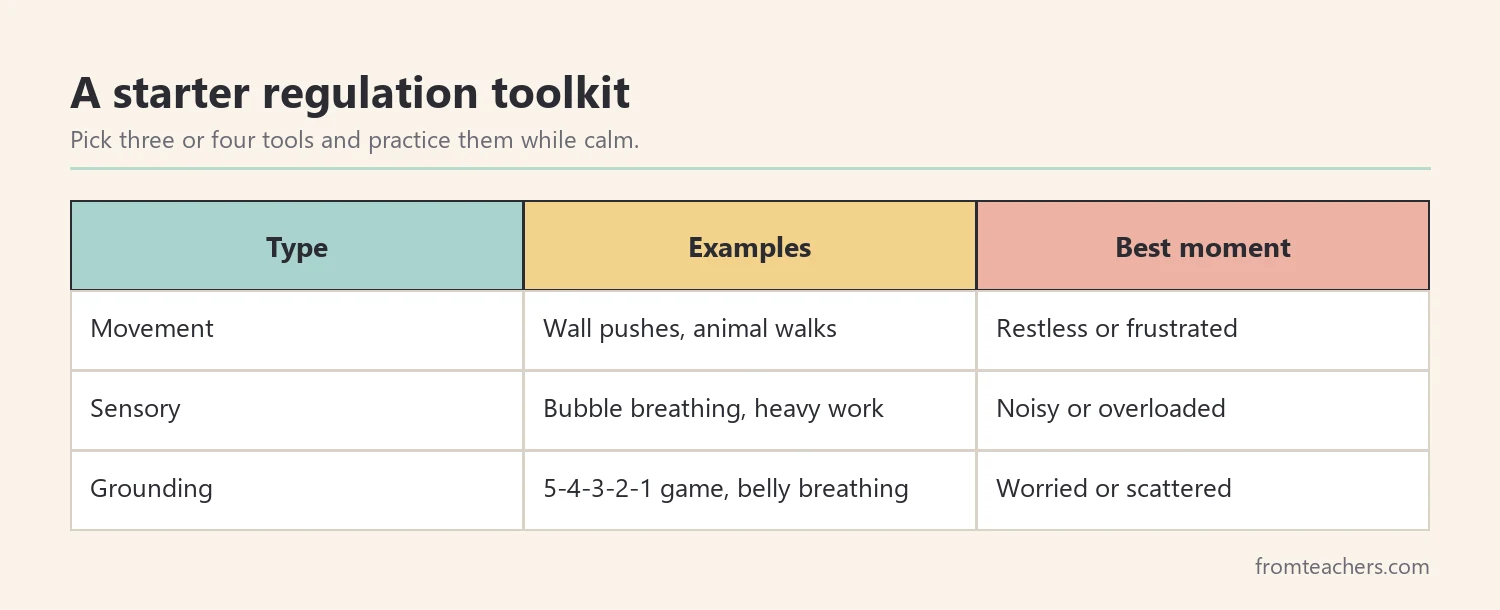
For instance, Leo’s toolkit has four cards: wall pushes, bubble breathing, carrying the book bin, and the 5-4-3-2-1 game. Each card has a picture and two or three words. The cards live on a ring on his desk, so he does not need to ask for them.
Above all, practice the tools when the child is calm. Nobody learns a new skill in the middle of a storm. Ms. Rivera practices one card with Leo each morning for a week, and she sometimes does it with the whole class so it feels normal.
If you would rather not design every card and table yourself, the Managing Big Feelings emotional regulation toolkit for children with ADHD organizes movement, sensory, grounding, and cognitive strategies into ready-to-use tables, each with a short explanation of why it helps.
Finally, let the child choose. A tool the child likes will get used. A tool an adult insists on often becomes one more battle.
4. Practice a reset routine for big feelings
A toolkit is only useful if the child knows when and how to reach for it. That is why the next step is a short reset routine. The routine is the same every time, so the child does not have to think through a plan while upset.
Keep the routine to four or five steps with simple words. In emotional regulation for ADHD, simple beats clever. Here is the one Ms. Rivera taught Leo:
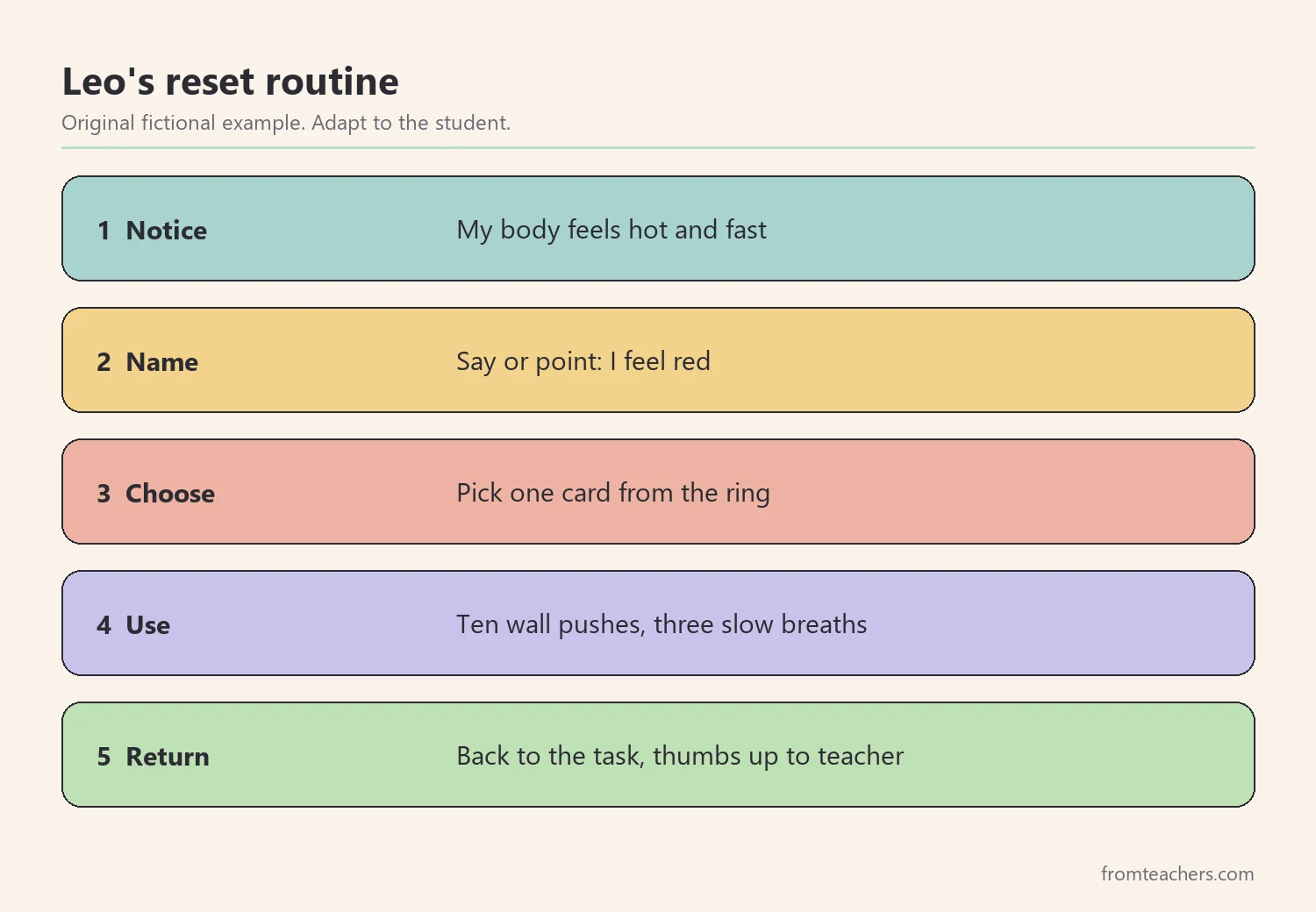
Teach the routine like any other skill. First, model it yourself while thinking aloud. Then, role-play it with the child using a pretend trigger, such as a silly “lost game.” Next, practice it during real but small frustrations. Gradually, prompt less and praise the attempt more.
Adults matter here as well. When a child is in the red zone, use few words and a calm voice. Long explanations add more input to a brain that is already overloaded. Save the talking for later, once the child is back in green.
For example, during a partner game Leo loses a round and his face turns red. Ms. Rivera quietly taps the reset card on his desk. He walks to the wall, does ten wall pushes, breathes out three times, and returns. Later, they talk for one minute about what worked.
Consistency across adults makes this step work. Share the routine card with the classroom aide, the specialists, and the family. Emotional regulation for ADHD improves faster when every adult uses the same words and the same steps.
5. Coach helpful thinking after the storm
Once the child is calm again, you can work on the thinking side of emotional regulation for ADHD. Cognitive reframing means noticing an unhelpful thought and trying a more useful one. For children, this sounds less like therapy and more like a friendly “flip it” game.
Start by naming the feeling together. Emotion coaching, an approach many counselors use, begins by naming the feeling so the child feels understood. Then, ask about the thought. “What did your brain tell you when you lost?” Finally, help the child find a kinder or more accurate thought.
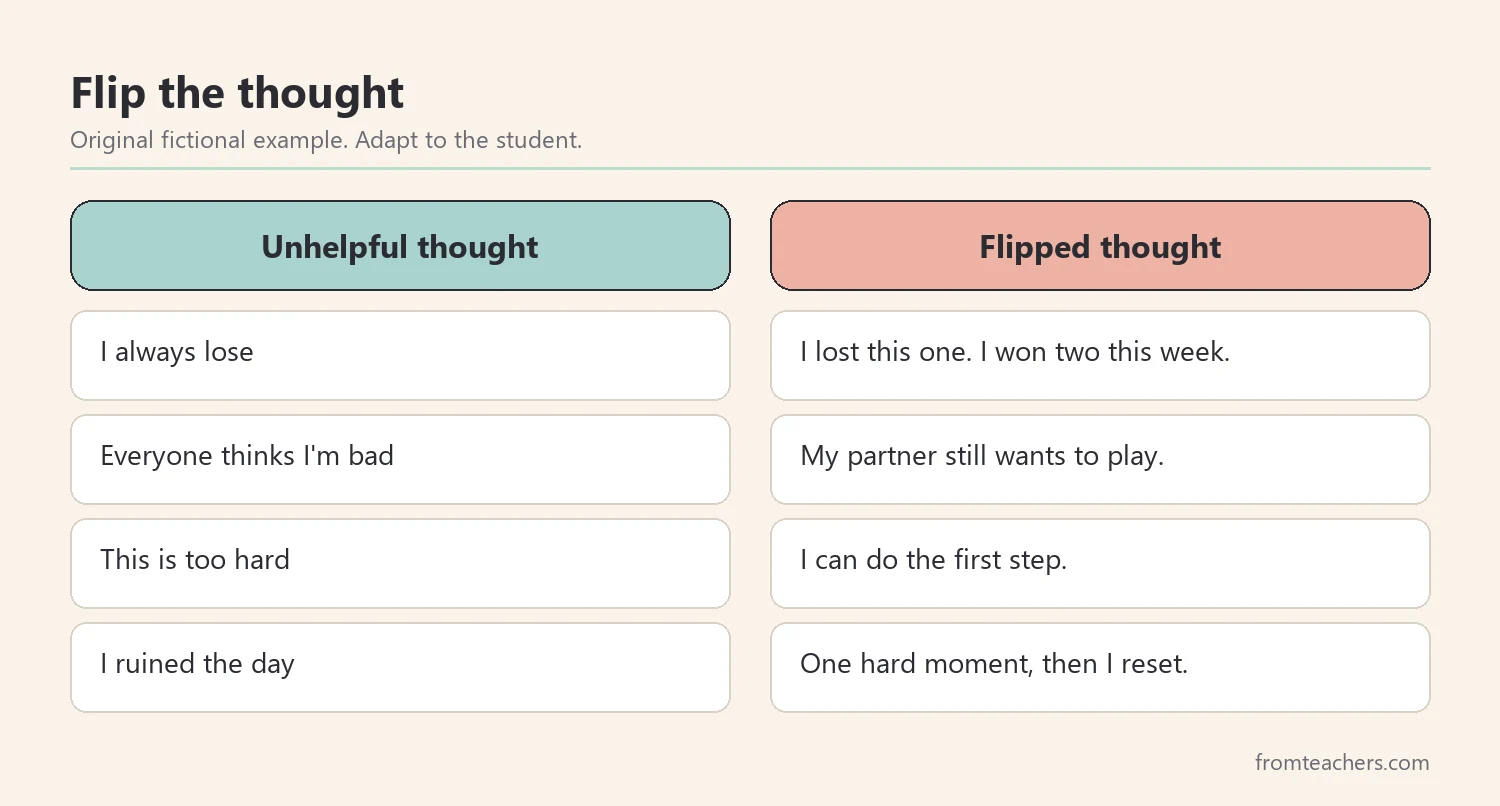
For instance, Leo said, “I always lose, everyone thinks I’m bad at games.” Ms. Rivera asked whether he had ever won a game this week. He remembered winning two. Together they wrote a new thought on a card: “I lost this one. I won two this week.”
Peer modeling and group emotion games can support this step too. When classmates practice naming feelings during a short morning game, the child with ADHD sees that everyone has big feelings sometimes. As a result, the skill feels less like a punishment and more like something the whole class does.
Keep these conversations short and positive. One flipped thought per week is a realistic goal. Over time, the child begins to flip thoughts with less help.
6. Track and review emotional regulation for ADHD progress
Finally, measure a few things so you know whether the plan is working. Tracking emotional regulation for ADHD does not need a complicated system. Two or three numbers per week are enough to see a trend.
Useful measures include the number of big-feeling moments, how many of those moments the child used a tool on their own, and roughly how long recovery took. Write them down on Friday afternoon while the week is fresh.
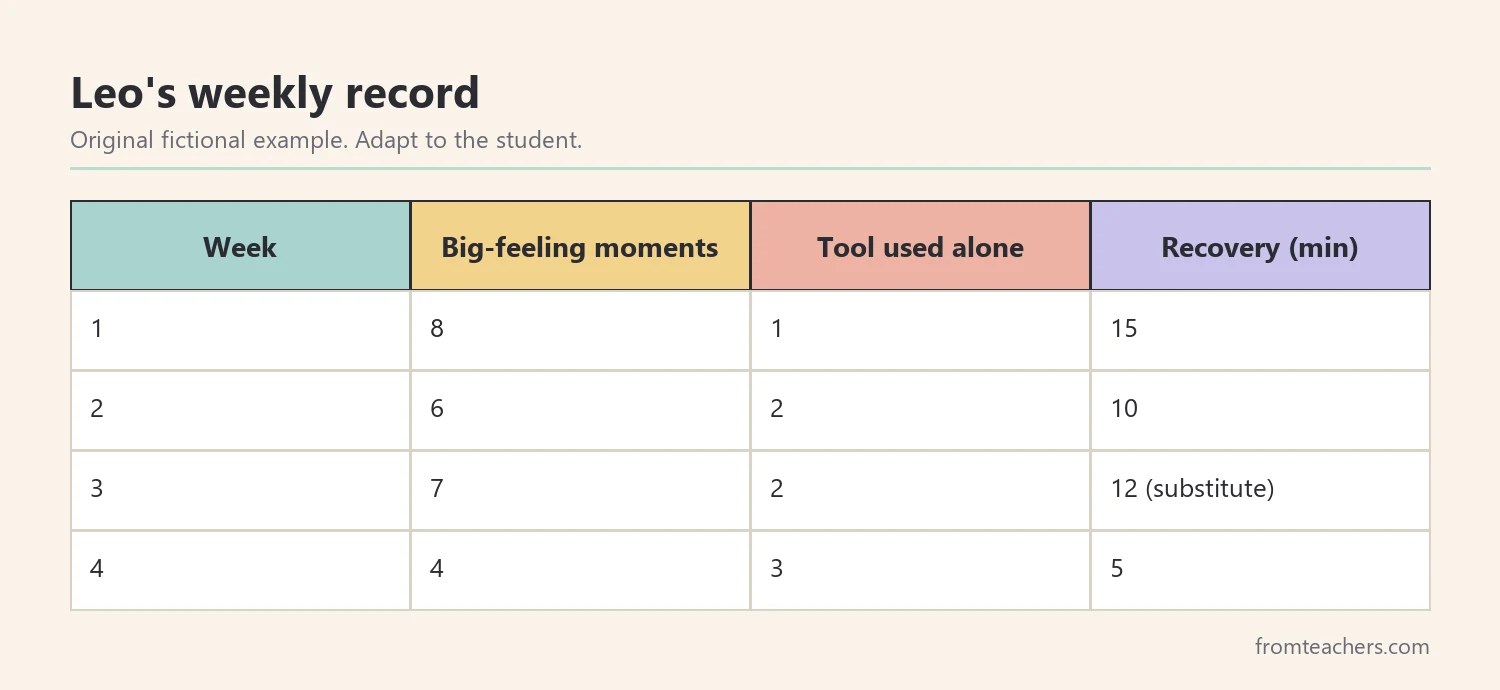
In Leo’s fictional record, big-feeling moments dropped from 8 in week 1 to 4 in week 4. Meanwhile, the times he used a tool on his own rose from 1 to 3, and his typical recovery time fell from about 15 minutes to about 5. A substitute teacher in week 3 explains the small bump that week, which is why the note column matters.
Then, review the data with the family and the child every three to four weeks. Ask what is working, what is not, and which one change to try next. Celebrate effort, not just results. A week with more big feelings is information, not failure.
If progress stalls, check the basics first. Are adults using the same routine? Is the child practicing tools while calm? Has something changed at home or in the schedule? Small adjustments often restart progress.
Common mistakes and how to avoid them
- Teaching tools in the middle of a meltdown. Fix: practice every tool while the child is calm, then use it during real moments.
- Offering too many choices. Emotional regulation for ADHD gets harder when the menu is long. Fix: start with three or four tools and add more only when those are used easily.
- Talking too much when the child is in red. Fix: use a few calm words or a picture card, and save the discussion for later.
- Treating every outburst as defiance. Fix: look at your notes for the feeling and the trigger underneath the behavior.
- Different rules at home and school. Fix: share the same check-in colors and reset routine with the family.
- Giving up after one hard week. Fix: look at the trend over a month, and use the note column to explain unusual weeks.
Questions teachers and parents ask about emotional regulation for ADHD
Why do children with ADHD seem to have bigger feelings?
Many children with ADHD find it harder to pause between a feeling and a reaction. The feeling may be the same size as a classmate’s, but the brakes engage later. Teaching skills and adjusting the environment helps them build that pause over time.
How long does it take to see progress?
Every child is different, and emotional regulation for ADHD develops at its own pace. Some show small changes within a few weeks, while others need several months of steady practice. Tracking a few numbers helps you see progress that is easy to miss day to day.
Can emotional regulation for ADHD strategies work for the whole class?
Yes. Check-ins, movement breaks, and breathing games benefit most students. Using them class-wide also means the child with ADHD does not feel singled out.
What should I do during a full meltdown?
Keep everyone safe, lower your voice, and reduce demands and noise. Do not teach or lecture in that moment. Once the child is calm, reconnect warmly and, later, review the reset routine together.
Should rewards be part of the plan?
Small rewards can help a child practice a new routine at first. Keep them specific, such as praise for using a tool on their own. Over time, aim for natural rewards like getting back to a favorite activity sooner.
Related reading: Understanding Autism ADHD Meltdowns: Signs and Support Strategies, Managing Sensory Overload: Practical Strategies for Autism and ADHD, and ADHD in Children: A Guide to Effective Classroom and Home Support.
A companion resource for emotional regulation for ADHD:
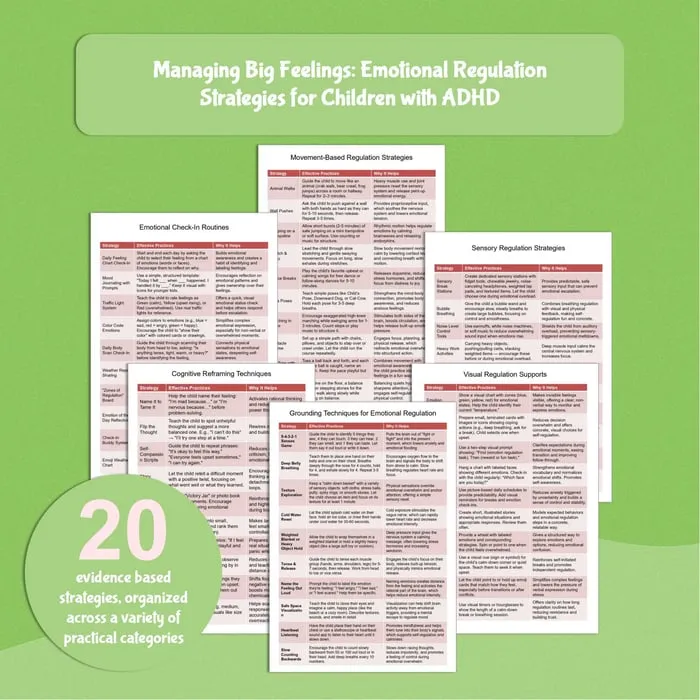
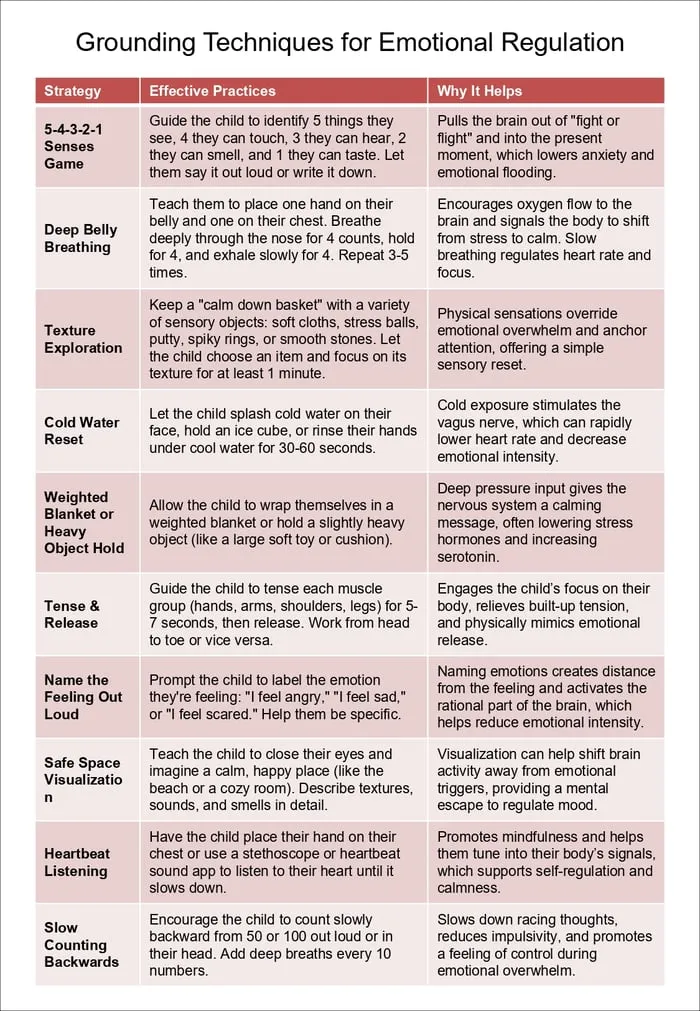
Managing Big Feelings: Emotional Regulation Strategies for Children with ADHD: a 20-page toolkit with check-in routines, movement, sensory, grounding, and cognitive reframing strategies, visual supports, and social-emotional ideas, each organized in Strategy, Effective Practices, and Why It Helps tables.
Sources and scope
- CDC ADHD information: general background on ADHD in children, including support at home and school.
- CHADD: a national organization with resources for families and educators of people with ADHD.
- CASEL: a widely used framework for social and emotional learning, including self-management.
- IRIS Center, Vanderbilt University: free modules on classroom behavior and evidence-based practices.
- Understood.org: practical articles for families and teachers on ADHD and learning differences.
This guide covers everyday classroom and home strategies for emotional regulation for ADHD. It does not cover diagnosis, medication, or therapy, which belong to qualified professionals and the child’s team.
Key takeaways
- Emotional regulation for ADHD starts with noticing when big feelings happen.
- A one-minute daily check-in builds the words a child needs before hard moments.
- Practice movement, sensory, and grounding tools while calm, then use them in real moments.
- One consistent reset routine, shared by every adult, makes emotional regulation for ADHD easier to practice.
- Track a few numbers and review them with the family every few weeks.










Leave a Comment