

AAC learning goals give a student’s communication plan a clear direction, so every adult knows what to model and what to celebrate. Without them, a talker or communication board can sit on the desk all morning while adults guess what the student is supposed to be practicing.
This guide walks you through setting, teaching, and tracking goals for a student who uses augmentative and alternative communication (AAC). By the end, you will be able to describe current skills, write a clear goal, plan daily practice, align the team, and review progress with simple data.
Examples are fictional. Adapt to the student’s goals and agreed supports. This is guidance, not a diagnosis.
At a glance
- Start from what the student already communicates, in any form.
- Write goals around a few useful words and real reasons to communicate.
- Build practice into daily activities and model on the device yourself.
- Put every adult on one shared plan with the same targets.
- Track a few simple numbers and review them with the team and family.
1. Describe current communication before setting AAC learning goals
Good goals start with an honest picture of today. Communication includes far more than words. Pointing, looking, gestures, sounds, pulling an adult’s hand, and pressing buttons all count.
First, observe across settings for a week or so. Note how the student asks for things, refuses, gets attention, comments, and asks for help. Write down what the student does, not what you think it means.
Next, look at the AAC system itself. Which words or symbols does the student touch on their own? Which ones only with a prompt? Are there words the student seems to understand but never uses yet?
Also, ask the family. Parents often see communication at home that never appears at school, such as a special sound for “more” or a gesture for “all done.”
Consider Maya, a fictional grade 2 student who uses a tablet-based AAC app. Her teacher, Mr. Delgado, and the speech-language pathologist observe for a week. They see that Maya pulls adults toward snacks, pushes away unwanted items, and touches “more” on her device when prompted. She rarely uses the device to refuse or to comment.
This snapshot already points toward useful AAC learning goals. Maya can request with support, so the team can build on that. Refusing with the device would give her a safer, clearer option than pushing things away, so that becomes a strong candidate for her first goal.
Write the snapshot in plain language and date it. Months later, it becomes the baseline that shows how far the student has come, and it keeps new AAC learning goals tied to real observations instead of guesses.
| Reason to communicate | What Maya does now | With device? |
|---|---|---|
| Request | Pulls adult, touches “more” | With prompt |
| Refuse | Pushes item away | Not yet |
| Get attention | Vocalizes, taps arm | Not yet |
| Comment | Smiles, points | Not yet |
2. Write clear AAC learning goals
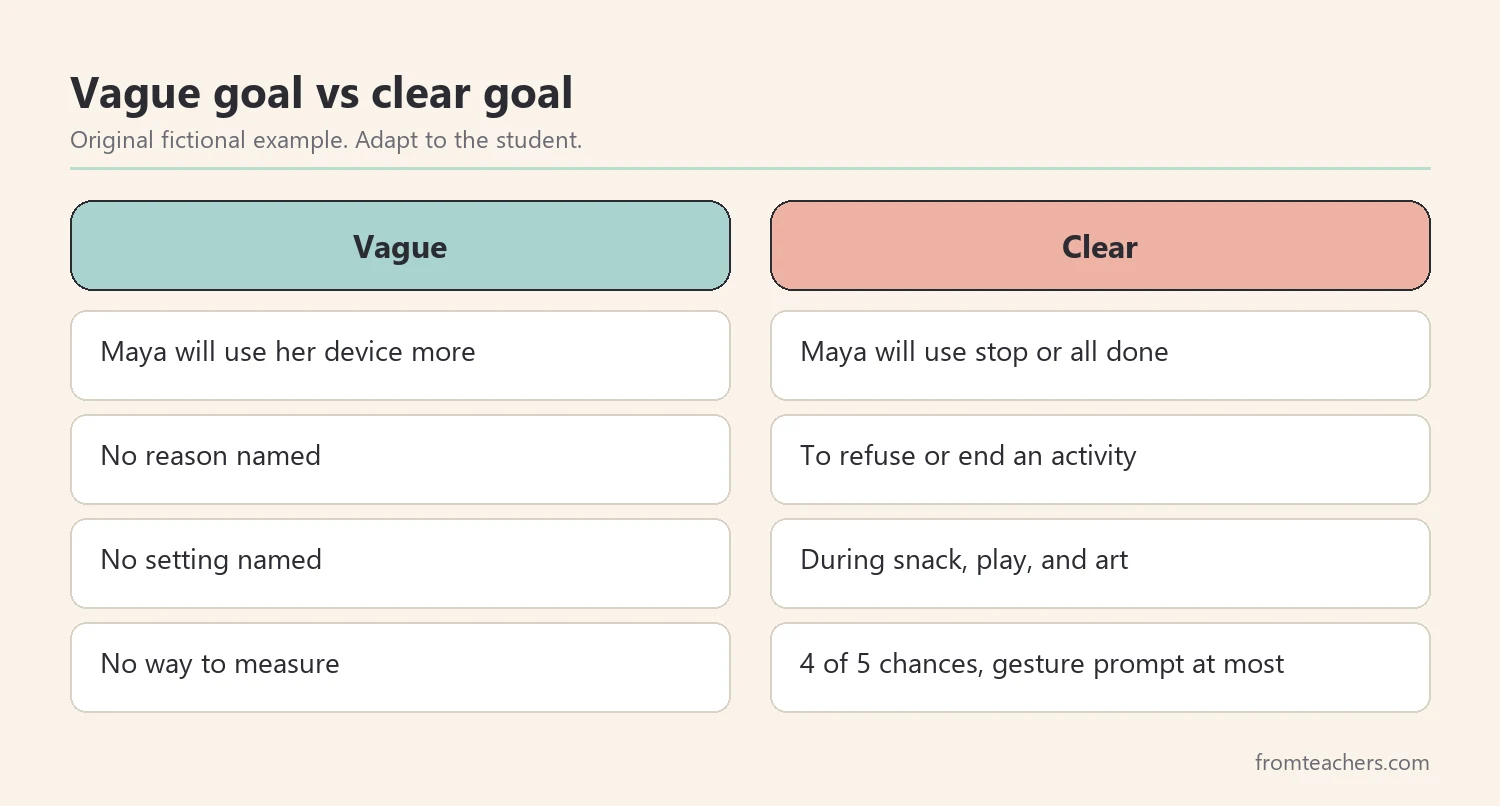
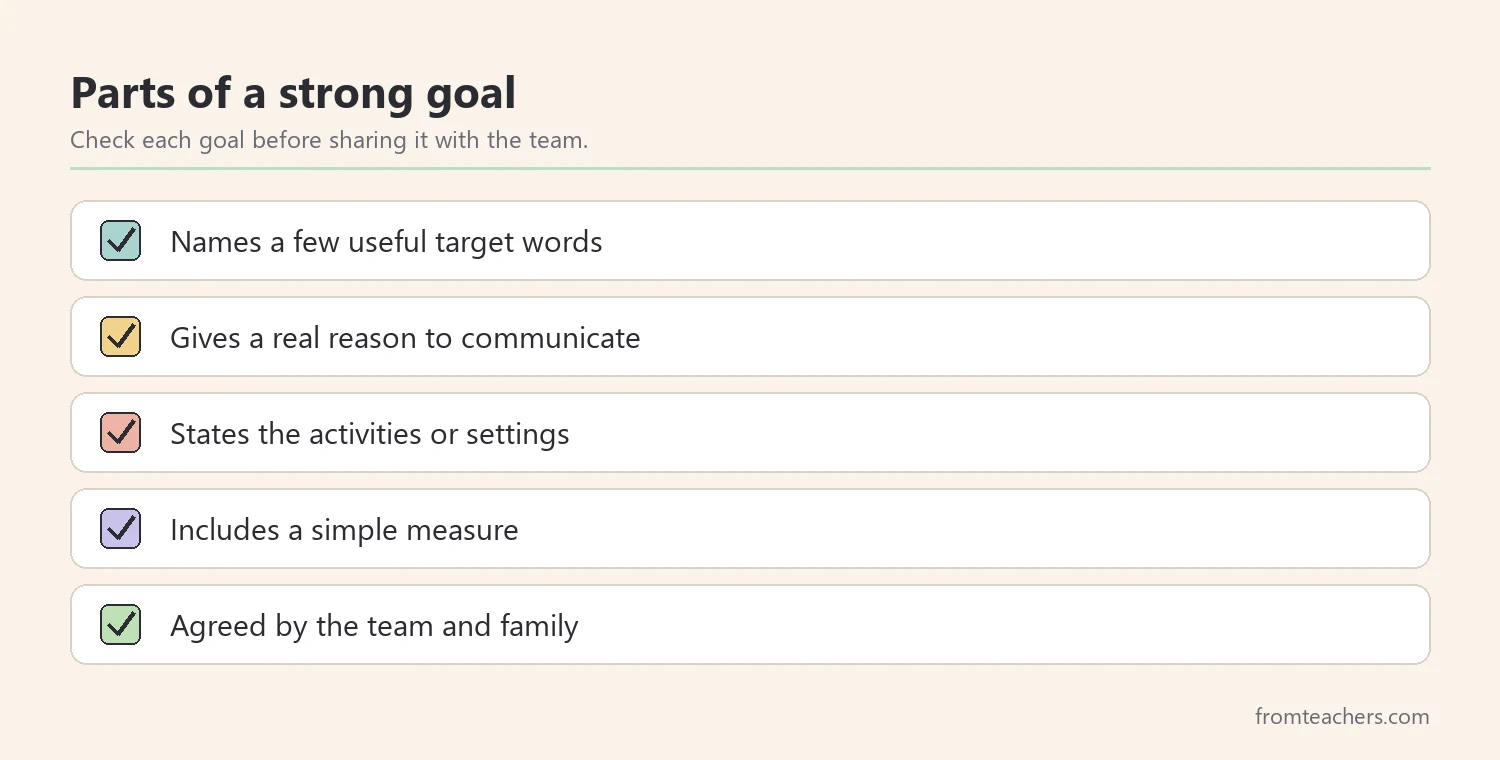
Now turn what you saw into a few focused goals. Strong AAC learning goals name a small set of useful words, a reason to use them, the setting, and how you will know the goal is met.
Start with core words. These are short, flexible words like “more,” “stop,” “go,” “help,” “want,” and “all done” that work in many activities. They often give a student more power than a long list of nouns.
Then, attach each word to a real reason to communicate. “Use ‘stop’ to end an activity” is more meaningful than “touch the stop symbol.” Finally, add a simple measure so the team can agree on progress.
Keep the list short. Two or three AAC learning goals at a time are easier to model consistently than ten.
In addition, check that each goal is about communication, not about operating the device. “Navigate to the food page” is a skill, but it is not a reason to talk. AAC learning goals should describe what the student can say and why it matters to them.
For Maya, the team writes this goal: “During snack, play, and art, Maya will use ‘stop’ or ‘all done’ on her device to refuse or end an activity in 4 of 5 opportunities, with no more than a gestural prompt.” It names the words, the reason, the settings, and the measure.
3. Plan daily activities for AAC learning goals
Goals grow through practice in real moments, not only in therapy sessions. The plan should name where and when each target word will be practiced during a normal day.
List the routines that already happen: arrival, snack, play, art, music, recess, and dismissal. Then, pick two or three activities where each target word fits naturally. “Stop” fits a bubble game or a swing. “All done” fits snack and art.
Write down the timing, how often, and the method for each. For example, “Snack, daily, 10 minutes, adult models ‘more’ and ‘all done’ on the device before offering food.” This turns a goal into a schedule people can follow.
Similarly, plan for the moments that are not on the schedule. Hallways, recess, and transitions are full of chances to model “go,” “stop,” and “help.” When adults see AAC learning goals as part of the whole day, practice adds up quickly.
A shared template helps here. An individual student communication and learning plan template includes a communication activities overview with activity, timing, frequency, and method, plus a section for AAC targets and target messages, so the plan lives in one document.
| Activity | Timing | Target words | Method |
|---|---|---|---|
| Snack | Daily, 10 min | more, all done | Model, then pause |
| Bubble play | 3 times a week | stop, go | Pause the game |
| Art | 2 times a week | help, all done | Offer a hard task |
4. Model and respond the same way every time
Students learn AAC the way all children learn language: by seeing others use it. Modeling means an adult touches words on the student’s device or a matching board while speaking, without requiring the student to copy.
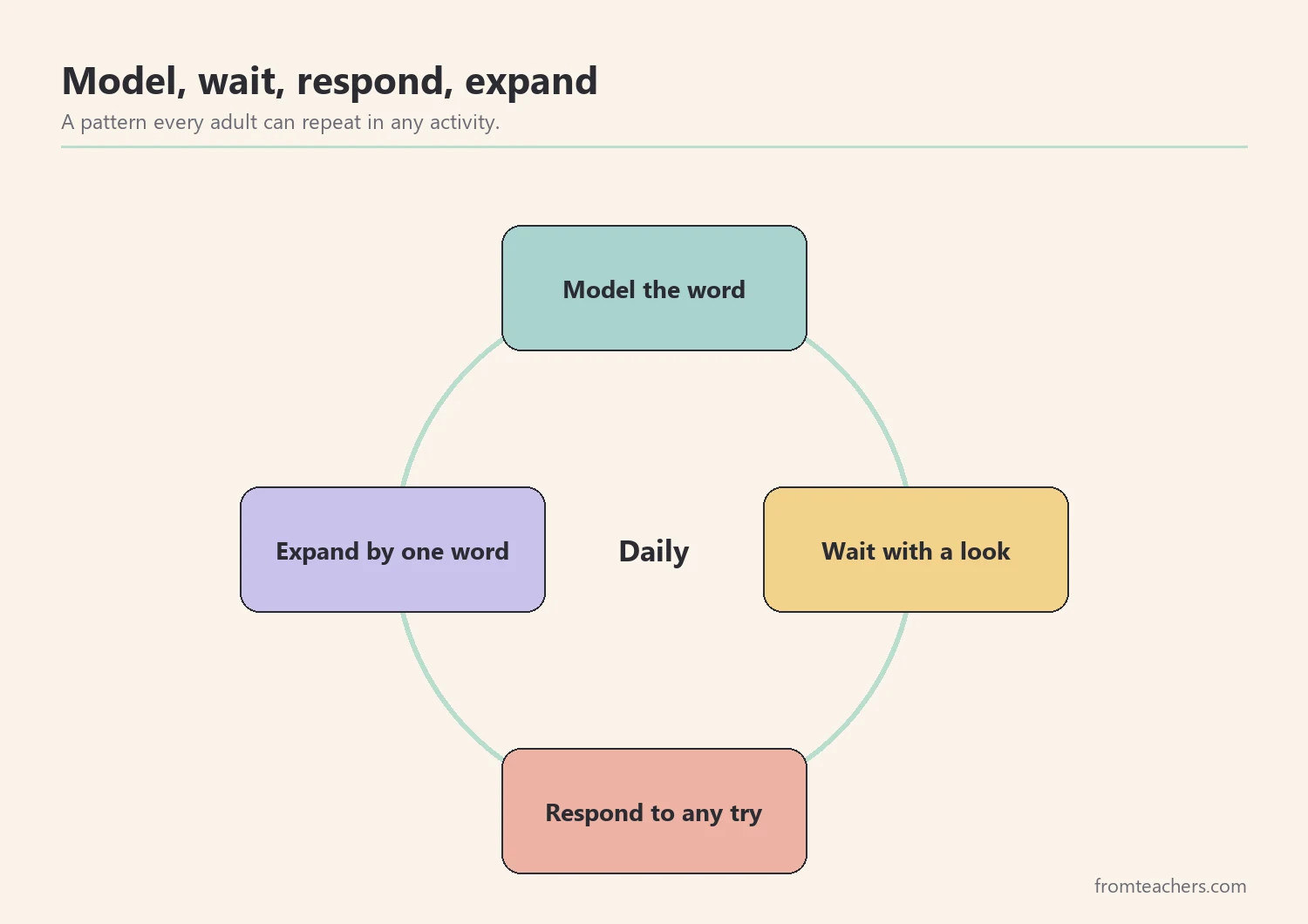
Use a short, repeatable pattern. Model the word in context, wait several seconds with an expectant look, respond to any communication attempt, and then expand by adding one word. For example, if the student touches “more,” you might say and touch “more bubbles.”
Moreover, honor what the student says. If Maya touches “stop,” stop the activity, even if you think she was only exploring. Honoring the message teaches that the device is powerful.
Avoid testing questions like “What color is this?” over and over. Instead, create real reasons to talk: pause a fun game, offer a tricky lid, or “forget” a needed item.
Mr. Delgado pauses the bubble wand mid-game and waits. Maya looks at him, then at her device. After about five seconds, she touches “go.” He immediately blows bubbles and models “go, go, go” on her device.
Modeling feels slow at first, and that is normal. Adults often model many times before a student uses a word on their own. Keep going, because steady modeling is how AAC learning goals turn into real, independent communication.
5. Put every adult on the same plan
AAC learning goals work best when everyone who supports the student follows the same plan. If the teacher models “all done” but the aide says “finished” without the device, the student gets mixed messages.
First, share a one-page summary of the goals, target words, and modeling pattern with all staff, including specials teachers and lunch supervisors. Keep it near the student’s device or in a shared folder.
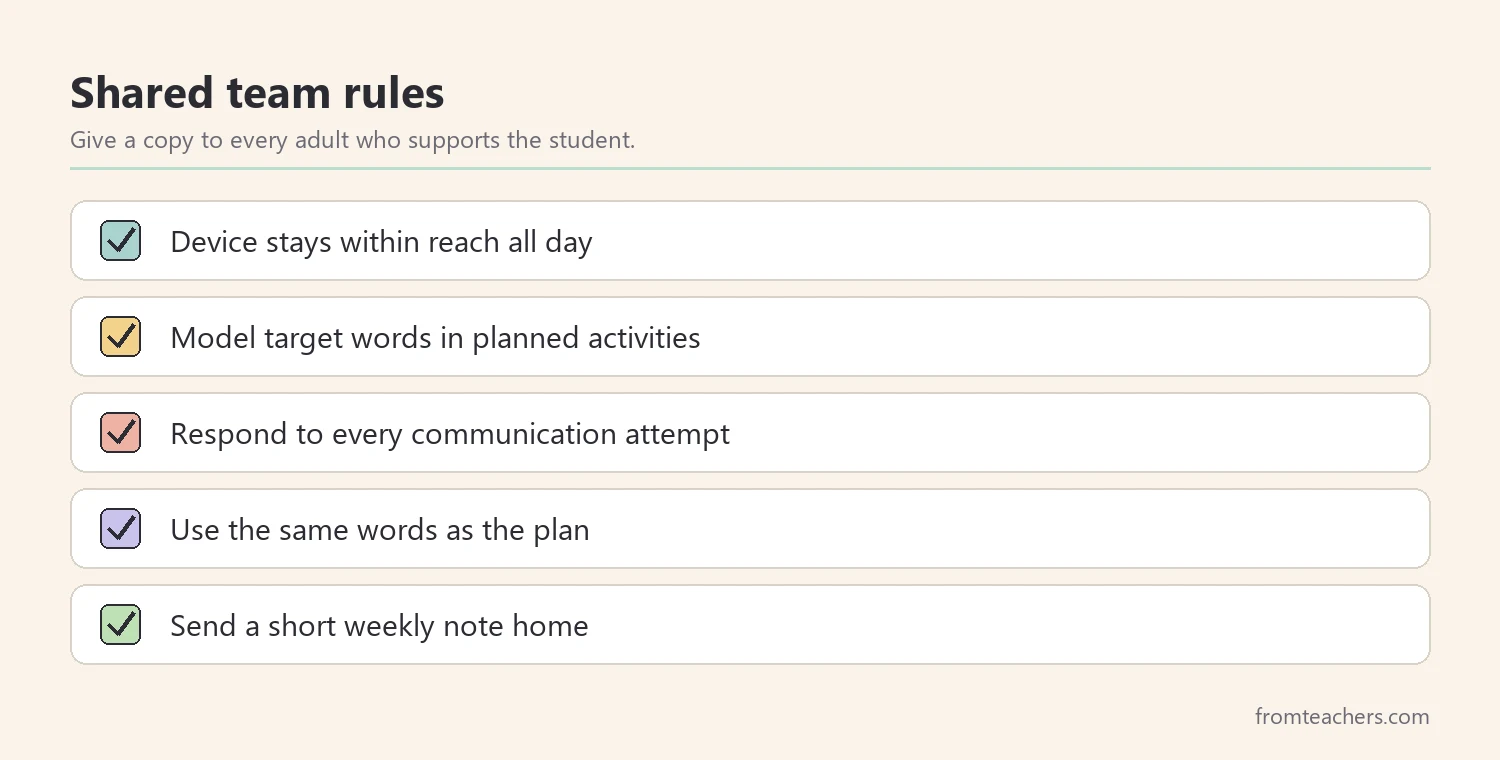
Then, agree on simple rules. The device stays within reach all day. Adults model target words in planned activities. Any communication attempt gets a response. These rules matter more than any single strategy.
Also, include the family. Share the target words and invite parents to model them at home during meals or play. A short weekly note works well, and it keeps AAC learning goals visible outside school too.
The team gives Maya’s aide and her art teacher a one-page plan. The plan includes a signature section for the parent, teacher, and student, so everyone sees that they agreed to the same targets.
6. Track and review AAC learning goals
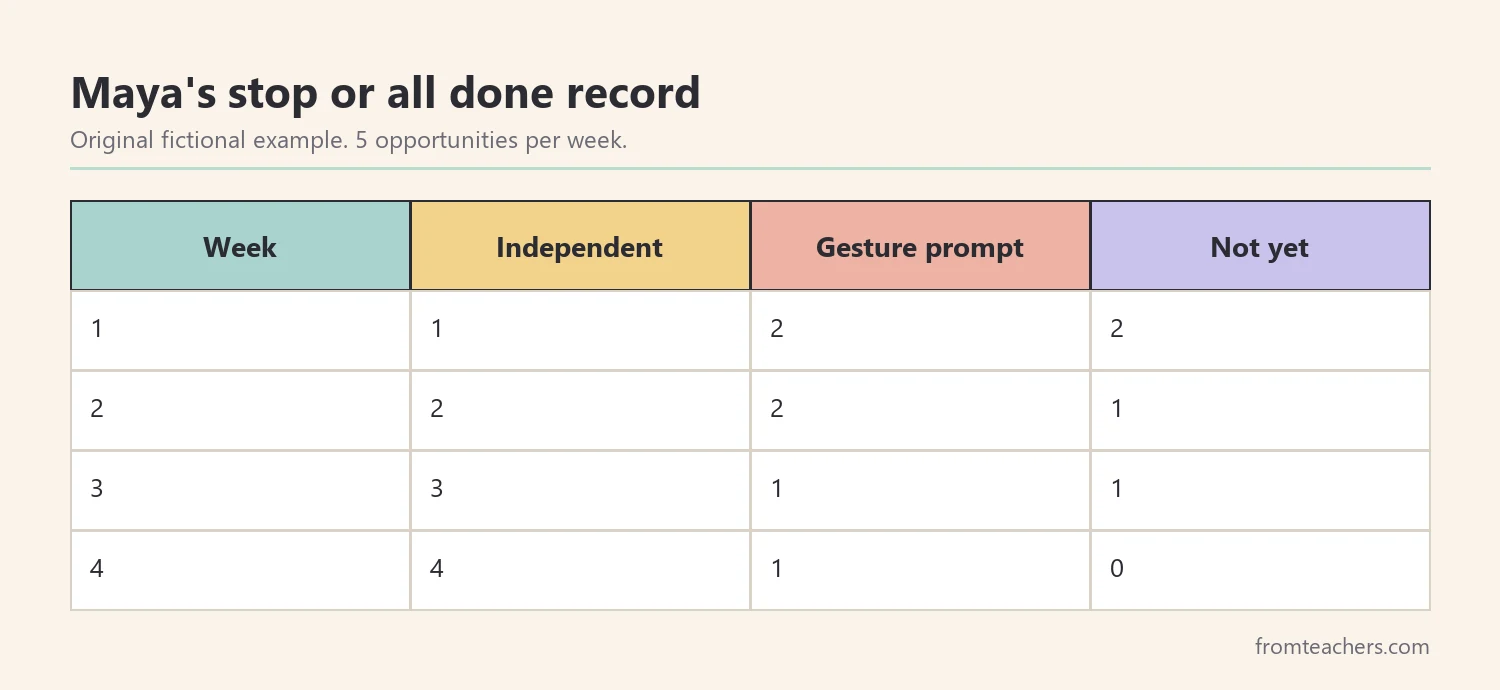
Simple data shows whether practice is working. You do not need a complex system. For each target, count opportunities and how the student responded: on their own, with a gesture prompt, or not yet.
Collect data during the planned activities only, a few times a week. Then, review the numbers every three or four weeks with the team and family. Look for growth, stalls, and activities where the student communicates most.
Include the student’s view when you can. A simple comfort scale, such as happy, okay, or not sure, can show how the student feels about using the device in different settings.
Over four weeks, the team tracks Maya’s use of “stop” or “all done” in 5 planned opportunities per week. Her independent uses rise from 1 of 5 in week 1 to 4 of 5 in week 4. In week 4, she also needed a gesture prompt once, so 4 independent plus 1 prompted equals all 5 opportunities.
When a goal is met for a few weeks in a row, add a new word or a new reason to communicate. When progress stalls, change one thing, such as more modeling or a new activity, before rewriting the goal.
Finally, write a short reflection at each review. Note what worked, what did not, and what the team will try next. Over a term, these notes become a useful story of the student’s growth that you can share at meetings and pass on to next year’s team.
Common mistakes and how to avoid them
- Writing too many goals at once. Fix: choose two or three, and add more as each one grows.
- Targeting only nouns. Fix: start with core words that work across many activities.
- Keeping the device out of reach. Fix: make “device within reach all day” a team rule.
- Requiring the student to copy every model. Fix: model freely and let the student respond when ready.
- Ignoring messages adults did not expect. Fix: honor every communication attempt, then teach.
- Collecting data no one reviews. Fix: schedule a short review every few weeks.
Questions teachers and parents ask about AAC learning goals
How many AAC learning goals should a student have?
Usually two or three active goals are enough. A short list makes modeling consistent and data simple. Add new goals as earlier ones become steady.
Should goals focus on core words or specific vocabulary?
Core words are often a strong starting point because they work in many settings. Add personal words, like favorite foods or people’s names, that matter to the student. A mix keeps communication both flexible and meaningful.
Will using AAC stop my child from talking?
This is a common worry. Organizations such as ASHA describe AAC as a support for communication, not a replacement for speech. Talk with your child’s speech-language pathologist about your specific questions.
Who should write AAC learning goals?
Goals are best written by the team together: the teacher, the speech-language pathologist, support staff, and the family. Each person sees different moments, and shared goals are easier to follow.
How do we know when to change a goal?
Change it when the student meets it consistently for a few weeks, or when data shows no progress after you have adjusted practice. Review the record together before deciding, and update AAC learning goals in the shared plan so every adult sees the change.
Related reading: Boost Access and Independence: An Assistive Technology Toolkit for Special Education, How Parents and Teachers Can Team Up for Special Education Success, and The Power of Data Tracking in Special Education.
A companion resource for AAC learning goals:
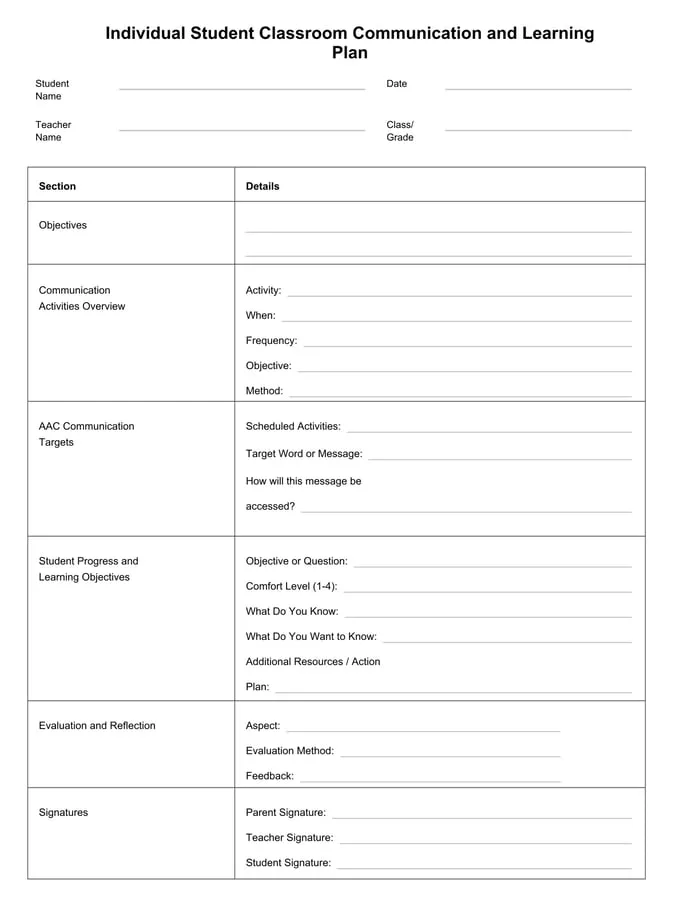
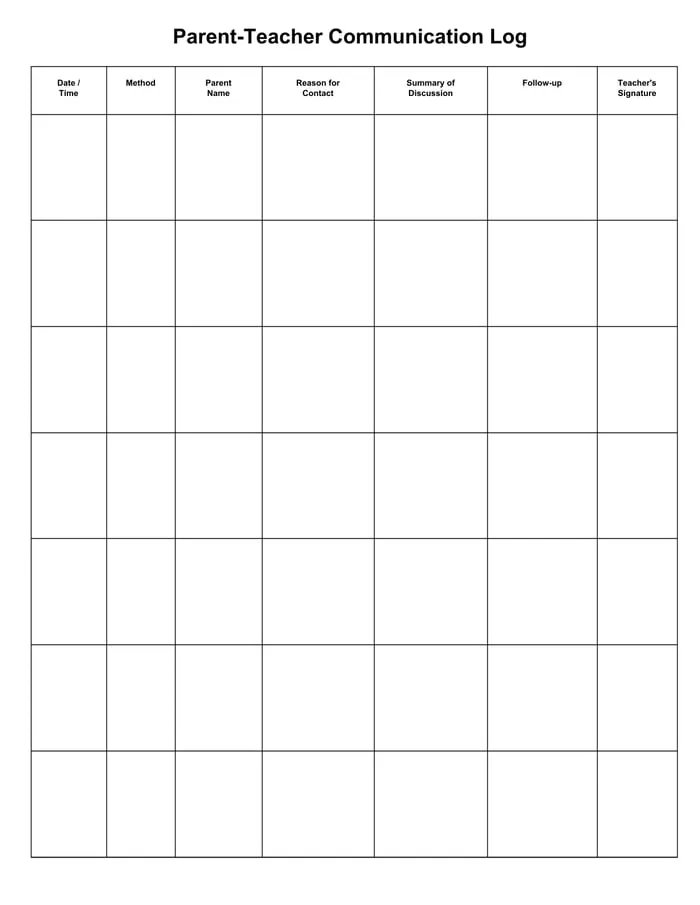
Individual Student Communication and Learning Plan: a fillable PDF template with sections for objectives, communication activities, AAC targets, learning progress with a comfort scale, evaluation and reflection, and parent, teacher, and student signatures.
Sources and scope
- American Speech-Language-Hearing Association (ASHA): professional information on AAC and communication supports.
- IRIS Center, Vanderbilt University: free modules on evidence-based practices and progress monitoring.
- IDEA, U.S. Department of Education: the law behind special education services, IEPs, and assistive technology.
- Understood.org: practical articles for families and teachers on learning and communication differences.
This guide covers everyday planning, modeling, and tracking for students who use AAC. It does not cover device selection, formal AAC evaluation, or writing legal IEP goals, which belong to the speech-language pathologist and the student’s team.
Key takeaways
- Base AAC learning goals on what the student already communicates.
- Name the words, the reason, the setting, and the measure in each goal.
- Practice AAC learning goals in daily routines with a model, wait, respond, expand pattern.
- Keep every adult and the family on one shared plan.
- Track simple numbers and review them every few weeks.









Leave a Comment