

Executive function challenges often show up as a crumpled worksheet at the bottom of a backpack, found two days after it was due. The student did the work. They simply could not find it, remember it, or turn it in at the right moment. Then the cycle repeats, and frustration grows on all sides.
This guide gives you a five-step process for organization and planning at school and home. You will learn how to spot the exact breakdown, set up simple systems for materials, teach time estimation, build a weekly planning routine, and respond to setbacks in a way that builds skills instead of shame. By the end, you will have a short, workable plan.
Examples are fictional. Adapt to the student’s goals and agreed supports. This is guidance, not a diagnosis.
At a glance
- Find the exact point where organization breaks down.
- Give every material one home and one daily reset.
- Teach students to estimate time and compare it with reality.
- Plan the week together, then check in briefly each day.
- Treat setbacks as information, not as character flaws.
1. Pinpoint the executive function challenges behind the problem
“He is just disorganized” is not something you can fix. Instead, look for the specific moment where things fall apart. Executive function challenges can affect remembering, starting, planning, time sense, or keeping track of materials. Each one needs a different support.
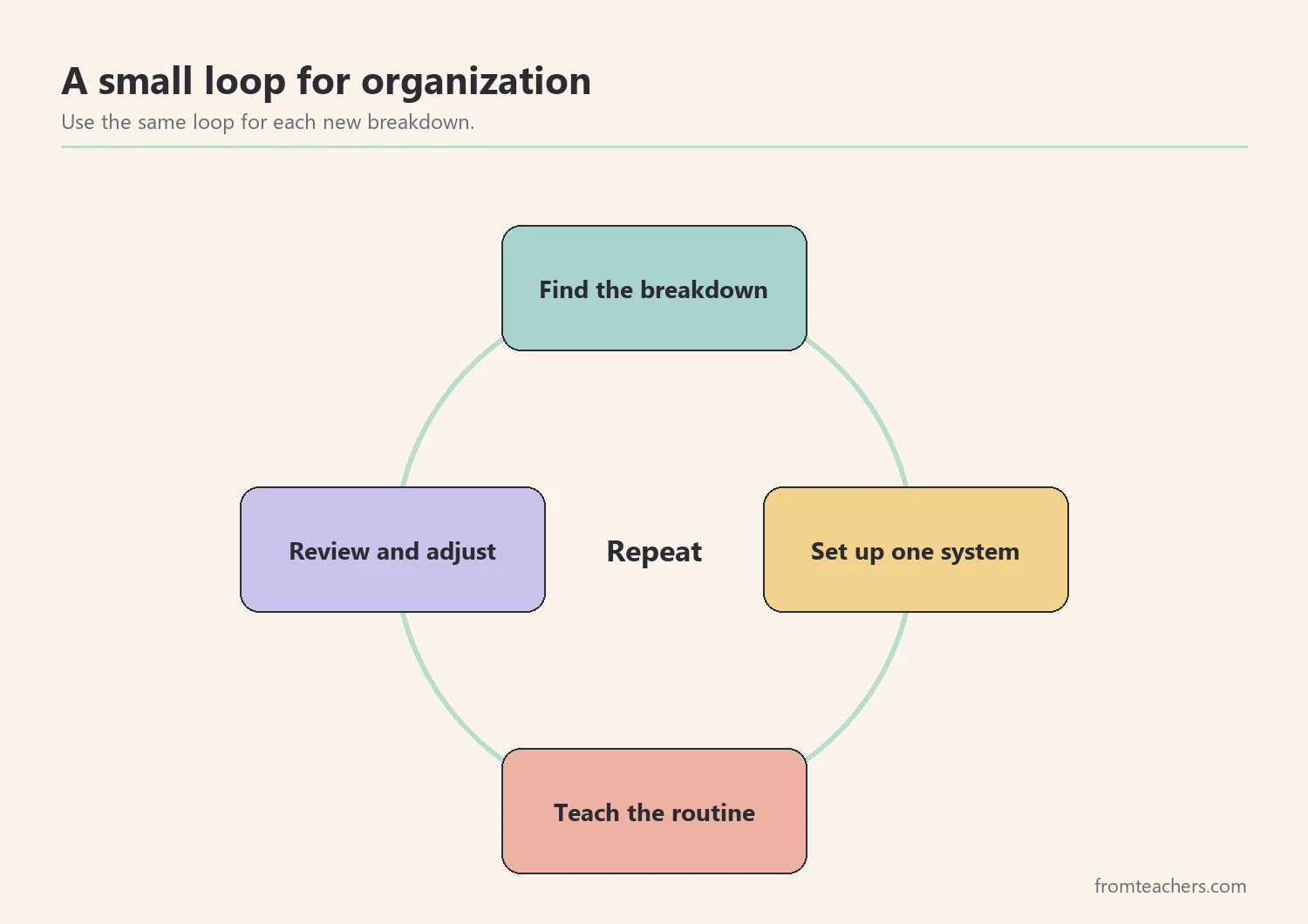
To begin, follow one assignment from start to finish. Was it written down? Did it get into the right folder? Did the student start it at home? Did it come back to school? Was it handed in? The first “no” in that chain is your starting point.
For example, meet Leo, a fictional seventh grader. His teachers said he misses many assignments. When his family and teacher traced a few, they found something surprising. Leo usually finished the work at home. However, the pages stayed loose in his backpack and never reached the right teacher.
| Step in the chain | Did it happen? |
|---|---|
| Assignment written down | Usually |
| Work started at home | Usually |
| Work finished | Usually |
| Work packed in the right folder | Rarely |
| Work turned in | Rarely |
Because of this, the team stopped focusing on homework effort and started focusing on materials. That small shift saved weeks of the wrong kind of help. In short, naming the real breakdown is the most useful first move with executive function challenges.
Put this step into practice
Additionally, ask the student. Many students can tell you exactly where things go wrong if you ask on a calm day, without blame. Leo said, “I finish it, then I forget which folder it goes in.” That one sentence confirmed what the adults had traced and gave Leo a voice in the plan from the start.
In addition, keep your notes short and shared. A single page listing the breakdown, the planned support, and who will check it is enough. When everyone reads the same page, executive function challenges stop being a vague complaint and become a clear target the team can work on together.
2. Give every material one home
Many students with executive function challenges lose things because nothing has a fixed place. Every paper ends up wherever it lands. Therefore, the next step is making homes for materials and keeping them simple.
For example, start with fewer containers, not more. One binder or accordion folder with a pocket for each subject is often easier than five separate folders. Add one bright “to turn in” pocket at the front. Then, label everything clearly with words the student uses.
Next, build a short daily reset. At the end of the last class, the student takes two minutes to put loose papers into the right pockets. At home, a similar two-minute reset happens before bed. Keep the steps the same every day so they become automatic.
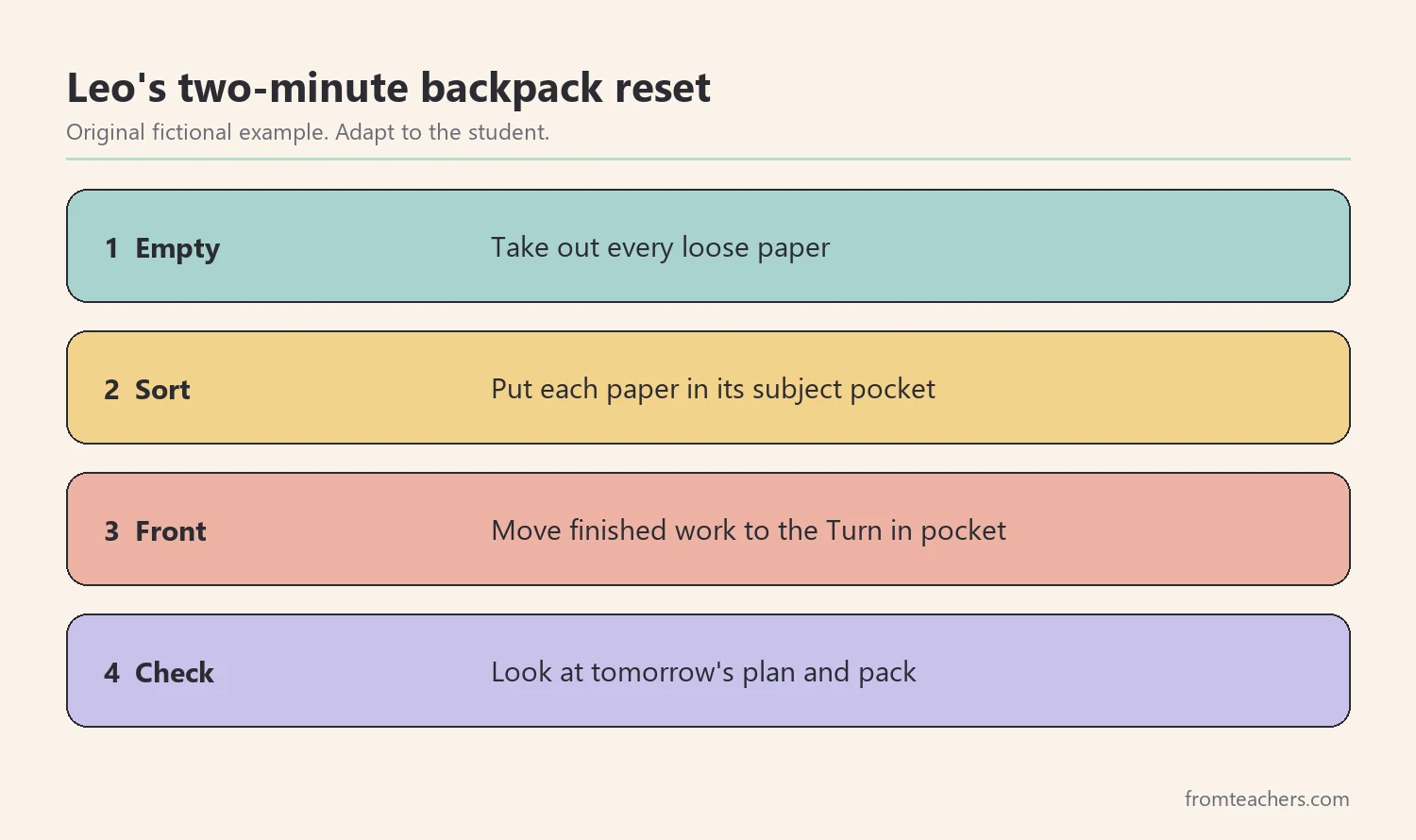
For Leo, the team replaced his five loose folders with one accordion folder. The front pocket was bright orange and labeled “Turn in.” His homeroom teacher gave a quiet cue for the reset at the end of each day for the first two weeks. After that, Leo started the reset himself on most days.
Also, check the reset briefly at first. A quick look at the folder on Fridays helps catch problems early. Over time, fade the checks as the habit grows stronger.
Beyond materials, think about the classroom itself. A clearly marked tray for finished work, a posted daily agenda, and a consistent spot for handouts all reduce the load on memory. These whole-class supports help students with executive function challenges without singling anyone out, and they often help the rest of the class too.
3. Teach time estimation for executive function challenges
Many students guess that homework will take ten minutes, then feel shocked when it takes forty. Poor time sense is one of the most common executive function challenges, and it quietly wrecks plans. Fortunately, time estimation can be taught and practiced.
In short, the method is simple. Before a task, the student writes down how long they think it will take. Afterward, they write down how long it actually took. Then, they look at the difference. Over a few weeks, most students start to notice patterns, such as always underestimating math.
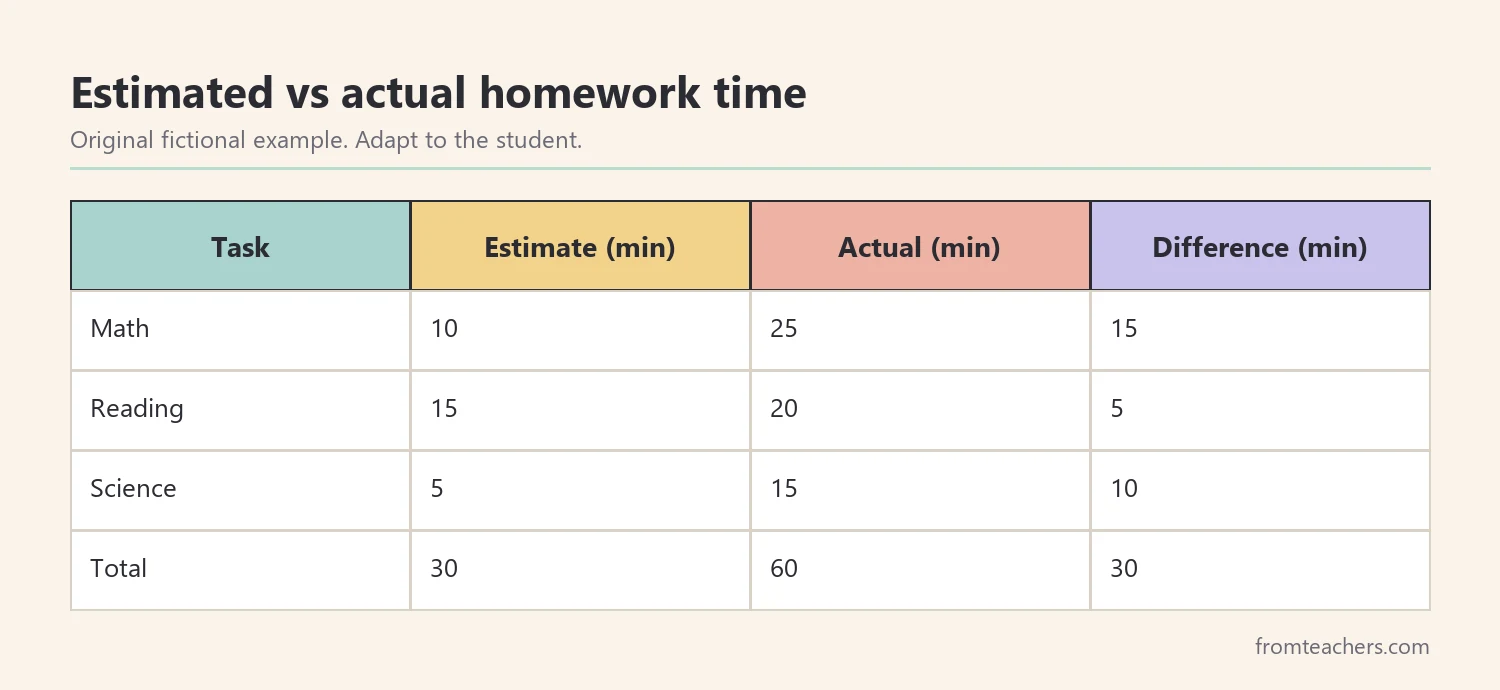
For Leo, one evening looked like this. He estimated 10 minutes for math, and it took 25, a difference of 15 minutes. He estimated 15 minutes for reading, and it took 20, a difference of 5. He estimated 5 minutes for science, and it took 15, a difference of 10. Altogether, he planned 30 minutes but needed 60.
A quick classroom example
Seeing that gap in his own handwriting helped more than any lecture. Leo started adding extra time to math plans without being reminded. In addition, a visual timer on his desk helped him feel how long 15 minutes really is.
Also, try the same idea at school. Before independent work, ask students to write a quick guess of how many minutes the task will take. At the end, they record the real time. Over several weeks, this short habit builds time sense for students with executive function challenges and gives the whole class useful practice.
When you need ready-made situations to discuss, the executive function organization and planning tables include a page on correcting a poor time estimate, alongside other real moments like a missing assignment or a lost schedule. Each page gives clear, practical steps.
4. Build a weekly planning routine
Daily systems keep materials in order. However, students also need a bigger picture of the week. A short weekly planning session helps students with executive function challenges see what is coming before it becomes urgent.
To start, pick a regular time, such as Sunday evening or Monday morning. Then, sit together for about fifteen minutes. First, list every due date and test for the week. Second, break big tasks into smaller pieces and place them on specific days. Third, mark any busy evenings, such as practices or family events, so the plan stays realistic.
| Day | Plan | Busy? |
|---|---|---|
| Monday | Read chapter 4, math page | No |
| Tuesday | Science notes only | Soccer practice |
| Wednesday | Start project outline | No |
| Thursday | Study for quiz | No |
During the session, let the student do as much of the writing as possible. Adults can ask guiding questions, such as “What is due first?” or “Which evening looks busiest?” Asking instead of telling builds the planning skill itself, not just a neat page.
After that, keep the planner simple. A paper planner, a whiteboard, or a basic calendar app can all work. The best tool is the one the student actually opens. Meanwhile, a daily two-minute check, like “What is on today’s plan?”, keeps the weekly plan alive.
Make it stick
Leo’s family chose Sunday evenings. At first, his parent led the session. After a month, Leo filled in the due dates himself and asked for help only with breaking down big projects. That gradual handoff is the real goal.
Moreover, connect school and home planning. If the teacher posts due dates in one place each week, families can copy them into the home planner in minutes. When the two calendars match, students with executive function challenges spend less energy figuring out what is due and more energy actually doing the work.
5. Respond to setbacks and review progress
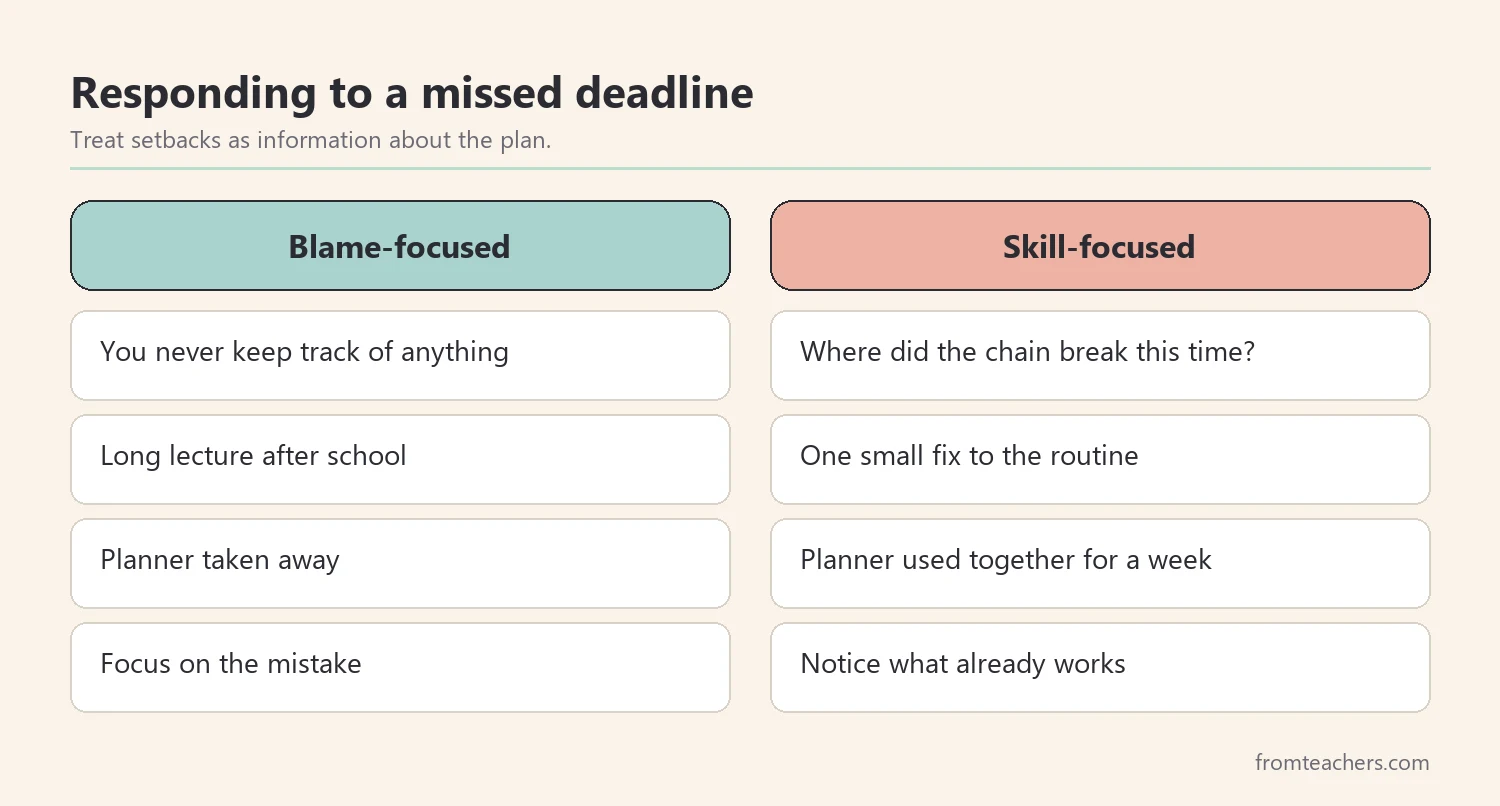
Even with good systems, things will still go wrong. A deadline gets missed. The folder gets messy again. How adults respond in those moments shapes whether the student keeps trying. Because executive function challenges are about skills, not character, setbacks are a chance to adjust the plan.
When a setback happens, stay calm and curious. Ask, “Where did the chain break this time?” Then, make one small fix. For example, if the same packing mistake repeats, add one step to the reset checklist. Avoid long lectures or taking away the planner as a punishment.
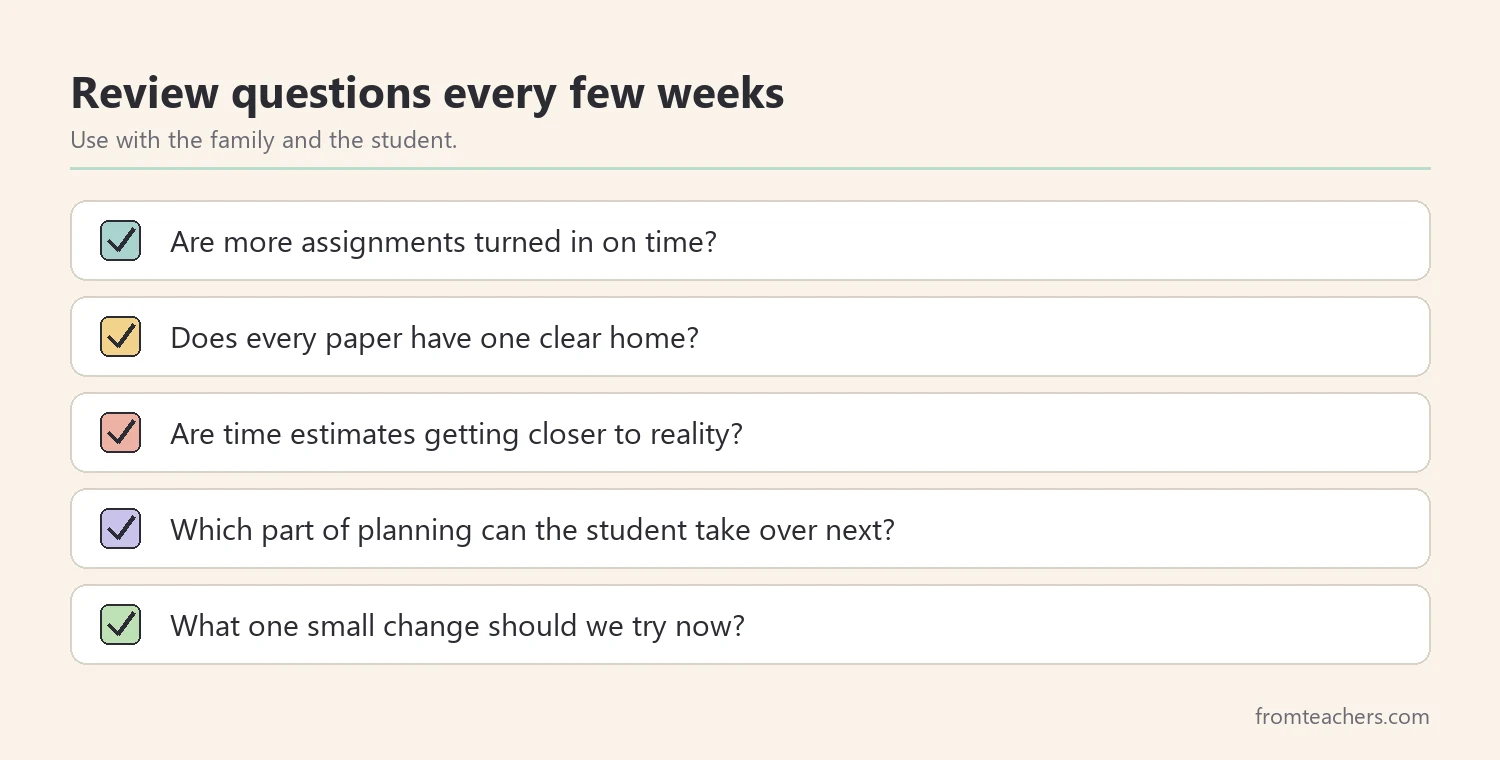
Next, review progress every few weeks. Keep one simple measure, such as the number of assignments turned in on time each week. Leo turned in 4 of 10 assignments on time in the first week of the plan. By the fourth week, he turned in 8 of 10. The team shared the numbers with Leo, who was proud to see the change.
Above all, keep the numbers honest and simple. A week with 6 of 10 after a week with 8 of 10 is not failure; it is a signal to look for what changed, such as a substitute teacher or a busy sports week. Talk about it with the student and adjust one part of the routine.
What this looks like day to day
Finally, celebrate what works. Noticing a well-planned week out loud helps the student connect effort with results. That positive link is what keeps new habits going long after adults step back.
Also, expect some slipping during busy seasons, such as the start of a new term or the weeks before holidays. Plan a short reset session at those times instead of waiting for things to fall apart. Executive function challenges rarely disappear completely, but steady routines make them much easier to manage.
Common mistakes and how to avoid them
- Too many folders and tools. Fix: start with one binder or folder and one planner.
- Fixing the wrong step. Fix: trace one assignment from start to finish to find the real breakdown.
- Planning without real time estimates. Fix: compare estimated and actual minutes for a few weeks.
- Adults doing all the planning. Fix: hand over one part of the weekly plan at a time.
- Punishing setbacks. Fix: ask where the chain broke and make one small change.
- Checking forever. Fix: fade adult checks as the student’s routine becomes steady.
Questions teachers and parents ask about executive function challenges
What are executive function challenges?
They are difficulties with skills such as planning, organizing, starting tasks, managing time, and remembering steps. They can affect any student, and they are common in students with ADHD and some learning differences. A qualified professional can assess them if there are concerns.
Are executive function challenges a sign of laziness?
No. Students who struggle with these skills often care a great deal and work hard. The difficulty is in managing the work, not in wanting to do it.
Should parents organize the backpack for their child?
Doing it for the child can help in a crisis, but it does not build the skill. Instead, guide a short reset with the child and slowly step back. The goal is independence over time.
Which planner works best?
The best planner is the one the student will actually use. Some prefer paper, others prefer a simple app. Keep it simple and check it together briefly each day at first.
How long until we see progress?
It varies by student. Many families notice small changes within a few weeks of consistent routines. Tracking one measure, like assignments turned in, helps you see progress clearly.
Related reading: ADHD in Children: A Guide to Effective Classroom and Home Support, 5 Practical Teaching Tips to Boost Classroom Focus and Learning, and How Parents and Teachers Can Team Up for Special Education Success.
A companion resource for executive function challenges:
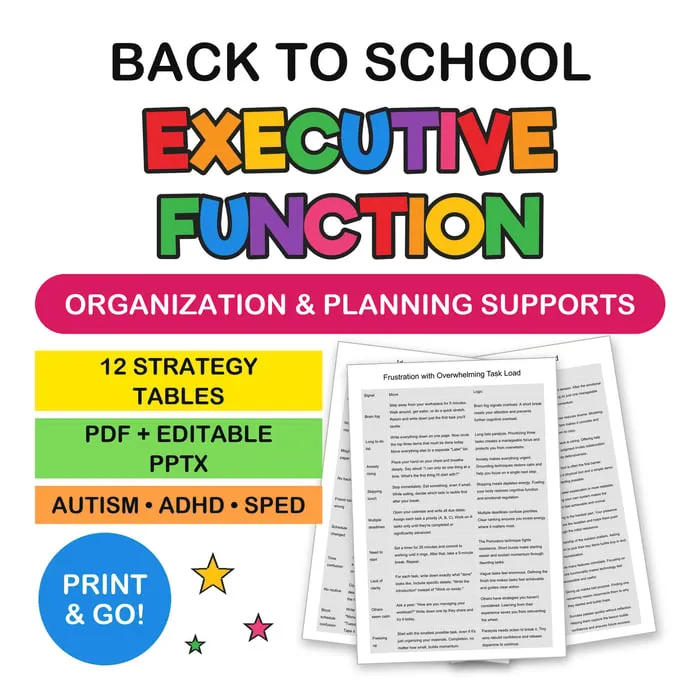
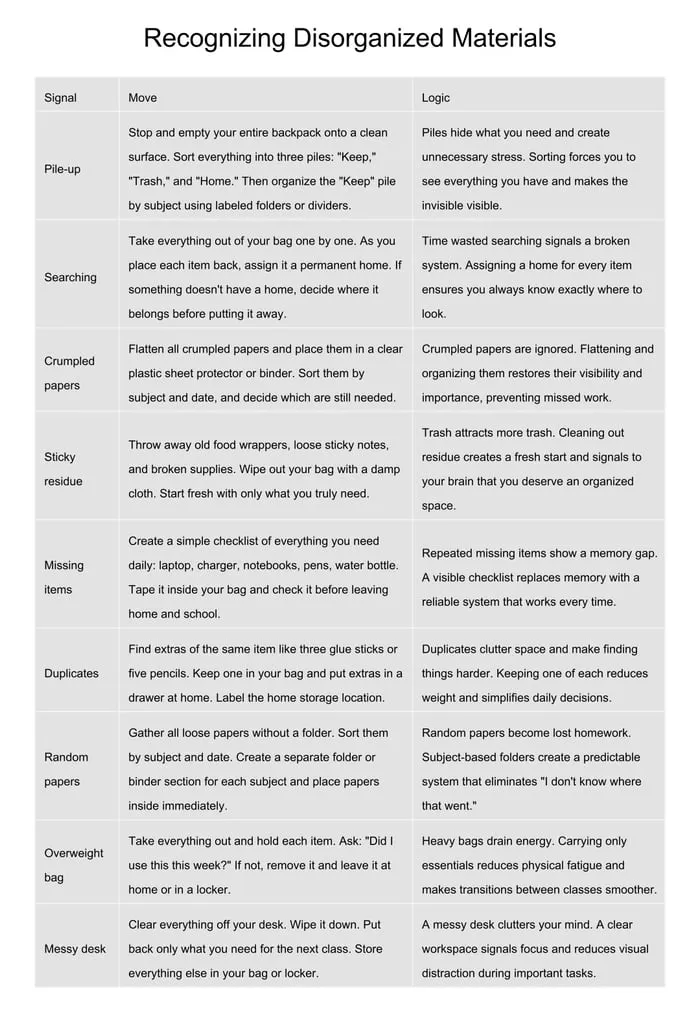
Back to School Executive Function Challenges: Organization and Planning Supports: twelve strategy tables, each focused on one real situation such as a missing assignment, a poor time estimate, or a lost schedule, with clear steps. Includes a 12-page PDF and an editable PowerPoint file.
Sources and scope
- Center on the Developing Child, Harvard University: background on how executive function skills develop in children.
- Understood.org: practical articles for families and teachers on executive function and learning differences.
- CHADD: information and support for families of children with ADHD.
- IRIS Center, Vanderbilt University: free modules on classroom routines and evidence-based practices.
This guide covers everyday organization and planning supports for school and home. It does not cover diagnosis or formal evaluation, which belong to qualified professionals and the student’s team.
Key takeaways
- Trace one assignment to find where executive function challenges really show up.
- Give every material one home and use a short daily reset.
- Compare estimated and actual time to build a realistic sense of time.
- Plan the week together, then hand over the planning step by step.
- Respond to setbacks with one small fix and review progress monthly.










Leave a Comment