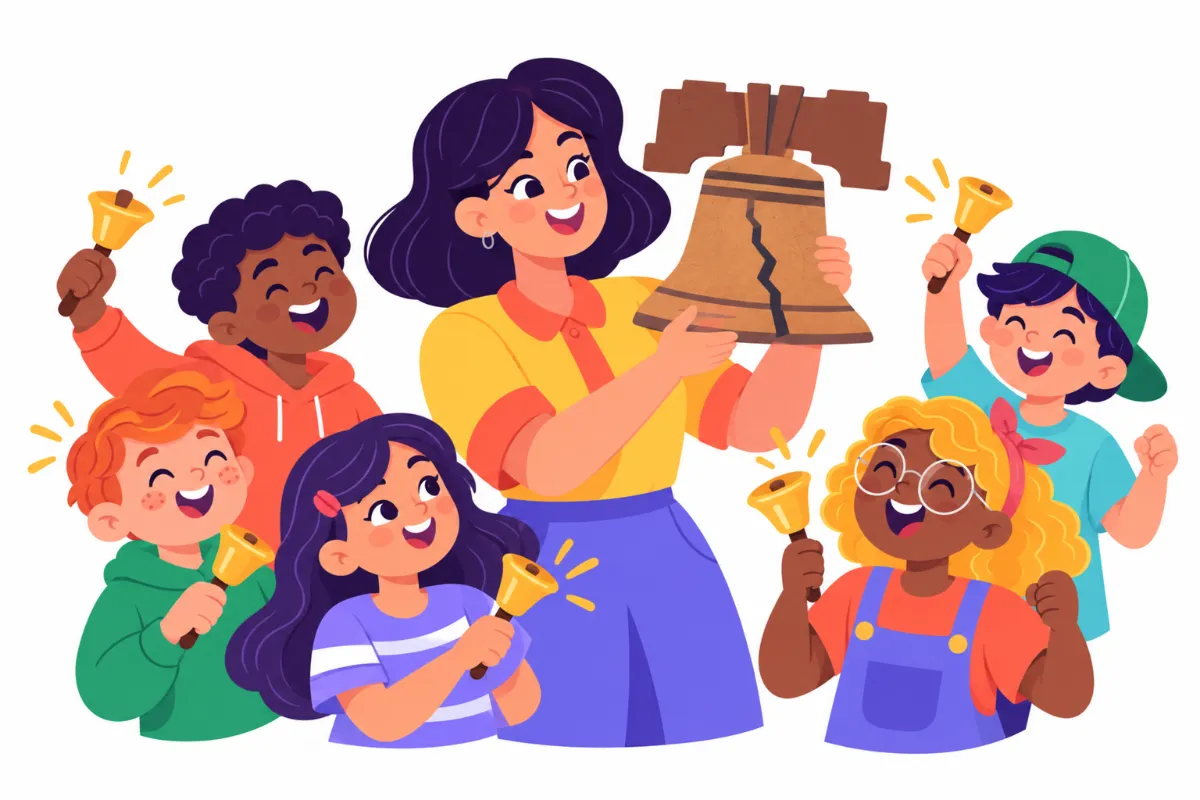

Pennsylvania facts for kids can turn a simple state study into a lesson about how the United States began. Picture a third grade classroom on a Monday morning: the teacher holds up a picture of a large bell with a long crack, and every hand goes up with the same question, “Why is it broken?”
This guide is a short course for teaching Pennsylvania facts for kids at school or at home. By the end, you will be able to set clear learning goals, introduce the state on a map, teach its key symbols, explore its cities and economy, connect students with its forests and parks, and check what they learned with a small project. Examples are fictional classroom scenes. Adapt them to your students and their needs.
At a glance
- Start Pennsylvania facts for kids with three or four clear goals, not a long trivia list.
- Use a map and the nickname “Keystone State” to anchor the unit.
- Teach symbols, such as the Liberty Bell and the eastern hemlock, with a story.
- Connect cities, jobs, and state parks to students’ own lives.
- Finish with a short fact card or poster that shows real understanding.
1. Set clear goals for Pennsylvania facts for kids
First, decide what students should know and do by the end of the unit. A unit on Pennsylvania facts for kids can easily become a long list of trivia. Instead, choose three or four big ideas and connect every activity to them.
For example, a simple set of goals might include locating Pennsylvania on a U.S. map, naming its capital and largest city, explaining why the Liberty Bell matters, and describing one way people in the state earn a living. These goals work for most elementary grades, and you can deepen them for older students.
| Goal | Students can… | Quick check |
|---|---|---|
| Place | Find Pennsylvania on a U.S. map | Point and name a neighbor state |
| Cities | Name the capital and largest city | Label Harrisburg and Philadelphia |
| Symbols | Explain why the Liberty Bell matters | One sentence about freedom |
| Economy | Describe one kind of work | Draw and label a job |
Classroom example. Ms. Patel teaches a fictional third grade class. She writes the four goals on chart paper as “I can” statements and reads them aloud on day one. Each day, students put a sticker next to the goal they practiced, so they can see the unit taking shape.
In addition, plan supports from the start. Picture cards, a word wall, and sentence starters such as “Pennsylvania is known for…” help every student take part, including English learners and students who need extra reading support.
Finally, keep the unit short and focused. Five to eight lessons are often enough for a single state, especially if it is part of a larger 50 states study.
2. Introduce the Keystone State on a map
Next, give students a sense of place before any other Pennsylvania facts for kids. Show a U.S. map and ask them to find Pennsylvania in the northeastern part of the country. Then trace its shape with a finger and point out a few neighbor states, such as New York, New Jersey, and Ohio.
After that, introduce the nickname. Pennsylvania is called the Keystone State. A keystone is the stone at the top of an arch that holds the other stones in place. Many teachers explain that the nickname reflects Pennsylvania’s central place among the early states and its important role in the nation’s founding.
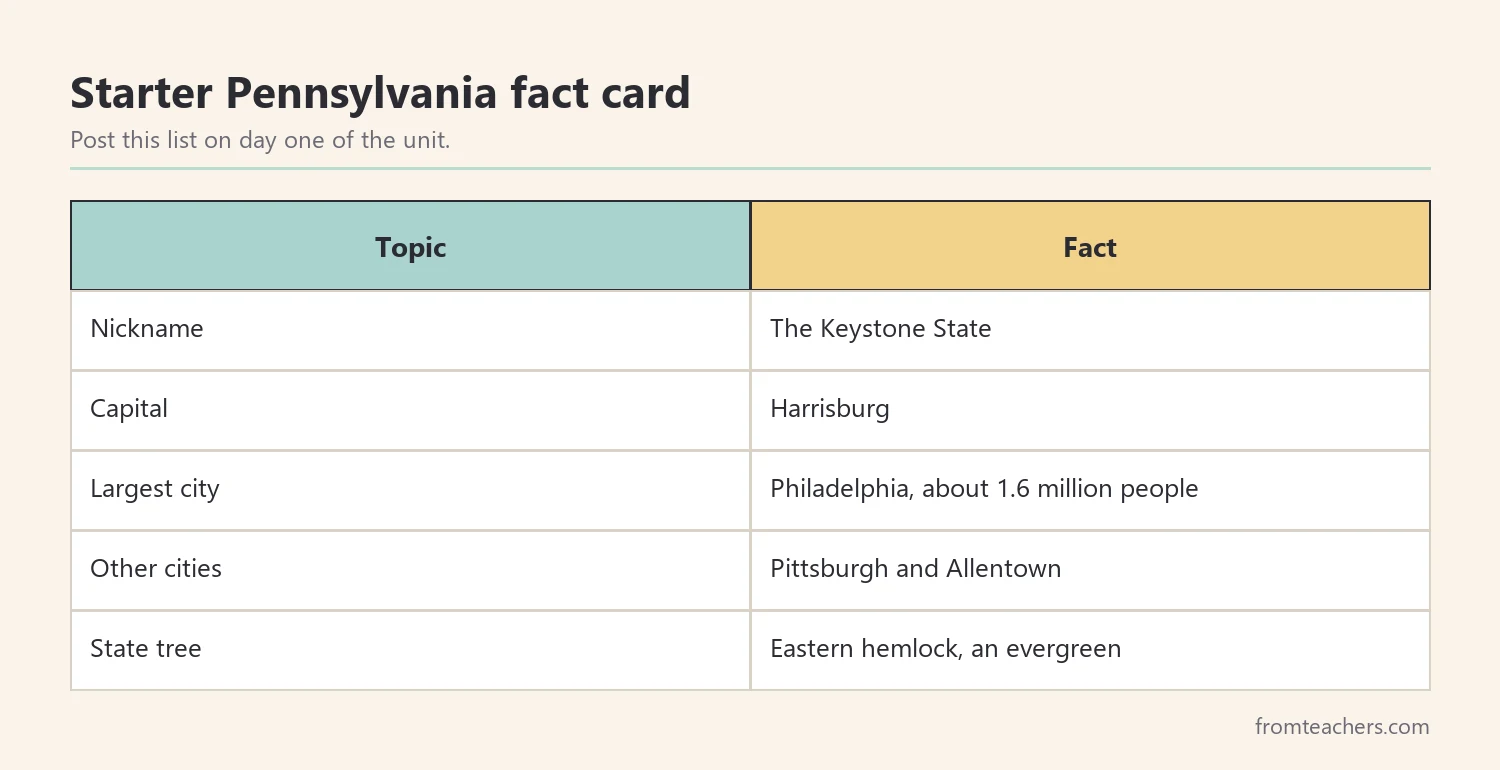
Then post a short list of starter Pennsylvania facts for kids. Keep it to five or six lines so students can read it in a minute. For instance: the capital is Harrisburg, the largest city is Philadelphia, and other cities include Pittsburgh and Allentown.
Classroom example. Ms. Patel builds a paper arch with students, using a clear keystone at the top. When she pulls the keystone out, the arch falls. Nora, one of her fictional students, says, “So the keystone holds everything up.” That moment makes the nickname easy to remember.
Also, connect the map to students’ own location. Ask, “Is Pennsylvania north, south, east, or west of us?” This simple question builds geography skills and keeps the unit personal.
3. Teach Pennsylvania facts for kids through symbols
Symbols make Pennsylvania facts for kids concrete and easy to hold on to. Two strong choices for Pennsylvania are the Liberty Bell and the state tree, the eastern hemlock. Each one tells a different part of the state’s story.
Start with the Liberty Bell in Philadelphia. It is a symbol of freedom, it is famous for its large crack, and it weighs more than 2,000 pounds. Then connect it to history: Philadelphia is where the Declaration of Independence and the U.S. Constitution were signed. So the bell links a single object to the big idea of how the country began.
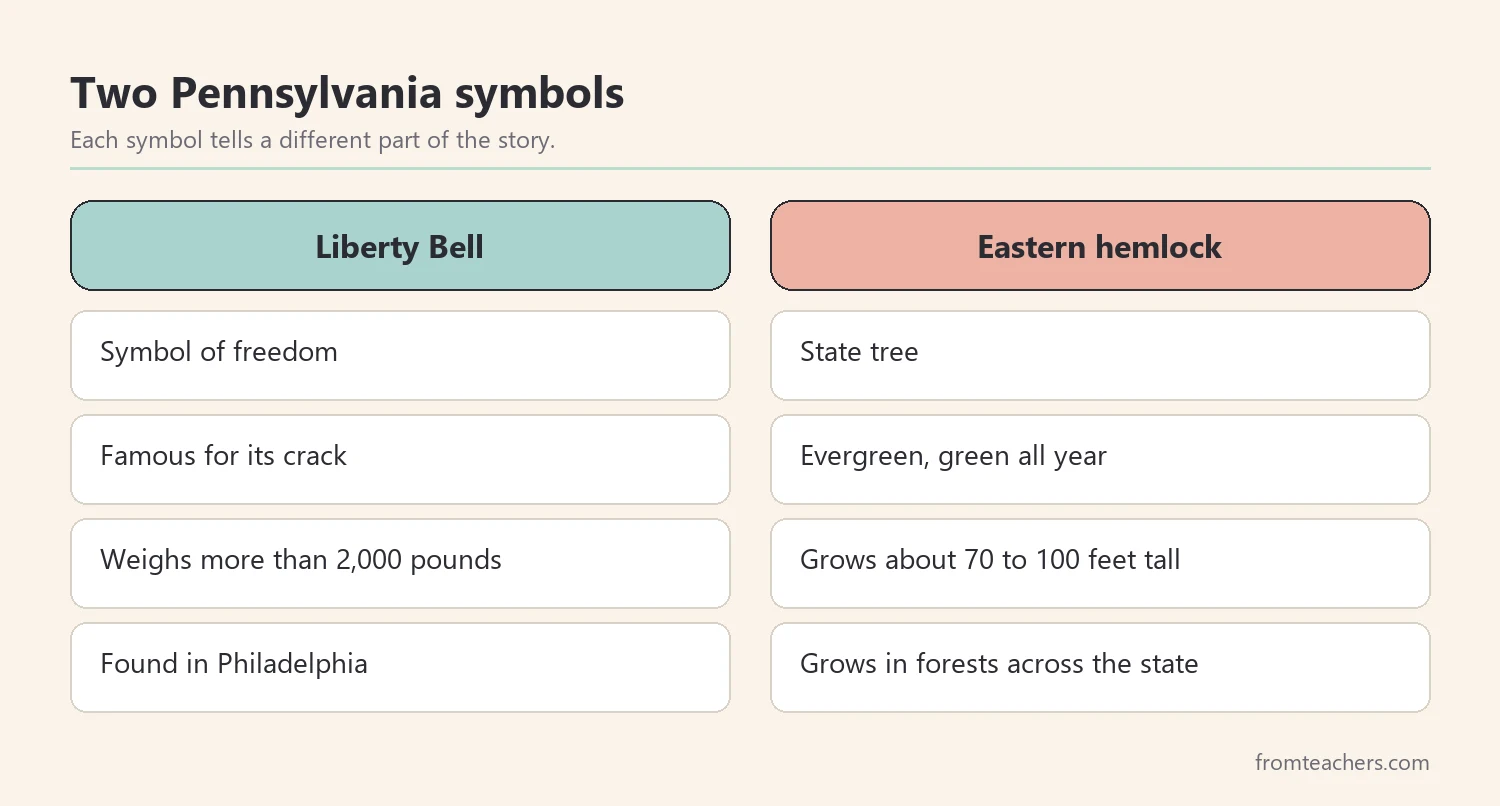
Next, introduce the eastern hemlock. It is an evergreen tree that can grow about 70 to 100 feet tall. Students can compare that height to something familiar, such as the height of their school building, which turns a number into a picture.
A ready-made slideshow can carry much of this lesson. The All About Pennsylvania state study slideshow includes slides on the Liberty Bell, the eastern hemlock, major cities, the state economy, and state parks, with simple facts and colorful illustrations for elementary students.
Classroom example. Ms. Patel shows a picture of the Liberty Bell and asks students to describe what they notice. Then she reads a short paragraph about freedom. Each student writes one sentence: “The Liberty Bell is a symbol of…” Nora writes, “The Liberty Bell is a symbol of freedom for everyone.”
Finally, let students draw each symbol and add one fact underneath. Drawing helps students remember details, and it gives every learner a way to show understanding.
4. Explore cities and work across the state
Next, use Pennsylvania facts for kids to show how people live and work across the state. Start with the cities. Philadelphia is the largest city, with about 1.6 million people. Pittsburgh is another major city in the western part of the state, and Allentown is in the east.
Then talk about the economy. Pennsylvania’s economy includes manufacturing, agriculture, and other industries. In simple terms, some people make things in factories, some grow food on farms, and many others work in offices, stores, hospitals, and schools.
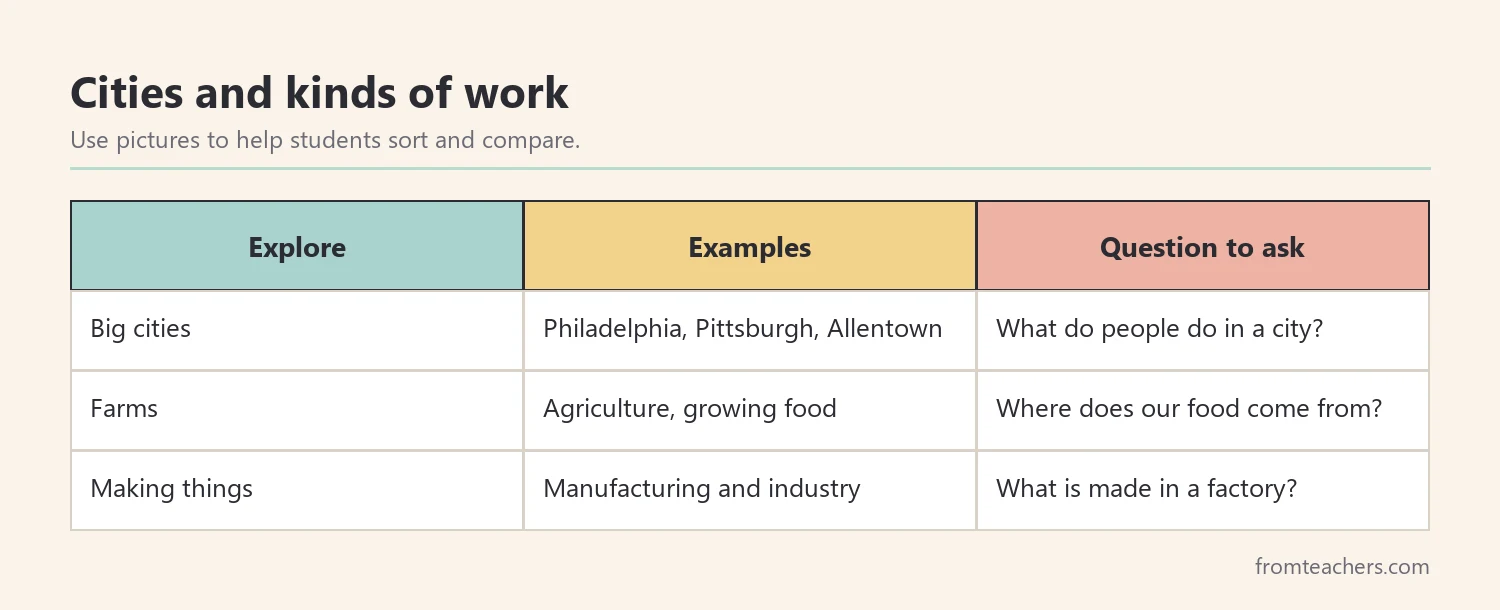
Classroom example. Ms. Patel sets up three stations: City Life, Farm Life, and Making Things. At each station, students look at pictures and sort cards into “I see” and “I wonder.” Afterward, the class makes a T-chart comparing city jobs and farm jobs.
In addition, connect the topic to students’ own community. Ask, “Which of these jobs do people do near us?” This question helps students notice that every state has many kinds of work, not just one.
Moreover, keep numbers simple and meaningful. Instead of listing many populations, compare just one: “About 1.6 million people live in Philadelphia. How many classrooms like ours would that fill?” A rough estimate makes the number real without turning the lesson into a math test.
Finally, avoid presenting Pennsylvania facts for kids that you cannot check. If a student asks a question you are unsure about, model good research habits by looking it up together on a reliable site.
5. Connect Pennsylvania facts for kids to forests and parks
Pennsylvania is not only cities and history. The state has more than 120 state parks that help protect forests and rivers. This part of the unit is a great chance to talk about nature, maps, and caring for the outdoors.
First, show students a map with a few state parks marked, and add them to your list of Pennsylvania facts for kids. Then ask what they might see or do in a park, such as hiking, looking at trees, or watching a river. If your class has visited a local park, invite students to compare it with what they see in pictures.
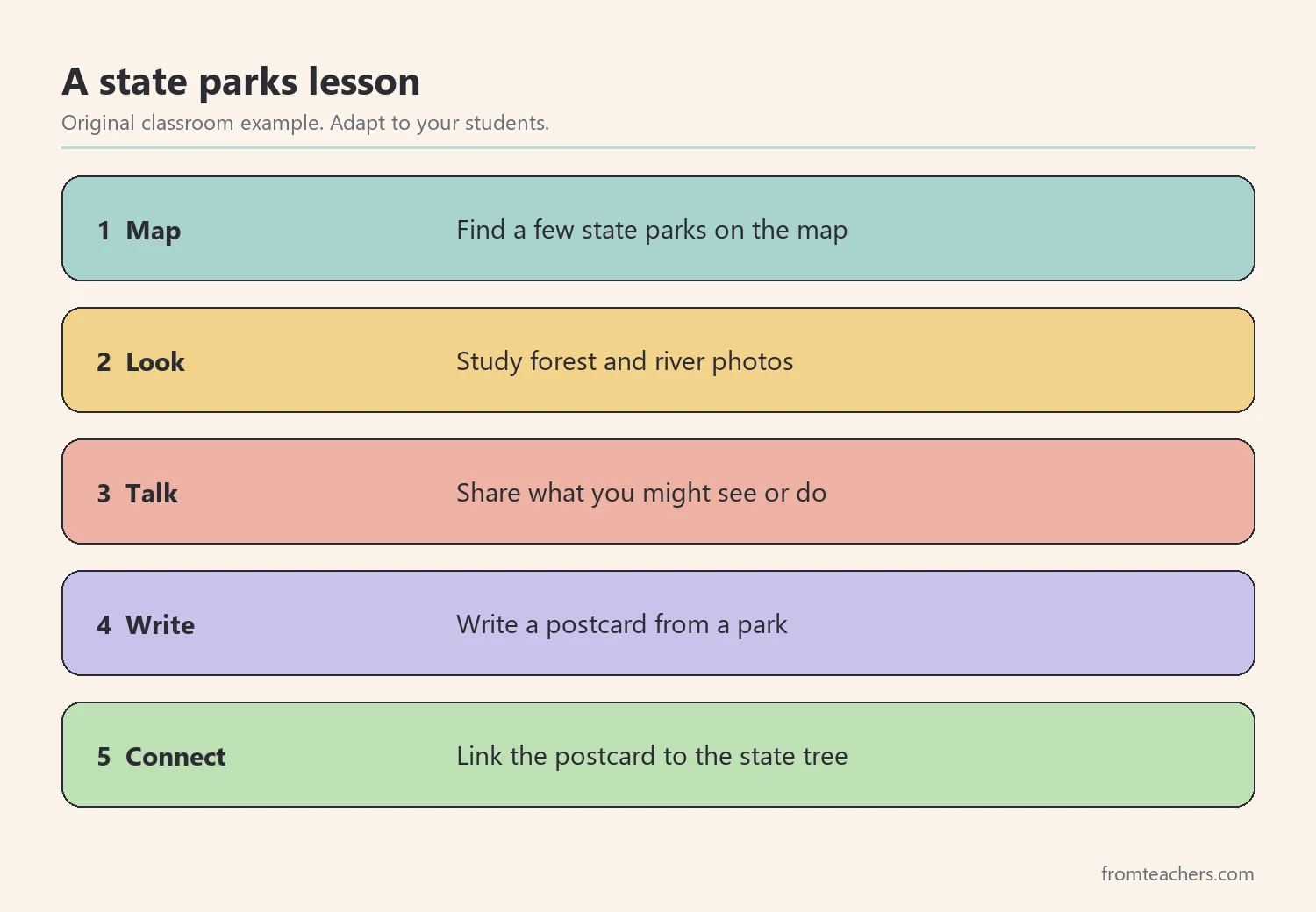
Classroom example. Ms. Patel shows three photos of forest and river scenes. Students choose one and write a short postcard as if they were visiting: “Dear Grandma, I am at a Pennsylvania state park. I see tall evergreen trees.” Nora connects her postcard to the eastern hemlock she learned about earlier.
Also, link this lesson back to the state tree. Hemlocks are evergreens, so they stay green all year. Students can sort pictures of trees into evergreen and not evergreen, which connects science and social studies in one activity.
Ultimately, the parks lesson shows students that a state study is about land and people, not only dates. These Pennsylvania facts for kids help students see why protecting forests and rivers matters.
6. Review and assess what students learned
Finally, bring your Pennsylvania facts for kids unit together with a short review and a small project. A fact card, a mini poster, or a one-page booklet works well. The project should show the four goals you set at the start, so students can see what they learned.
For example, each student can make a fact card with the state shape, the capital, the largest city, one symbol with a sentence, and one kind of work. Then students share their cards in pairs and add one new fact they learned from a partner.
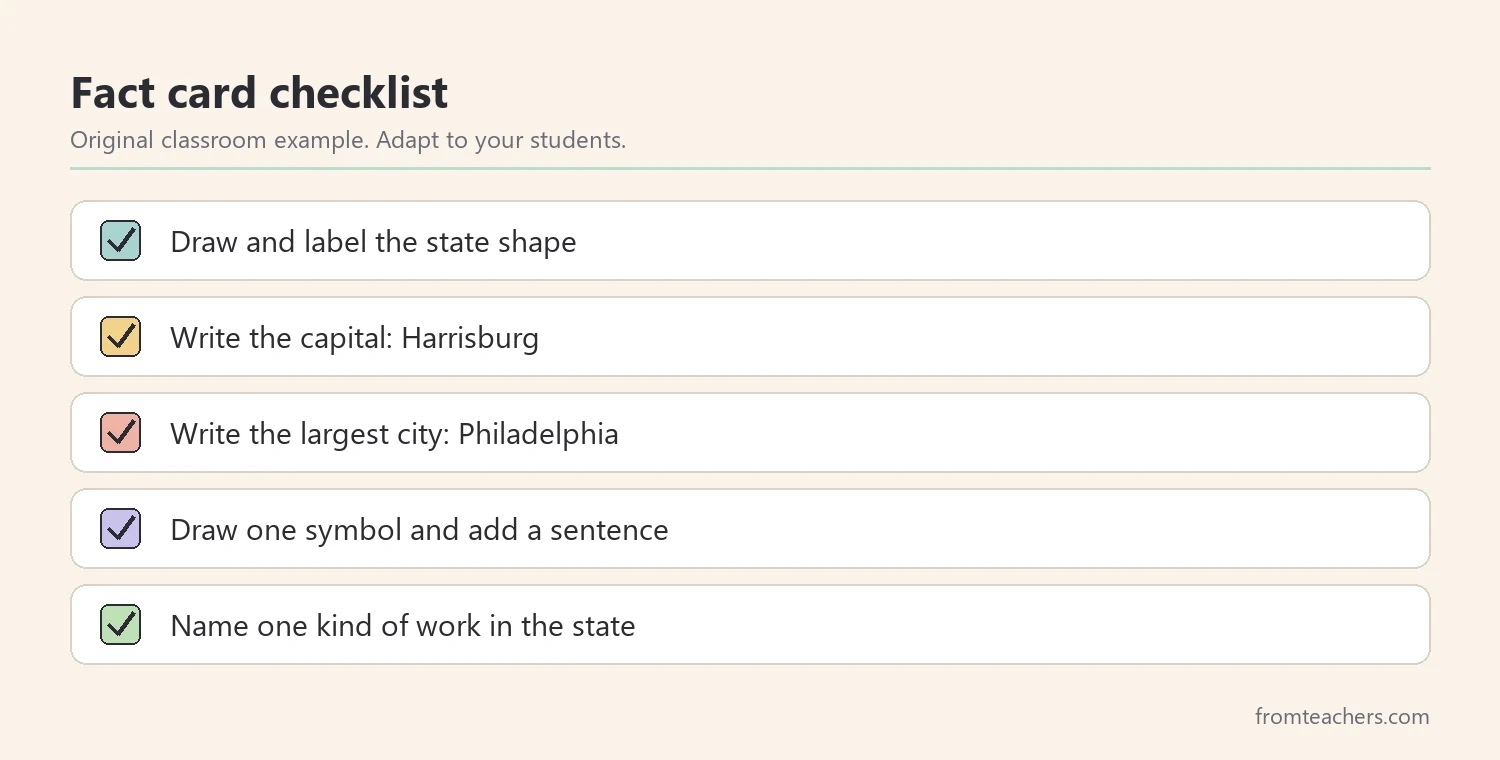
Classroom example. Ms. Patel gives students a checklist with five items for the fact card. Of her 24 fictional students, 20 complete all five items on the first try. The other 4 finish with a partner and a word bank, so all 24 complete the card by the end of the lesson.
In addition, offer choices in how students show what they know. Some may draw, some may write, and some may explain aloud. Flexible options keep the focus on understanding Pennsylvania facts for kids rather than on writing speed.
Moreover, use the fact cards as a quick check on your goals. Sort them into three piles: cards that show all four goals, cards that miss one, and cards that need more support. That simple sort tells you which Pennsylvania facts for kids to revisit in a short review lesson, and which students might enjoy an extension, such as researching another Pennsylvania city.
Lastly, display the cards on a “Keystone Wall” in the hallway. Visible work celebrates effort and invites other classes to learn from your students.
Common mistakes and how to avoid them
- Teaching Pennsylvania facts for kids as a long list of trivia. Fix: choose three or four big ideas and connect every fact to them.
- Skipping the map. Fix: start each lesson by pointing to Pennsylvania and naming a nearby state.
- Using numbers without meaning. Fix: compare one number to something students know.
- Relying only on reading. Fix: add pictures, drawing, and hands-on models such as the paper arch.
- Repeating facts you are unsure about. Fix: check details on official or museum websites with students.
- Ending without a product. Fix: finish with a fact card or poster tied to your goals.
Questions teachers and parents ask about Pennsylvania facts for kids
What grade level is this unit best for?
The approach fits most elementary grades, especially grades 2 to 5. Younger students can focus on the map and symbols, while older students can add more history and economy details.
Why is Pennsylvania called the Keystone State?
A keystone holds an arch together, and the nickname reflects Pennsylvania’s central place among the early states and its role in the nation’s founding. A paper arch model helps students understand the idea quickly.
How long should a Pennsylvania state study take?
Many teachers spend five to eight short lessons on one state. If the state is part of a larger 50 states unit, you can shorten it to two or three lessons with a fact card at the end.
How can parents teach Pennsylvania facts for kids at home?
Parents can look at a map together, read about the Liberty Bell, and talk about parks or cities the family has visited. A homemade fact card on the fridge is a simple way to review.
Where can I check facts before teaching?
Use official and museum sources, such as the National Park Service for the Liberty Bell and the Pennsylvania state parks agency for park information. Checking together also teaches students good research habits.
Related reading: Learning Styles Student Success Guide, 5 Practical Teaching Tips to Boost Classroom Focus and Learning, and Homeschooling vs. Public Schooling: Which Educational Path Is Right for Your Child?
A companion resource for Pennsylvania facts for kids:
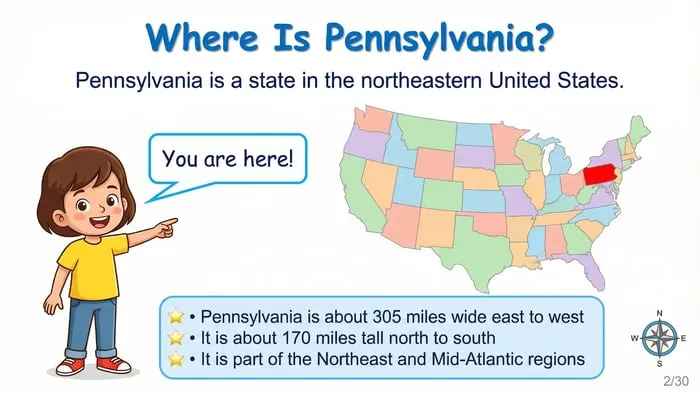
Pennsylvania State Study: Facts, Symbols, and Famous Landmarks: an illustrated “All About Pennsylvania” slideshow with slides on the state shape and flag, major cities, the eastern hemlock, the Liberty Bell, the state economy, state parks, and a closing review for elementary students.
Sources and scope
- Independence National Historical Park (National Park Service): the park in Philadelphia that includes the Liberty Bell and Independence Hall.
- Pennsylvania Department of Conservation and Natural Resources: the state agency that manages Pennsylvania state parks and forests.
- Commonwealth of Pennsylvania official website: general information about the state and its government.
- Library of Congress: primary sources and teacher materials on early American history.
- National Council for the Social Studies: guidance and resources for teaching social studies in the elementary grades.
This guide offers a practical lesson sequence for an elementary state study; it is not a complete history of Pennsylvania, and teachers should confirm details with official sources before teaching.
Key takeaways
- Set three or four clear goals for Pennsylvania facts for kids and connect every fact to them.
- Anchor the unit with a map and the Keystone State nickname.
- Use symbols like the Liberty Bell and eastern hemlock to tell a story.
- Link cities, work, and state parks to students’ own lives.
- Finish with a fact card that shows what students really learned.



Leave a Comment