

Adjustment disorder progress notes can take longer to write than the session itself, especially at the end of a full day. Picture it: your last client left twenty minutes ago, you have three notes still open, and you are trying to remember whether last week’s stressor rating was a five or a six. Clear, consistent notes protect your client’s care, support your clinical reasoning, and make reviews far less stressful.
After reading this guide, you will be able to choose a note structure, document the stressor and symptoms clearly, link each session to measurable treatment goals, record risk and safety when needed, and review progress over time. In short, you will have a repeatable process for adjustment disorder progress notes that saves time after every session.
Examples are fictional. Adapt to the client’s goals and agreed supports. This is guidance, not a diagnosis, and it does not replace your clinical judgment, supervision, or the rules of your setting.
At a glance
- Use one consistent note structure for every session.
- Name the stressor and track its status each week.
- Link every note to a specific treatment goal.
- Use simple rating scales so change is visible over time.
- Document risk and safety planning clearly whenever it applies.
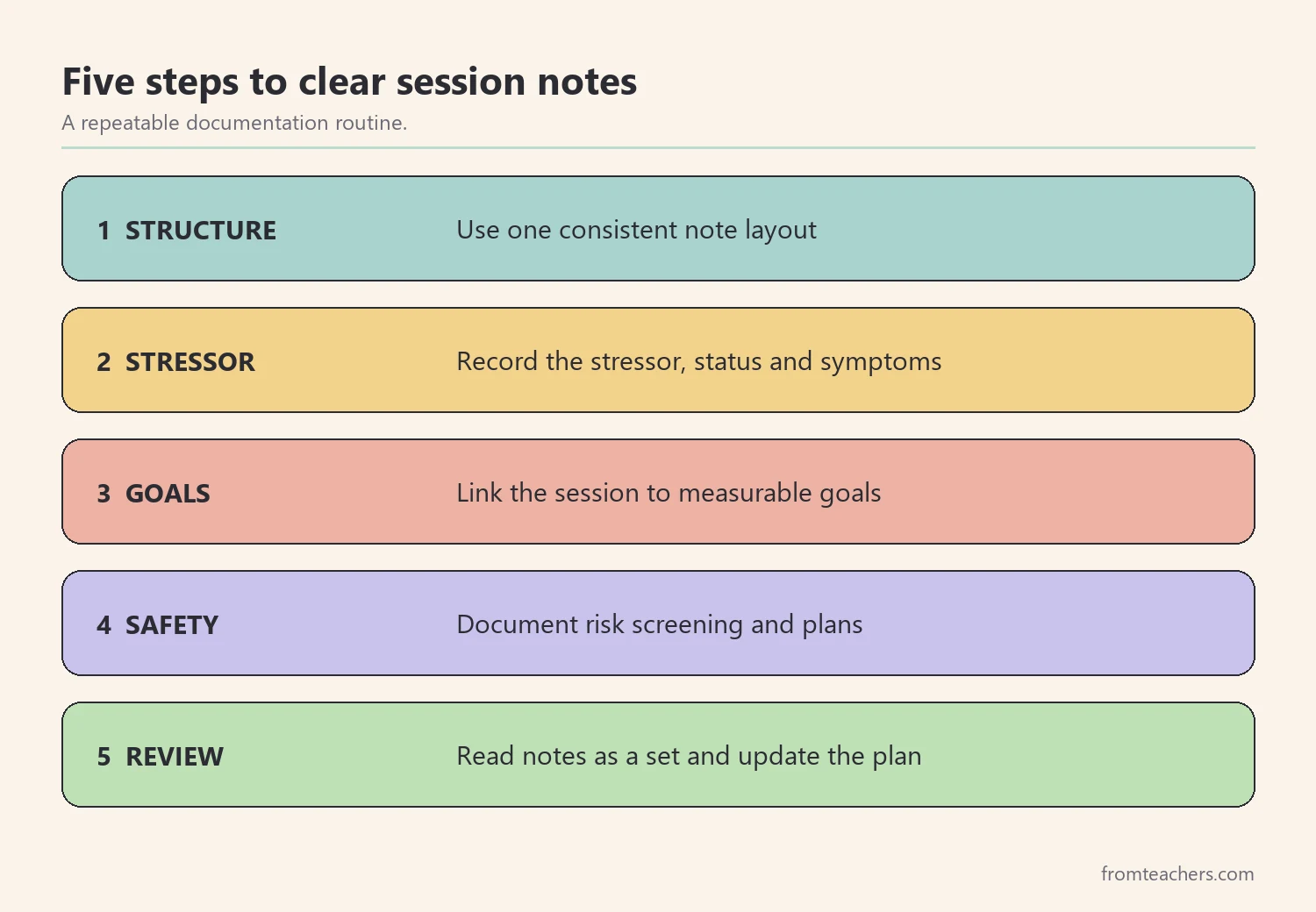
1. Choose a structure for adjustment disorder progress notes
First, pick one structure and use it every time. Many clinicians use formats such as SOAP (Subjective, Objective, Assessment, Plan) or DAP (Data, Assessment, Plan). The exact format matters less than consistency, because a consistent layout makes notes faster to write and easier for anyone to review.
Next, decide which sections every note will include. For adjustment disorder progress notes, a practical set is: the current stressor and its status, symptoms and their severity, interventions used in session, the client’s response, progress toward goals, risk status, and the plan for next session.
| Section | What to record |
|---|---|
| Stressor | What it is and whether it has changed |
| Symptoms | Main symptoms and a severity rating |
| Intervention | What you did in session |
| Response | How the client engaged and responded |
| Plan | Next steps and homework |
It also helps to set a time limit. Many clinicians aim to finish each note within a few minutes of the session ending. A fixed structure for adjustment disorder progress notes makes that realistic, because you are filling known sections rather than composing from a blank page.
Also check your setting’s requirements. Agencies, insurers, and licensing boards may require particular elements, so adapt your template to those rules first. Then keep the template the same across clients, so you are not reinventing the note every hour.
Throughout this guide, we will follow a fictional client, Jordan, an adult who began counseling after an unexpected job loss. Jordan’s clinician uses the same structure every week, which makes his adjustment disorder progress notes easy to compare from one session to the next.
2. Document the stressor and symptoms clearly
Adjustment concerns are linked to an identifiable stressor, so the stressor deserves its own line in every note. Record what it is, and then record its current status: ongoing, changing, or resolved. As a result, anyone reading the record can see how the client’s situation is evolving.
If more than one stressor is present, list each one on its own line. For example, a job loss may also bring money worries or tension at home. Separate lines make it clear which stressor is changing and which is not, and they help you choose where to focus the next session.
Then document symptoms in specific, observable language. Instead of “client seemed down,” write what the client reported and what you observed, for example “reported difficulty sleeping on four of the last seven nights; spoke slowly and made limited eye contact.” Specific wording is easier to compare across sessions.
Also note functioning, not only feelings. Adjustment concerns often show up at work, at school, or in relationships, so a line about daily functioning, such as “missed two family meals this week,” adds useful context. Over time, functioning lines in adjustment disorder progress notes often show improvement before ratings do.
A simple severity rating helps further. Many clinicians ask clients to rate distress or a key symptom on a 0 to 10 scale. The number is not a diagnosis; it is a quick, shared reference point that shows change over time.
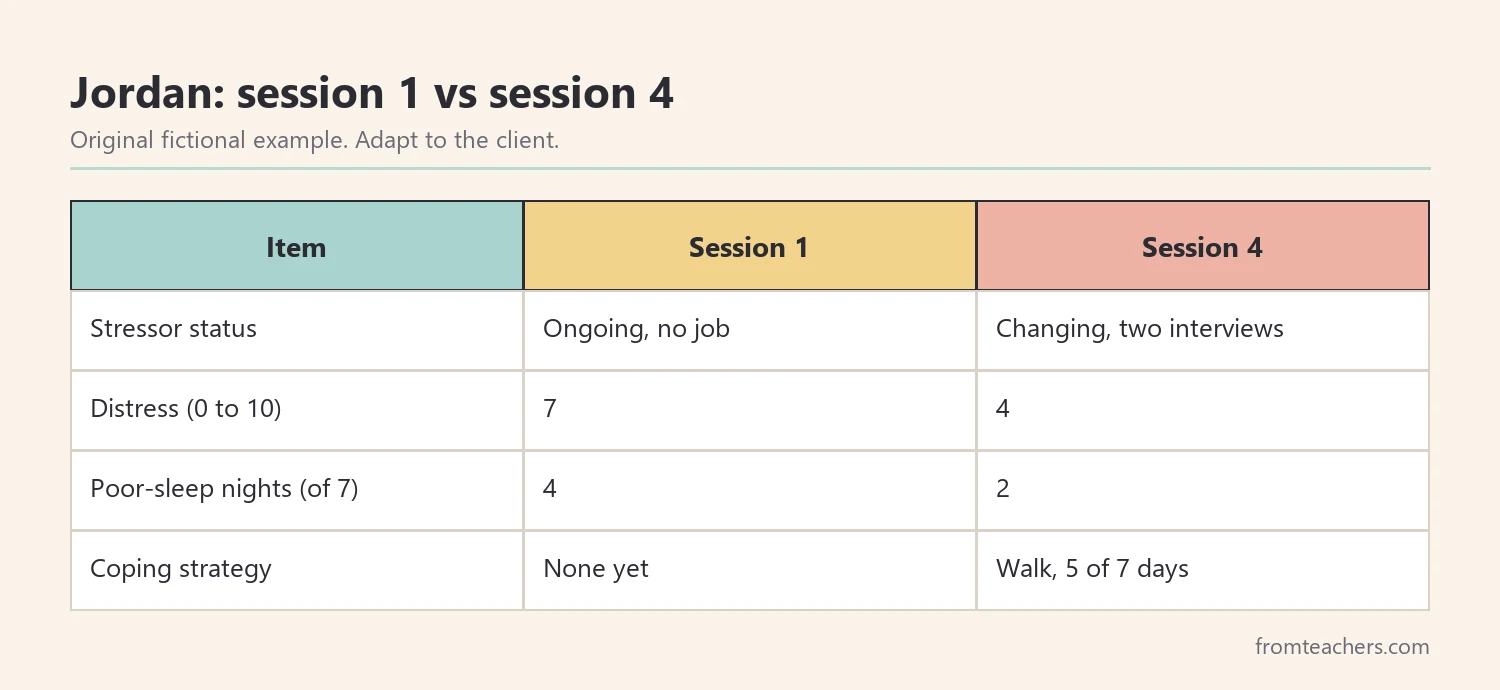
Here is how Jordan’s first and fourth sessions compared:
| Item | Session 1 | Session 4 |
|---|---|---|
| Stressor status | Ongoing, no job | Changing, two interviews |
| Distress rating (0 to 10) | 7 | 4 |
| Nights with poor sleep (of 7) | 4 | 2 |
| Coping strategy used | None yet | Daily walk, 5 of 7 days |
Notably, a table like this turns several adjustment disorder progress notes into a clear picture of change. The distress rating dropped by 3 points, and poor-sleep nights dropped from 4 to 2.
3. Link adjustment disorder progress notes to treatment goals
Every note should connect to the treatment plan. Therefore, write goals that are specific and measurable at intake, and then refer to them by name in each session note. This shows why each intervention was chosen and whether it is helping.
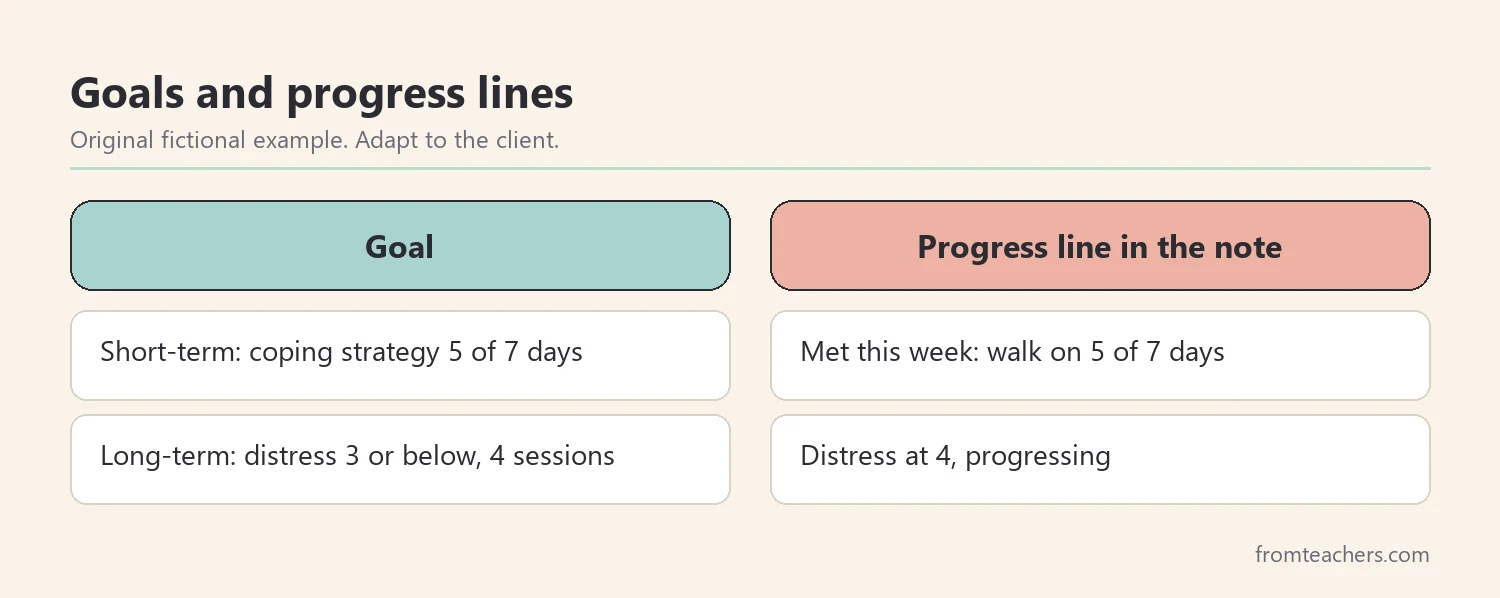
For example, Jordan’s plan included a short-term goal and a long-term goal:
- Short-term: Use one coping strategy on at least 5 of 7 days for four weeks.
- Long-term: Report distress at 3 or below for four consecutive sessions.
In each note, the clinician wrote a short progress line, such as “Short-term goal: met this week (walk on 5 of 7 days). Long-term goal: distress at 4, progressing.” Consequently, a reviewer can see progress without reading every detail.
Keep goal language in the client’s terms when you can. A goal the client helped write, and can repeat in his own words, is easier to track honestly. Moreover, it makes the progress line in adjustment disorder progress notes more meaningful to the client when you review it together.
Also document the interventions you used and why. If a session focused on cognitive behavioral work, note the specific technique, such as a thought record or identifying an unhelpful thought pattern, and how the client responded. In contrast, “discussed feelings” tells a reviewer very little.
If you want ready-made forms for this, the Adjustment Disorder Progress Notes template bundle includes initial assessment and treatment planning with short and long term goal setting, weekly progress monitoring with severity and coping strategy ratings, and cognitive behavioral session notes.
4. Record risk and safety planning when needed
Stressful life events can sometimes bring periods of higher risk, so your notes should show that you checked. Record whether risk was assessed, what you found, and what you did. Follow your setting’s procedures and your professional standards for when and how to assess.
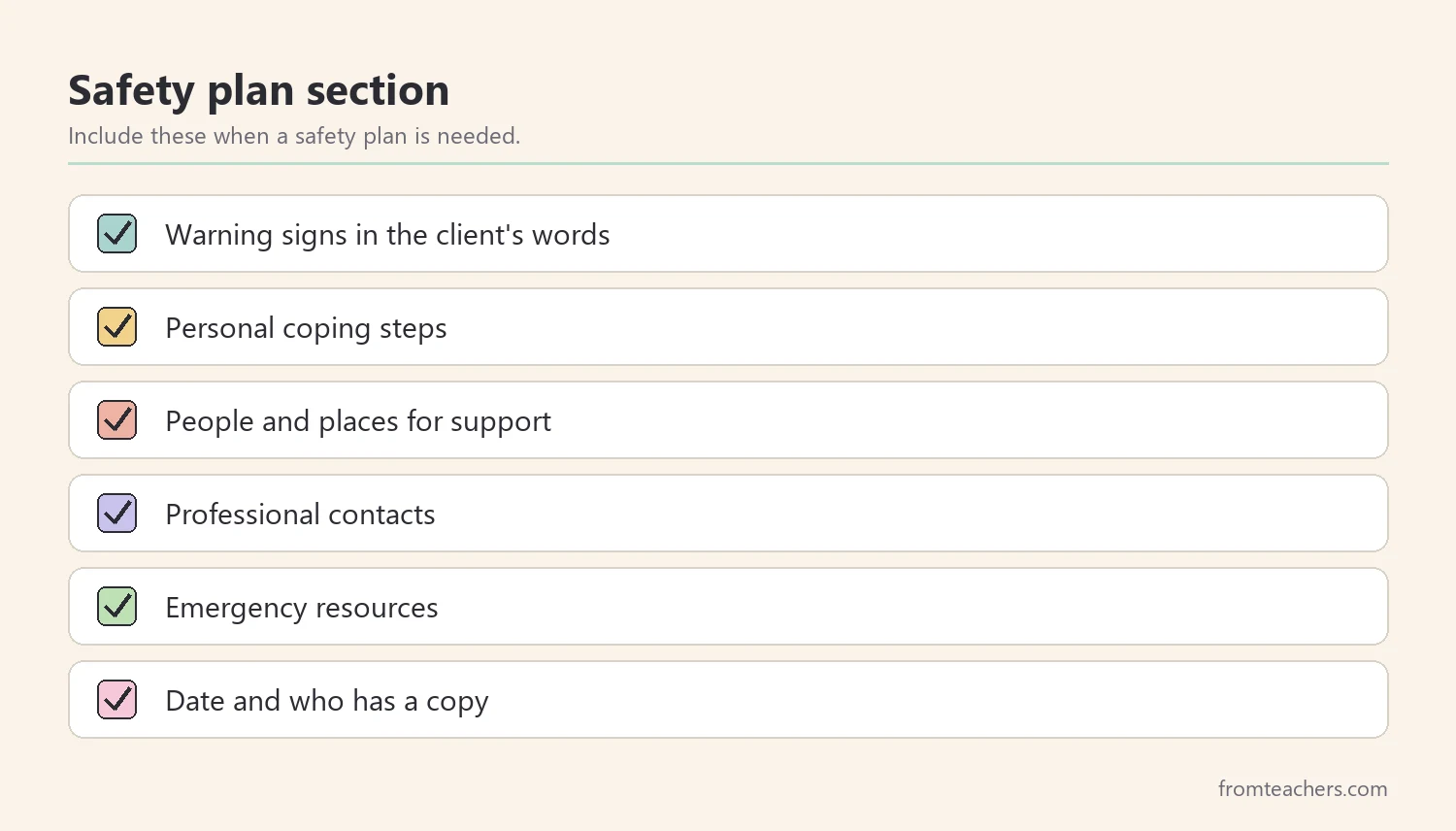
When risk is present, the documentation should include risk indicators, a severity level, and the safety plan agreed with the client. A good safety plan usually lists warning signs, coping steps, people and places for support, professional contacts, and emergency resources. Write these in the client’s own words where possible.
Keep copies of the safety plan where your setting requires, and note in the record that the client received a copy. If the plan changes, record the date and what changed, so the most current version is always clear.
When risk is not present, still record that you checked. A single clear line, such as “Risk screened; client denied current thoughts of harm; no change to plan,” shows that the question was asked. Without that line, a reviewer cannot tell whether it was skipped.
| Situation | What the note should show |
|---|---|
| Risk screened, none found | That you asked, and the answer |
| Risk present | Indicators, severity, actions taken |
| Safety plan made | Plan contents and who has a copy |
| Follow-up needed | When and how you will recheck |
For Jordan, risk was screened at every session and recorded with one line each time. Because the line was always in the same place, his adjustment disorder progress notes made this easy to confirm at review.
5. Review adjustment disorder progress notes over time
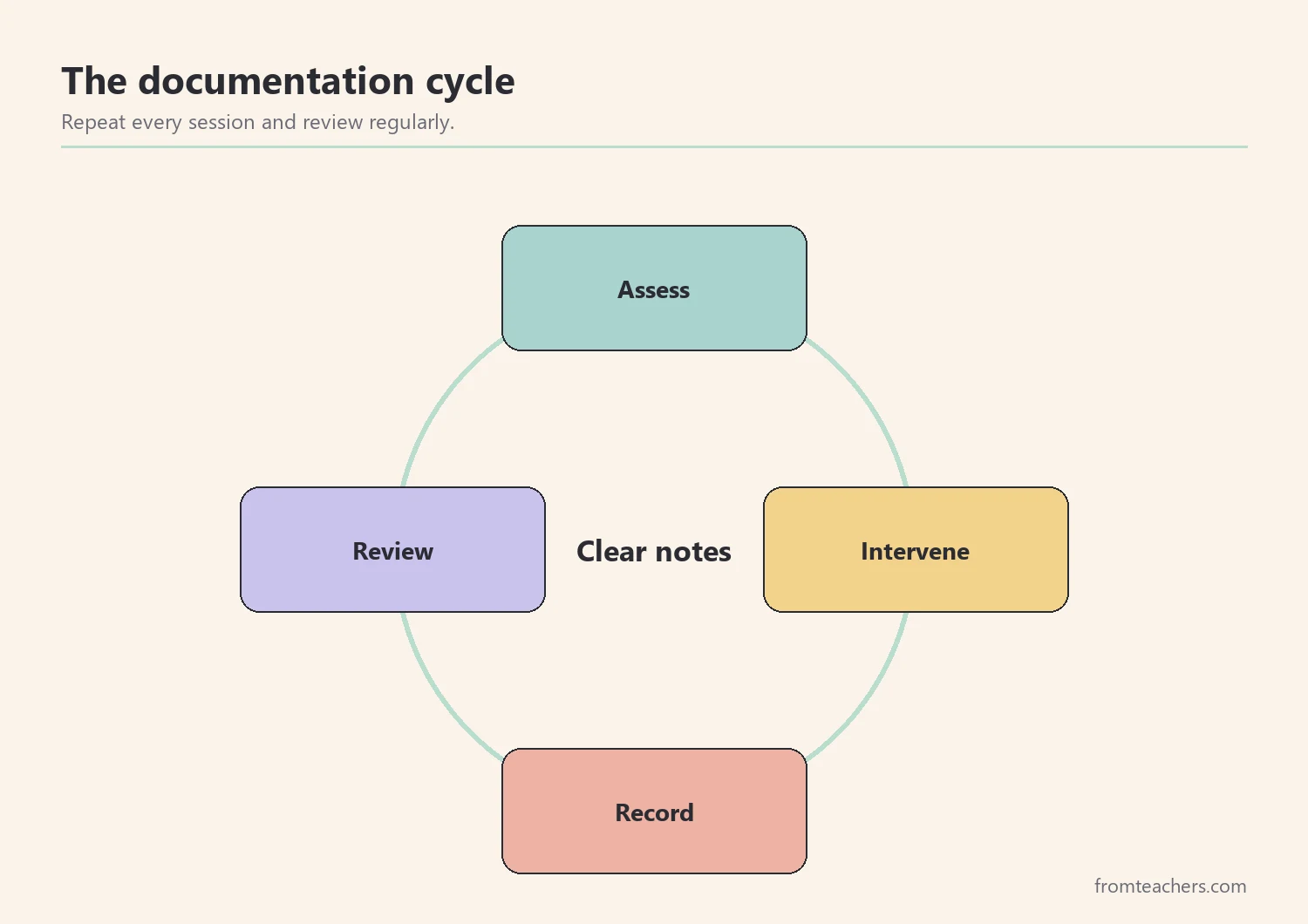
Finally, step back regularly and read the notes as a set. Every few sessions, or at your setting’s review points, compare the stressor status, ratings, and goal progress. As a result, you can see whether treatment is working, stalling, or nearing completion.
Before each review, pull the key numbers into one small table: stressor status, the main rating, and the status of each goal. Seeing four or five sessions side by side often reveals patterns that are hard to notice note by note, such as ratings that improve only in weeks with a regular routine.
Use three simple questions at each review: Has the stressor changed? Are symptoms and ratings improving? Are goals met, progressing, or stuck? If a goal has not moved in several sessions, note your clinical reasoning and any plan change.
For Jordan, the review after session 8 showed the short-term goal met for four weeks and distress at 3 or below for the last four sessions, so the long-term goal was met. Meanwhile, he had started a new job, and the stressor was recorded as resolved. The clinician documented a plan to discuss spacing out sessions and preparing for discharge.
Reviews are also a good moment to involve the client. Sharing the ratings table and asking what has helped most can strengthen engagement, and the client’s answer becomes a useful line in your adjustment disorder progress notes.
In addition, write a brief summary at each review and at discharge. A short paragraph covering the presenting stressor, main interventions, progress on each goal, and the aftercare plan makes the whole record readable in minutes.
Finally, protect the record. Store notes only in systems your setting approves, avoid identifying details in places they do not belong, and share information only as permitted by law, policy, and client consent. Good documentation is useful only when it is also secure.
Common mistakes and how to avoid them
- Vague language. Fix: write what the client reported and what you observed.
- No stressor update. Fix: record stressor status in every note.
- Notes not linked to goals. Fix: name the goal and add a one-line progress update.
- Risk not documented when screened. Fix: add one clear line every time you check.
- Writing notes days later. Fix: complete notes as soon as possible after each session.
- Copying the same text each week. Fix: update each section with what actually happened in this session.
- A different layout every time. Fix: use one template across clients.
Questions clinicians ask about adjustment disorder progress notes
Which format is best for adjustment disorder progress notes?
SOAP and DAP are both widely used. The best choice is the one your setting requires and that you can complete consistently. Consistency matters more than the format name.
How detailed should each note be?
Adjustment disorder progress notes should be detailed enough that another clinician could understand what happened, why, and what comes next. Usually that means short, specific sections rather than long narratives.
Should I use rating scales in every session?
Brief ratings are helpful because they show change over time. Use the scales your setting approves, and record the same ones each session so they can be compared.
How do I document when the stressor is resolved?
In adjustment disorder progress notes, record the change and the date, and note how symptoms responded. Then review goals and discuss next steps, such as spacing out sessions or planning discharge.
Can school counselors use this approach?
Many of the same principles apply, such as specific language and links to goals. However, school counselors should follow their district’s documentation and privacy rules.
Related reading: Building Stronger School Counseling Programs, Essential Trauma-Informed Teaching Strategies, and The Power of Data Tracking.
A companion resource for adjustment disorder progress notes
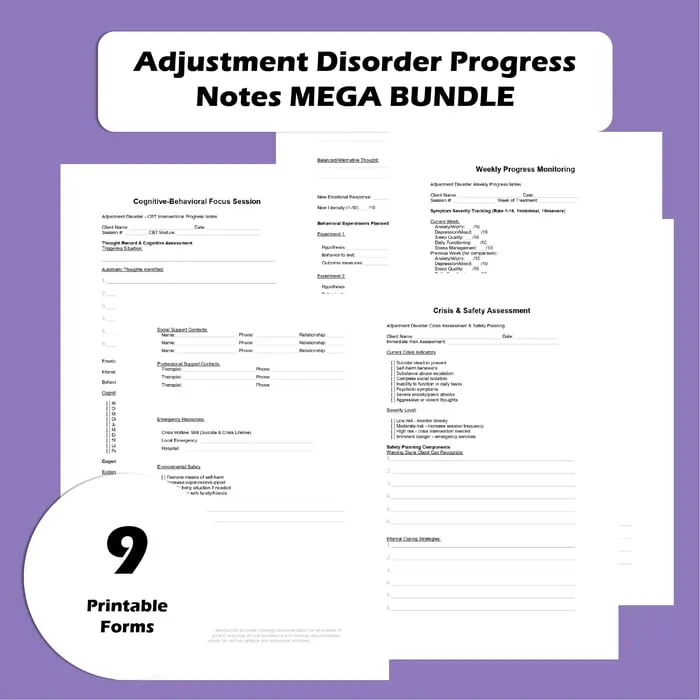
Adjustment Disorder Progress Notes: Therapist Documentation Templates: a bundle of 9 ready-to-use forms covering initial assessment and treatment planning, weekly progress monitoring, cognitive behavioral session notes, and crisis and safety assessment.
Sources and scope
- American Psychological Association: professional guidance on psychological practice and record keeping.
- National Institute of Mental Health: general information on mental health topics.
- Substance Abuse and Mental Health Services Administration: resources on mental health services and crisis support.
- U.S. Department of Health and Human Services, HIPAA: information on privacy of health information.
This guide covers practical documentation habits for clinicians; it does not cover diagnosis, treatment selection, or legal advice, and it does not replace supervision or your setting’s policies.
Key takeaways
- Adjustment disorder progress notes work best with one consistent structure.
- Record the stressor and its status in every note.
- Link each session to a measurable goal with a one-line update.
- Document risk screening every time, and safety plans when needed.
- Review notes as a set to see progress and plan next steps.










Leave a Comment