

Learning from mistakes is a skill students can be taught, yet many children react to a wrong answer by shutting down, erasing until the paper tears, or announcing “I’m stupid.” Picture independent math time: one red mark appears, and a student who was working happily a minute ago now has his head on the desk.
After reading this guide, you will be able to spot the reaction behind the shutdown, calm the moment with short scripts, help students name the type of mistake, teach a simple fix routine, and track progress over a few weeks. Examples are fictional. Adapt to the student’s goals and agreed supports. This is guidance, not a diagnosis.
At a glance
- Students learn from mistakes when the first adult response is calm and short.
- If, Then, Why scripts give you ready words for the hardest moments.
- Naming the mistake type (careless, rule, or not yet learned) points to the right fix.
- A four-part routine (pause, find, fix, reflect) makes correcting work predictable.
- Owning a mistake without blame is a separate skill worth teaching on purpose.
1. Notice how the student reacts to a mistake
Before you can teach learning from mistakes, you need to see what actually happens in the moment. Different students react in different ways, and each reaction needs a slightly different response. Watch for a week and jot down what you see.
Common reactions include:
- Shutting down: head on desk, refusing to continue, staring at the page.
- Destroying work: crumpling or tearing the paper, scribbling over answers.
- Negative self-talk: “I’m dumb,” “I always get it wrong.”
- Blaming: “The pencil is broken,” “She distracted me,” “There wasn’t enough time.”
- Hiding: covering the work, quietly skipping the problem.
For example, meet Leo, a fictional third grader. Over five days of math practice, his teacher notices that Leo makes about ten mistakes a day, which is normal for new material. However, he shuts down after half of them and blames the eraser or a classmate after several others. He rarely fixes an error on his own.
Also, look for patterns in when the reaction happens. Leo is calmer in the morning and more upset after lunch. He reacts most strongly when classmates can see his paper. These details help you plan where to start, because the goal is to make the hardest moment a little easier, not to fix everything at once.
Finally, remember that strong reactions usually signal worry, not defiance. A student who tears his paper often cares a great deal about getting it right. Seeing the feeling behind the behavior makes it easier to stay calm yourself.
2. Calm the moment with If, Then, Why scripts
The minute after a mistake is when habits form. If an adult rushes in with a long lecture or extra pressure, the student often digs in. Instead, have short, ready phrases that keep the moment calm and focused on fixing the work.
An If, Then, Why format works well. “If” names the reaction, “Then” names your move, and “Why” reminds you of the purpose. Writing your scripts down ahead of time means you do not have to invent words when emotions are high.
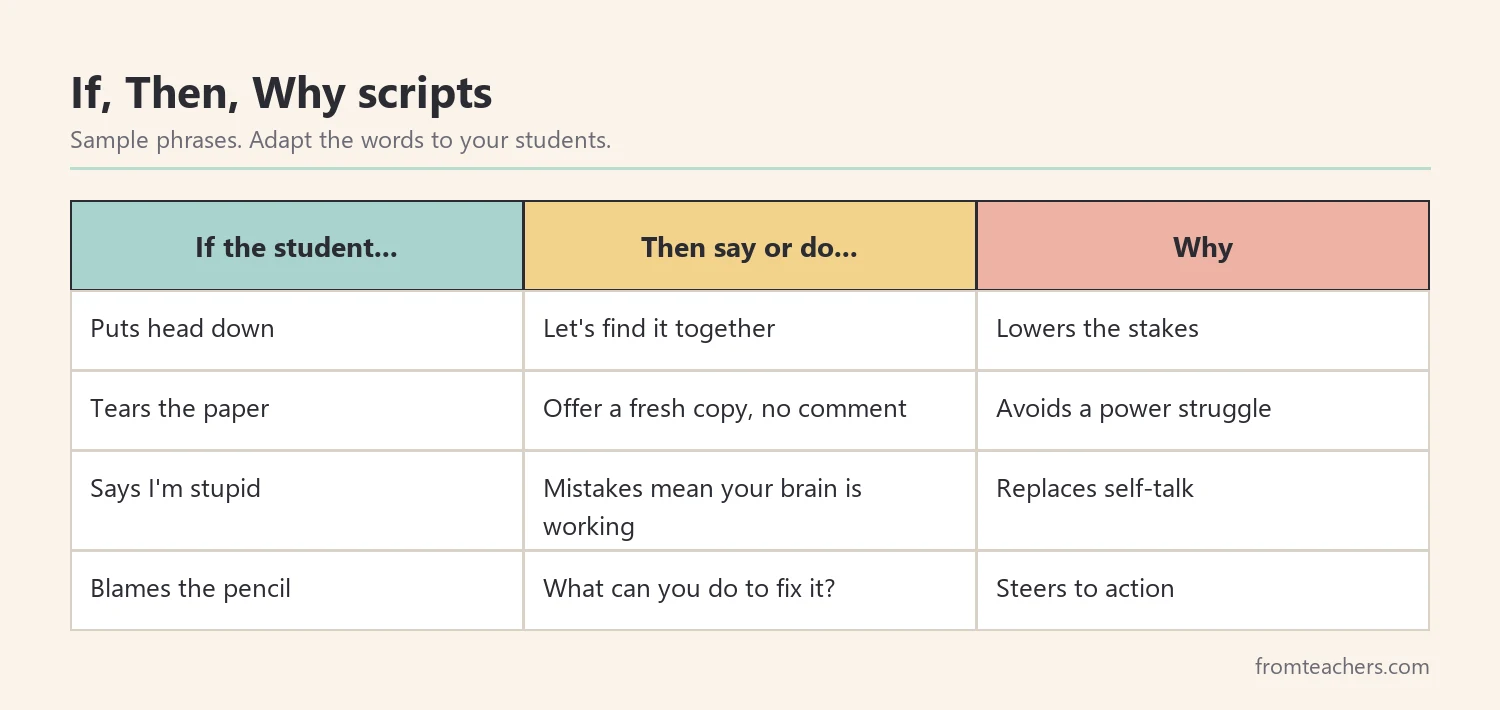
For Leo, his teacher uses the shutdown script most often. When his head goes down, she kneels nearby and says quietly: “Mistakes mean your brain is working. Let’s find it together.” She waits a few seconds, then points to the first step of the problem. Because her words are the same each time, Leo begins to recognize the routine and recovers faster.
Keep these points in mind:
- Use a low, quiet voice and stay at the student’s eye level when possible.
- Say one or two sentences, then pause.
- Focus on the work, not the feeling: “Let’s look at step two,” not “Why are you upset?”
- Avoid sarcasm or comparisons with other students.
If you would like ready-made wording, the Learning from Mistakes If, Then, Why scripts include twelve pages of tables for wrong answers, correcting errors, and identifying mistake types, plus moves for reactions like shutting down or tearing the paper.
3. Help students name the type of mistake
Not every mistake means the same thing, and learning from mistakes looks different for each type. When students can name the type, learning from mistakes becomes less personal and more practical. Instead of “I’m bad at math,” the student can say “I made a careless mistake,” which suggests a clear fix.
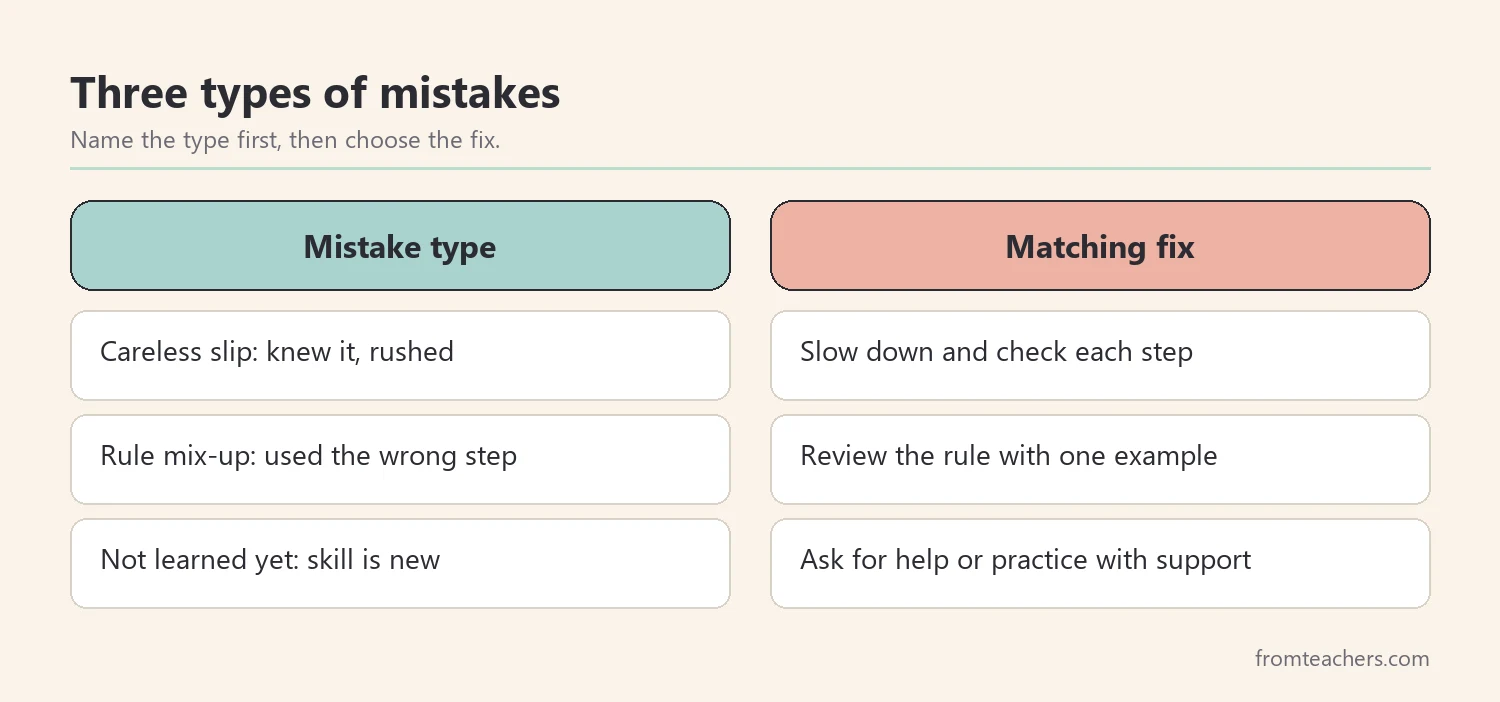
Teach three simple types:
- Careless slip: the student knows the skill but rushed. Fix: slow down and check.
- Rule mix-up: the student used the wrong step or rule. Fix: review the rule with an example.
- Not learned yet: the skill is still new. Fix: ask for help or practice with support.
Post the three types on a small card at the student’s desk or on the wall. When a mistake happens, ask: “Which kind do you think this was?” That question invites thinking, and it moves the student away from the emotional reaction.
For Leo, the first sorting showed something useful. Of ten mistakes in one session, six were careless slips, three were rule mix-ups with regrouping, and one was a new skill he had not learned yet. Six plus three plus one makes ten. Because most of his errors were careless, his teacher focused first on a “check your work” habit rather than reteaching the whole unit.
In addition, use the language yourself. When you make a mistake on the board, say “That was a careless slip, let me fix it.” Modeling learning from mistakes in front of the class shows students that errors are a normal part of the work for everyone, adults included.
4. Teach a simple routine for learning from mistakes
Once the student is calm and knows the mistake type, they need a clear routine for fixing it. A predictable set of steps makes correcting feel manageable, especially for students who get overwhelmed easily.
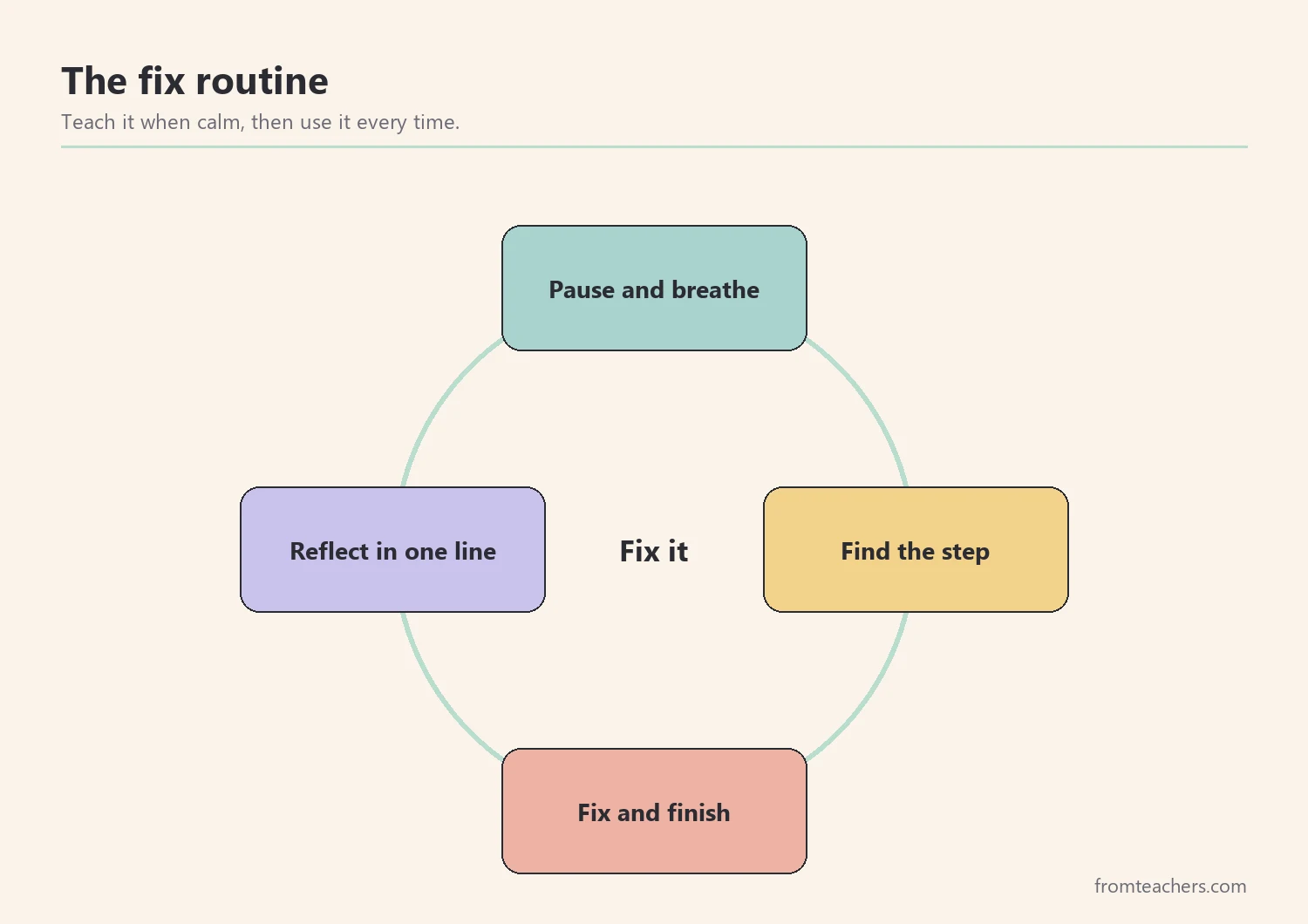
- Pause: take one slow breath and put the pencil down.
- Find: look for the exact step where it went wrong.
- Fix: correct that step and finish the problem.
- Reflect: say what to do next time in one short sentence.
Teach the routine when the student is calm, not in the middle of a hard moment. For instance, practice with a “mystery mistake” you made on purpose. Students act as detectives, walk through the four steps, and explain the fix. That way the routine is familiar before it is really needed.
For Leo, his teacher printed the four steps on a small strip taped to his desk. During the first week, she pointed to each step as he worked through a mistake. By the third week, Leo touched the strip himself and worked through the steps quietly. His reflection sentences were short, such as “Next time I will line up my numbers.”
Keep the routine the same across subjects. Whether the mistake is in spelling, math, or a science lab, the four steps still apply. Consistency helps students carry the habit of learning from mistakes into every part of the day.
5. Practice owning mistakes without blame
Blaming is one of the most common reactions, and it is worth teaching around directly. Students often blame the pencil, a classmate, or the clock because admitting a mistake feels risky. Give them a respectful way to own it instead.
First, teach a short phrase: “I made a mistake, and I can fix it.” Practice saying it in a calm, matter-of-fact tone. Next, role-play quick scenarios: a spelling error, a spilled paint cup, or a wrong answer read aloud. Students practice the phrase and one fix for each.
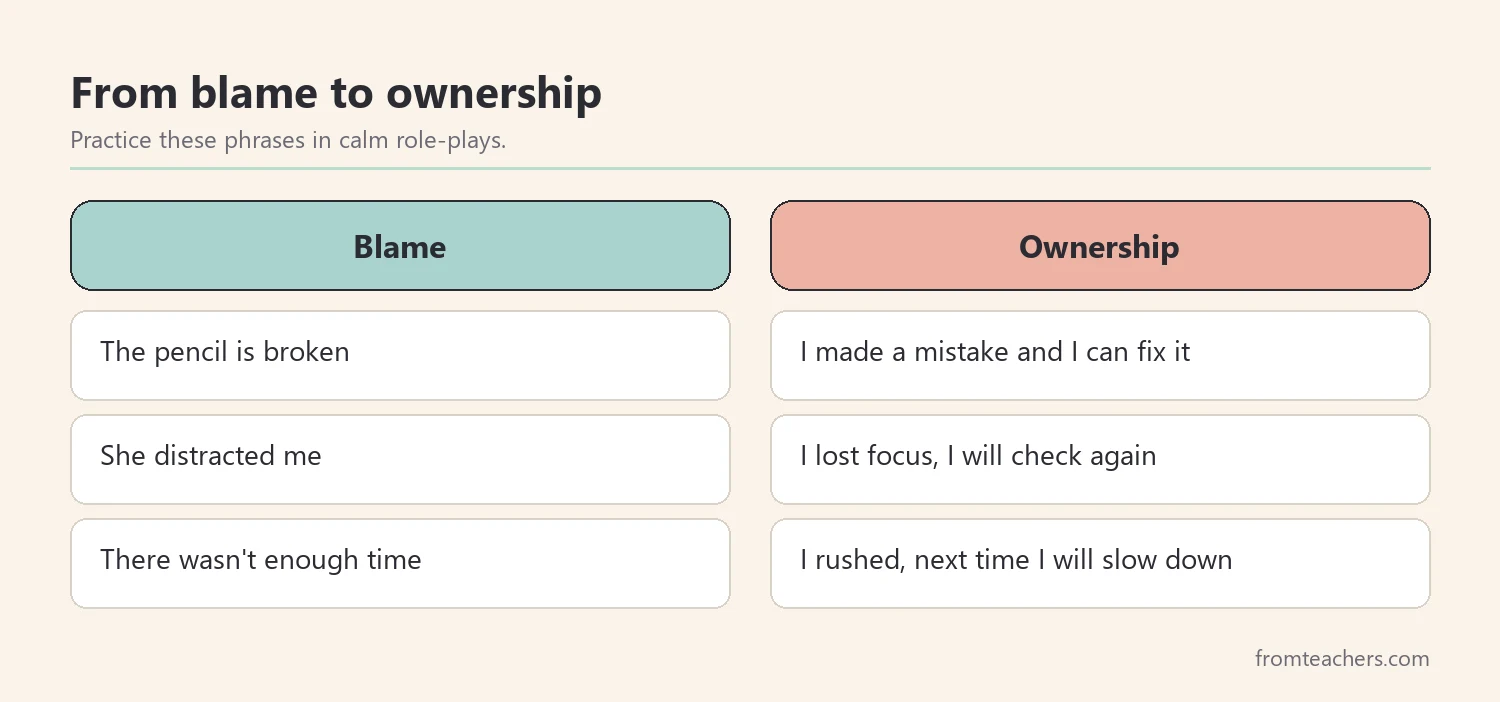
When a student does blame, respond without arguing. For instance: “Maybe the pencil was tricky. What is one thing you can do to fix this problem?” That response accepts the feeling but steers back to action. Over time, students need the blame less because they know the adult will not shame them.
For Leo, the blaming dropped once his teacher stopped debating whose fault it was. She simply said, “Let’s fix it,” and pointed to his routine strip. When Leo used the phrase “I made a mistake and I can fix it” on his own, she noticed it quietly: “You owned that and fixed it. That’s what learners do.”
Also, acknowledge honesty more than accuracy. Students learning from mistakes need to feel that admitting an error is safe and even respected in your classroom.
6. Track progress and celebrate small wins
Change in how a student handles mistakes is often slow, so a simple record helps you see it. Choose two or three measures, keep them the same each week, and review them every few weeks.
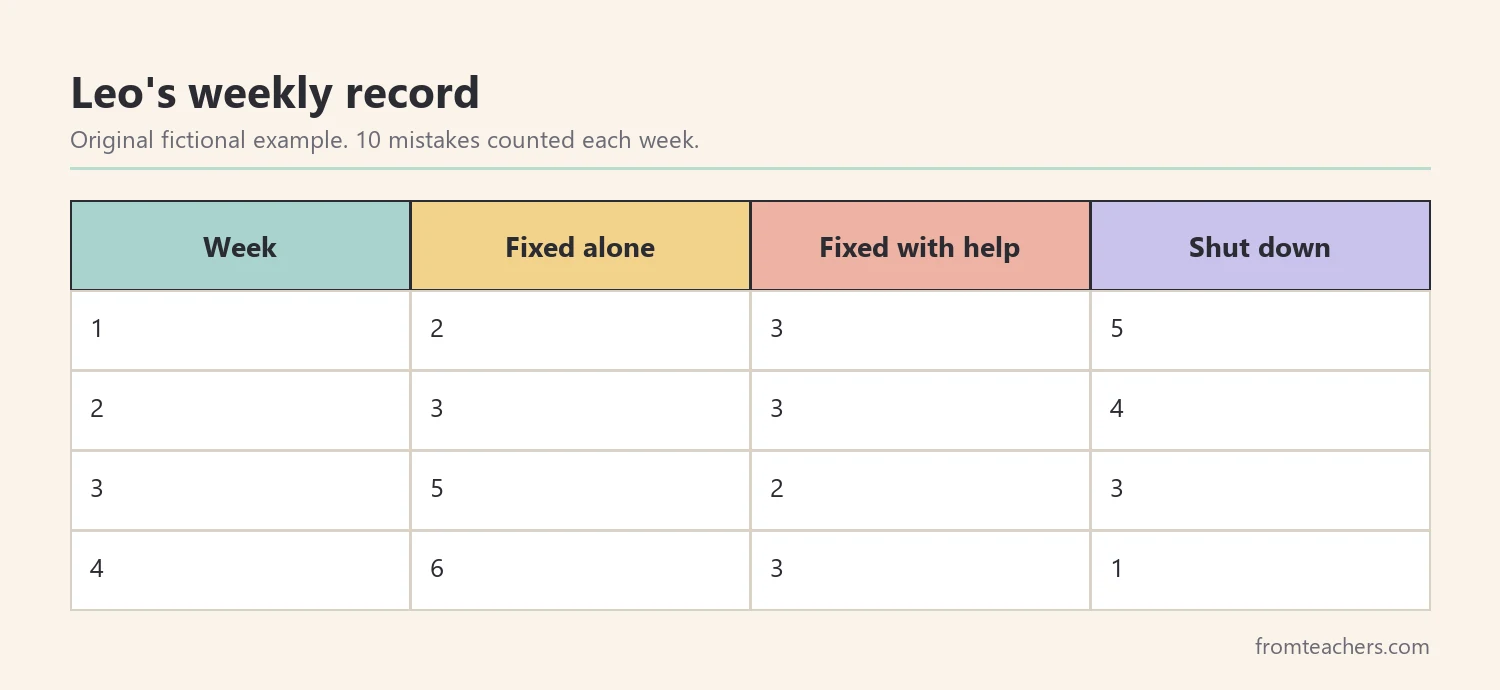
For Leo, his teacher counted ten mistakes in a sample session each Friday and sorted what happened next. In week one, he fixed 2 on his own, fixed 3 with help, and shut down on 5. By week four, he fixed 6 on his own, fixed 3 with help, and shut down on only 1. Each week still adds up to ten, which makes the change easy to see.
Share wins with the student in a concrete way. For example: “Four weeks ago you shut down on five mistakes. Today it was one, and you fixed six by yourself.” Specific feedback helps students believe that learning from mistakes is working for them.
In addition, review the record with the student every two weeks. Ask what helped most and what still feels hard. Students who see their own numbers often take more ownership of learning from mistakes, because the progress is theirs to explain. You can also invite the student to set a small target, such as shutting down on no more than two mistakes next week.
Keep the tracking light. A tally sheet on a clipboard is enough, and it should take less than a minute per session. If tracking starts to feel like a burden, reduce it to one measure rather than stopping entirely, since steady data is what makes learning from mistakes visible to everyone on the team.
Finally, share progress with families. A short note about one new habit, such as using the four-step routine, gives parents words to use at home with homework.
Common mistakes and how to avoid them
- Lecturing in the moment. Fix: use one calm script, then point to the next step.
- Praising only correct answers. Fix: also notice effort, honesty, and good fixes.
- Arguing about blame. Fix: acknowledge the feeling and redirect to the fix.
- Teaching the routine during a meltdown. Fix: practice when calm with planned mistakes.
- Expecting fast change. Fix: track a few measures weekly and look for trends.
Questions teachers and parents ask about learning from mistakes
What age can students start learning from mistakes this way?
The scripts and routine work well in elementary and middle school. Younger children need shorter phrases and more modeling. Older students can handle more reflection and goal setting.
What if a student tears up every worksheet?
Start by staying calm and offering a fresh copy without comment. Later, when the student is calm, practice the fix routine with low-stakes work. If the reaction is intense or frequent, talk with the family and school team.
Should I correct every mistake I see?
No. Focus on a few errors that matter most for the lesson. Too many corrections at once can overwhelm a student and make the reaction worse.
How can parents support learning from mistakes at home?
Parents can use the same short phrases during homework and model owning their own small mistakes. Calm, brief responses at home make the classroom routine stronger.
Is this the same as growth mindset?
It is related. Growth mindset is about believing abilities can develop. This guide focuses on specific actions and words for the moments right after a mistake.
Related reading: Moving Beyond Shame and Behavior Charts: Positive Alternatives, 5 Practical Teaching Tips to Boost Classroom Focus and Learning, and Essential Trauma-Informed Teaching Strategies for Modern Classrooms.
A companion resource for learning from mistakes:
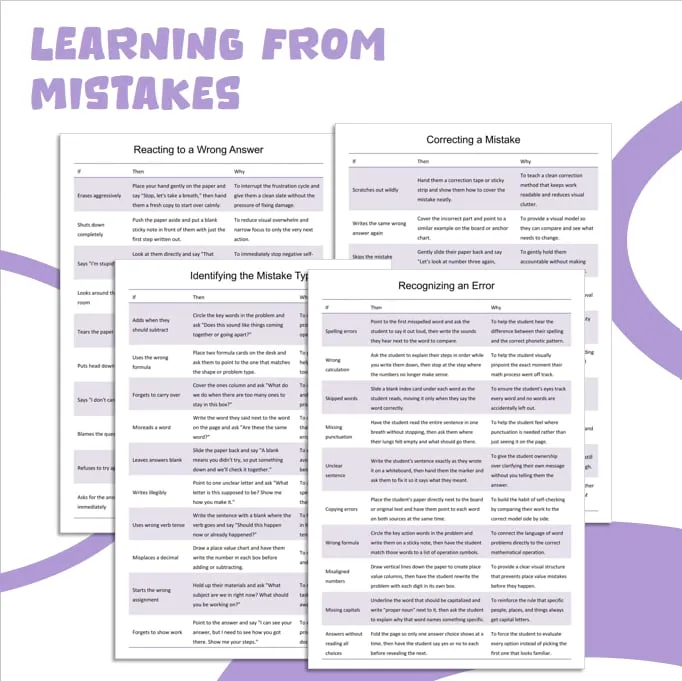
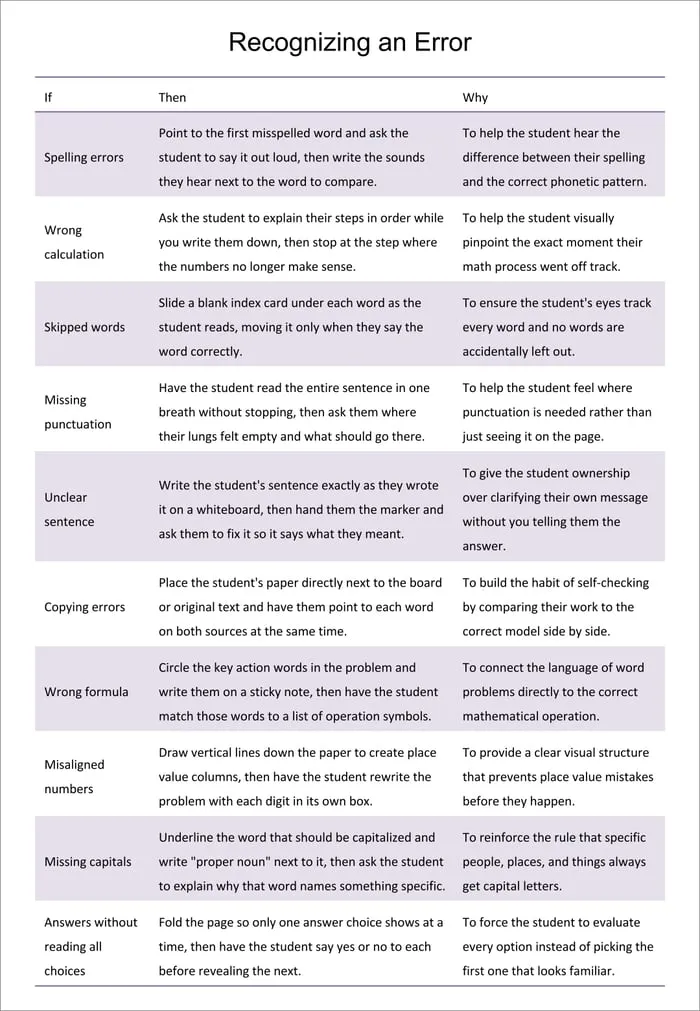
Learning from Mistakes: twelve pages of If, Then, and Why tables for reacting to wrong answers, correcting errors, and naming mistake types, with word-for-word phrases and a section on accepting responsibility.
Sources and scope
- CASEL: a framework for social and emotional learning, including self-management and responsible decision-making.
- Center on the Developing Child, Harvard University: background on self-regulation and executive function skills.
- American Psychological Association: general resources on child development and resilience.
- What Works Clearinghouse: reviews of education research and practice guides.
This guide covers classroom and home routines for helping students respond to everyday academic mistakes. It does not cover anxiety disorders, clinical behavior support, or mental health treatment, which belong to qualified professionals and the student’s team.
Key takeaways
- Learning from mistakes starts with a calm, short adult response.
- Use If, Then, Why scripts so your words are ready before the hard moment.
- Teach students to name the mistake type and choose the matching fix.
- Practice a pause, find, fix, reflect routine and owning mistakes without blame.
- Track a few simple measures weekly and celebrate specific progress.






Leave a Comment