

Teacher observation feedback often goes wrong in the ten minutes after a lesson. The observer has three pages of notes, the teacher has a class waiting, and the conversation ends with a vague “nice job” or a long list nobody remembers. A week later, nothing in the classroom has changed, and both people feel the visit was wasted.
This guide walks you through a simple, repeatable process. By the end, you will be able to plan a focused visit, collect notes that are evidence instead of opinion, write feedback that is specific and balanced, lead a calm follow-up conversation, and check whether anything actually improved.
Examples are fictional. Adapt to the teacher’s goals and your school’s agreed process. This is guidance, not an evaluation policy.
At a glance
- Agree on one or two focus areas before you walk into the room.
- Write down what you see and hear, not what you think of it.
- Link every comment to evidence and keep strengths and growth areas in balance.
- Use the follow-up talk to agree on one next step the teacher owns.
- Return within two weeks to see whether the next step worked.
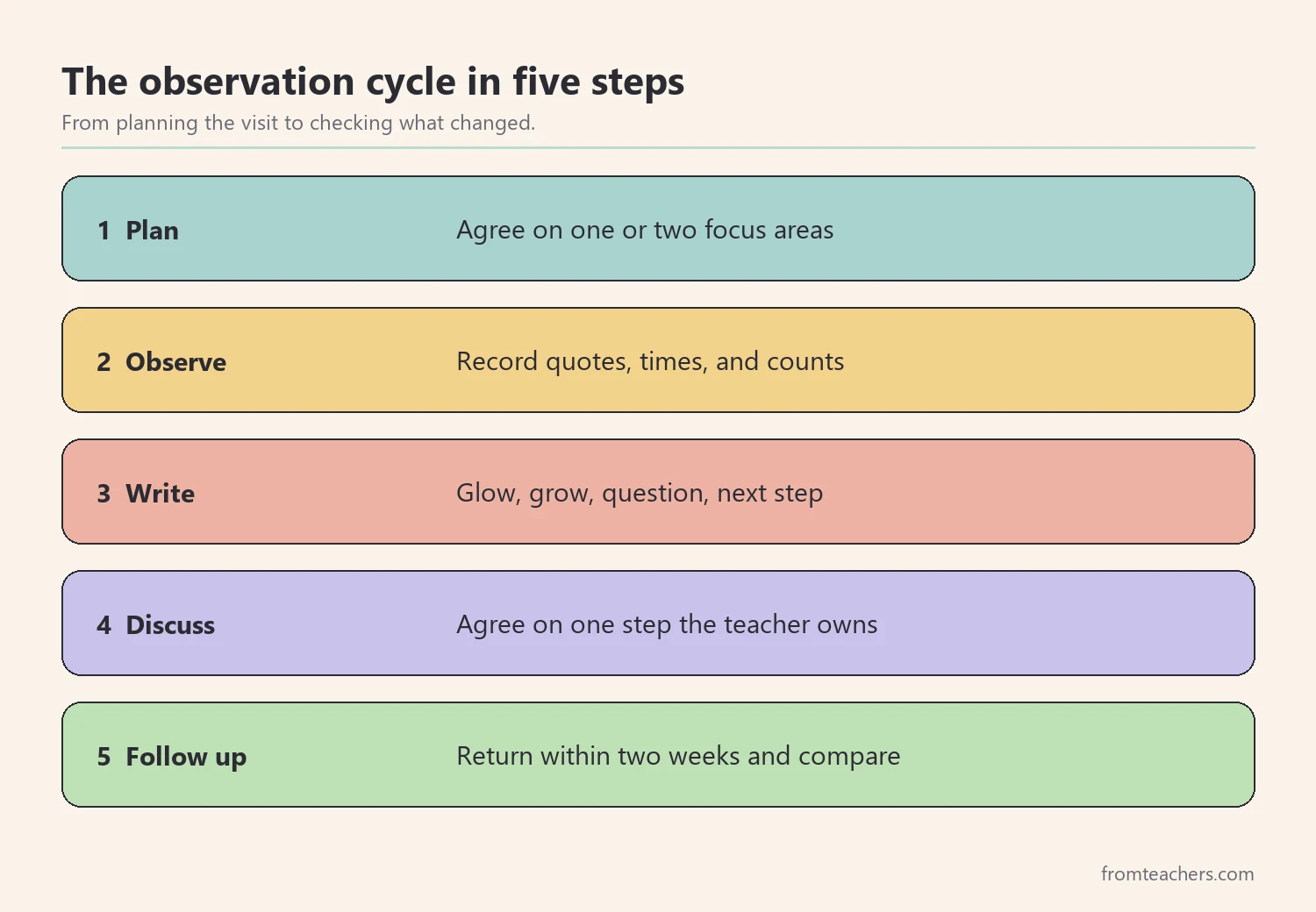
1. Plan the visit before you give teacher observation feedback
Good teacher observation feedback starts before the observation. When the observer and the teacher agree on a focus ahead of time, the visit has a purpose. Without that, the observer tends to notice whatever stands out most, which is often the least important thing.
First, hold a short pre-conference of five to ten minutes. Ask the teacher what the lesson is about, what students should be able to do by the end, and what they would like a second pair of eyes on. Next, pick one or two focus areas, not six. Common choices include lesson objectives, student engagement, questioning, pacing, differentiation, and classroom routines.
Also, ask how the teacher prefers to receive teacher observation feedback: a written note first, a conversation first, or both together.
Then, agree on practical details: when you will arrive, how long you will stay, where you will sit, and when you will meet afterward. Finally, confirm that the visit is for growth. Teachers relax when they know the purpose and the timeline.
Here is our fictional example. Ms. Carter is an instructional coach. Mr. Diaz teaches grade 5 and is planning a fractions lesson. In the pre-conference, he says students rush through partner work and he wants to know whether his directions are clear. Together they choose two focus areas: clarity of directions and student talk during partner work.
| Pre-conference question | Mr. Diaz’s answer |
|---|---|
| What is the lesson goal? | Compare fractions with unlike denominators |
| What should I watch? | Directions and partner talk |
| When do I visit? | Tuesday, 25 minutes, back table |
| When do we meet? | Wednesday at 3:15 |
In short, the pre-conference decides what the teacher observation feedback will be about. When the teacher chooses the focus, the feedback later feels like an answer to their own question rather than a surprise.
As a result, Ms. Carter now knows what to look for, and Mr. Diaz knows what she will and will not comment on.
2. Observe and record evidence, not opinions
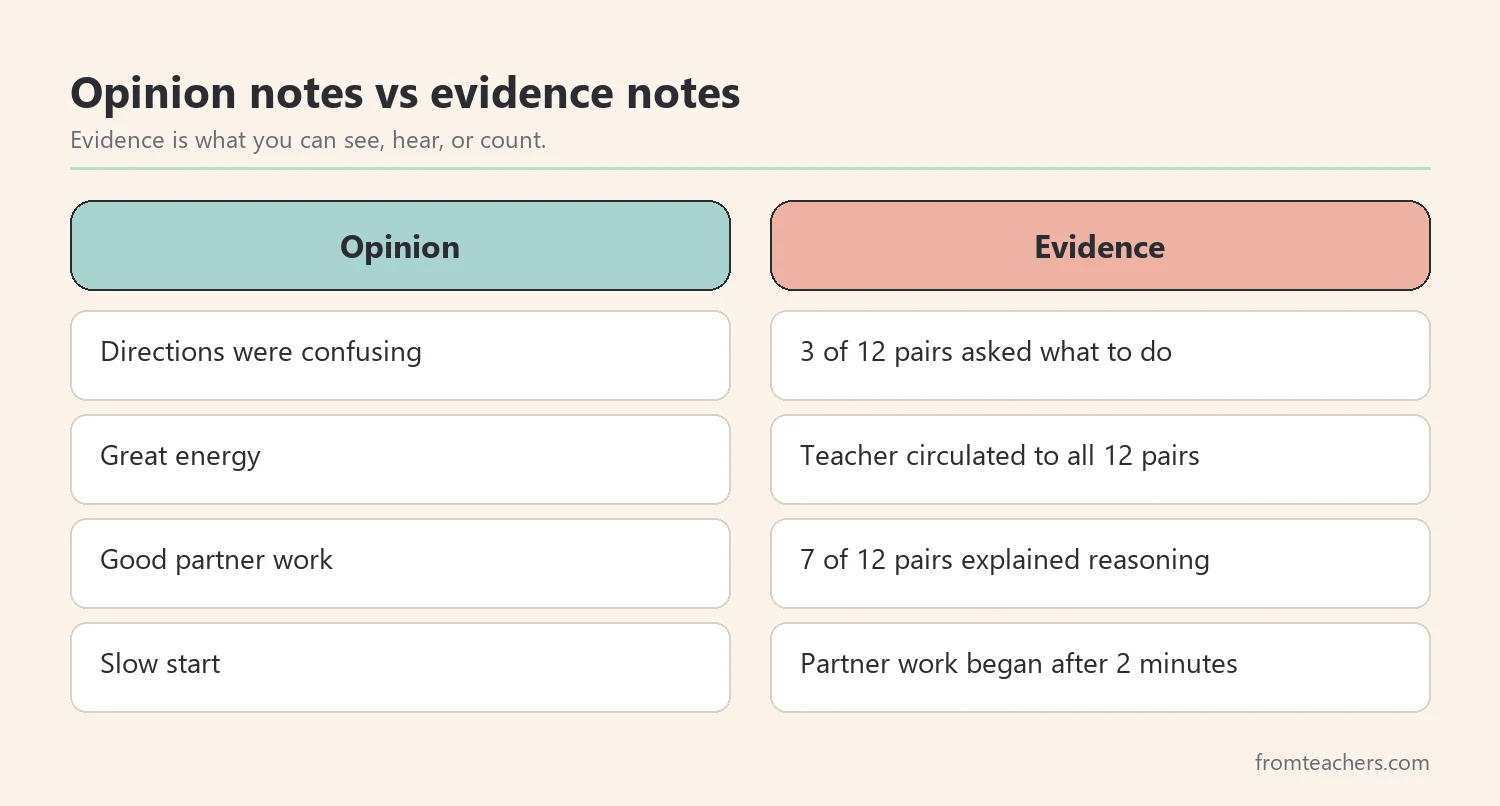
During the visit, your only job is to collect evidence. Evidence is what you can see or hear: words the teacher says, what students do, how many students respond, how long a transition takes. Opinions are labels such as “engaging,” “chaotic,” or “great energy.” Opinions are not wrong, but they are hard to act on and easy to argue with.
To keep notes neutral, use a few habits. Write down exact quotes when you can. Note times in the margin so you can see pacing later. Count instead of guessing: how many hands went up, how many pairs were talking about fractions. In addition, stay focused on the agreed areas. If you notice something important outside the focus, jot it on a separate line for later, but do not let it take over.
A short evidence table helps. Here are three lines from Ms. Carter’s notes in Mr. Diaz’s room.
| Time | Evidence | Focus area |
|---|---|---|
| 10:04 | Teacher gives four steps orally, no visual | Directions |
| 10:06 | Three of 12 pairs ask “What do we do?” | Directions |
| 10:10 | Seven of 12 pairs explain their reasoning aloud | Partner talk |
Notice that nothing in this table judges Mr. Diaz. However, the pattern is already visible: some pairs were unsure of the directions, and most pairs did talk about the math. Because the numbers come from counting, both people can trust them.
Clean evidence is the raw material of teacher observation feedback. If the notes are vague, the feedback will be vague too, no matter how carefully you word it later.
Finally, before you leave, note one or two clear strengths. Strengths are evidence too, and they matter. Mr. Diaz used a warm, calm voice and circulated to every table, which Ms. Carter wrote down with times.
3. Write teacher observation feedback that is specific and balanced
Once the visit ends, turn your evidence into written teacher observation feedback. Aim for a short document the teacher can read in three minutes. Long reports feel like a verdict. Short, focused notes feel like support.
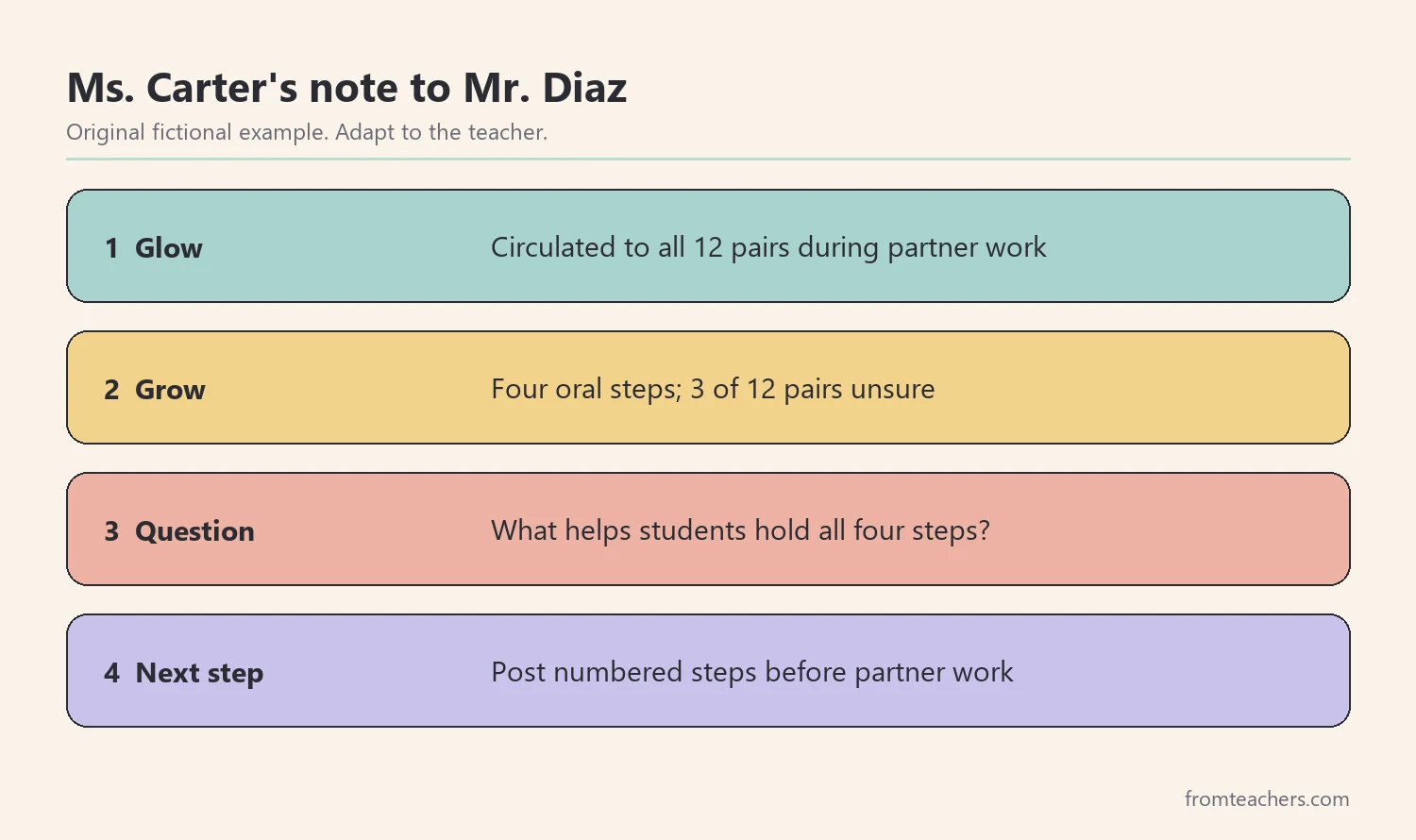
A reliable structure has four parts. First, a glow: one or two strengths with evidence. Second, a grow: one area for growth with evidence. Third, a question: something that invites the teacher to reflect. Fourth, a suggested next step that is small and practical. Keep each part to one to three sentences.
Here is how Ms. Carter wrote hers:
- Glow: You circulated to all 12 pairs during partner work, and 7 of 12 pairs explained their reasoning aloud when you checked in.
- Grow: Directions were given orally in four steps, and 3 of 12 pairs asked what to do in the first two minutes.
- Question: What might help students hold all four steps in mind once you stop talking?
- Next step to discuss: Post the steps on the board or a slide before partner work starts.
Notice how each sentence names something observable. Also, the numbers line up: 12 pairs in total, 7 talking about reasoning, 3 unsure of directions. Accurate numbers build credibility.
If you want a ready-made structure for this step, a fillable teacher observation and feedback form can guide the observer through sections such as classroom environment, instructional strategies, and student engagement so that comments stay specific and balanced.
Before you send it, read your teacher observation feedback once more and ask a simple question: could the teacher picture the exact moment each sentence describes? If not, add the time, the quote, or the count.
Above all, avoid the “compliment sandwich” when it hides the real message. Teachers can tell when praise is filler. Instead, make strengths real and specific, and state the growth area plainly and kindly.
4. Lead the follow-up conversation
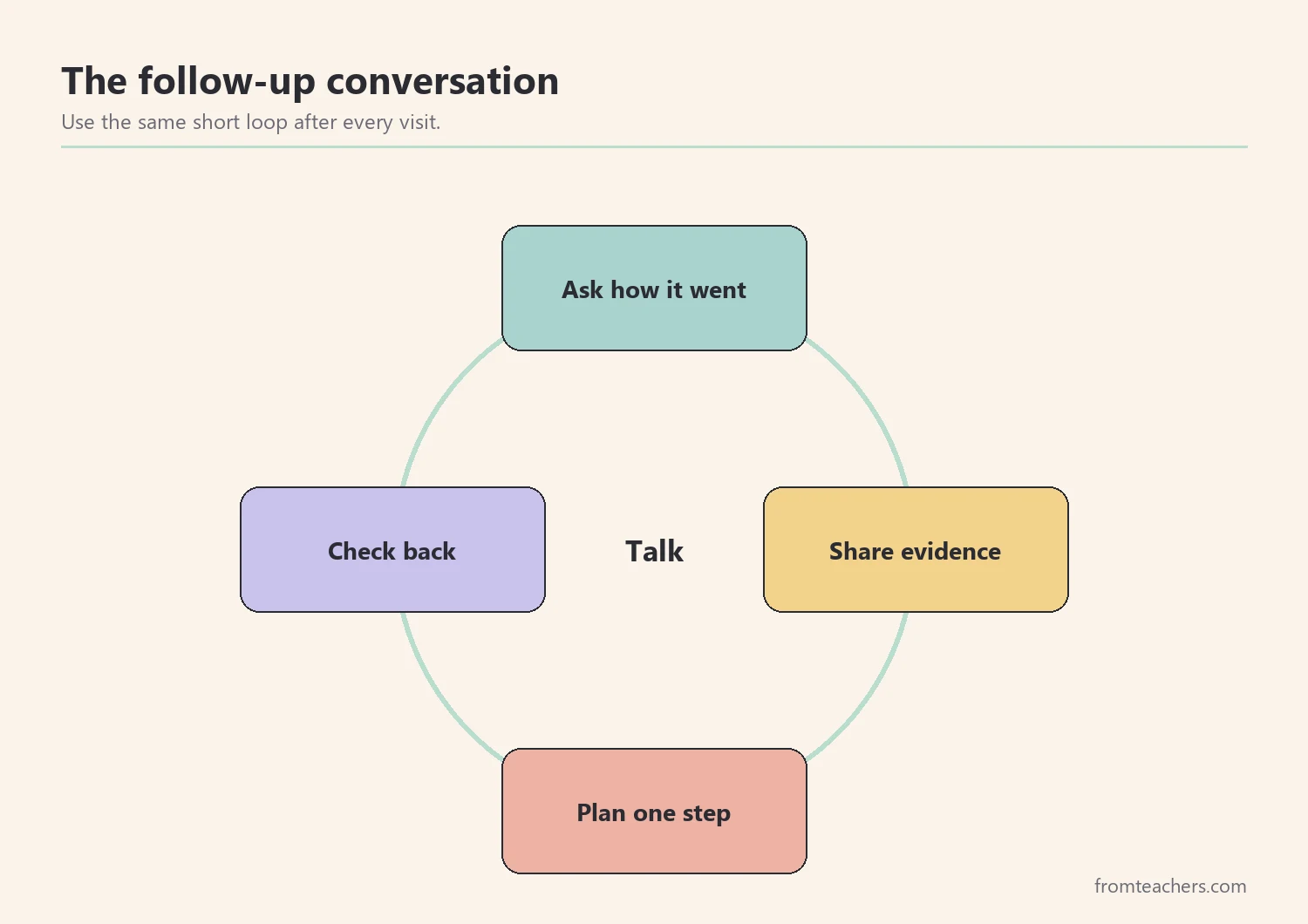
The written note opens the door, but the conversation is where change happens. Ideally, meet within 24 to 48 hours, while the lesson is still fresh. Keep the meeting to about 20 minutes and sit side by side, not across a desk, if you can.
Start by asking the teacher how they felt the lesson went. Often the teacher will name the same growth area you noticed, which makes the rest of the talk easier. Then share the glow with evidence. Next, share the grow, again with evidence, and pause. Silence gives the teacher time to think.
After that, ask the reflective question and let the teacher propose ideas first. People commit more to plans they help write. Your role is to offer options if the teacher is stuck, not to dictate. Finally, agree on one next step, write it down, and set a date to check in.
In our example, Mr. Diaz says he noticed the confusion too. He suggests writing the four steps on a slide and asking one student to repeat them before partners begin. Ms. Carter agrees and adds one option: number the steps so pairs can say which one they are on. They settle on both, with a check-in visit in ten school days.
| Talk phase | Sample phrase |
|---|---|
| Open | “How do you think the lesson went?” |
| Strength | “Here is what I saw that worked.” |
| Growth | “Here is a pattern I noticed.” |
| Plan | “What would you like to try first?” |
Spoken teacher observation feedback should match the written note. If the conversation introduces new concerns, the teacher may feel the goalposts moved, so save extra topics for a later cycle.
As a rule, end with a summary in one sentence and thank the teacher for opening their room. Trust is the foundation for every future visit.
5. Follow up so teacher observation feedback leads to change
Even excellent teacher observation feedback does little if nobody returns to see what happened. A short follow-up visit, often 10 to 15 minutes, closes the loop. It also tells the teacher that the next step mattered.
First, look only at the agreed next step. Do not start a new full observation. Second, collect the same kind of evidence as before so you can compare fairly. Third, share what changed and ask the teacher what they noticed. Then decide together whether to keep going, adjust, or choose a new focus.
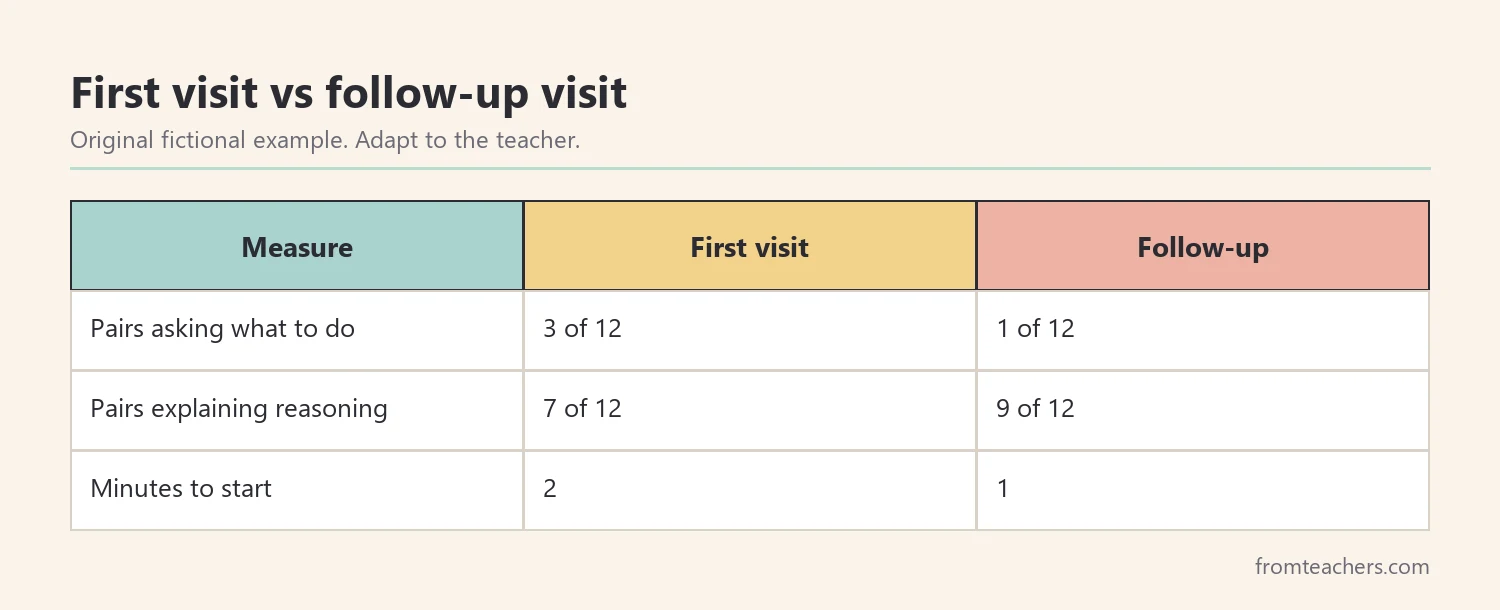
Back in Mr. Diaz’s room, Ms. Carter returns ten school days later. This time, the four numbered steps are on a slide and one student repeats them aloud. Ms. Carter counts again.
| Measure | First visit | Follow-up |
|---|---|---|
| Pairs asking “What do we do?” | 3 of 12 | 1 of 12 |
| Pairs explaining reasoning | 7 of 12 | 9 of 12 |
| Minutes to start partner work | 2 | 1 |
In other words, the change was small and real. Mr. Diaz decides to keep the numbered slide and asks to focus next on questioning during whole-class discussion. The cycle starts again with a new pre-conference.
This is the moment teacher observation feedback proves its value. A number that moved, even slightly, shows the teacher that the time spent together was worth it.
Over a school year, these small loops add up. Keep a simple log of each focus, next step, and result. It becomes a useful record for coaching conversations and for the teacher’s own professional growth goals.
Common mistakes and how to avoid them
- Watching everything at once. Fix: agree on one or two focus areas in a pre-conference and stay with them.
- Writing opinions instead of evidence. Fix: record quotes, times, and counts, then add interpretation later.
- Giving a long list of suggestions. Fix: choose one next step the teacher can try within a week.
- Delaying the conversation. Fix: meet within 24 to 48 hours while the lesson is still fresh for both people.
- Treating teacher observation feedback as a one-time event. Fix: plan it as a cycle with a clear next visit.
- Never coming back. Fix: schedule a short follow-up visit before you leave the first meeting.
- Mixing coaching with formal evaluation without saying so. Fix: state the purpose of the visit clearly at the start.
Questions teachers and parents ask about teacher observation feedback
How long should teacher observation feedback be?
Short is usually better for teacher observation feedback. One strength, one growth area, one question, and one next step fit on half a page. Teachers can act on that, while a long report often gets filed away.
Should the teacher see the notes?
In most coaching settings, yes. Sharing the raw evidence builds trust and lets the teacher check the facts. Follow your school’s policy for formal evaluations, which may have their own rules.
What if the teacher disagrees with the feedback?
Go back to the evidence and ask what the teacher saw from their position. Often both views are partly right. If you still disagree, agree to look at the same moment again during a short follow-up visit.
How often should observations happen?
That depends on your school and role. Many coaches prefer short, frequent visits over one long visit per year, because small cycles make it easier to notice change. Agree on a rhythm with the teacher at the start of the year.
Can peers give teacher observation feedback?
Yes. Peer teacher observation feedback can be very useful. Peer observation be very useful when both teachers agree on the focus and use the same evidence-based structure. Keep it clearly separate from formal evaluation so the conversation stays open.
Related reading: Reflect & Plan: A Teacher’s New Year Guide, 5 Practical Teaching Tips to Boost Classroom Focus and Learning, and The Power of Data Tracking in Special Education.
A companion resource for teacher observation feedback:
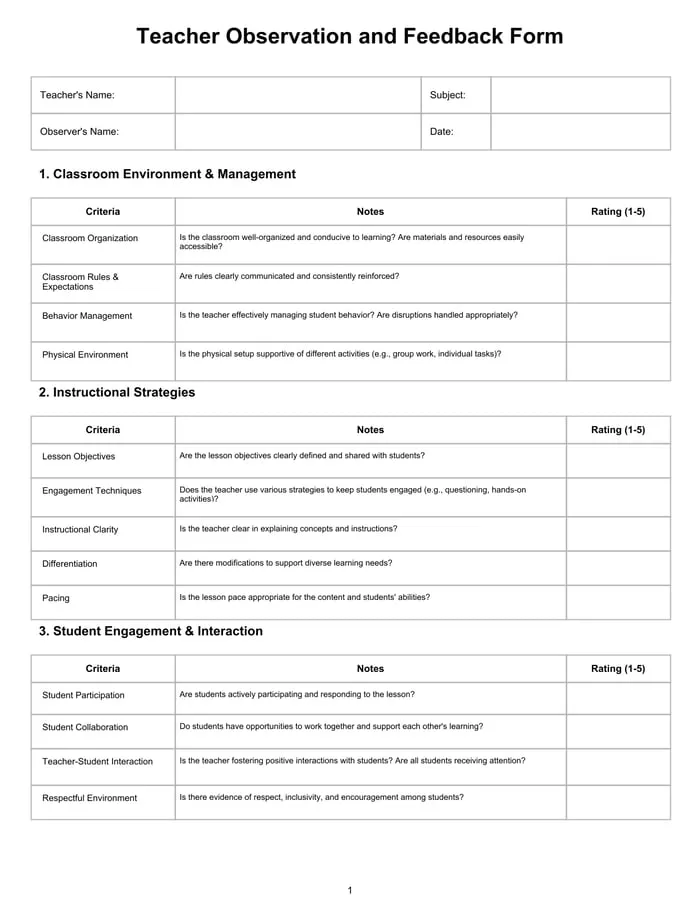
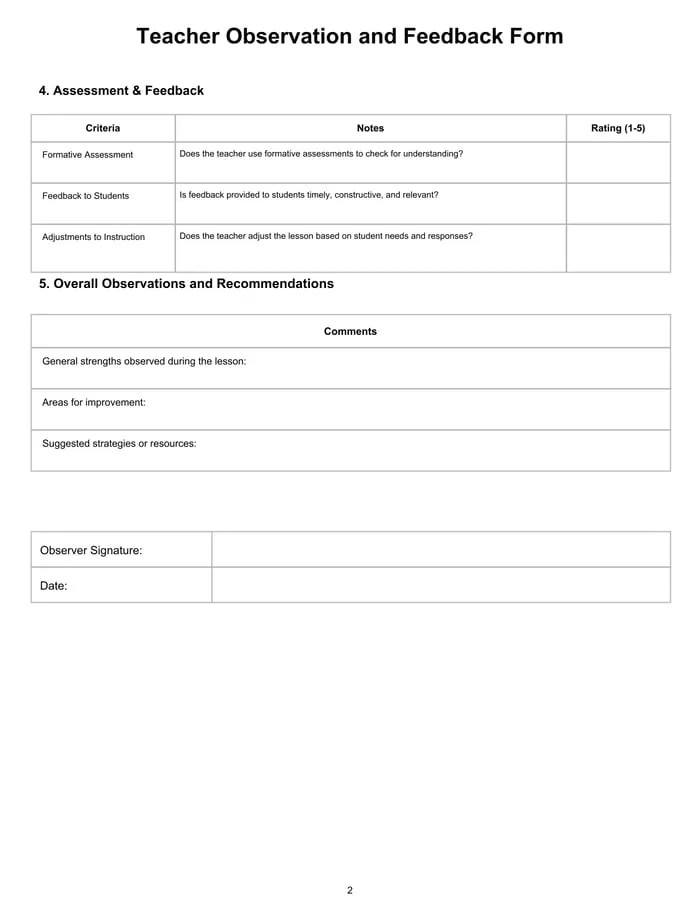
Teacher Observation and Feedback Form: a fillable PDF that walks an observer through classroom environment and management, instructional strategies, and student engagement and interaction, so feedback stays specific, balanced, and easy to act on.
Sources and scope
- Learning Forward: a professional association focused on professional learning and coaching for educators.
- The Danielson Group: home of the Framework for Teaching, widely used to describe effective teaching practice.
- ASCD: an education organization publishing practical articles on instructional coaching and leadership.
- Institute of Education Sciences: the research arm of the U.S. Department of Education.
This guide covers growth-focused observation and coaching conversations. It does not replace your district’s formal evaluation procedures, contracts, or legal requirements.
Key takeaways
- Plan teacher observation feedback with a short pre-conference and one or two focus areas.
- Collect evidence such as quotes, times, and counts instead of labels.
- Write a short note: glow, grow, question, and one next step.
- Let the teacher help choose the next step during a calm conversation.
- Return for a short follow-up visit to see what changed.


Leave a Comment