

Dyslexia support at home works best as a short, calm routine that happens most days, not as long, tearful homework battles. Picture a second grader at the kitchen table after school. He knows the story his class read today and can retell it with detail, yet he stalls on the word “said” for the third time and pushes the book away. His parent wants to help but is not sure what kind of practice actually builds a reader.
In addition, this guide offers five steps families and teachers can use together. You will understand what dyslexia is and is not, build a fifteen-minute daily routine, practice words in multisensory ways, make homework manageable, and track progress with the school. Each step follows the same fictional child so you can picture it at your own table.
Examples are fictional. Adapt to the student’s goals and agreed supports. This is guidance, not a diagnosis.
At a glance
- Dyslexia affects how the brain processes written language, not intelligence or effort.
- A short, predictable daily routine beats long, irregular practice sessions.
- Multisensory practice links sounds, letters, and movement.
- Separate reading practice from homework content so both feel manageable.
- Use the same words and tools as school, and track one simple measure.
1. Understand dyslexia before starting dyslexia support at home
First, start with a clear picture. Dyslexia is a learning difference that affects how the brain connects sounds to letters and words. It is not about intelligence, effort, or laziness. Many children with dyslexia have strong vocabulary, creativity, and reasoning.
Next, clear away common myths. Children with dyslexia do not see letters backward in a literal sense, though letter reversals can be part of early reading difficulty for many children. More practice of the same kind will not always help; the type of practice matters. And dyslexia does not go away with time, but children can become capable readers with the right teaching.
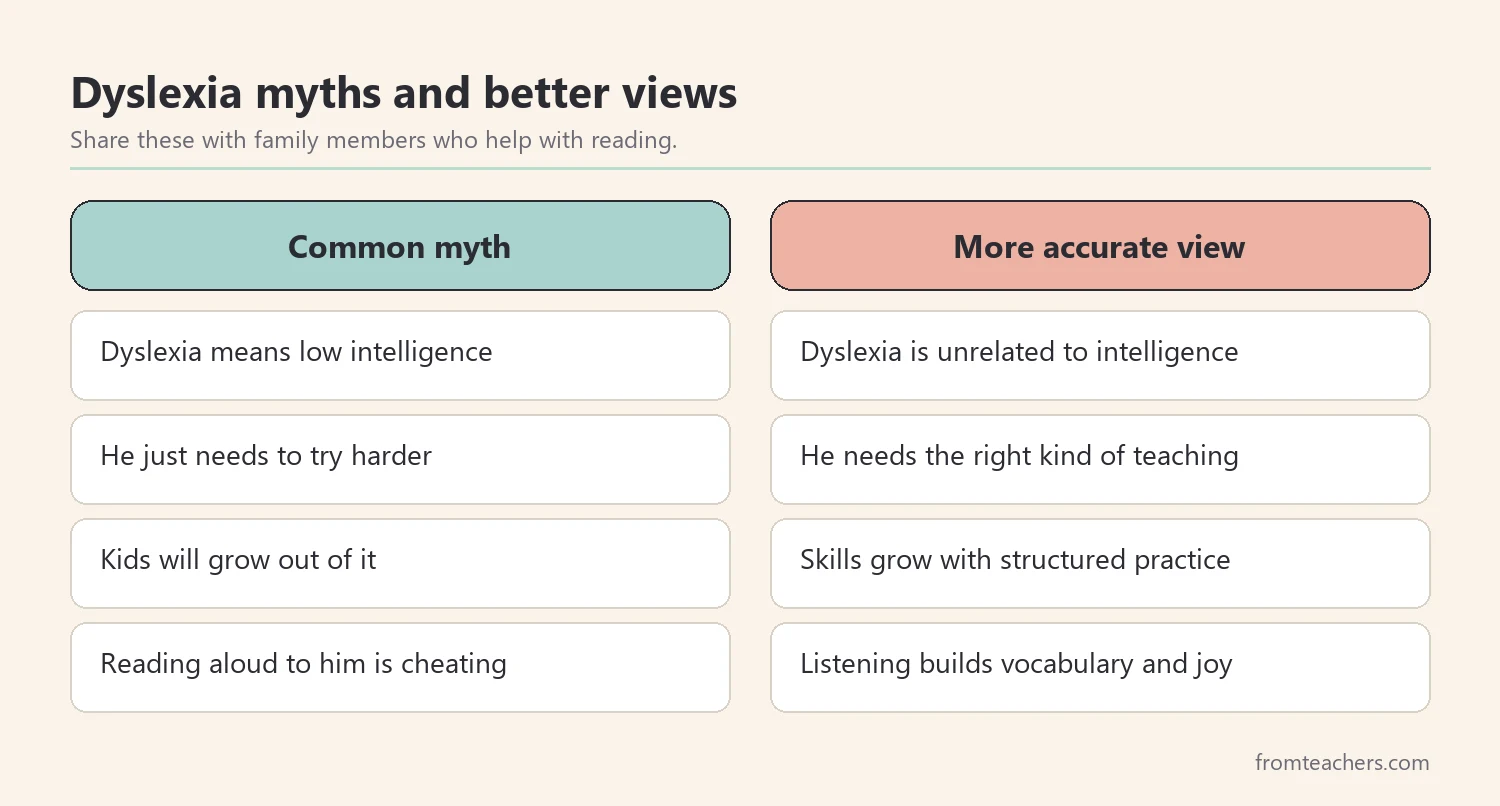
| Myth | More accurate view |
|---|---|
| Dyslexia means low intelligence | Dyslexia is unrelated to intelligence |
| He just needs to try harder | He needs the right kind of teaching |
| Kids will grow out of it | Skills grow with structured practice |
| Reading aloud to him is cheating | Listening builds vocabulary and love of books |
For example, meet Ethan, a fictional second grader whose school has identified reading difficulties consistent with dyslexia. He tells long, funny stories and builds detailed Lego cities. Reading, though, feels like hard labor. He has started to say “I’m dumb” when he gets stuck.
Put this step into practice
So the first goal of dyslexia support at home is emotional. Ethan’s parents tell him that his brain learns reading in a different way, and that his teachers and family will help him learn it. They also name his strengths often. A child who feels capable is far more willing to practice.
Finally, ask the school what Ethan is learning. If his class or intervention group uses a structured literacy program, home practice should use the same sounds, rules, and words.
In addition, involve siblings and grandparents carefully. Everyone who helps should use the same calm approach and the same words for sounds. When adults are consistent, dyslexia support at home feels predictable and safe to the child.
2. Build a fifteen-minute daily routine for dyslexia support at home
Short and steady wins. Fifteen focused minutes, most days of the week, often do more than an hour on Sunday. A predictable routine also lowers stress because the child knows exactly what will happen and when it will end.
Here is a simple four-part routine. It adds up to fifteen minutes.
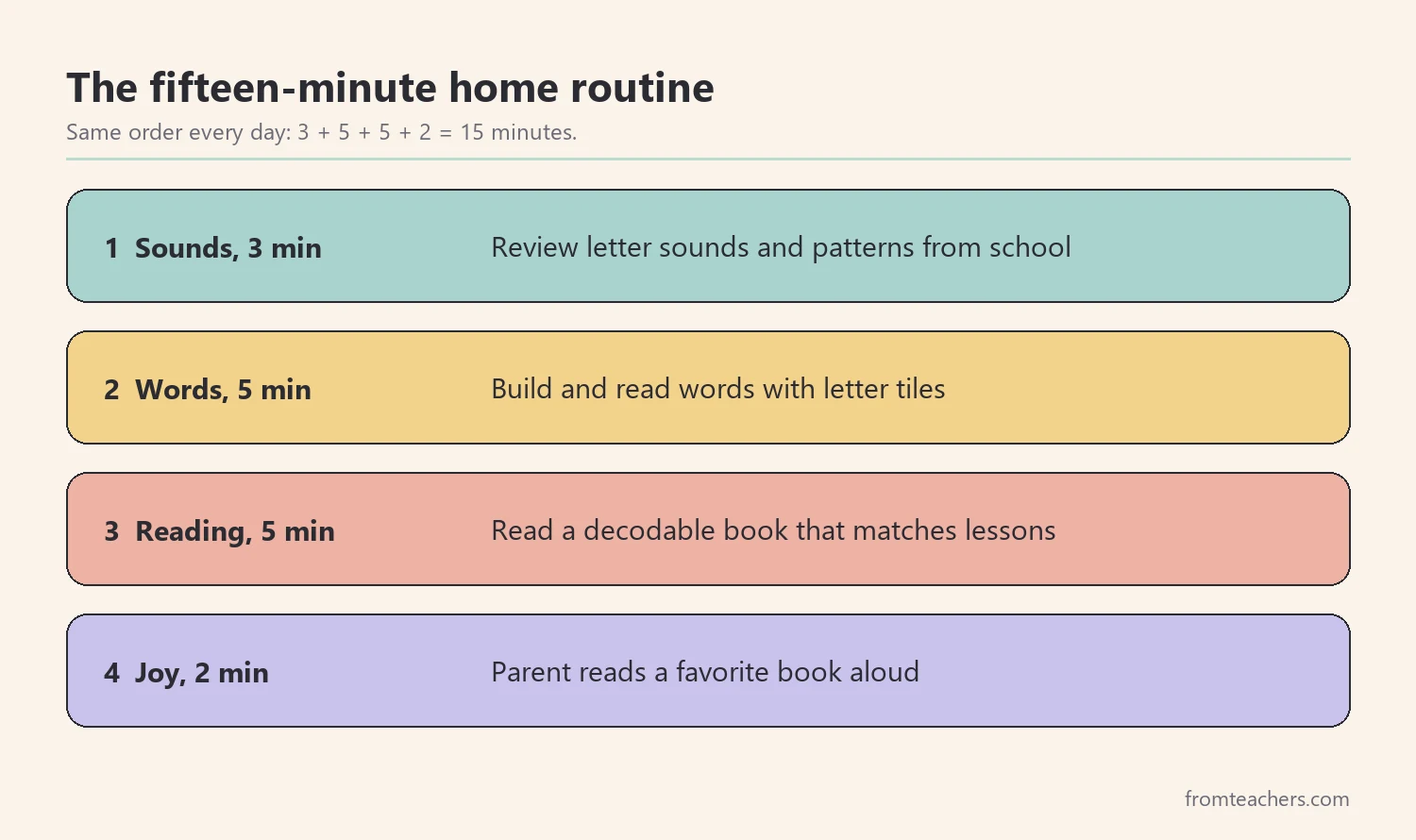
First, a three-minute sound warm-up. Review letter sounds and patterns the school is teaching, using cards. Second, five minutes of word work, such as building and reading words with those patterns. Third, five minutes of connected reading in a decodable book that matches what Ethan has learned. Fourth, two minutes of shared reading for joy, where the parent reads a favorite book aloud.
Next, choose a regular time and place. For Ethan, it is right after snack at the kitchen table, with a visual timer. When the timer ends, practice ends, even if things are going well. That promise builds trust.
A quick classroom example
Also, keep the mood light. Praise effort and specific wins, such as “You blended that word all by yourself.” When Ethan gets stuck, give the sound or the word calmly and move on. Dyslexia support at home should feel safe, not like a test.
If you want ready materials, the dyslexia support toolkit for classroom and home strategies includes simple home reading routines, homework tips, multisensory routines, and printable reading trackers.
Finally, count the days that happen, not the ones you miss. Some evenings are too busy. Aim for most days, and treat the routine as a habit, not a chore.
Moreover, let the child have some control. Ethan chooses the decodable book from two options and picks which game ends the session. Small choices increase willingness, and willingness is the fuel of effective dyslexia support at home.
3. Practice words in multisensory ways
Children with dyslexia often learn better when they see, hear, say, and touch at the same time. Multisensory practice links the sound of a letter to its shape and the movement used to write it.
Here are simple options for home. Trace letters in a tray of sand or salt while saying the sound. Tap out sounds on your arm or fingers, one tap per sound, then sweep to blend. Build words with letter tiles and read them aloud. Write tricky words in large letters on a whiteboard while naming each letter.
| Activity | Senses used | Best for |
|---|---|---|
| Sand tray tracing | Touch, sight, hearing | Letter-sound links |
| Finger tapping | Touch, hearing | Blending and segmenting |
| Letter tiles | Sight, touch, speech | Building and reading words |
| Big whiteboard writing | Movement, sight, speech | Tricky words |
For Ethan, the hardest words are irregular high-frequency words like “said,” “was,” and “they.” His parent uses a “say, trace, write” routine. Ethan says the word, traces it on a card while naming each letter, and then writes it from memory. Five words per week is enough.
Make it stick
In addition, practice spelling the same way. Ask Ethan to tap the sounds in a word before he writes it. This links spelling to the sound patterns he is learning, instead of asking him to memorize shapes.
Meanwhile, keep sessions playful. Turn word work into a short game, such as reading tile words to “unlock” a toy. Multisensory practice is a core part of effective dyslexia support at home, and play keeps it from feeling like extra school.
Then review the words often. A word practiced once is easily forgotten, while a word reviewed for several days in a row starts to stick. Keep a small box of mastered words and mix three of them into each session. This spaced review is a simple, powerful habit for dyslexia support at home.
4. Make homework manageable with dyslexia support at home
Homework can easily become the hardest part of the day. A child who has worked hard on reading all day may be tired by evening. So separate reading practice from homework content when possible.
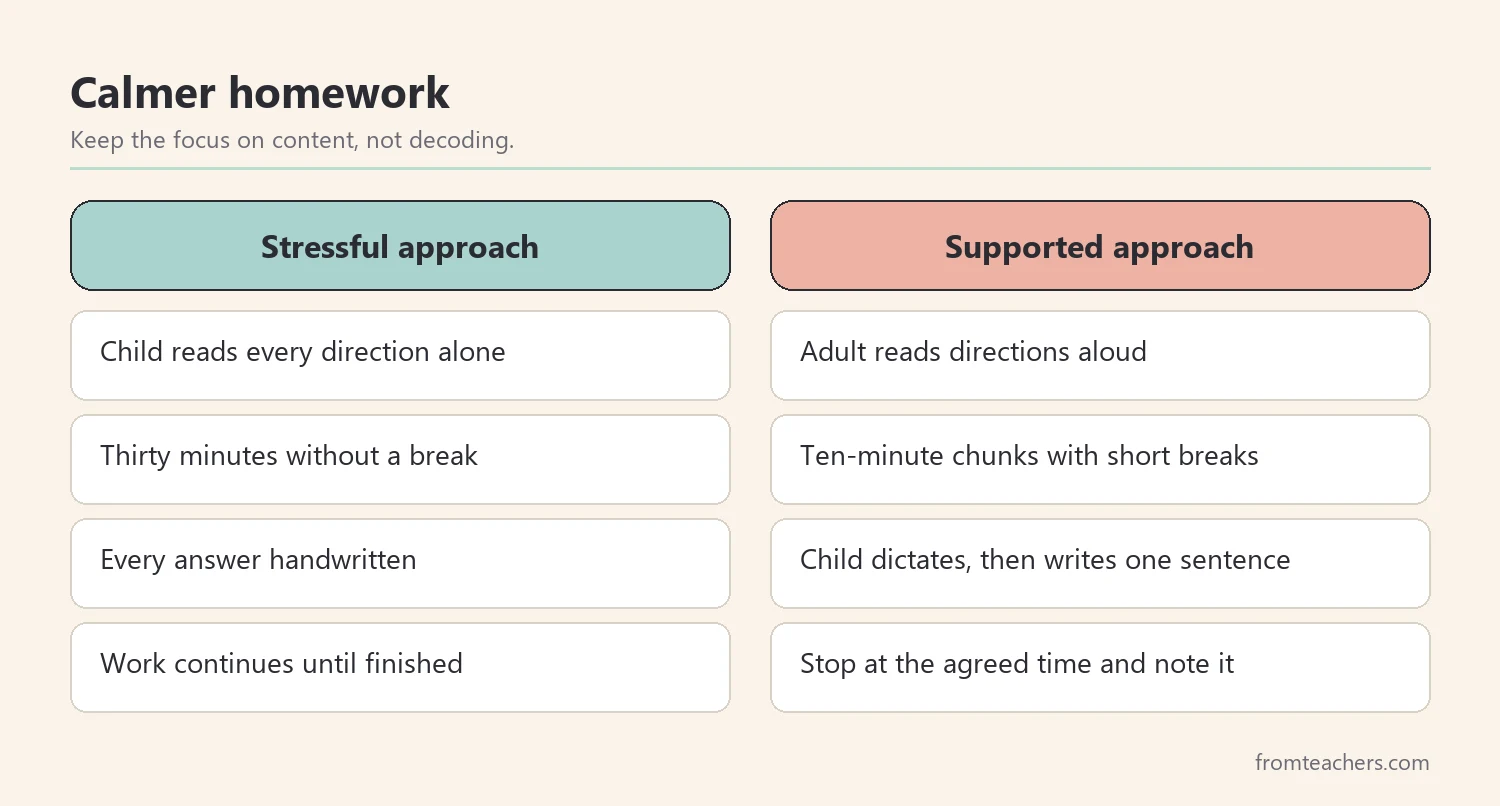
First, read assignment directions aloud. If the homework is about science or social studies, the goal is the content, not the reading. Reading the text aloud, or using an audiobook when available, lets the child focus on the ideas.
Next, break tasks into short chunks with breaks. Ten minutes of work, a two-minute movement break, then ten more minutes is easier than thirty minutes straight. A simple checklist on a sticky note helps the child see the end.
Then, let the child show knowledge in other ways when the teacher allows it. Ethan can dictate an answer while his parent writes it, then copy one sentence himself. Ask the teacher which supports are acceptable for homework, so you stay consistent with school.
What this looks like day to day
Also, know when to stop. If homework regularly takes much longer than the teacher expects, write a short note saying how long Ethan worked and what he finished. Teachers need this information to adjust. Honest communication is part of good dyslexia support at home.
Finally, protect time for joy. Reading aloud to Ethan, listening to audiobooks in the car, and talking about stories all build vocabulary and a love of books, even when his own reading is still developing.
Also, watch for signs that a child is overwhelmed, such as headaches before homework, tears, or refusal. These are signals to shorten tasks and talk with the teacher, not to push harder. Gentle, realistic dyslexia support at home protects the child’s relationship with learning.
5. Partner with school and track dyslexia support at home
Home and school work best as one team. Regular, short communication keeps practice aligned and shows everyone what is working.
For example, start by asking the teacher three questions: Which sounds and patterns is Ethan learning now? Which words should we practice? How can we tell if he is making progress? The answers shape your home routine.
Next, track one simple measure. Ethan’s family uses a Friday check of 10 practice words from the week. They count how many he reads correctly on the first try.
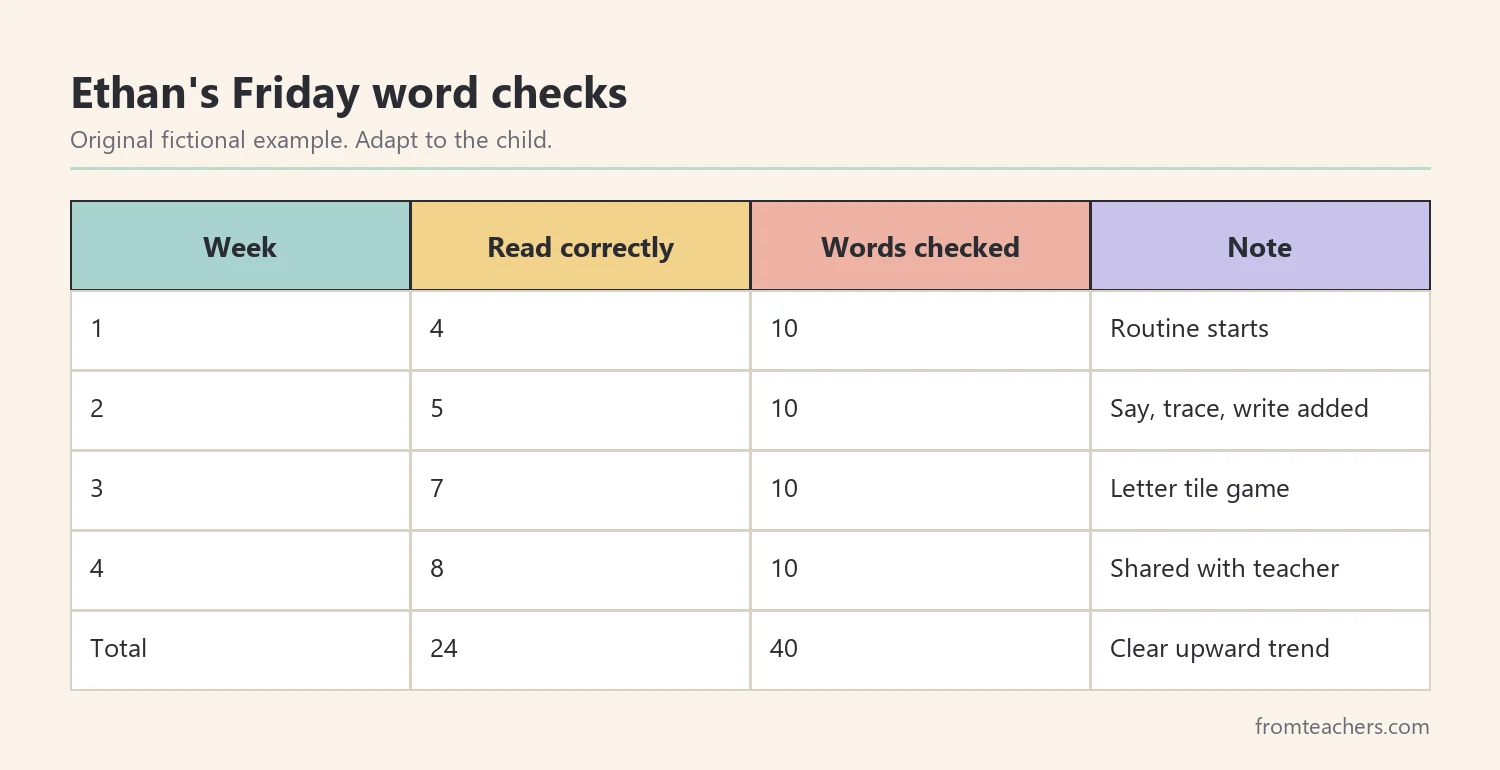
In week 1, Ethan read 4 of 10 words correctly. By week 2, he read 5 of 10. In week 3, he read 7 of 10, and in week 4, he read 8 of 10. That is 24 of 40 words over the month, with a clear upward trend. His parents share the chart with his teacher at a short check-in.
Keep it simple
Then prepare for school meetings. Write down what you see at home, what is working, and your questions. Bring your tracker. Clear notes help the team understand the full picture and make decisions together.
Also, celebrate growth. Ethan’s family adds a sticker to the chart every Friday, whatever the score. The message is simple: practice matters, and he is getting stronger. Consistent dyslexia support at home builds both skill and confidence over time.
Lastly, remember that progress is rarely a straight line. Some weeks will be flat or even dip, especially after illness or holidays. Look at the trend over a month or more, and keep the routine going. Patient, steady dyslexia support at home pays off over time.
Common mistakes and how to avoid them
- Long weekend practice sessions. Children tire and lose interest. Fix: use a short daily routine instead.
- Practicing different methods than school. Children get confused. Fix: ask the teacher which sounds, rules, and words to use.
- Making the child read every homework text. Content gets lost in decoding. Fix: read content texts aloud and save reading practice for the routine.
- Correcting every error. Confidence drops. Fix: give the word calmly and praise specific wins.
- Stopping read-alouds. Vocabulary and love of books suffer. Fix: keep shared reading every day.
Questions teachers and parents ask about dyslexia support at home
How much time should dyslexia support at home take each day?
About fifteen focused minutes most days works well for many young children. Consistency matters more than length. Older children may handle a little more, depending on energy and school workload.
Should I correct every mistake when my child reads?
No. Give the word or sound calmly and keep going. Focus feedback on one or two patterns the child is learning, and praise specific successes.
Is listening to audiobooks cheating?
No. Audiobooks build vocabulary, knowledge, and a love of stories. They work alongside, not instead of, direct reading practice.
What should I ask the school about dyslexia support at home?
Ask which sounds and patterns your child is learning, which words to practice, and how progress is measured. Also ask which homework supports are acceptable. Matching home practice to school makes it much more effective.
Can teachers use the same routine in class?
Yes. The same short structure, sound warm-up, word work, connected reading, and shared reading, fits small group intervention well. Using similar routines at home and school helps the child connect the two.
Related reading: Dyslexia in Education Guide, Dyslexia Solutions for the Classroom, and Parent and Teacher Collaboration in Special Education.
A companion resource for dyslexia support at home:


Dyslexia Support Toolkit: Classroom and Home Strategies: a 49-page guide with a plain-language explanation of dyslexia, myths and facts, classroom supports, multisensory routines, phonics pages, home reading routines, homework tips, meeting prep, and printable trackers.
Sources and scope
- International Dyslexia Association: information on dyslexia and structured literacy for families and educators.
- Understood.org: practical articles for parents on reading difficulties and homework.
- What Works Clearinghouse: practice guides on foundational reading skills.
- IDEA, U.S. Department of Education: the law behind special education evaluations and services.
This guide covers everyday home and classroom routines for children with reading difficulties. It does not cover diagnosis or formal intervention programs, which belong to qualified professionals and the school team.
Key takeaways
- Dyslexia support at home starts with a clear, strengths-based understanding.
- Use a short, predictable routine most days.
- Practice letters and words with multisensory activities.
- Separate homework content from reading practice.
- Match school methods, track one measure, and celebrate growth.




Leave a Comment