

Specific learning disability accommodations work when they match the exact barrier a student faces, not the label on a file. Picture a fourth grader who understands every science discussion, then freezes when the worksheet asks her to read three paragraphs and write a summary. She is not lazy or unwilling. The reading and writing are blocking her from showing what she knows.
This guide walks you through five steps to choose, use, and review accommodations in reading, writing, and math. You will pinpoint the barrier, match supports to each subject, put them into daily routines, and check whether they help. Each step follows the same fictional student so you can see the full process in a real classroom.
Examples are fictional. Adapt to the student’s goals and agreed supports. This is guidance, not a diagnosis.
At a glance
- Start with the specific barrier: decoding, fluency, spelling, handwriting, or math facts.
- An accommodation changes how a student learns or shows learning, not what is expected.
- Choose a small set of supports per subject instead of a long generic list.
- Teach the student to use each accommodation, then build it into routines.
- Track one measure per subject and review it with the IEP or 504 team.
1. Pinpoint the barrier before choosing specific learning disability accommodations
First, remember that a Specific Learning Disability, or SLD, looks different in every student. One child struggles with decoding words. Another reads well but cannot spell. A third understands math concepts but cannot recall basic facts quickly. Because of this, specific learning disability accommodations must start with the exact barrier.
A helpful question is “won’t or can’t?” When a student avoids a task, it is easy to assume a motivation problem. However, avoidance often means the task is blocked by a skill the student does not yet have. Asking this question shifts the plan from consequences to supports.
Next, gather a few pieces of evidence. Look at work samples, listen to the student read, and watch how they approach writing and math. Also, read the student’s evaluation and IEP, which describe the areas of need. Then write down the barrier in plain words.
| Area | Possible barrier | What you may see |
|---|---|---|
| Reading | Decoding or fluency | Slow, effortful reading, guessing words |
| Writing | Spelling or handwriting | Short answers, avoids writing |
| Math | Fact recall or number sense | Finger counting, runs out of time |
For example, meet Nora, a fictional fourth grader with an SLD in reading and written expression. She has strong vocabulary and loves science talk. Her evaluation describes slow decoding and frequent spelling errors. In class, she leaves most written answers unfinished.
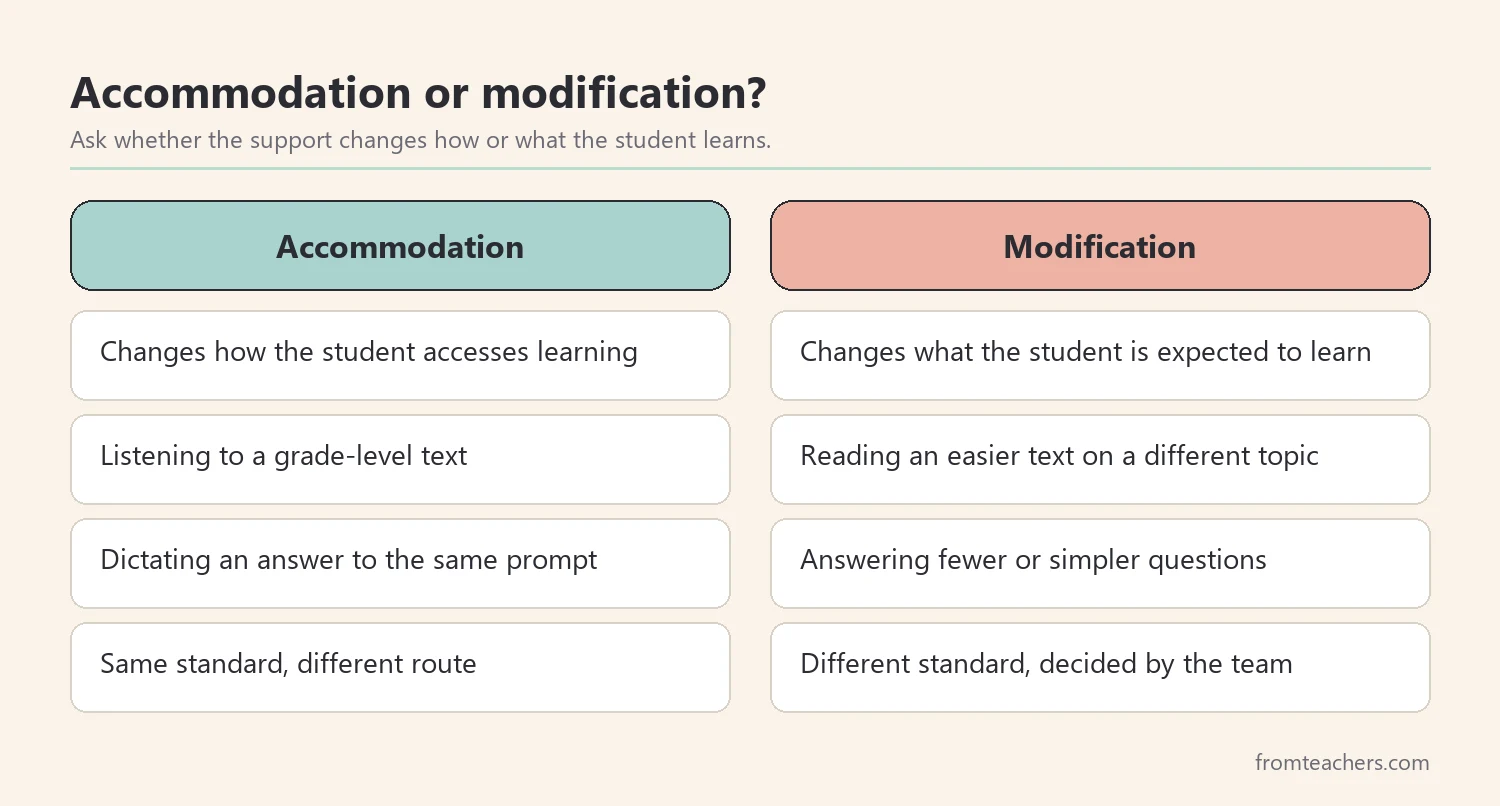
Finally, separate accommodations from modifications. An accommodation changes how Nora accesses or shows learning, such as listening to a text. A modification changes what she is expected to learn, such as a shorter list of standards. This guide focuses on accommodations, which keep expectations the same.
2. Choose reading specific learning disability accommodations
Once you know the barrier, choose reading supports that remove it without lowering the thinking. For a student with slow decoding, the goal is to separate reading the words from understanding the ideas.
Common reading accommodations include audiobooks or text-to-speech, a read-aloud of test directions, extra time, reduced reading load per page, and highlighted key passages. A reading guide or ruler can help students who lose their place. Each one targets a slightly different need, so choose with care.
| Reading need | Accommodation |
|---|---|
| Slow decoding | Audiobook or text-to-speech for content texts |
| Losing place | Reading guide strip or ruler |
| Long passages | Chunked text with one question per section |
| Timed tasks | Extra time, as listed in the IEP |
For Nora, the team chooses two reading supports for science and social studies: text-to-speech for longer texts and chunked passages with one question after each section. During her reading intervention block, she still practices decoding directly. Specific learning disability accommodations support access to content. They do not replace skill instruction.
Also, check that the accommodation is actually available. Text-to-speech only helps if the device works, the text is digital, and the student knows how to use it. A quick setup check at the start of the week avoids frustration.
If you want a ready menu, the SLD support toolkit for reading, writing, and math accommodations includes separate accommodation sections for each subject, plus classroom systems for directions, copying, and organization.
Then think about how the class sees the support. When audiobooks or chunked texts are available to everyone, using them feels normal. Nora is more likely to use her supports if they do not single her out.
Meanwhile, watch for signs of fatigue. Reading with a decoding barrier takes a lot of energy. If Nora is exhausted by the end of a long text, specific learning disability accommodations such as text-to-speech protect her energy for the thinking part of the lesson.
3. Choose writing accommodations that protect ideas
For many students with an SLD, writing is where ideas get lost. Spelling, handwriting, and organizing sentences all compete for attention at once. Therefore, good writing supports let the student focus on one part at a time.
Useful options include speech-to-text, a word bank of key vocabulary, sentence starters, graphic organizers, and reduced copying from the board. Grading content separately from spelling on content assignments also helps students show what they know.
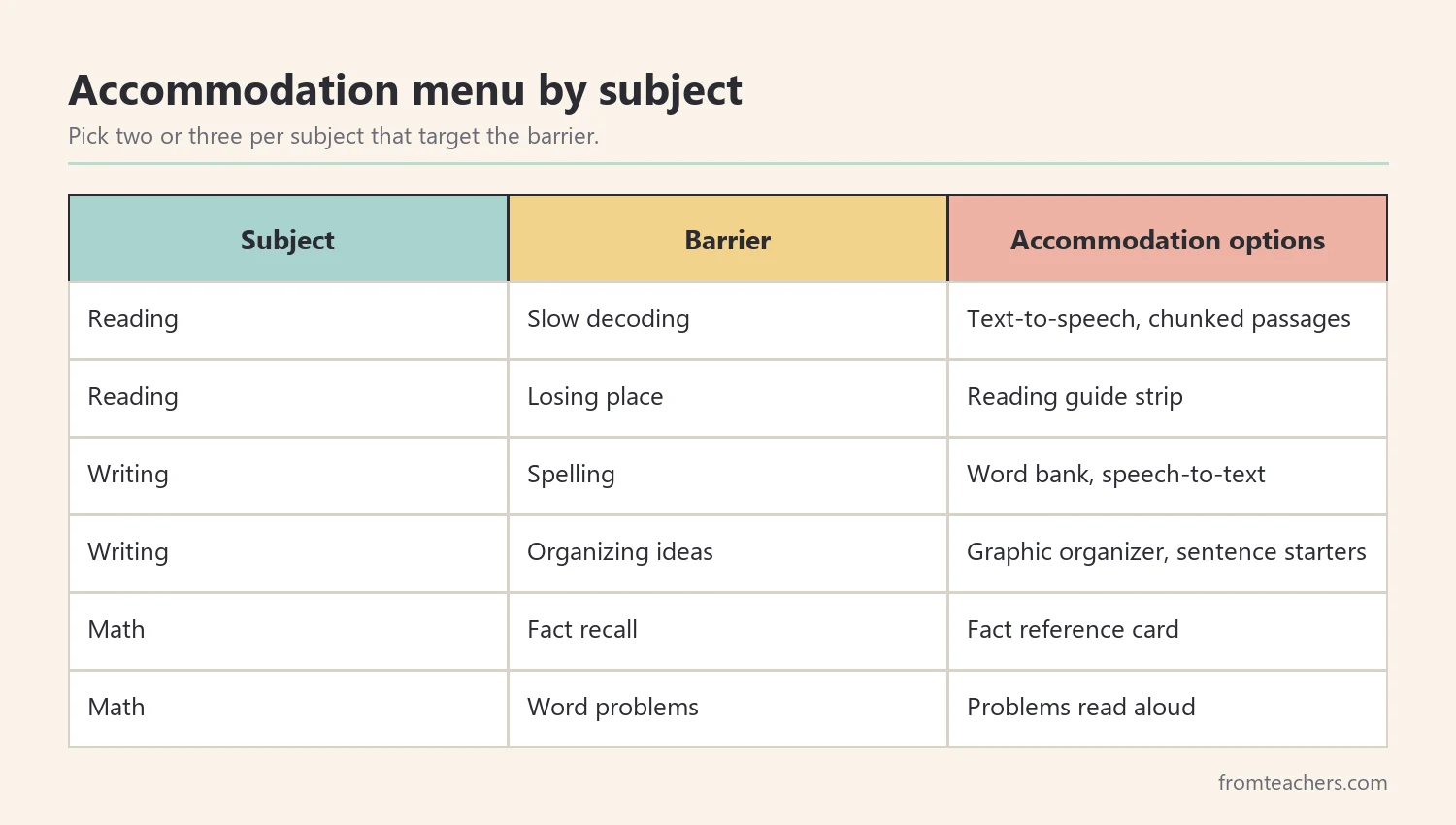
For Nora, the team picks three writing supports. First, she uses a graphic organizer to plan her answer. Second, she has a word bank for science terms. Third, she can dictate her first draft with speech-to-text, then edit it with a checklist. Her spelling practice continues during intervention, where it is the target skill.
Next, reduce copying. Copying notes from the board takes a long time for students with spelling or handwriting challenges. A printed copy of notes with a few blanks to fill keeps Nora engaged without wasting her energy on copying.
Also, teach the student to use each support. A graphic organizer is only useful if Nora knows how to fill it in. Model it with the class, practice it together, and then let her use it on her own. Specific learning disability accommodations become powerful when students can use them independently.
In addition, check that teachers in every subject know the plan. Writing supports often start in English class and then disappear in science or social studies. A one-page summary of specific learning disability accommodations, shared with every teacher, keeps support consistent across the day.
4. Plan math specific learning disability accommodations
Math SLD may involve number sense, fact recall, or multi-step procedures. The key idea is concept first. Let the student show understanding of the concept even if quick fact recall is not there yet.
Helpful math supports include a multiplication chart or fact reference card, manipulatives, graph paper to line up numbers, worked examples, and fewer problems with the same skill coverage. Reading word problems aloud also helps students whose reading barrier spills into math.
| Math need | Accommodation |
|---|---|
| Fact recall | Fact reference card during problem solving |
| Lining up numbers | Graph paper or column guides |
| Multi-step problems | Worked example and step checklist |
| Word problems | Problems read aloud |
For Nora, math concepts are a relative strength, but word problems are hard because of reading. So her main math accommodation is having word problems read aloud. She also uses a step checklist for multi-step problems.
Moreover, keep the distinction clear. A fact card during a problem-solving lesson is an accommodation, because the goal is reasoning. During a fact fluency check, though, the card would remove the skill being measured. Decide with the team when each support applies.
Finally, use errors as teaching moments. When Nora makes a mistake, ask her to explain her thinking. Often, the error shows exactly which step needs more teaching. Error correction that teaches is more helpful than simply marking answers wrong.
Above all, keep the expectations high. Specific learning disability accommodations exist so students like Nora can reach grade-level thinking. When a support is working, she should be doing the same reasoning as her classmates, just through a route that fits how she learns.
5. Track and review specific learning disability accommodations
Accommodations should earn their place. Pick one measure per subject and check it weekly. For Nora, the team tracks how many written science answers she completes each week out of the answers assigned.
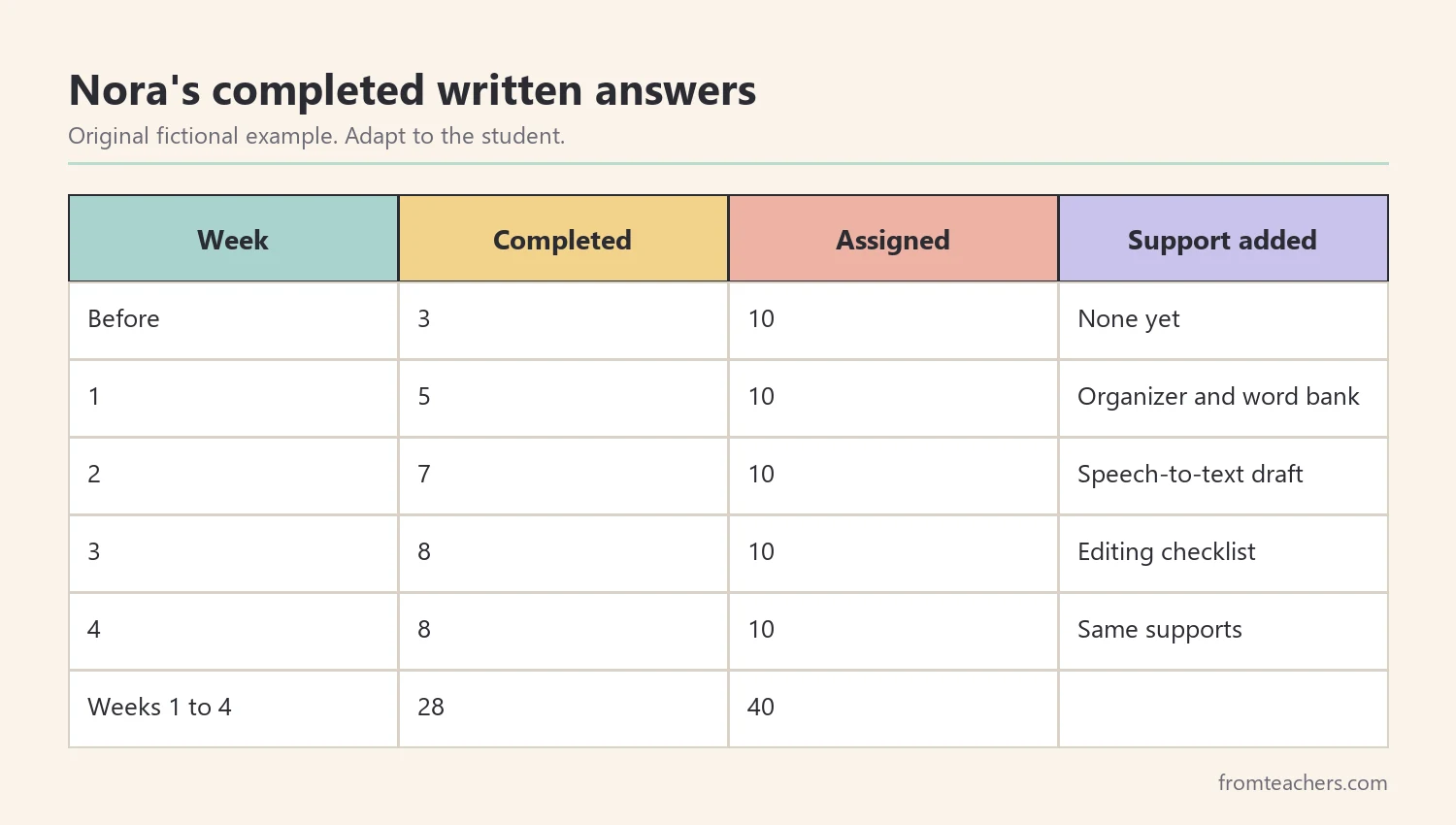
Before the supports, Nora completed 3 of 10 written answers in a typical week. In week 1, with the organizer and word bank, she completed 5 of 10. By week 2, after speech-to-text was added, she completed 7 of 10. In weeks 3 and 4, she completed 8 of 10 each week. That is 28 of 40 answers across the four weeks, compared with roughly 3 in 10 before.
Next, look at quality as well as quantity. Are her answers showing the science ideas she knows? Her teacher notes that answers are longer and use more science vocabulary. That fits the goal of the accommodations.
Then review the plan with the IEP or 504 team every few weeks or at the scheduled review. Ask three questions: Is each accommodation being used? Is it helping? Does the student still need it, or can support be reduced? Some specific learning disability accommodations will stay for years, while others fade as skills grow.
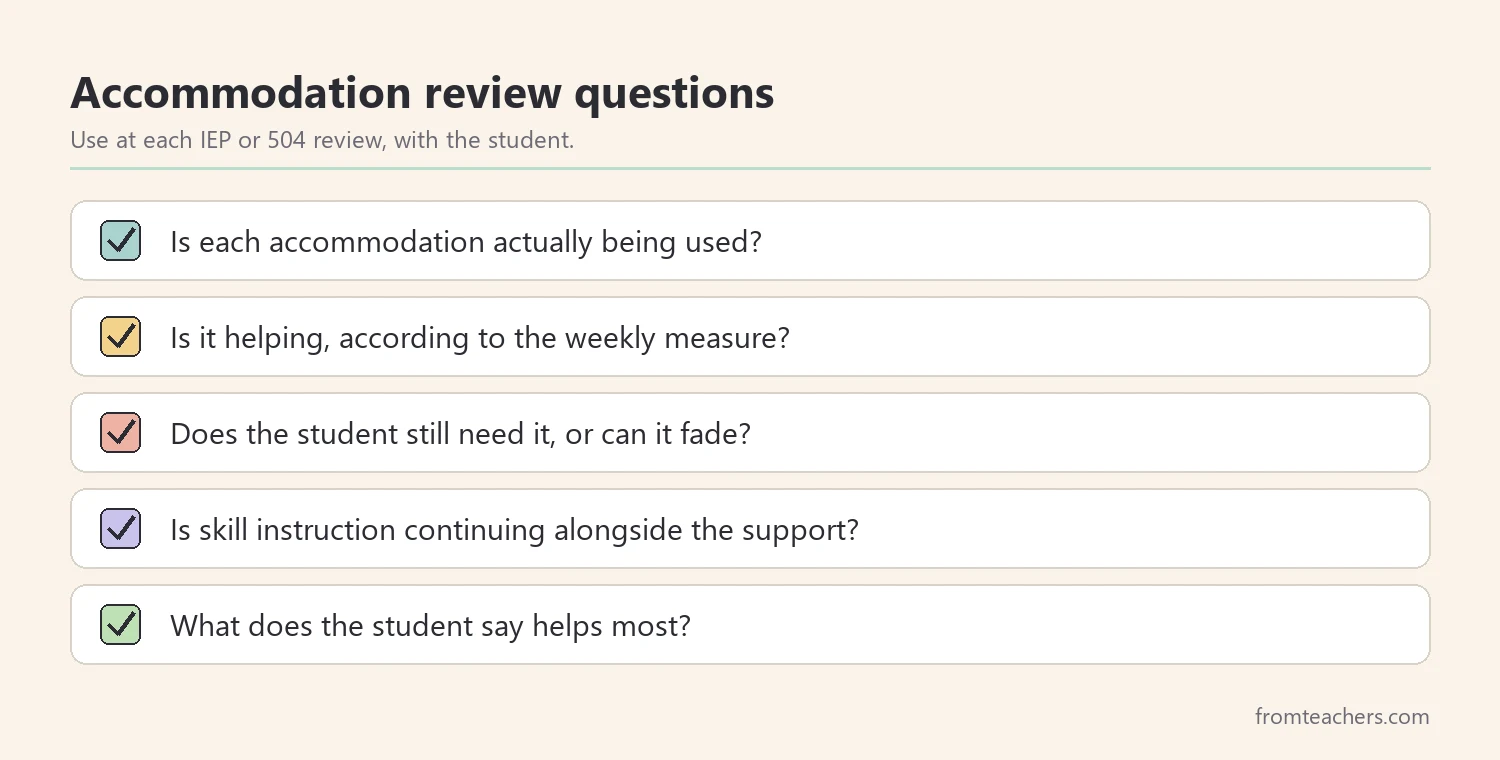
Also, include the student. Ask Nora which supports help most and which feel awkward. Her answers can guide adjustments and build her self-advocacy, which she will need in later grades.
Lastly, share progress with the family. A short note that explains which supports Nora uses and how they help lets parents offer similar support with homework. Consistent specific learning disability accommodations across school and home make the strongest difference.
Finally, write down what you learn. A short record of which specific learning disability accommodations worked, and which did not, helps next year’s teacher start strong instead of starting over. That record is often one of the most valuable things a team can pass along.
Common mistakes and how to avoid them
- Using a generic accommodation list. Supports may miss the real barrier. Fix: name the specific barrier first, subject by subject.
- Replacing instruction with accommodations. Skills stop growing. Fix: keep direct skill instruction alongside access supports.
- Confusing accommodations and modifications. Expectations drop without a team decision. Fix: check whether the support changes how or what the student learns.
- Not teaching the student to use supports. Tools go unused. Fix: model and practice each support until the student uses it alone.
- Never reviewing the plan. Supports pile up or stay when no longer needed. Fix: track one measure and review regularly.
Questions teachers and parents ask about specific learning disability accommodations
What are the most common specific learning disability accommodations?
Common options include audiobooks or text-to-speech, extra time, speech-to-text, graphic organizers, word banks, printed notes, and math reference cards. The best choice depends on the student’s specific barrier. The IEP or 504 plan lists the ones that apply.
Do accommodations give students an unfair advantage?
No. Accommodations remove a barrier so the student can show what they know. They do not change the learning goal. Fair means each student gets what they need to access learning.
Can a student use accommodations on tests?
Often, yes, if they are listed in the IEP or 504 plan and allowed by the test rules. State and district tests have their own policies. Check with your school’s test coordinator.
How many specific learning disability accommodations should a student have?
Fewer, well-chosen supports usually work better than a long list. Choose two or three per subject that target the main barrier. Add or remove supports based on data.
How can parents support accommodations at home?
Use the same tools at home, such as audiobooks, word banks, or a fact chart. Ask the teacher which supports help most. Share what you notice during homework so the team can adjust.
Related reading: Accommodations vs Modifications in Special Education, Dyslexia Solutions for the Classroom, and Assistive Technology in Special Education.
A companion resource for specific learning disability accommodations:


SLD Support Toolkit: Reading, Writing and Math Accommodations: a 50-page guide with a plain-language explanation of SLD, separate sections and accommodation menus for reading, written expression, and math, classroom systems, home support, printables, and classroom scenarios.
Sources and scope
- IDEA, U.S. Department of Education: the law that defines Specific Learning Disability and IEP services.
- IRIS Center, Vanderbilt University: free modules on accommodations and instruction for students with disabilities.
- Understood.org: practical guidance for families and teachers on learning differences.
- What Works Clearinghouse: practice guides on reading, writing, and math instruction.
This guide covers selecting and reviewing classroom accommodations for students with an SLD. It does not cover evaluation, eligibility decisions, or test policy details, which belong to the student’s team and your district.
Key takeaways
- Specific learning disability accommodations start with the exact barrier.
- Accommodations change access, not expectations.
- Choose a short list of supports for reading, writing, and math.
- Teach students to use each support and keep skill instruction going.
- Track one measure per subject and review it with the team.






Leave a Comment