

In addition, a well-built school counselor toolkit means you never walk into a hard conversation without a plan. Picture a Tuesday morning: a seventh grader is waiting outside your door after a panic moment in math, a teacher emails about a lunch table conflict, and a parent calls about a bullying worry. Each need is different, and each deserves a thoughtful response, not an improvised one.
For example, this guide shows you how to build and use a practical toolkit in five steps. You will map the needs you see most, organize strategies by situation, open every session with trust, respond in layers, and track what works with teachers and families. By the end, you will have a system you can open on any busy day.
Examples are fictional. Adapt to the student’s goals and agreed supports. This is guidance, not a diagnosis.
At a glance
- Start by counting the referrals you actually receive, not the ones you expect.
- Organize strategies by situation so you can find the right one in seconds.
- Open every first meeting with trust before you move to problem solving.
- Respond in layers: whole class, small group, then individual support.
- Track a simple outcome and review it with teachers and families.
1. Map the needs before you build a school counselor toolkit
First, look at your real caseload. A school counselor toolkit should match the situations that walk through your door, not a generic list. For one month, keep a simple tally of every referral or drop-in by type.
Next, use broad categories. Stress and anxiety, peer conflict, bullying concerns, academic or time management struggles, and career or goal questions cover most of what middle and high school counselors see. Elementary counselors may add friendship skills and separation worries.
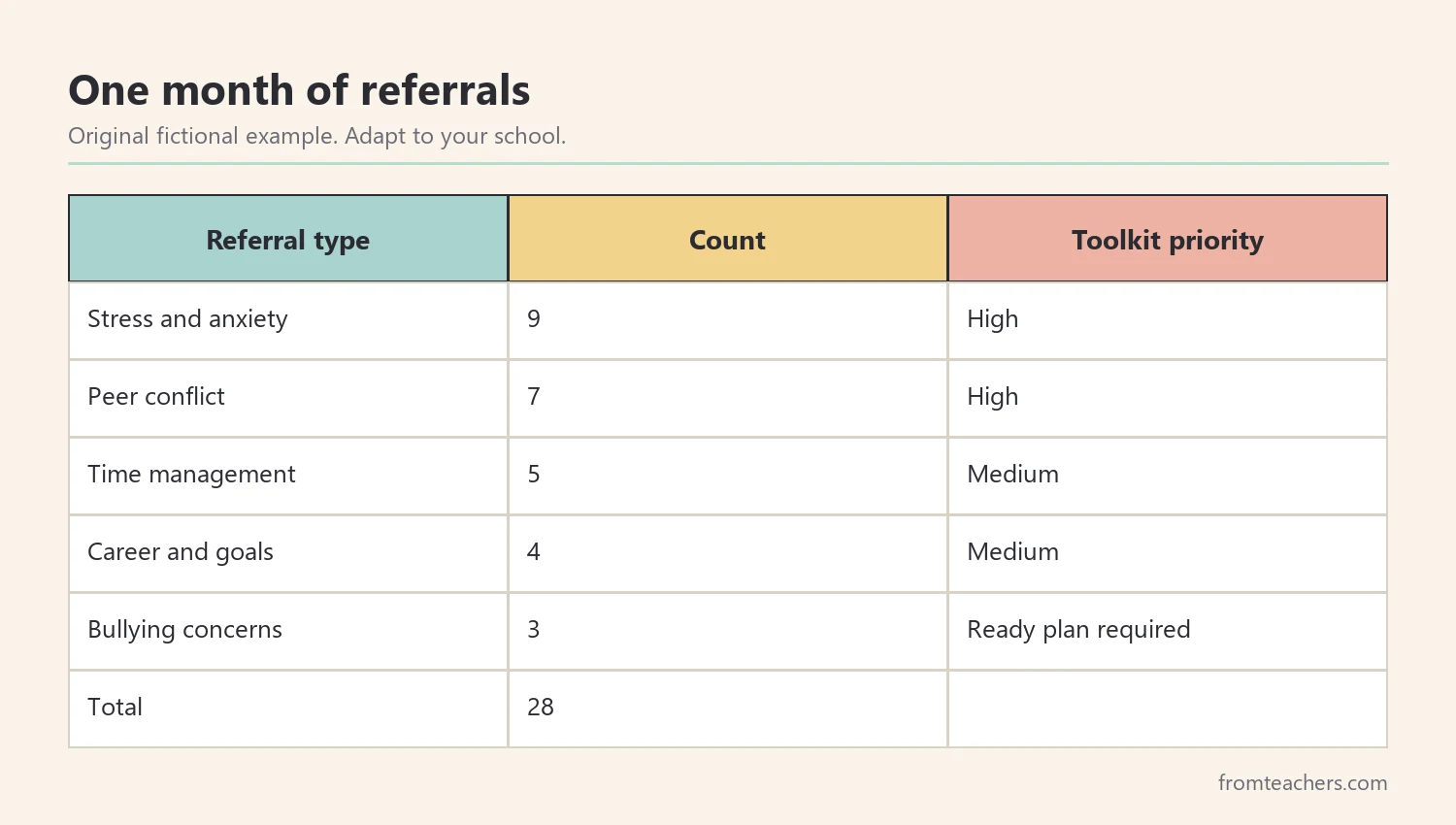
Here is a fictional month at a middle school.
| Referral type | Count |
|---|---|
| Stress and anxiety | 9 |
| Peer conflict | 7 |
| Time management and work completion | 5 |
| Career and goal questions | 4 |
| Bullying concerns | 3 |
| Total | 28 |
Also, this tally tells you where to invest. In this example, anxiety and conflict make up 16 of the 28 referrals, more than half. So those two areas deserve the most developed strategies in your toolkit.
Next, note the timing. If most anxiety referrals come before tests, your plan can include a pre-test routine for whole classes. If conflicts spike at lunch, you can work with lunch supervisors.
Finally, keep the tally going. A school counselor toolkit is never finished. When a new pattern appears, such as a rise in online conflicts, your tally will show it early.
In addition, ask teachers what they see. A two-question survey, such as “What student needs come up most in your room?” and “When do they happen?”, adds a classroom view to your tally. Teacher answers often point to needs that never reach your office, like quiet students who withdraw instead of acting out.
2. Organize your school counselor toolkit by situation
As a result, when a student is in front of you, you do not have time to search. Therefore, organize your strategies by the situation, not by the source you learned them from.
After that, a practical structure is one page per situation. Each page lists the strategy, the objective, how to run it, and a short tip for your setting. Twelve situations cover most of a counselor’s week.
| Student-facing | Relationship and safety | Systems |
|---|---|---|
| Building trust | Peer relationships | Teacher collaboration |
| Stress and anxiety | Conflict resolution | Inclusive environment |
| Emotional support | Addressing bullying | Goal setting |
| Time management | Crisis support | Career guidance |
Also, keep the pages short. A strategy you can scan in ten seconds is more useful than a long article you meant to reread. Use plain headings and short bullet steps.
Keep each tool easy to find
Because of this, if you would rather not build every page from scratch, the school counselor strategy guide with 12 reference tables covers these same situations, from building trust to crisis support, with an objective, details, and a practical tip for each strategy.
For example, meet Priya, a fictional seventh grader. Her math teacher refers her after she leaves class twice during quizzes. Because your school counselor toolkit is organized by situation, you open the stress and anxiety page and the building trust page before you meet her.
In addition, store the toolkit where you work. A binder on the desk, a folder on your tablet, or both. The best toolkit is the one you can reach while a student is sitting with you.
Similarly, give each page the same layout. When every page in your school counselor toolkit follows one pattern, such as strategy, objective, steps, and tip, your eyes learn where to look. That consistency matters most on hectic days when you need an idea in seconds.
3. Open every first session with trust
Strategies only work if the student is willing to try them. That is why the trust page belongs at the front of any school counselor toolkit.
Similarly, start with a predictable opening. Greet the student by name, explain what counseling is in one sentence, and describe the limits of confidentiality in plain words. Students feel safer when they know the rules from the start.
Next, let the student lead for a few minutes. Ask an open question, such as “What has this week been like?” Then listen more than you speak. Reflect back what you hear in short phrases.
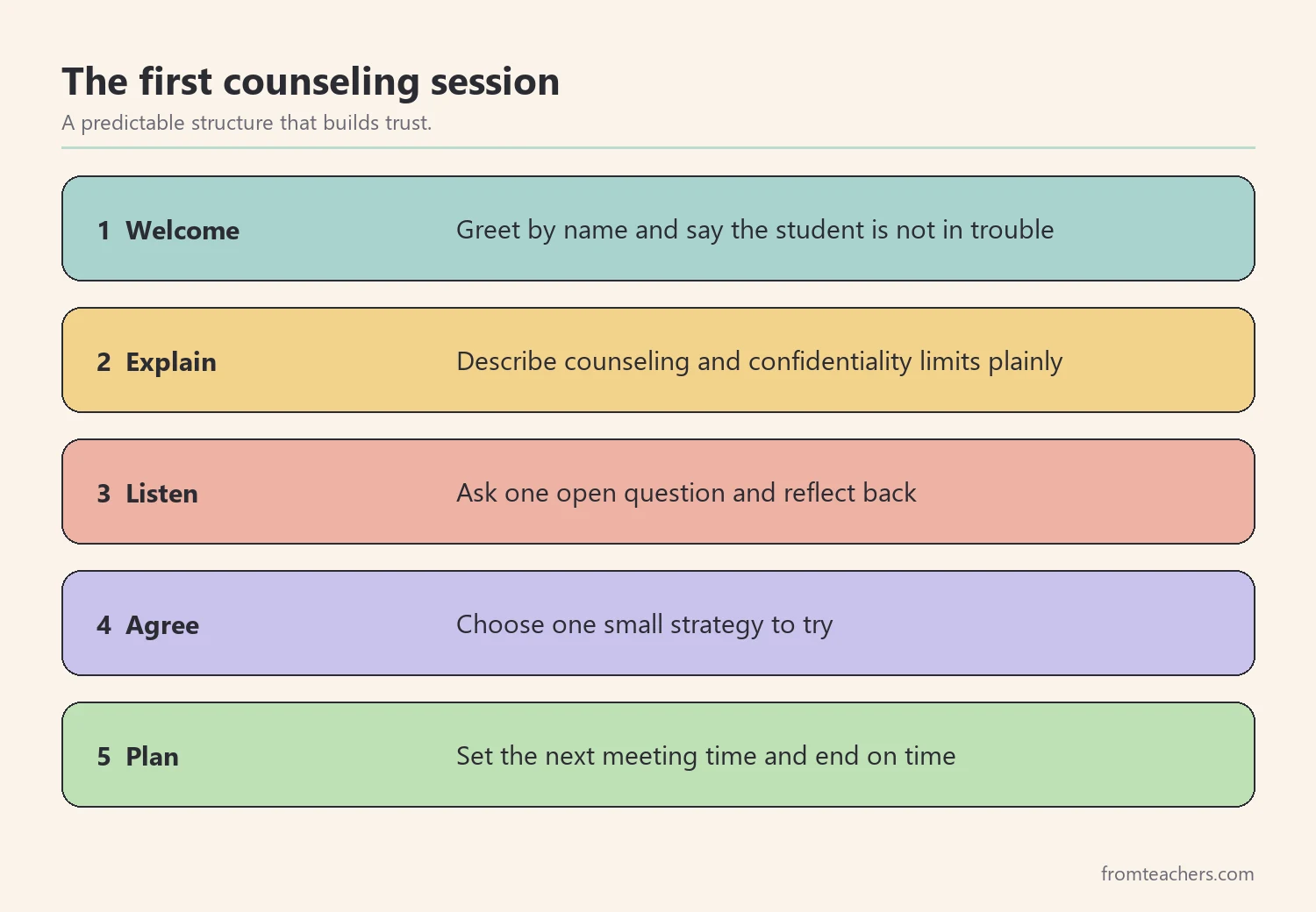
For Priya, the first meeting is short. You tell her that she is not in trouble and that your job is to help school feel more manageable. She says that quizzes make her chest feel tight and she worries everyone will see her struggle. You thank her for telling you.
Then agree on one small thing. You and Priya decide that she will try one calming strategy before the next quiz and check in with you afterward. One agreement is enough for a first session.
Finally, end on time and on a positive note. Tell the student when you will see them next. Predictable endings build trust as much as warm beginnings do.
Meanwhile, remember that trust is built across many small moments, not one meeting. Saying hello in the hallway, remembering a detail the student shared, and keeping your promises all count. The trust page in a school counselor toolkit can list these small habits as reminders.
4. Respond in layers with your school counselor toolkit
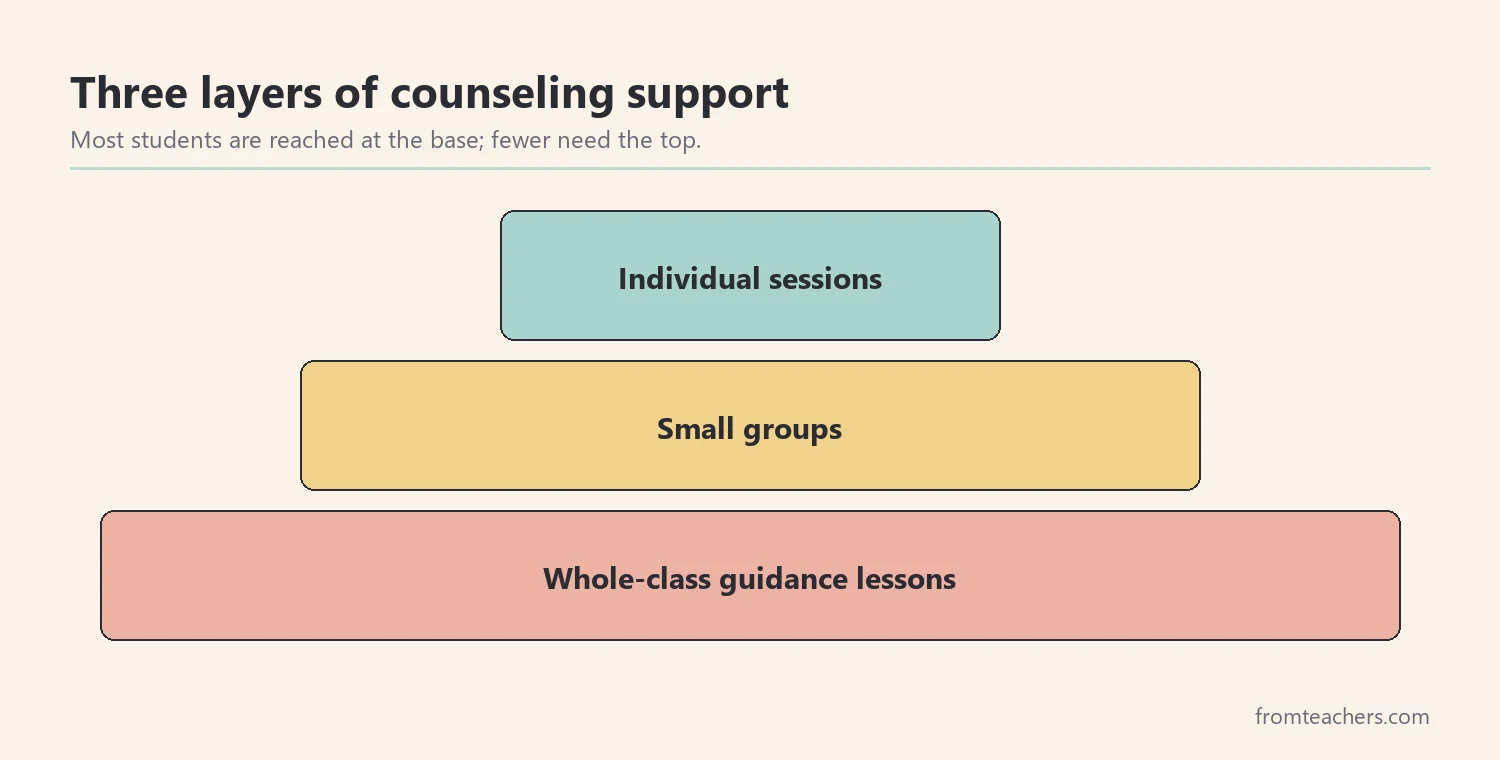
Not every need requires an individual session. A strong school counselor toolkit includes strategies at three levels: for the whole class, for small groups, and for individual students.
At the widest level, classroom guidance lessons reach every student. A short lesson on calming strategies before testing week, for example, may reduce the number of students who need individual support. At the middle level, small groups work well for common needs like friendship skills or study habits. At the narrowest level, individual sessions address needs that are personal, persistent, or sensitive.
Here is how layers might look for the three most common needs in our example.
| Need | Whole class | Small group | Individual |
|---|---|---|---|
| Anxiety | Breathing lesson before tests | Test stress group | Personal coping plan |
| Conflict | I-statement practice | Lunch friendship group | Mediated conversation |
| Bullying | Upstander lesson | Peer support group | Safety plan, as school policy requires |
Choose the right layer
For Priya, you use two layers. She joins a four-week test stress group with three other students, and she has a short individual check-in after each quiz. Meanwhile, her math class gets the breathing lesson, so the strategy feels normal rather than special.
Also, know where your toolkit stops. Crisis situations, safety concerns, and suspected abuse follow your district’s procedures and mandated reporting rules. Keep those procedures on the crisis page of your school counselor toolkit so you never have to search for them under pressure.
Furthermore, plan how students move between layers. A student in a small group who still struggles after several weeks may need individual sessions. On the other hand, a student whose individual sessions are going well may step down to a group. Writing these movement rules into your school counselor toolkit keeps decisions fair and consistent.
5. Track outcomes and collaborate with teachers and families
Finally, check whether the plan is working. You do not need complex data. One simple measure, recorded weekly, is enough for most goals.
Choose a measure that connects to the original concern. For Priya, the concern was leaving class during quizzes. So the measure is the number of quizzes she stays for, out of the quizzes given each week.
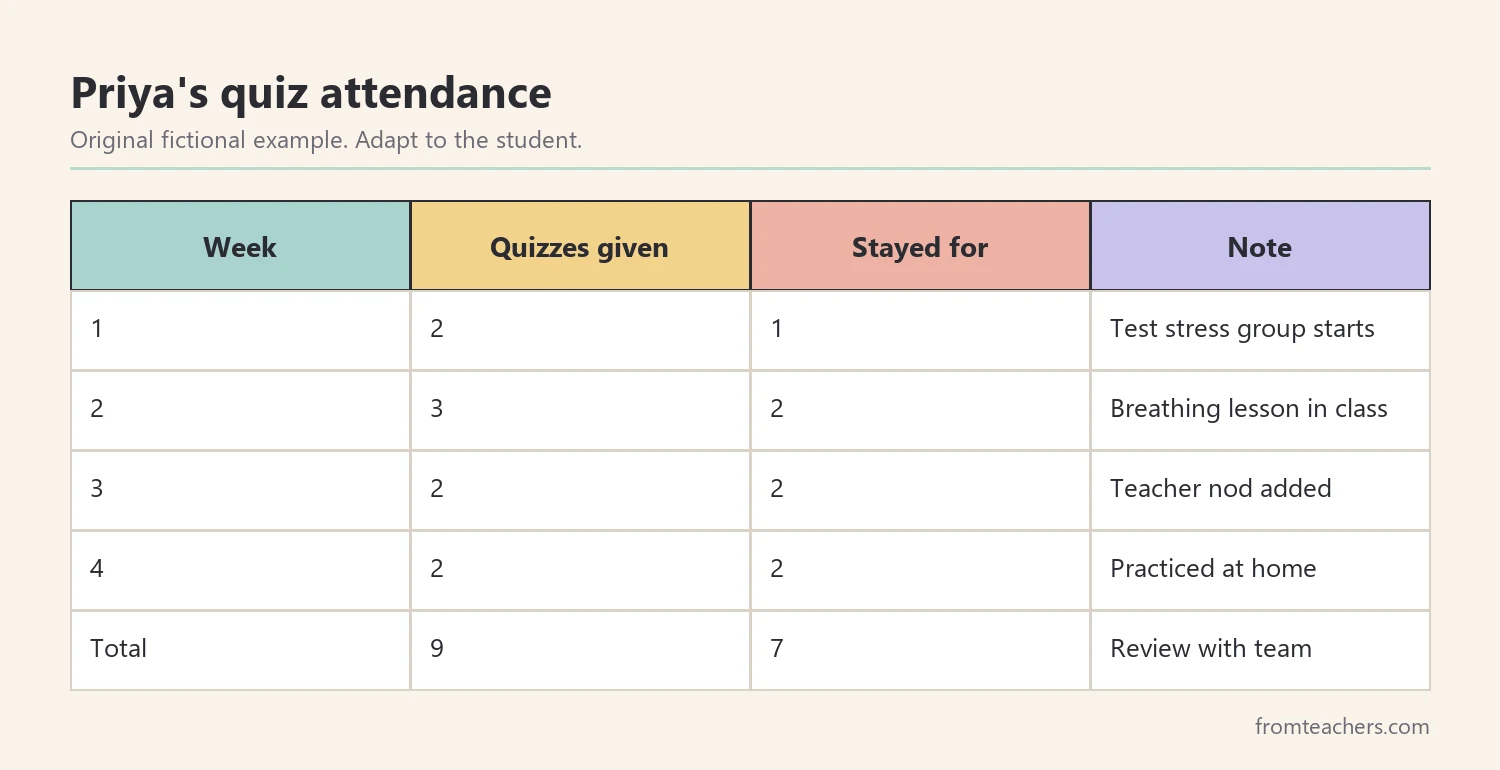
In week 1, Priya stayed for 1 of 2 quizzes. By week 2, she stayed for 2 of 3. In weeks 3 and 4, she stayed for 2 of 2 each week. Over four weeks, that is 7 of 9 quizzes, a clear improvement from the referral week.
Next, share the picture with the people around the student. A short email to the math teacher explains the strategy Priya is using and asks the teacher to give a quiet nod when she uses it. A brief call to the family shares the same strategy, so it can be practiced at home.
Then review the plan every few weeks. If the measure improves, fade the individual check-ins slowly. If it stays flat, return to your toolkit and try a different strategy from the same page. Either way, write a one-line note so the next review starts from facts.
Also, add what you learn back into your school counselor toolkit. If a strategy worked especially well, write your own tip beside it. Over a year, the toolkit becomes a record of what works in your school.
Common mistakes and how to avoid them
- Building the toolkit from a generic list. It may miss your real needs. Fix: tally a month of referrals first.
- Jumping to solutions in the first meeting. Students may close up. Fix: open with trust and one small agreement.
- Handling every need individually. Your schedule fills quickly. Fix: use classroom lessons and small groups for common needs.
- Keeping crisis steps in your head. Stress makes recall harder. Fix: write district procedures on the crisis page.
- Not telling teachers the plan. Strategies fall apart in class. Fix: send a short note explaining what the student is practicing.
- Measuring too many things. Data becomes a chore. Fix: track one measure tied to the referral.
Questions teachers and parents ask about a school counselor toolkit
What should be in a school counselor toolkit?
At minimum, include strategies for trust, anxiety, emotional support, conflict, bullying, and crisis response. Many counselors also add pages for goal setting, career guidance, time management, and teacher collaboration. Organize them by situation so they are fast to find.
Can teachers use parts of a school counselor toolkit?
Yes, many strategies, such as calming routines or I-statements, work well in classrooms. Counselors often share these through guidance lessons or short notes. Individual counseling and crisis response remain the counselor’s role.
How do I keep my school counselor toolkit current?
Keep a referral tally and review it each term. Add new pages when new needs appear. Write your own tips beside strategies that worked well in your school.
How should parents work with the counselor?
Parents can share what they see at home and ask which strategy the student is practicing. Practicing the same strategy at home helps it stick. Regular short check-ins work better than rare long meetings.
Is a toolkit useful for new counselors?
Very much so. A clear toolkit gives new counselors a starting point for common situations. Experienced counselors also use toolkits to share ideas and stay consistent across a team.
Related reading: School Counseling Programs, School Counseling Strategies: Empowering Students to Dream Big, and Trauma-Informed Teaching Strategies.
A companion resource for your school counselor toolkit:
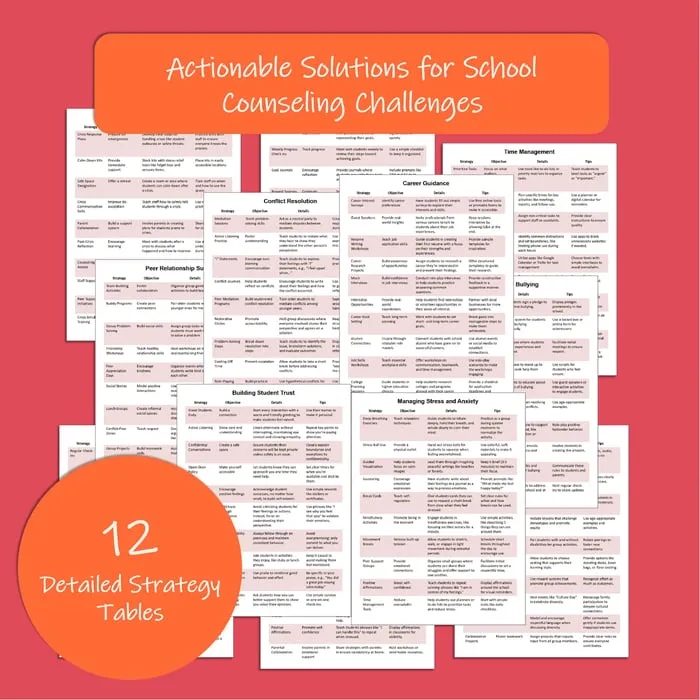
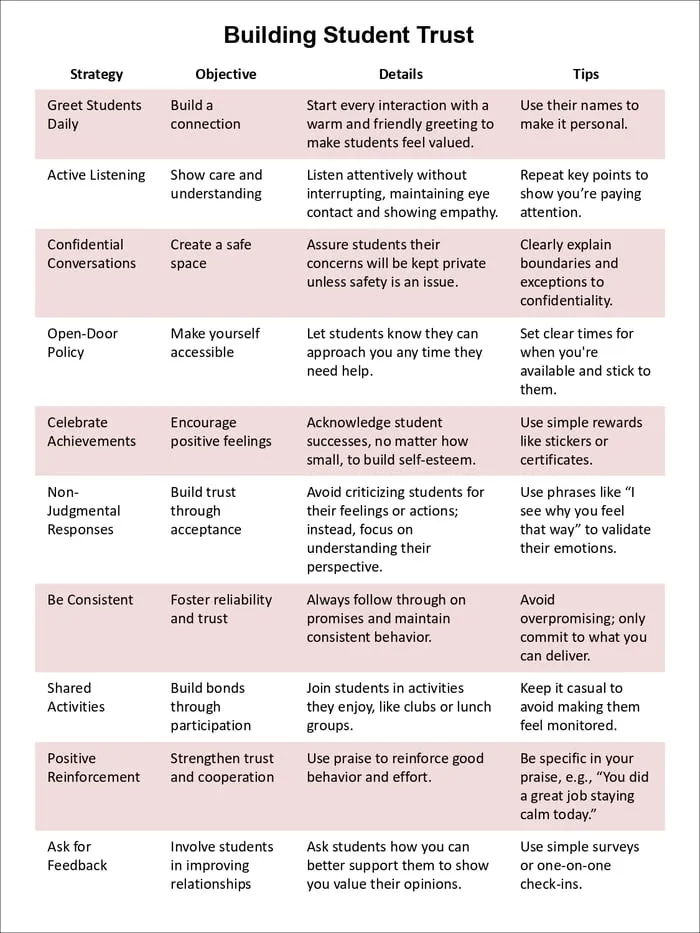
School Counselor Strategy Guide: 12 Student Support Reference Tables: a print-and-go PDF with 12 strategy tables covering trust, stress and anxiety, career guidance, conflict resolution, emotional support, peer relationships, bullying, goal setting, teacher collaboration, inclusive environments, crisis support, and time management.
Sources and scope
- American School Counselor Association (ASCA): professional standards and resources for school counselors.
- StopBullying.gov: federal information on preventing and responding to bullying.
- Centers for Disease Control and Prevention (CDC): general information on children’s mental health and school health.
- IRIS Center, Vanderbilt University: free modules on behavior support and tiered systems.
This guide covers everyday planning and organization for school counseling support. It does not replace district crisis procedures, mandated reporting rules, or clinical mental health care, which should be followed and referred as your school requires.
Key takeaways
- Build your school counselor toolkit from a real tally of referrals.
- Organize strategies by situation so they are quick to find.
- Open with trust and end each first meeting with one small agreement.
- Respond in layers: class, small group, then individual.
- Track one measure and share the plan with teachers and families.




Leave a Comment