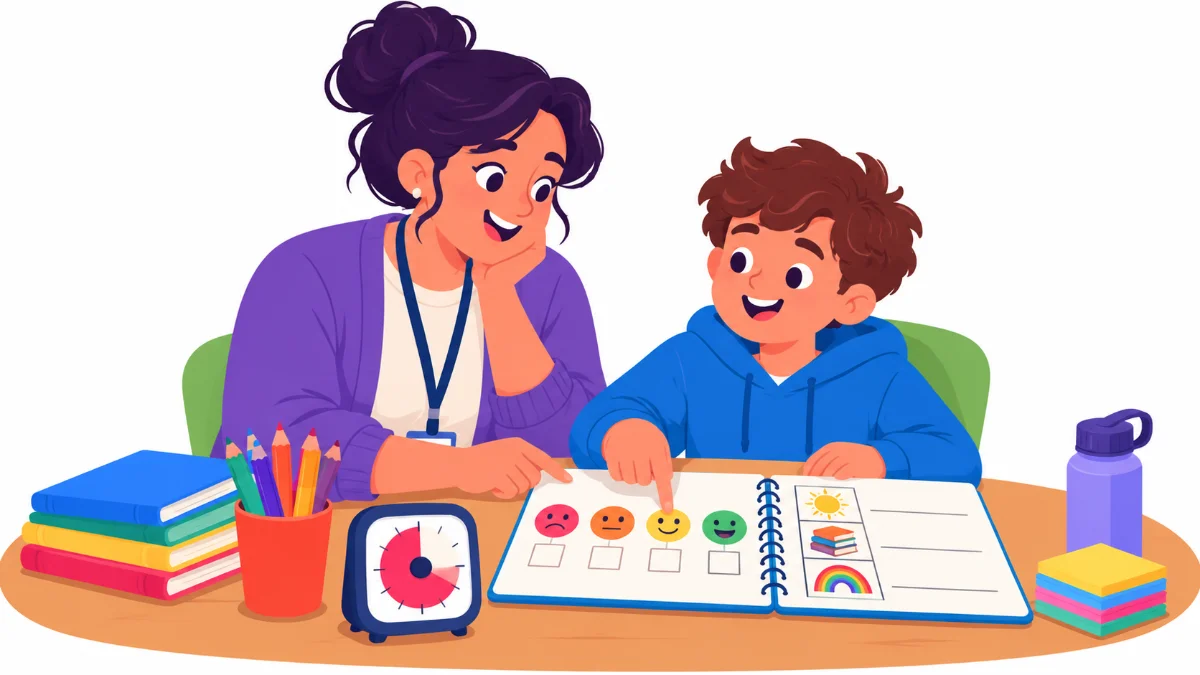

Reflection journal ideas for special education need to start from one honest fact: a blank page can stop a student before reflection even begins. Picture Mr. Okafor’s resource room. Jayden, age 9, has an IEP for writing and attention. When the class writes about their day, Jayden stares at the page, writes “good” and asks to go to the break corner.
This list is for special education teachers, inclusion teachers and paraprofessionals. It ranks seven ways to make daily reflection possible for students with writing, language or attention needs, from the least writing to the most. Jayden appears as the fictional example, so you can see how one student moves from pointing to writing a short goal.
Examples are fictional. Adapt to the student’s goals and agreed supports. This is guidance, not a diagnosis.
At a glance
- Separate the thinking from the writing.
- Start with pointing, choosing or drawing.
- Keep the same short page every day.
- Use sentence starters and word banks.
- Increase writing slowly, one prompt at a time.
How we ranked these ideas
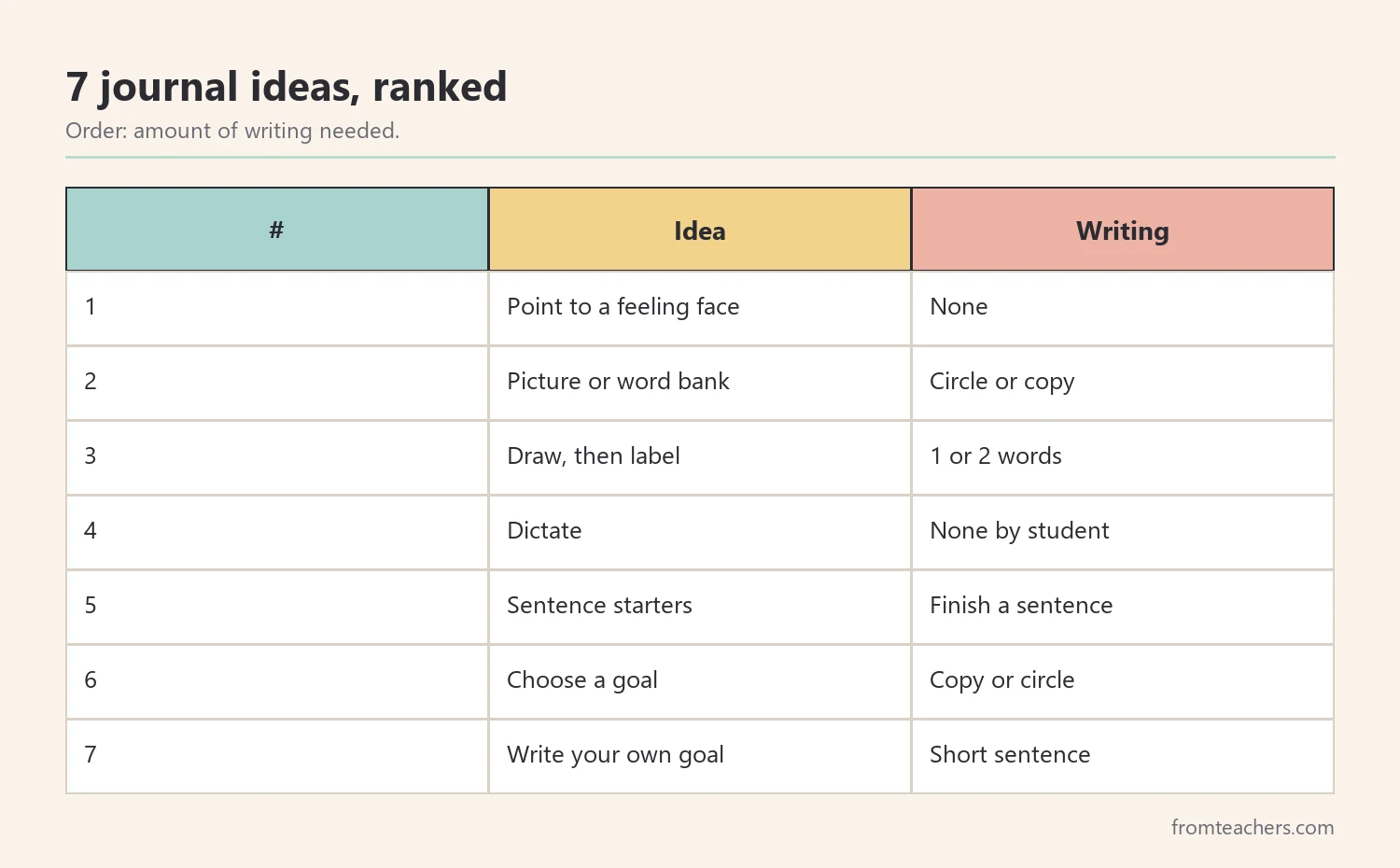
We ranked the seven ideas by how much writing each one asks of the student. Idea 1 needs no writing at all. Idea 7 asks the student to write a short goal independently. The order helps you meet each student where they are and then move up one step at a time.
The key principle comes from Universal Design for Learning: students can show what they think in more than one way. Reflection is a thinking skill. Writing is only one way to express it, so the tools below give students other options first. Figure 1 shows the ranking.
1. Point to a feeling face
What it is: the student points to or circles one of three faces to show how the day felt.
Why it works: it takes seconds and needs no writing or spelling. It still builds the habit of stopping and noticing a feeling.
How to use it: ask, “Which face matches your day?” and accept the answer without arguing. If the student wants, ask one follow-up question out loud.
Example: on day one, Jayden circled the middle face. When Mr. Okafor asked why, he said, “Math was long.”
2. Choose from a picture or word bank
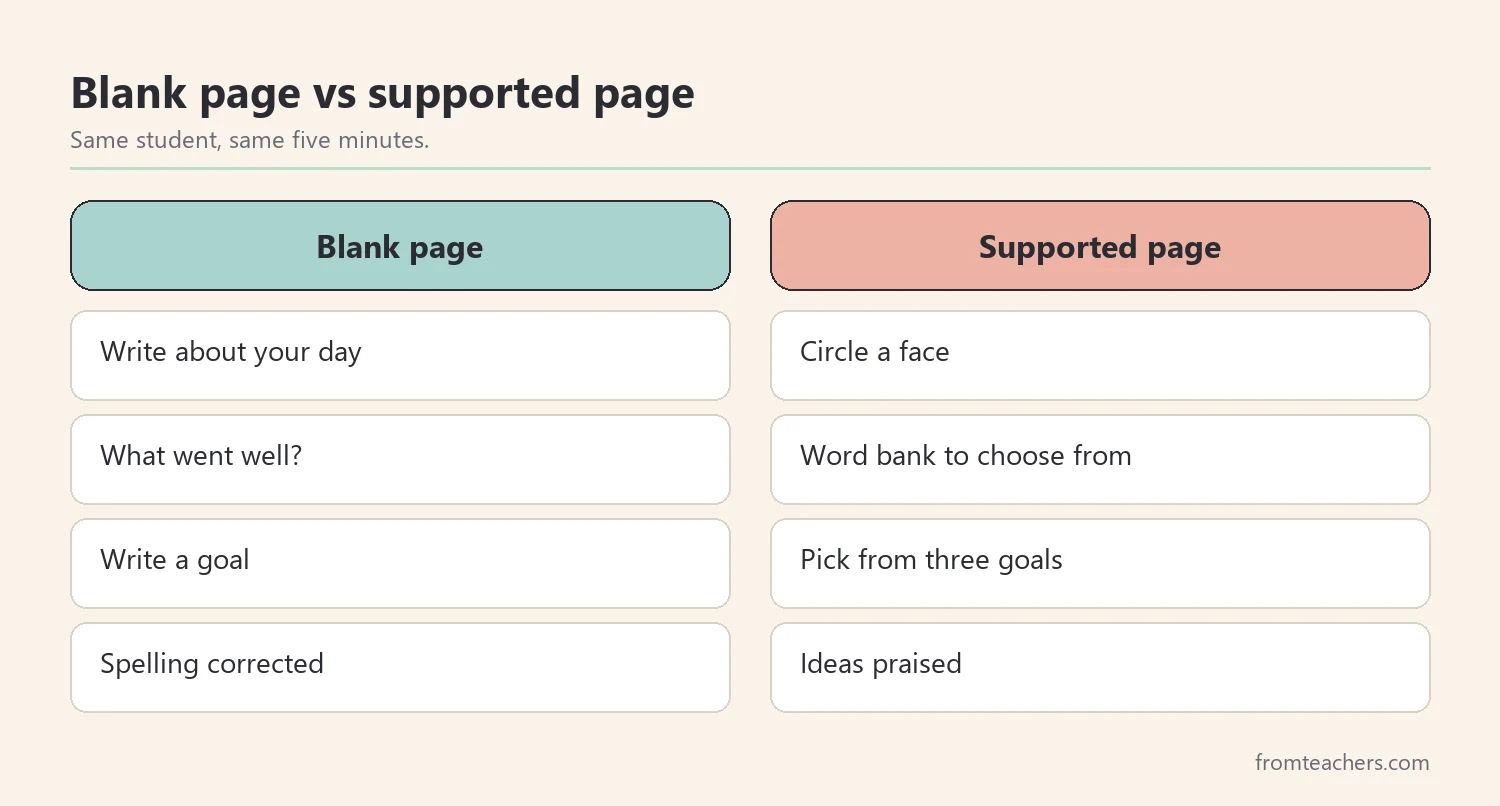
What it is: a small bank of pictures or words, such as “recess,” “reading,” “my friend” or “art,” that the student can copy or circle to answer “What went well?”
Why it works: a word bank removes the spelling barrier and gives ideas to students who struggle to recall the day.
How to use it: keep the same bank for a few weeks, then add new words. Post it on the desk or inside the journal folder.
Example: Jayden circled “recess” and “art” and drew a quick line under “art” to show it was best.
3. Draw, then label
What it is: the student draws a quick picture of one moment and adds one or two labels.
Why it works: drawing helps many students organize their thoughts before they write. The labels connect the picture to words.
How to use it: set a short timer, such as three minutes, so the drawing stays quick. Accept stick figures.
Example: Jayden drew himself painting and wrote “art” and “blue.” It was the most he had written in a journal all month.
4. Dictate to an adult or a device
What it is: the student says the answer, and an adult writes it or speech-to-text records it.
Why it works: dictation lets students show deeper thinking than their handwriting allows. Many IEPs already include dictation or speech-to-text as an accommodation.
How to use it: write the student’s exact words, then read them back. Let the student trace or copy one key word if that is a goal.
Example: Jayden dictated, “I was proud because I finished my painting before the bell.” Mr. Okafor wrote it and Jayden underlined “proud.”
5. Use sentence starters
What it is: each prompt begins a sentence that the student finishes, such as “Today I felt ___ because ___.”
Why it works: starters reduce the planning load. The student only has to add the important part.
How to use it: use the same three or four starters every day, so the format becomes automatic. Pair them with a word bank at first.
Example: Jayden wrote, “Today I felt tired because math was long.” This was a full sentence with a reason, written by him.
6. Set tomorrow’s goal with choices
What it is: the student chooses tomorrow’s goal from two or three options, then checks the next day whether it happened.
Why it works: goal setting and checking build self-management. Choices make the goal realistic and give the student control.
How to use it: offer goals like “ask for a break card,” “finish my first math row” or “say hi to a new friend.” A one page daily reflection journal with a goal for tomorrow includes a “did I meet my goal from yesterday” check, which makes this step quick.
Example: Jayden chose “finish my first math row.” The next day, he checked “yes” and asked for a harder goal.
7. Write a short goal on your own
What it is: the student writes a goal in their own words, with support available but not automatic.
Why it works: it is the most independent form of reflection, and it grows naturally from the earlier steps.
How to use it: keep the word bank and starters nearby. Praise effort and clear ideas, not spelling.
Example: after six weeks, Jayden wrote, “Tomorrow I will ask for help sooner.” The spelling was not perfect, but the thinking was clear.
A sample progress table
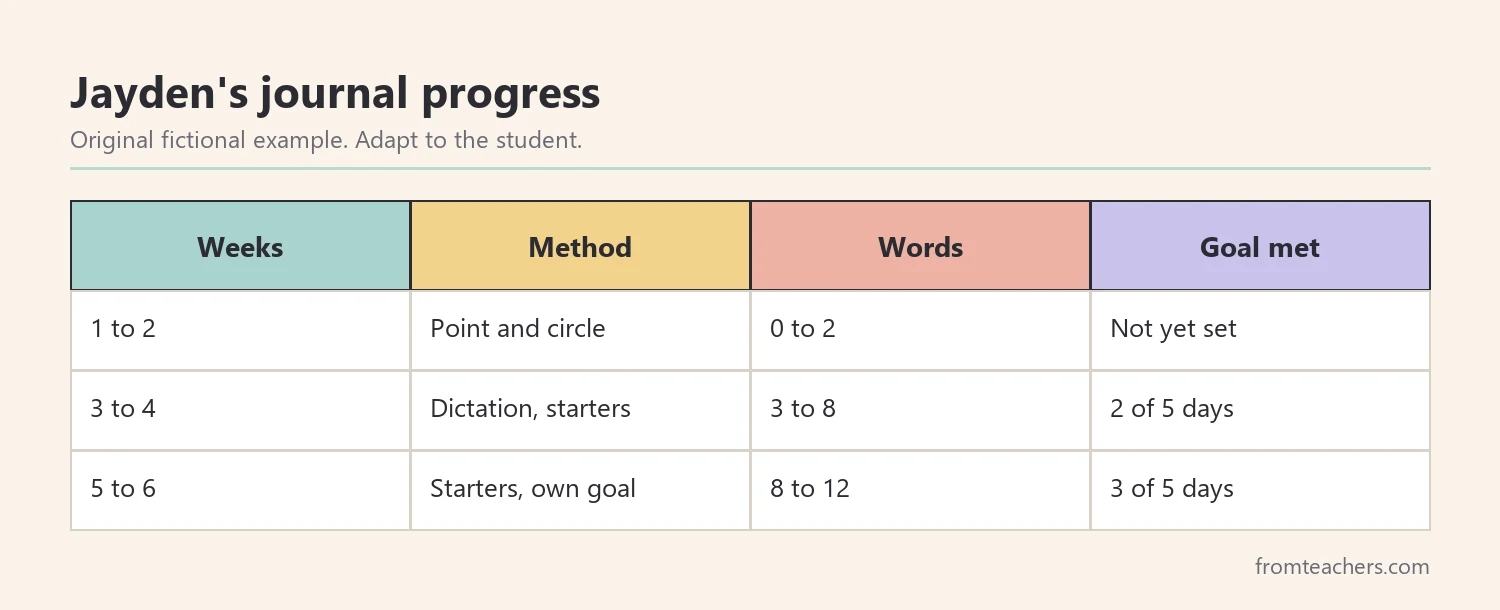
The table below shows how Jayden’s journal entries changed over six weeks. The data is fictional and shows the format only.
| Weeks | Main method | Words written | Goal met |
|---|---|---|---|
| 1 to 2 | Point and circle | 0 to 2 | Not yet set |
| 3 to 4 | Dictation and starters | 3 to 8 | 2 of 5 days |
| 5 to 6 | Starters and own goal | 8 to 12 | 3 of 5 days |
Tracking like this gives the IEP team concrete information on both writing growth and self-management.
A daily routine that fits in five minutes
Most reflection journal ideas for special education work best as a short, fixed routine at the same time every day. Figure 4 shows a simple five-minute flow that many resource rooms and inclusion classes can use before dismissal.
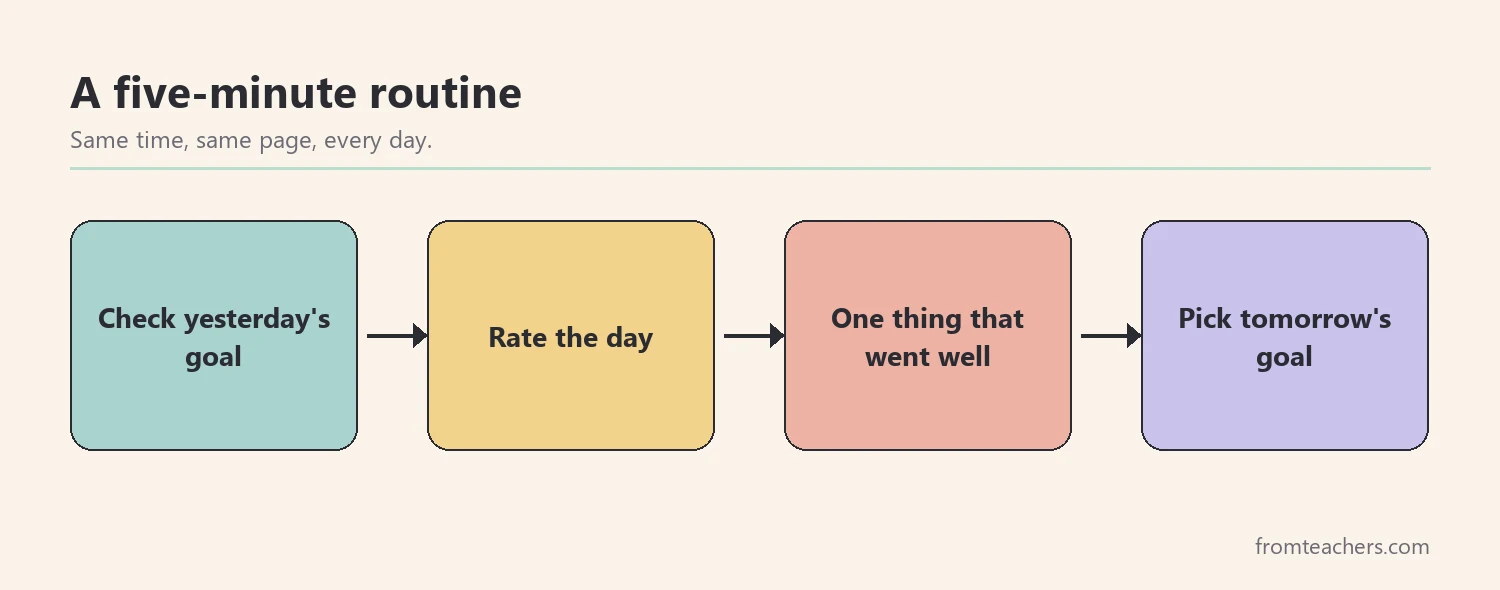
Keep the routine predictable. Use the same page, the same order of prompts and the same time of day. Predictability lowers stress for many students with disabilities and makes the journal feel like a calm end to the day, not another task.
Also, think about where the journal lives. A folder that stays in the classroom is less likely to get lost than a notebook that travels in a backpack. If families want to see entries, send a photo or a copy home on Fridays.
Involving families and other staff
A journal becomes more powerful when the adults around the student use the same language. Share the feeling faces, the word bank and the sentence starters with paraprofessionals, related service providers and families. When everyone asks, “What went well today?” in the same way, the student hears one clear message.
For families, a short note explaining the routine is usually enough. Explain that the journal is about noticing feelings and setting small goals, not about perfect writing. Invite parents to ask the same question at dinner or on the drive home, and to celebrate when their child meets a goal.
Paraprofessionals often run the journal routine in inclusion classes. Give them a one-minute model of how to offer choices, how long to wait and when to step in with dictation. Consistent support across adults helps the student move up the ladder of ideas without confusion, and it keeps the routine running on days when the lead teacher is out.
Common mistakes and how to avoid them
- Asking for paragraphs on day one. Fix: start with pointing or circling.
- Grading spelling in a reflection journal. Fix: respond to ideas, not mechanics.
- Changing the page every week. Fix: keep one format for several weeks.
- Removing supports too fast. Fix: fade one support at a time.
- Skipping the goal check. Fix: start each journal by checking yesterday’s goal.
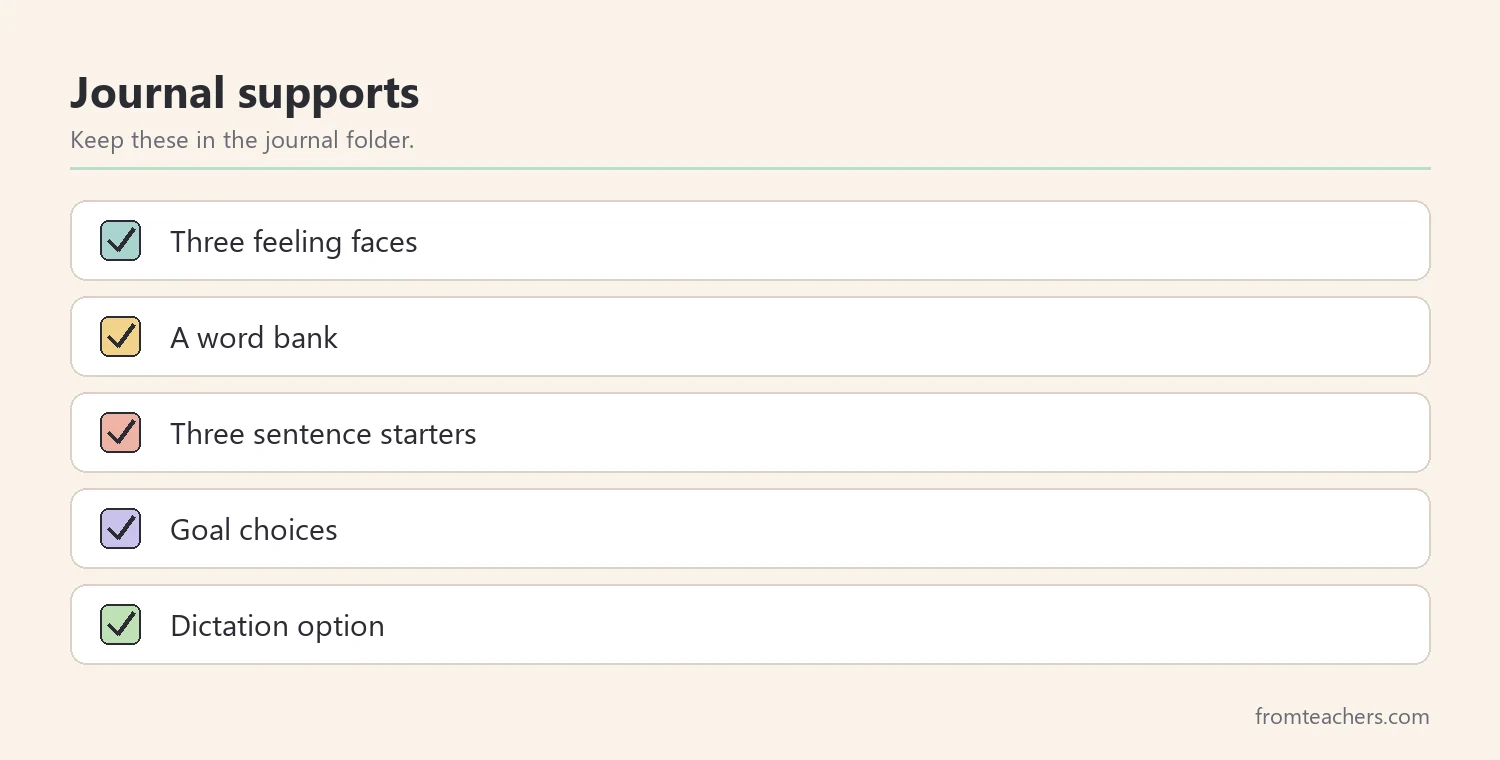
Figure 5 is a quick checklist you can keep with the journal folder.
Questions teachers ask about reflection journal ideas for special education
How long should journal time be?
Five minutes is often enough. Longer sessions may tire students with attention or writing needs and make the routine feel like a chore.
What if a student refuses to reflect?
Offer the easiest option, such as pointing to a face, and accept it. A small daily success builds the habit better than a long battle.
Can journal entries be used as IEP data?
They can show patterns in self-awareness and goal setting, but check with your team about how informal data is used and stored.
Should teachers comment every day?
A short, positive comment once or twice a week is often enough. Students notice and value it.
Does this work for nonspeaking students?
Yes, with adapted access. Students who use AAC can answer with their device or with picture choices, in partnership with the speech-language pathologist.
Related reading: 5 Practical Teaching Tips to Boost Classroom Focus, ADHD Children Support Strategies, and Positive Alternatives to Behavior Charts.
You may also need: Daily Routine Journal for Students.
A companion resource for special education teachers:
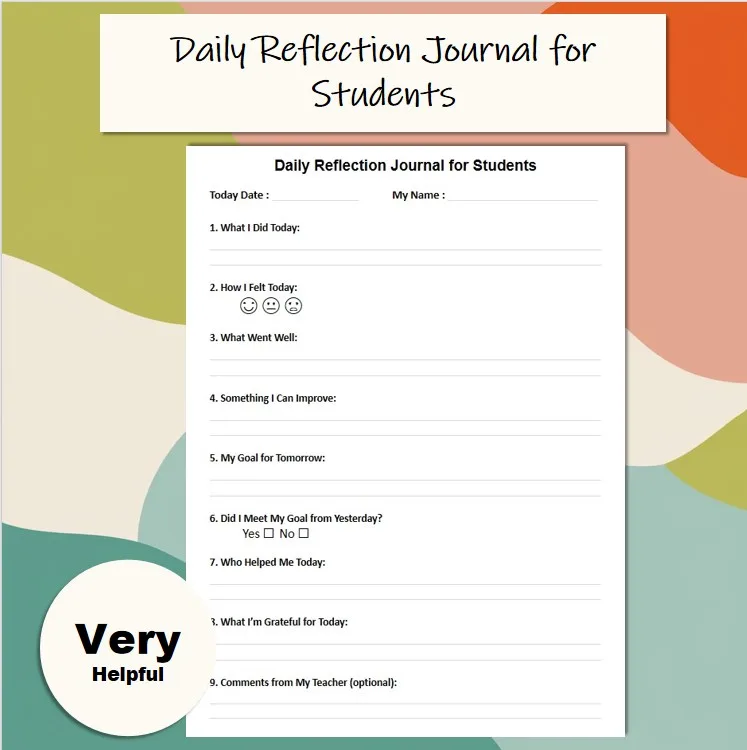
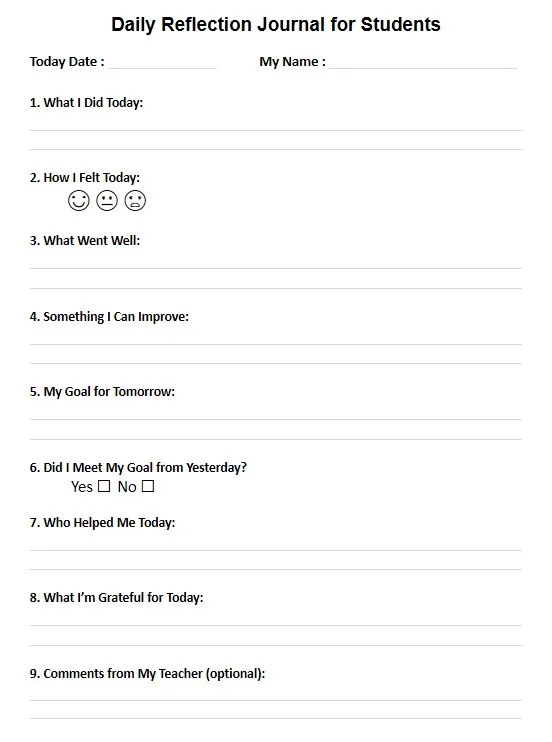
Daily Reflection Journal for Students: SEL Check-In & Goal Setting Sheet: a one page journal, editable or print-ready, with name and date fields, what I did today, a three face feeling scale, what went well, something I can improve, my goal for tomorrow with a did I meet my goal from yesterday check-in, who helped me today, a gratitude prompt and an optional teacher comment space.
Sources and scope
- CASEL: the social and emotional learning framework, including self-awareness and self-management.
- Understood: plain-language articles on writing challenges and supports for students who learn differently.
- CAST: information on Universal Design for Learning and multiple means of expression.
- Center for Parent Information and Resources: plain-language information on IEPs and accommodations.
This guide shares classroom ideas for daily reflection. It does not replace the accommodations, goals or therapy plans written in a student’s IEP.
Key takeaways
- Reflection journal ideas for special education separate thinking from writing.
- Start with pointing, word banks or drawing.
- Use dictation and sentence starters as bridges to writing.
- Add a simple goal and check it the next day.
- Fade supports slowly and keep the routine short and predictable.









Leave a Comment