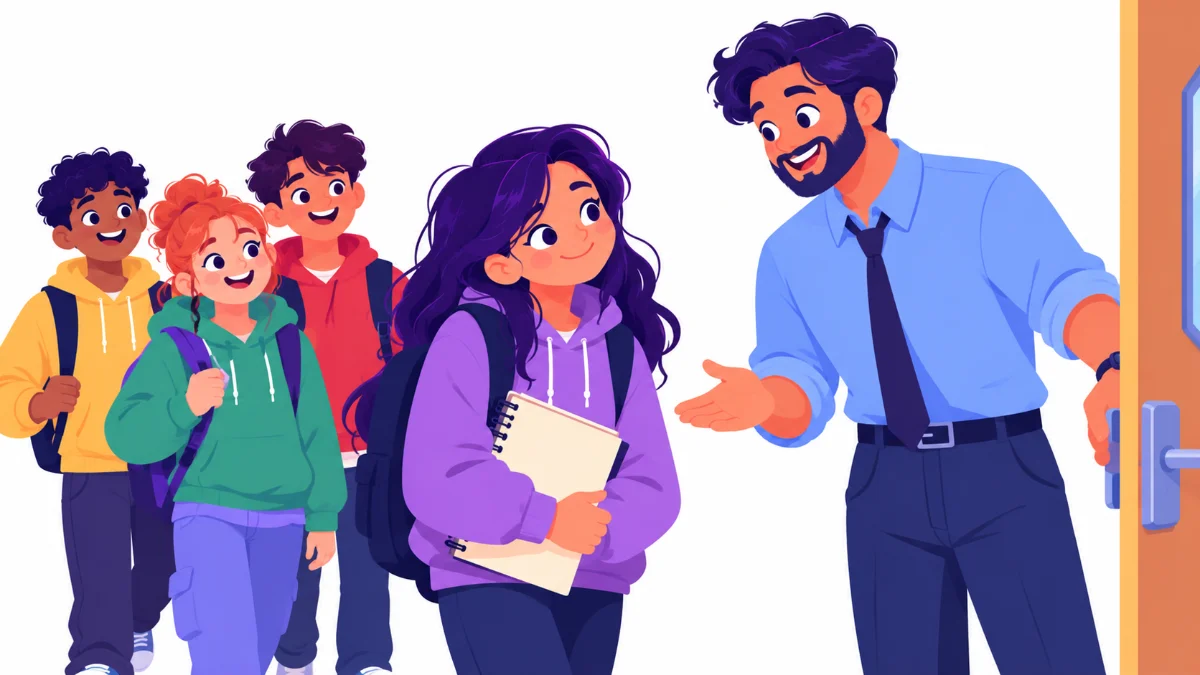

Trust building strategies for students matter most with the young people who seem to want them least. Picture Kayla, a ninth grader who arrives with her hood up, answers “whatever” to every question and walks out when a teacher raises their voice. Her file mentions emotional and behavioral needs, several school changes and a long list of discipline notes. Her new teachers have nine months, and she has already decided not to trust them.
This list is for middle and high school teachers, paraprofessionals and counselors who work with students who push adults away. It offers ten strategies, ordered from the first week to the long term, with what each looks like in practice and a short example from Kayla’s year. By the end, you will have a realistic plan for earning trust slowly, without giving up structure or expectations.
Examples are fictional. Adapt to the student’s goals, the IEP or behavior plan, and guidance from your school’s mental health staff. This is guidance, not a diagnosis.
At a glance
- Students who push adults away often have reasons, and behavior is often communication.
- Trust grows through small, predictable actions repeated over time, not one big talk.
- Calm, consistent limits build trust; unpredictable reactions break it.
- Repairing after a conflict matters as much as avoiding conflict.
- Trust building works best when the whole team responds in the same way.
How this list is ordered
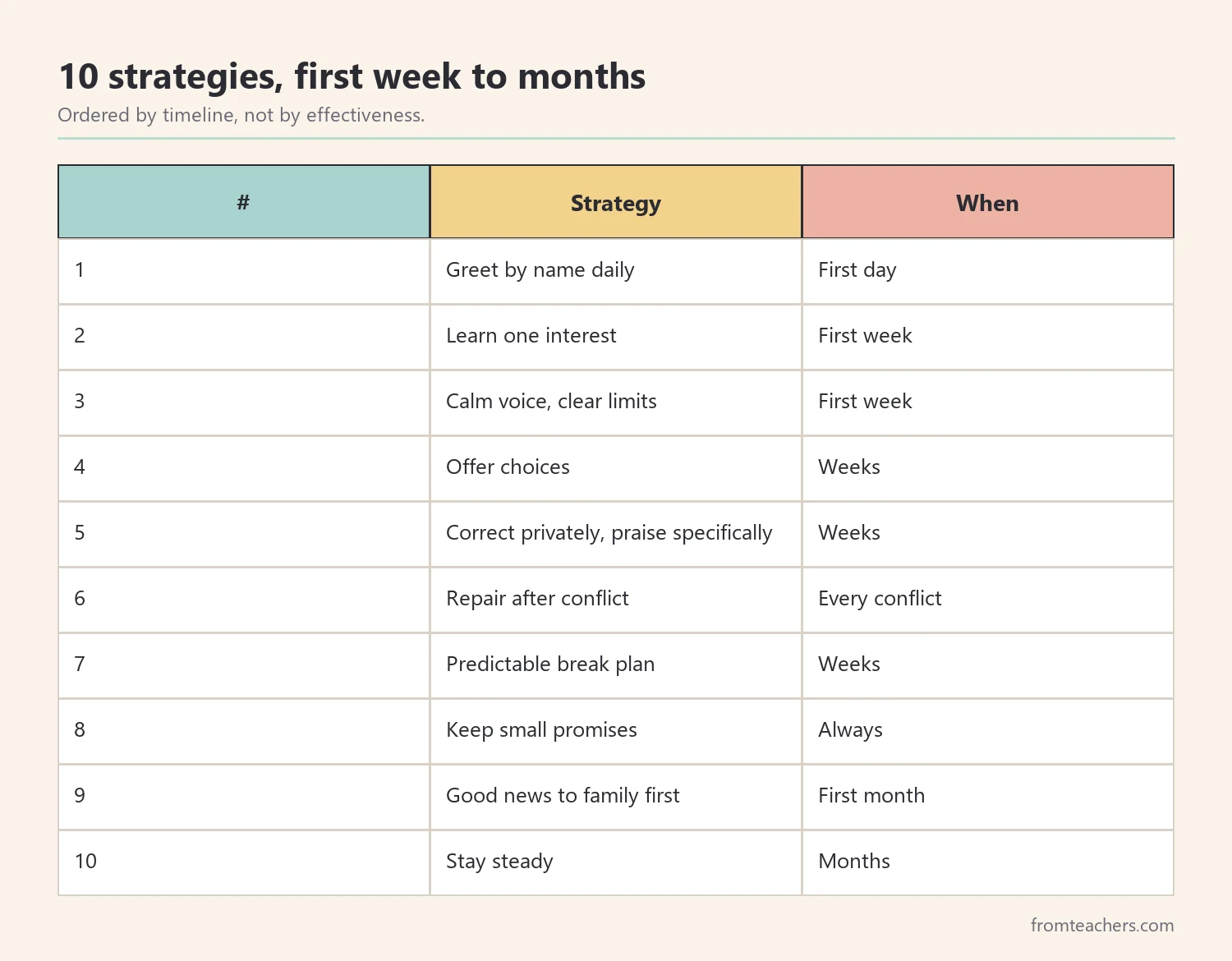
We did not rank these strategies by effectiveness, because no single strategy works for every student. Instead, the list follows a realistic timeline: what to do in the first days, what to keep doing for weeks and what to build over months. As a result, you can start at the top on the first day and keep moving down as the relationship grows.
Keep in mind that trust building strategies for students are not a replacement for mental health support. Students with emotional disturbance or trauma histories may need counseling, family involvement and a behavior plan as well. Figure 1 shows the full list.
1. Greet by name every day
The first of these trust building strategies for students is the simplest. Stand at the door and greet the student by name, every day, whatever happened yesterday.
Why it helps: a predictable, warm greeting sends a clear message: you are expected here, and yesterday is over.
Example: Kayla ignored Mr. Brooks’s “Morning, Kayla” for two weeks. In week three, she nodded. In week five, she said “Hey” back.
2. Learn one thing they care about
Next, find a real interest. Music, a sport, a game, a pet or a younger sibling can all open a door.
Why it helps: showing interest in the student as a person, not only as a behavior problem, changes the tone of every interaction.
How to do it: listen during passing moments and remember details. Bring them up later in a light way.
Example: Mr. Brooks overheard Kayla talking about drawing. A week later, he asked if she would design the cover for a class project.
3. Keep your voice calm and your limits clear
Many students who push adults away have learned that adults can be unpredictable. Calm, consistent limits are therefore a form of safety.
How to do it: state expectations in a neutral voice, follow through the same way each time and avoid sarcasm or public arguments.
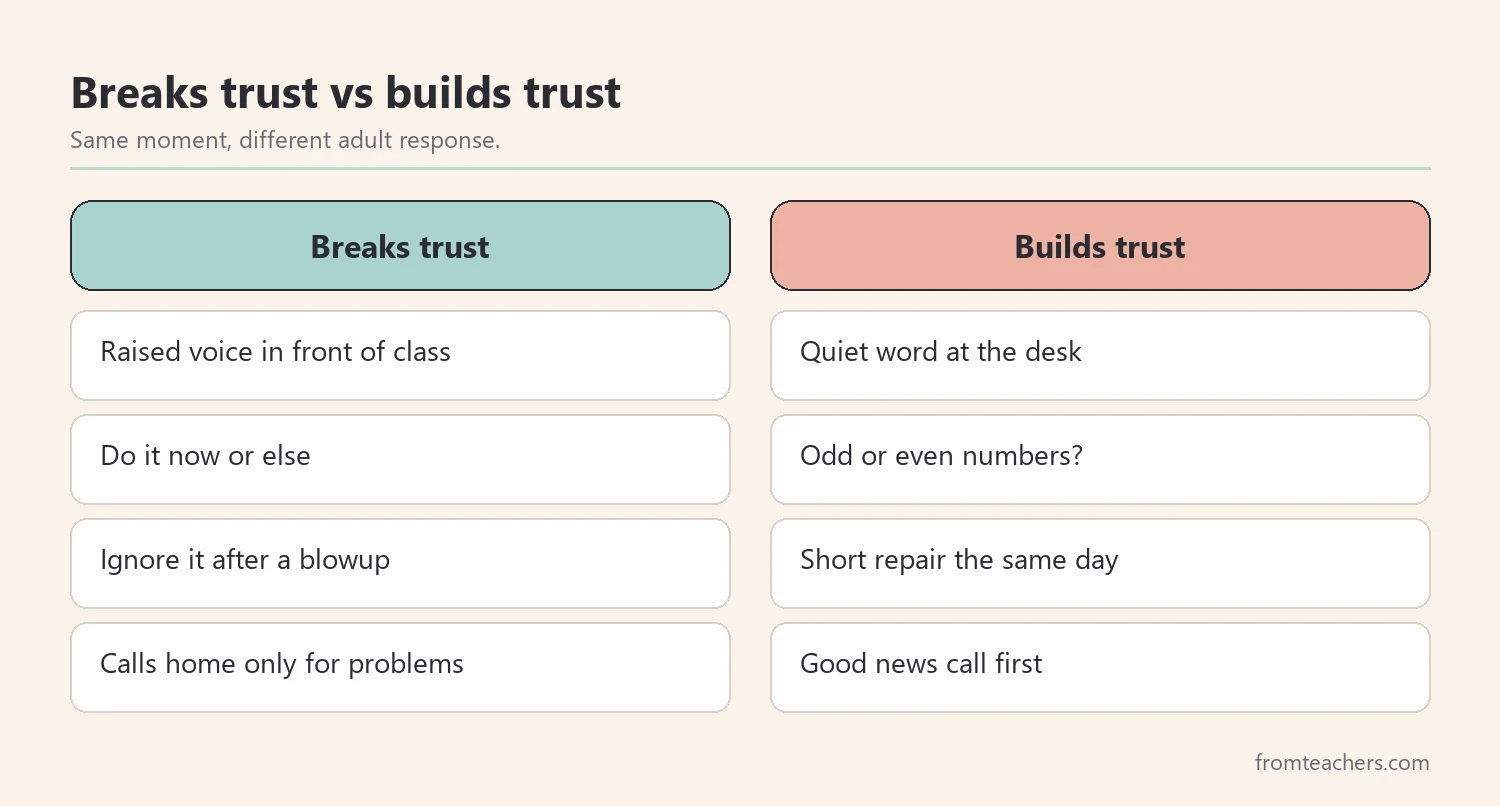
Example: when Kayla put her head down, Mr. Brooks quietly said, “Take two minutes, then I need you on question one.” He walked away and checked back later.
4. Give choices whenever possible
Students who feel controlled often push back. Small choices give back some control without lowering expectations.
How to do it: offer two acceptable options, such as “Pen or laptop?” or “Start with question one or question three?”
Example: Kayla refused worksheets but accepted “Do the odd numbers or the even numbers.” She finished half the page for the first time.
5. Correct privately, praise specifically
Public correction can feel humiliating, especially to a teen. On the other hand, vague public praise can feel fake or embarrassing.
How to do it: give corrections quietly, at the desk or in the hallway. Make praise specific and low-key, such as a short note or a quiet word.
Example: a sticky note on Kayla’s desk said, “Your answer to number 4 was really clear.” She kept it in her phone case.
6. Repair after every conflict
Conflicts will happen. What builds trust is what comes after. A short repair conversation shows the student that the relationship survives a hard moment.
How to do it: once everyone is calm, meet briefly. Say what happened, own your part if you had one, and agree on a next step. Then start fresh.
Example: after Kayla walked out, Mr. Brooks found her at lunch: “I raised my voice, and I’m sorry about that. Tomorrow, if you need a break, show me the card.” Kayla shrugged, but she used the card the next week.
7. Offer a predictable break plan
Students who feel overwhelmed often escape in the only way they know: walking out or shutting down. A planned break option gives a safer path.
How to do it: agree on a signal, a place and a time limit, and practice it on a calm day. Include it in the behavior plan if the student has one.
For a ready set of tools, the ED Support Toolkit for calm classrooms and SEL strategies includes sections on de-escalation, emotion regulation, sensory tools and behavior contracts, plus real classroom scenarios on building trust and handling defiance.
8. Keep your promises, especially small ones
Trust is built on reliability. If you say you will check in, return the paper or save a seat, do it.
How to do it: promise less and deliver every time. If you cannot keep a promise, explain why before the student notices.
Example: Mr. Brooks said he would return Kayla’s drawing on Friday. He did, with a short comment. She asked what he thought of her next one.
9. Involve the family with good news first
Many families of students who push adults away only hear from school when something goes wrong. A positive call or message changes that pattern.
How to do it: share one specific positive moment before any concern. Ask what works at home and what the student enjoys.
Example: Kayla’s grandmother cried on the phone when Mr. Brooks called about a good week. She shared that Kayla loved animals, which gave him a new topic to talk about.
10. Stay steady over months
Finally, trust with students who have been let down before often takes a long time. Some students test adults repeatedly to see if they will leave.
How to do it: keep the same warmth and the same limits on hard days. Track small signs of progress, such as eye contact, a greeting or asking for help.
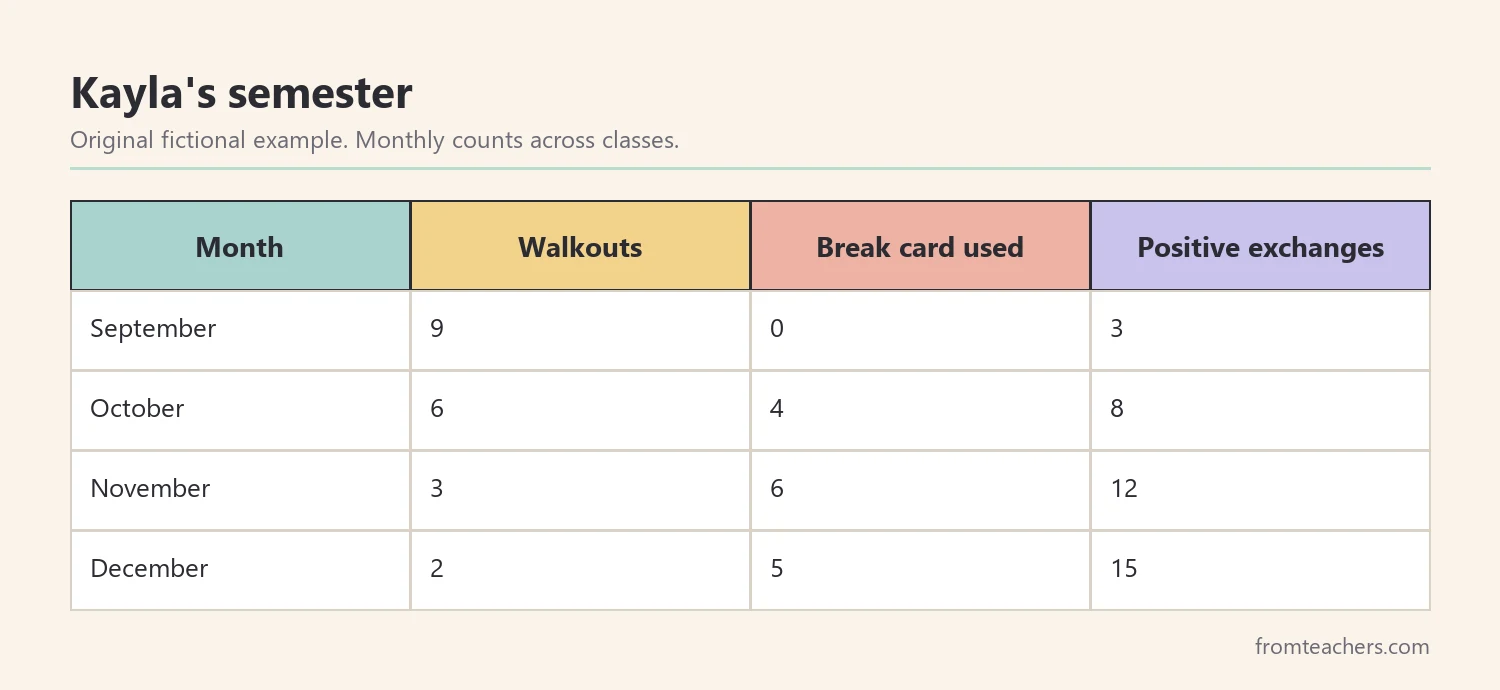
Example: in October, Kayla had a terrible week and called Mr. Brooks names in front of the class. He followed the plan, repaired the next day and greeted her at the door as usual. By December, she was staying after class to show him new drawings and once asked him to read a story she had written.
Also, notice what changes around the student. Classmates often follow the adult’s lead. When peers see a teacher treat a student with steady respect, they are more likely to do the same, which gives the student more reasons to stay connected to school.
In addition, keep a short private log of positive moments. On hard days, reading back through a month of small wins reminds you that progress is real, even when it feels slow.
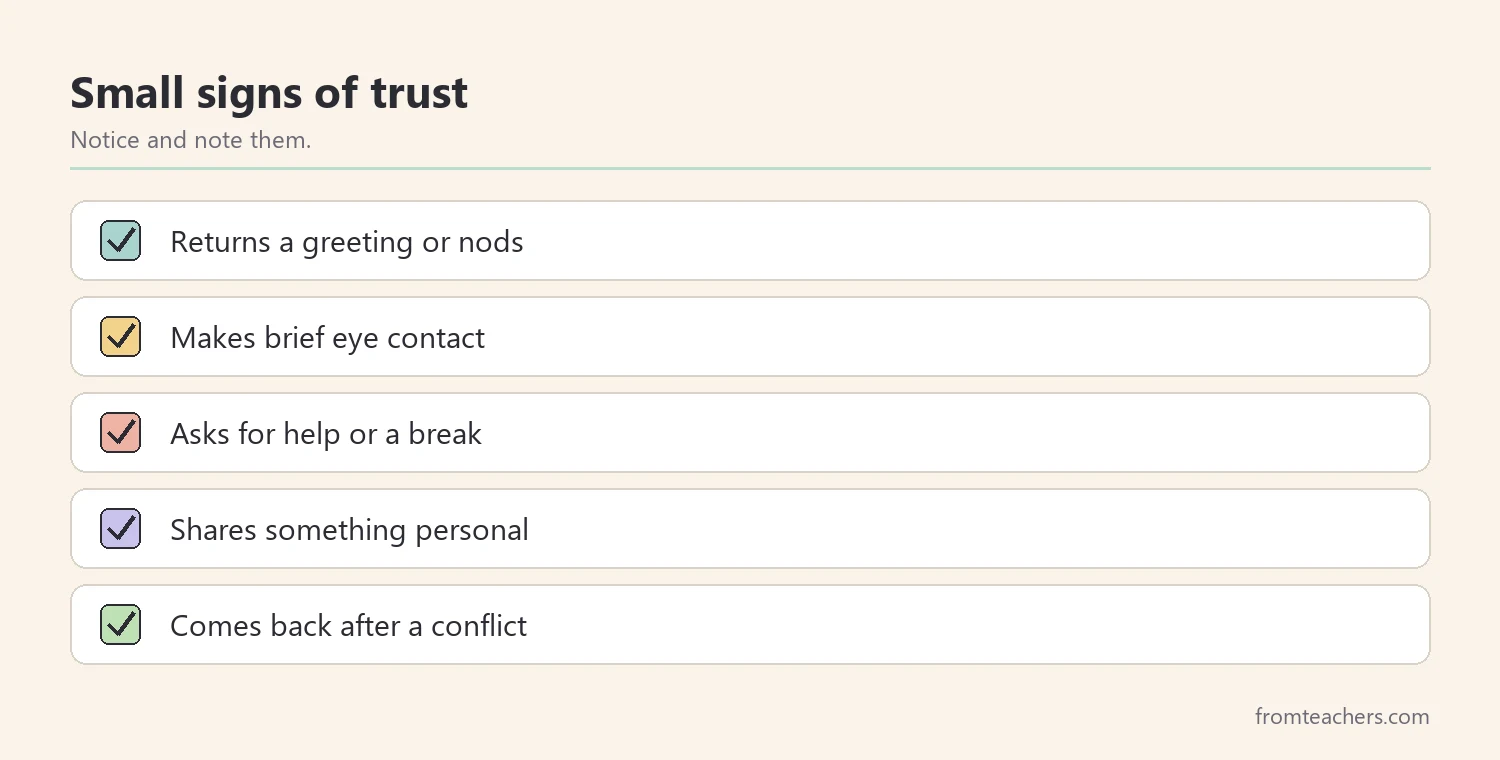
Making trust building strategies for students a team effort
One caring teacher can make a real difference. Still, a student sees many adults each day. When responses vary from room to room, the student may learn that adults are unpredictable, which works against trust.
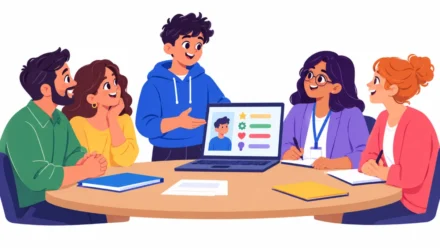
First, agree as a team on a few shared responses, such as the same break signal, the same calm wording and the same repair routine. Next, share small successes in team meetings, not only incidents. A quick “She greeted me today” helps every adult notice progress.
Also, track simple measures over time. In Kayla’s case, the team counted walkouts, break card use and positive exchanges each month. As Figure 3 shows, walkouts fell as break card use rose, and positive exchanges grew slowly across the semester.
In addition, take care of yourself. Working with students who push adults away can be draining. Talk with colleagues, use school support staff and remember that rejection is often a test, not a final answer.
Next, be patient with setbacks. A hard week at home, a conflict with a peer or a change in staff can bring back old behavior. When that happens, return to the basics: the greeting, calm limits and repair. Students often recover faster the second time because the relationship is already there.
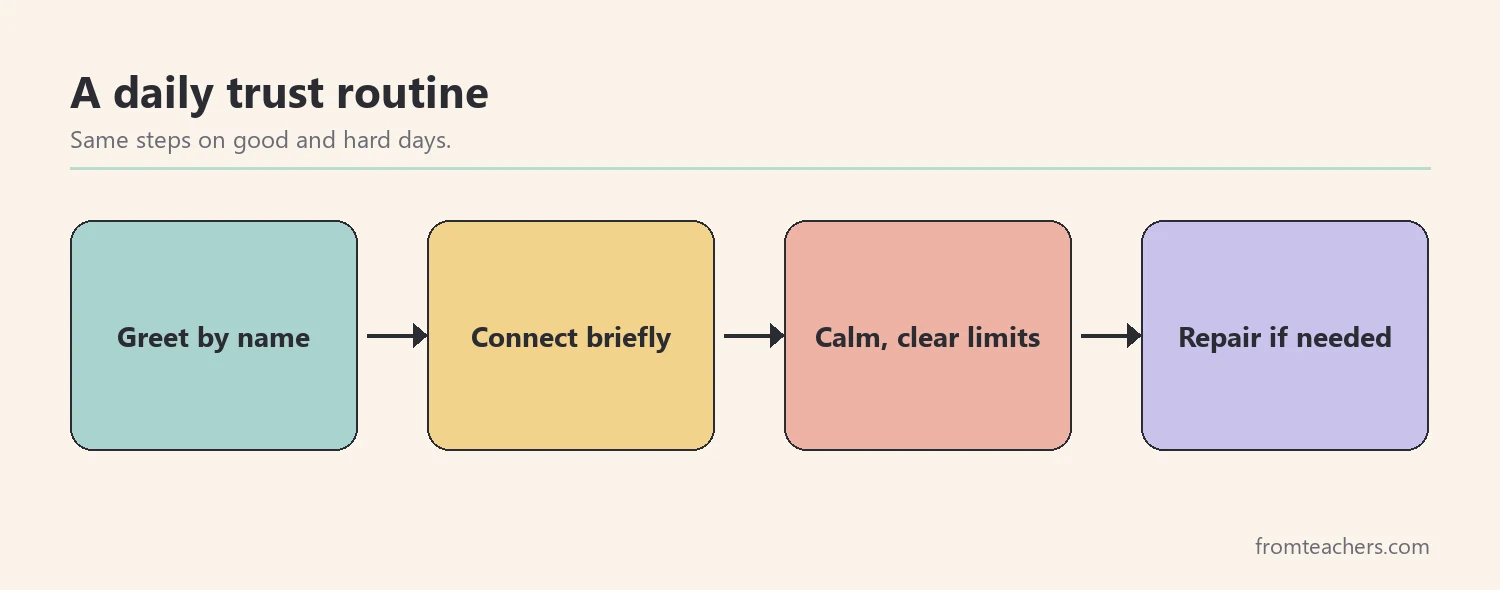
Finally, know when to ask for more help. Signs of self-harm, threats or sudden changes in mood need a response from counselors, school psychologists or other mental health professionals right away. Figure 5 shows a simple daily routine.
Common mistakes and how to avoid them
- Taking rejection personally. Fix: expect testing and stay steady.
- Lowering expectations to keep the peace. Fix: keep expectations and add support and choices.
- Power struggles in front of peers. Fix: correct privately and give time.
- Skipping repair after a conflict. Fix: hold a short, calm conversation the same day.
- Calling home only for problems. Fix: share good news first.
Questions teachers ask about trust building strategies for students
How long does it take to build trust?
It varies widely. Some students respond in weeks, while others need months of consistent behavior from adults before they relax.
Isn’t being warm the same as being soft?
No. Warmth and clear limits work together. Students often trust adults who are both kind and predictable.
What if the student is rude to me?
Respond calmly and privately, follow the plan and repair later. Avoid matching the student’s tone.
Should I share personal information to connect?
Small, appropriate details, such as a favorite team or pet, can help. Keep professional boundaries and follow school policy.
When should I involve a counselor?
Involve school mental health staff early for students with emotional needs, and immediately if you notice signs of harm or crisis.
Related reading: Trauma-Informed Teaching Strategies, Moving Beyond Shame and Behavior Charts, and School Counseling Programs.
You may also need: Calm Down Corner: Guided Visual Choice Board for Kids.
A companion resource for trust building strategies for students:
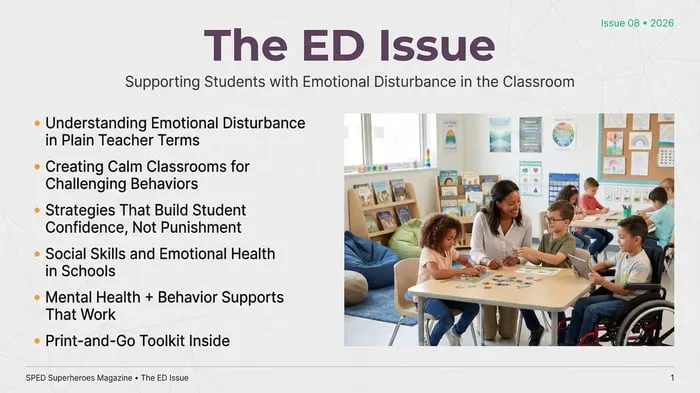
ED Support Toolkit: Calm Classroom & SEL Strategies: a 49-page guide covering a calm classroom setup, routines, de-escalation, emotion regulation, SEL support, teamwork with families and printables, plus scenarios on managing outbursts, building trust and handling defiance.
Sources and scope
- CASEL: the framework for social and emotional learning, including relationship skills.
- Center on PBIS: resources on positive behavior support and teacher-student relationships.
- IRIS Center: free modules on classroom behavior and supporting students with emotional and behavioral needs.
- Child Mind Institute: guides on teen mental health and behavior.
This list offers everyday relationship strategies for teachers of students who push adults away. It does not replace counseling, crisis procedures or a functional behavior assessment and behavior plan.
Key takeaways
- Trust building strategies for students work through small actions repeated daily.
- Greet, show interest and keep calm, clear limits.
- Offer choices and a planned break path.
- Repair after every conflict and keep small promises.
- Work as a team, involve families with good news and stay steady over months.


Leave a Comment