

Energy tracking for teens can turn “I’m just tired all the time” into a pattern a family can actually work with. Picture a ninth grader who drags through every afternoon, snaps at a sibling after school, and then cannot fall asleep at night. Everyone has a theory, but nobody has written anything down.
This guide is for parents and caregivers who want to run a short, respectful energy check at home with a teenager. By the end, you will know how to set it up with your teen, what to record, how to read two weeks of entries, and how to pick one small change that fits real family life.
Examples are fictional. Adapt to your teen’s needs and any supports already in place. This is guidance, not a diagnosis.
At a glance
- Ask your teen to own the tracker; your role is support, not surveillance.
- Track for a short, fixed window, such as two weeks.
- Record a few check-ins across the day, not only one rating at night.
- Look for repeated patterns, not single bad days.
- Change one habit at a time and track again to see if it helped.
1. Agree on energy tracking for teens as a shared experiment
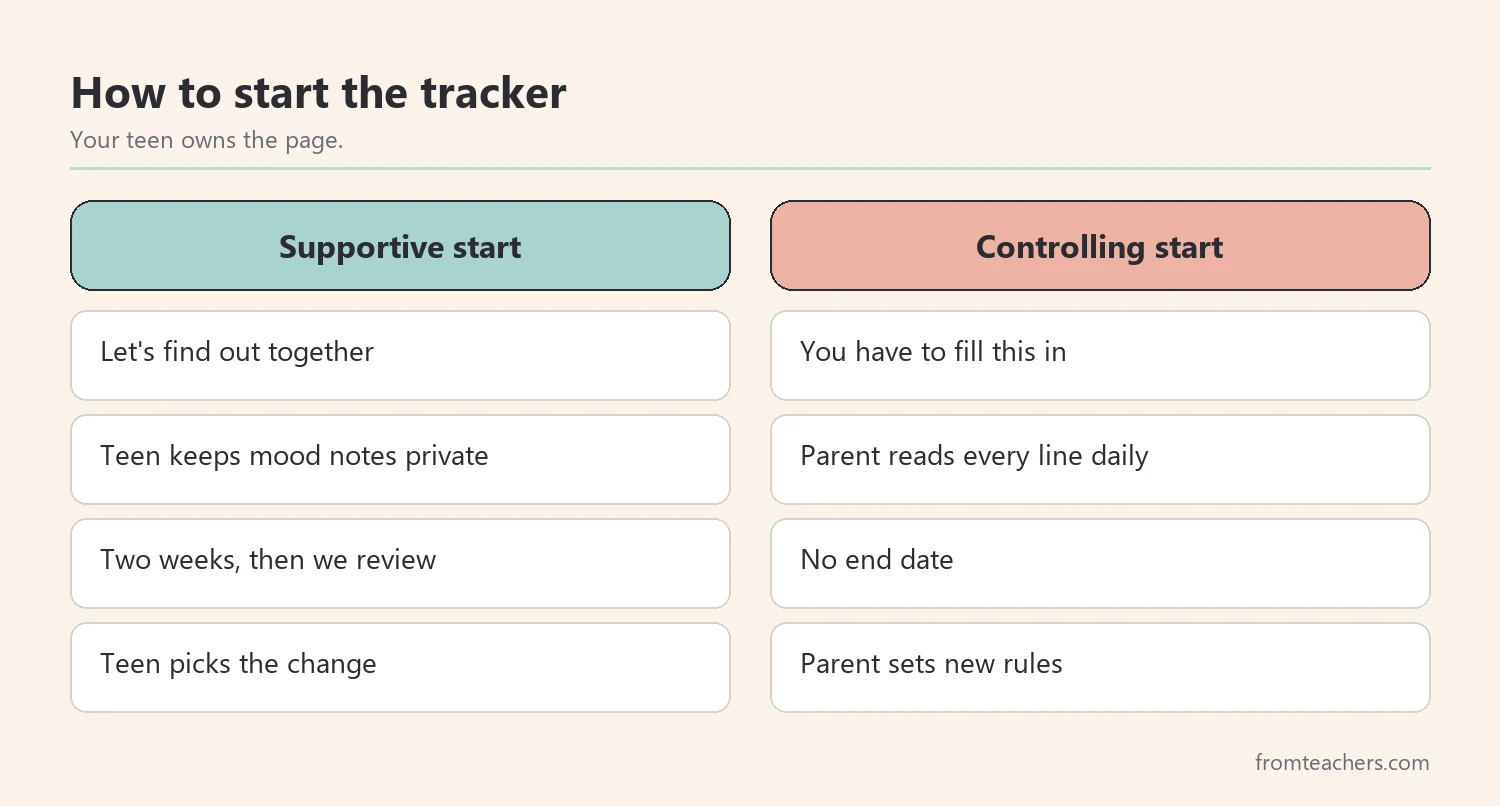
First, invite rather than assign. Teenagers are far more likely to stick with energy tracking for teens when it feels like their own project. Present it as a short experiment: “Let’s find out when your energy is best and what drains it.”
Next, agree on privacy. Decide together what you will see and what stays private. For example, your teen might share the energy numbers and habits, but keep mood notes to themselves unless they choose to talk about them. Respecting that line builds trust.
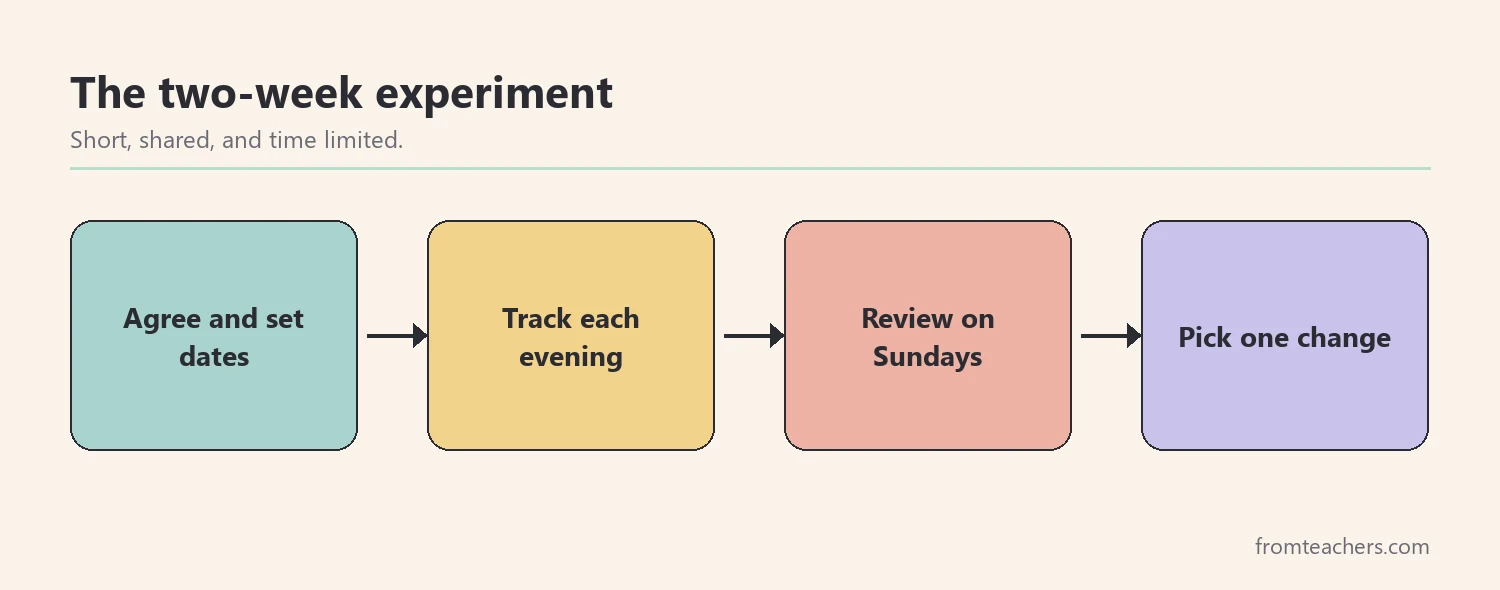
Then, set a clear time window. Two weeks is long enough to include school days and weekends, yet short enough that it does not become a chore. Mark the start and end dates on a calendar so everyone knows the experiment has a finish line.
Nora (fictional, age 14) complained of afternoon tiredness most school days. Her mother, Ms. Reyes, suggested a two-week check. Nora agreed on one condition: she would fill it in herself, and her mother would only read the reflection section on Sundays.
Finally, explain why it matters. Energy affects focus, patience, homework, and sleep. When a teen can see their own pattern, they gain a tool for self-awareness that will help long after the experiment ends.
2. Decide what to record each day
A good tracker is short enough to finish in a few minutes. Still, it should capture the main things that tend to affect energy. Most families do well with four parts: a morning check-in, check-ins across the day, daily habits, and a short reflection.
In the morning, record wake-up time, a first energy rating, sleep quality, and what was eaten for breakfast. A one to ten scale is simple and quick. In addition, a short note about stress or mood can explain an unusual rating.
During the day, a few check-ins tell you more than one rating at bedtime. Rate energy and mood in the early morning, late morning, early afternoon, late afternoon, evening, and night, along with what the teen was doing at that moment. On school days, teens can fill in the school-time rows from memory after school.
Then, add habits: exercise, water, caffeine, and meals or snacks. Keep it factual. “Two glasses of water, one energy drink at 3 p.m.” is more useful than “drank badly.”
Nora used a daily energy level tracker with a morning check-in, time-of-day ratings, habits, and a reflection section. Because every section was already laid out, she finished each page in about five minutes after dinner.
| Section | What to write (fictional example) |
|---|---|
| Morning check-in | Woke 6:40, energy 5, slept poorly |
| Early afternoon | Energy 3, math class, felt foggy |
| Habits | No breakfast, one soda after lunch |
| Reflection | Lowest point after lunch |
Adapting the tracker for different teens
Every teen is different, so adjust energy tracking for teens to fit the person. For a teen who finds writing tiring, reduce the page to ratings and one word per check-in. Similarly, a teen who loves detail can add notes about music, friends, or screen time.
For teens with attention or learning differences, short and visual works best. Use a highlighter color for each energy level, or let them circle numbers instead of writing. In addition, a phone reminder at the agreed time can replace a parent’s reminder, which keeps the tracker feeling independent.
For teens who experience strong emotions, keep the mood column optional. Some teens find that naming a feeling helps; others find it uncomfortable on paper. Either way, the energy ratings and habits are still useful on their own.
3. Build a two-week routine that lasts
Energy tracking for teens works only if it actually happens. Therefore, attach it to something that already occurs every day, such as after dinner or before screens go off at night. A fixed moment removes the need to remember.
Next, keep the tracker visible. A printed page on the desk or a clipboard by the bed works better than a file buried in a folder. Some teens prefer to type into an editable copy; either is fine if it is easy to reach.
Also, expect gaps. A missed day is not a failure. Simply leave it blank and continue the next day. Filling in old days from memory a week later tends to produce guesses rather than data.
Moreover, keep your comments light during the two weeks. If you react to every entry with advice, your teen may start writing what they think you want to see. Save the discussion for the weekly review.
Nora’s routine was simple: she filled in the page after dinner, then placed it in a folder on the kitchen shelf. On two busy evenings she forgot, and the family simply moved on. By the end, she had twelve complete days out of fourteen, which was plenty.
4. Read the patterns together
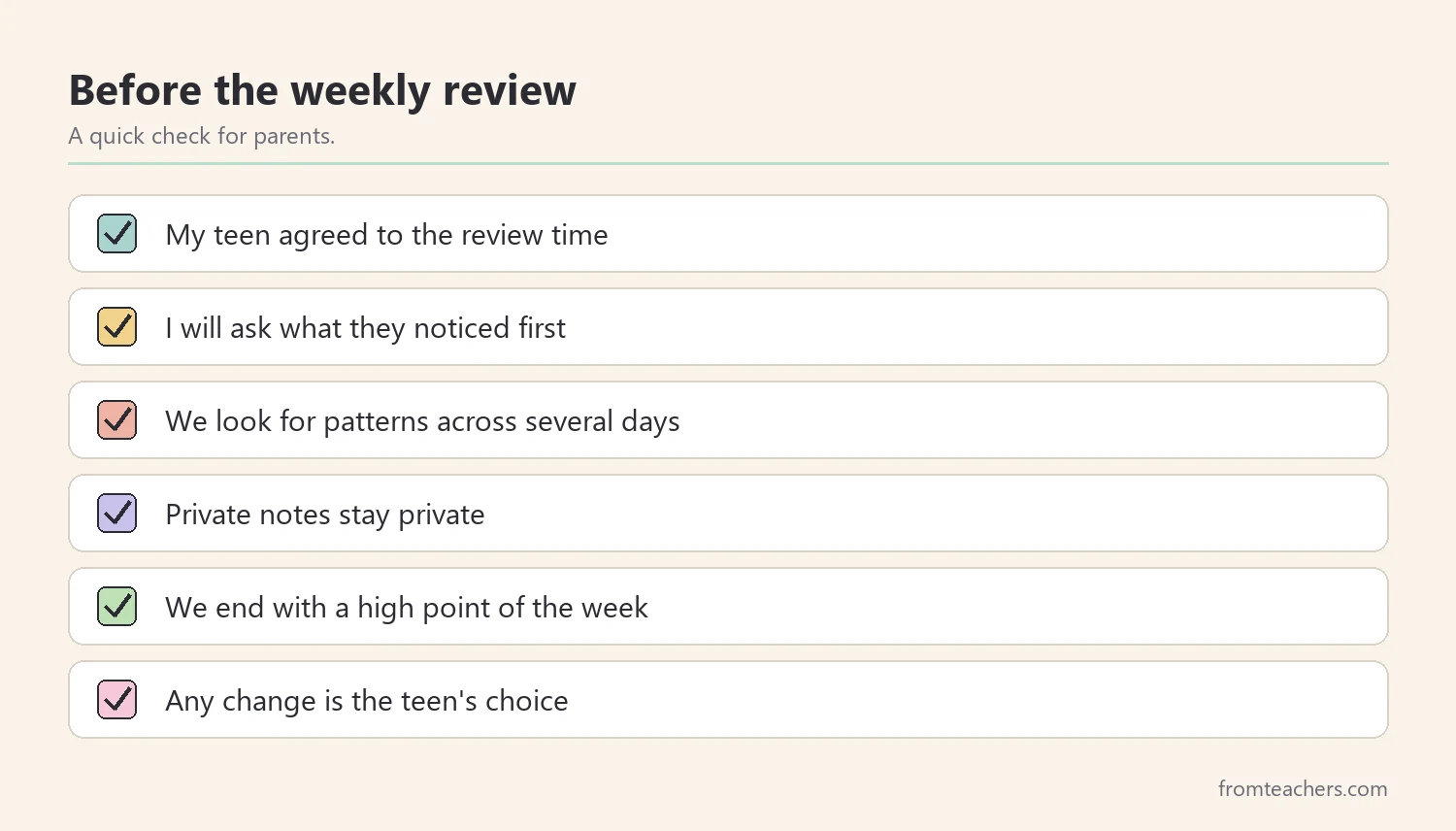
At the end of each week, sit down together for ten minutes. Start by asking your teen what they noticed. Their observations matter more than yours, and they often spot things adults miss.
Then, look across the days for repeated patterns. Is energy always low at the same time? Does it change on days with less sleep, no breakfast, or an afternoon caffeine drink? Energy tracking for teens is most useful when a pattern appears on several days, not just one.
A simple summary table helps. For each day type, note the average morning rating and the lowest point of the day. You do not need precise math; a rough comparison is enough to start a conversation.
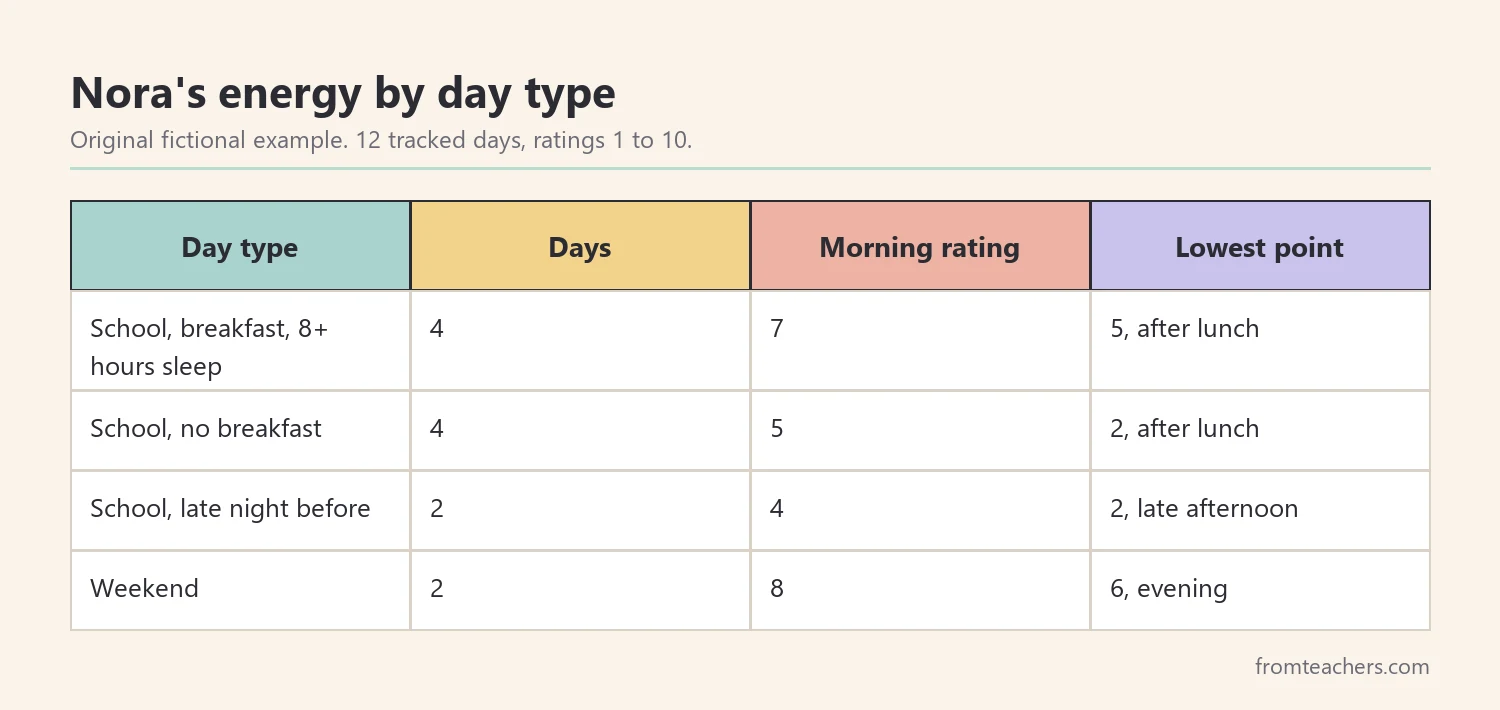
As Figure 3 shows, Nora’s lowest ratings came on days when she skipped breakfast and slept less than eight hours. Her ratings on weekends, when she woke later and ate breakfast, were noticeably higher. Nora said it first: “I think breakfast is the thing.”
However, avoid jumping to big conclusions. Two weeks of entries show patterns, not proof of causes. If tiredness is severe, constant, or comes with other worrying changes, speak with your child’s doctor. A tracker is a useful thing to bring to that appointment.
Finally, end the review on something positive. Ask, “When was your energy best this week, and what was happening?” High points tell you what to protect.
5. Choose one change and track again
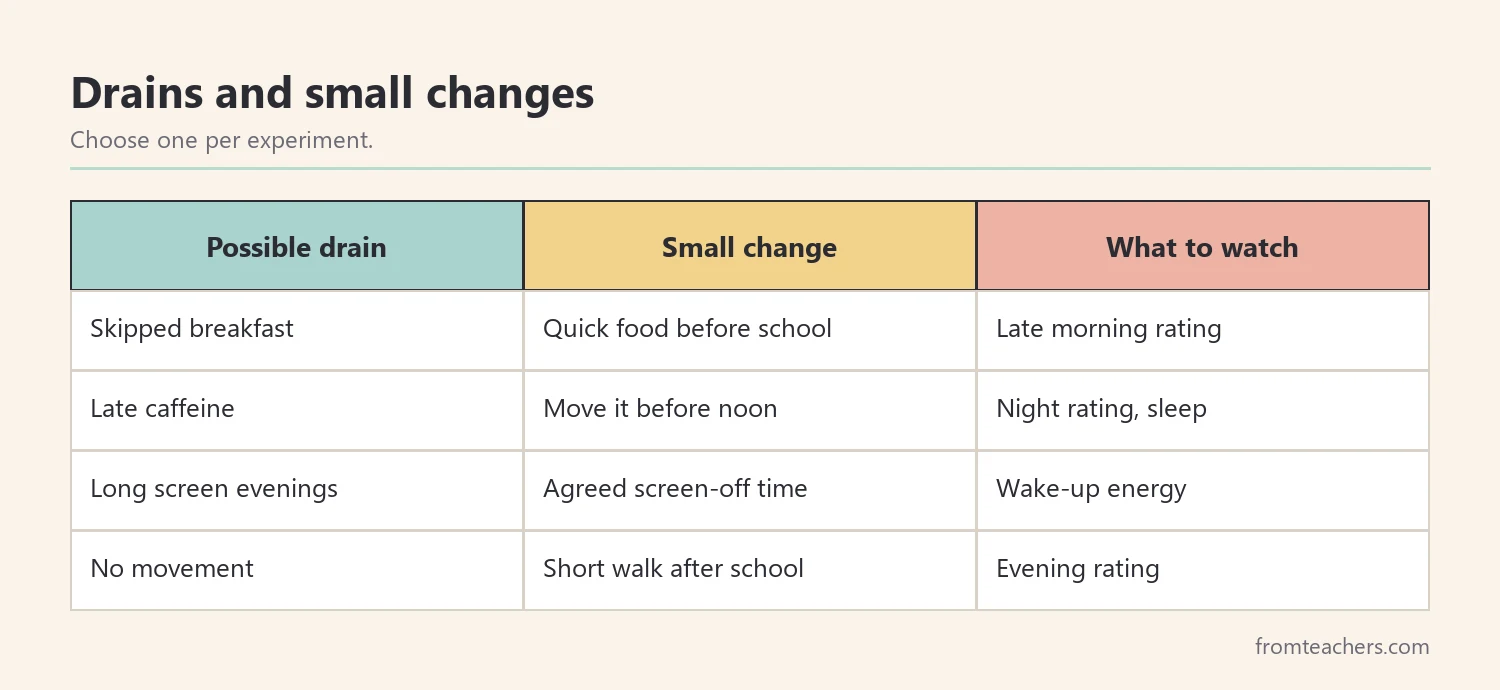
Next, pick one small change. The tracker’s “improvement for tomorrow” idea works well here: one thing to boost energy and one thing to avoid. Let your teen choose. A change they picked is a change they will try.
Good first changes are small and concrete. For example, eating something before school, moving caffeine earlier in the day, adding a short walk after school, or setting a screen-off time. Choose only one, because changing several habits at once makes it hard to know what helped.
Then, run energy tracking for teens for another week or two with the new habit. Compare the new entries with the first two weeks. If the low point is smaller or later, the change probably helped. If nothing changed, try a different idea.
Nora chose a quick breakfast of toast and fruit on school days. Over the next week, her early afternoon ratings rose on most days. She also noticed that afternoons were still harder after late nights, so she picked bedtime as her next experiment.
In addition, share useful findings with school if your teen agrees. A note to a teacher or counselor such as “Nora’s energy is lowest right after lunch” can help with seating, breaks, or the timing of tasks. Keep the decision about sharing with your teen whenever possible.
Also, keep a simple record of what you tried. One line per experiment is enough, such as “Week 3: breakfast before school, afternoon ratings up on most days.” Over a few months, this list becomes a personal guide your teen can use on their own. In this way, energy tracking for teens grows into a lasting habit of noticing and adjusting, rather than a one-time project run by a parent.
Finally, step back as your teen gains confidence. Many teens eventually run their own short check when something feels off, such as during exam season or after a schedule change. That independence is the real goal of energy tracking for teens.
Common mistakes and how to avoid them
- Turning tracking into monitoring. If the tracker feels like surveillance, teens stop being honest. Fix: agree on privacy and let your teen own the page.
- Tracking with no end date. Open-ended energy tracking for teens soon feels like homework. Fix: set a two-week window and celebrate finishing it.
- Rating only once a day. A single bedtime rating hides the afternoon dip. Fix: use several time-of-day check-ins.
- Reading one bad day as a pattern. Everyone has off days. Fix: look for the same pattern on several days.
- Changing everything at once. New bedtime, new breakfast, and no caffeine together hide what worked. Fix: one change per experiment.
- Using the tracker instead of medical advice. Ongoing exhaustion needs a professional view. Fix: bring the tracker to a doctor’s appointment.
Questions parents ask about energy tracking for teens
What age is energy tracking for teens suitable for?
Most young teens can fill in a simple tracker on their own, and older teens often enjoy the self-awareness side of it. Younger children usually need an adult to help with the ratings. Adjust the amount of writing to your child’s age and needs.
My teen refuses to do it. What now?
Do not force it. Instead, offer a shorter version, such as three ratings a day, or suggest trying it for only five days. You can also track your own energy alongside them, which makes it feel shared rather than imposed.
Should I check the tracker every day?
Usually not. Daily checking can feel like supervision and change what your teen writes. A weekly review, agreed in advance, keeps the data honest and the conversation calm.
Can this help with school?
It can. Patterns such as an after-lunch dip or tired Monday mornings can help teachers and counselors plan supports. Share them with your teen’s permission.
When should I talk to a doctor?
If tiredness is constant, severe, getting worse, or comes with changes in mood, appetite, or weight, contact your child’s doctor. The tracker can give the doctor useful everyday information, but it is not a medical tool.
Related reading: Understanding Autistic Burnout and School Exhaustion, How Teachers Communicate With Parents in Special Education, and 5 Practical Teaching Tips to Boost Classroom Focus and Learning.
You may also need: Healthy Habits for Kids: Sleep, Nutrition & Routines.
A companion resource for energy tracking for teens:
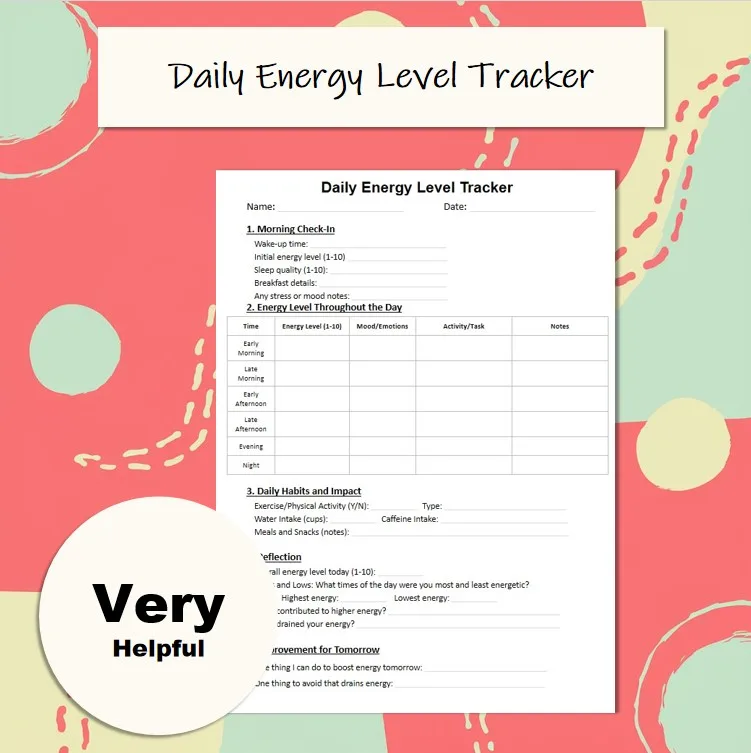
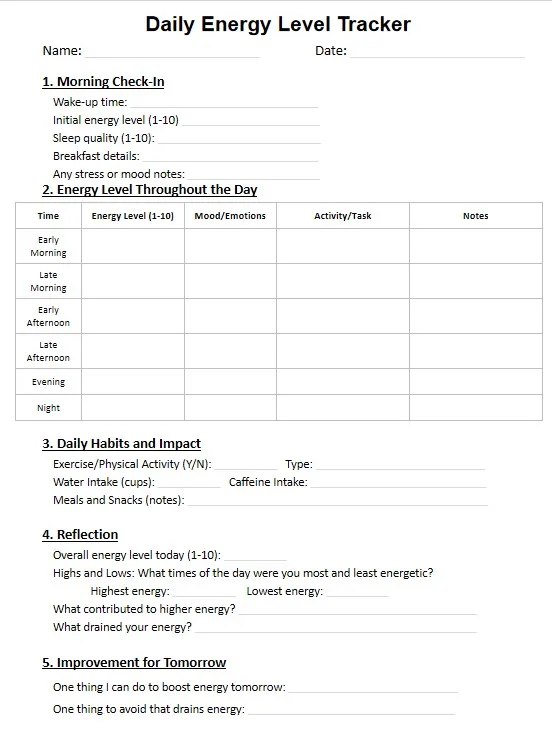
Daily Energy Level Tracker: Sleep, Mood and Habit Reflection Worksheet: a one-page tracker with a morning check-in, energy and mood ratings across six times of day, daily habits, a reflection, and one idea to boost energy tomorrow.
Sources and scope
- CDC: Sleep: public health information on sleep, including guidance for children and teens.
- HealthyChildren.org, American Academy of Pediatrics: parent information on teen sleep, nutrition, and healthy routines.
- Understood.org: family-friendly articles on focus, routines, and self-awareness.
- CASEL: background on social and emotional learning, including self-awareness and self-management.
This guide covers a short, informal energy check at home. It does not diagnose sleep, mood, or medical conditions, and it does not replace advice from your child’s doctor.
Key takeaways
- Energy tracking for teens works best as a shared, time-limited experiment.
- Several check-ins a day reveal dips that one rating hides.
- Weekly reviews led by the teen find patterns and keep trust.
- One small change at a time shows what really helps.
- Ongoing exhaustion is a reason to see a doctor, with the tracker in hand.






Leave a Comment