
Feedback for student teachers in special education can shape how a new teacher thinks about every student they will ever teach. Picture the ten minutes after a formal observation. The candidate is nervous, you have a page of notes, and the next class arrives soon. What you say, and how you say it, decides whether those notes become growth or just a grade.
This guide is written for cooperating teachers and university supervisors who mentor candidates in special education and early childhood special education placements. By the end, you will know how to prepare for the post-observation conference, give feedback that is specific and kind, set goals the candidate owns, and track growth across the placement.
Examples are fictional. Follow your university’s and district’s procedures for evaluation and records.
At a glance
- Good feedback names what was seen, not general impressions.
- Start with real strengths, then focus on one or two growth areas.
- Let the candidate reflect first, then add your view.
- Turn each conference into a small, measurable goal.
- Track the same domains across visits to see growth.
1. Prepare before the feedback conference
First, gather your evidence while the lesson is fresh. During the observation, write down short, factual notes: what the candidate said, what students did, and how long key moments took. For example, “Transition from reading group to centers took about four minutes; three students waited without a task” is far more useful than “transitions were slow.”
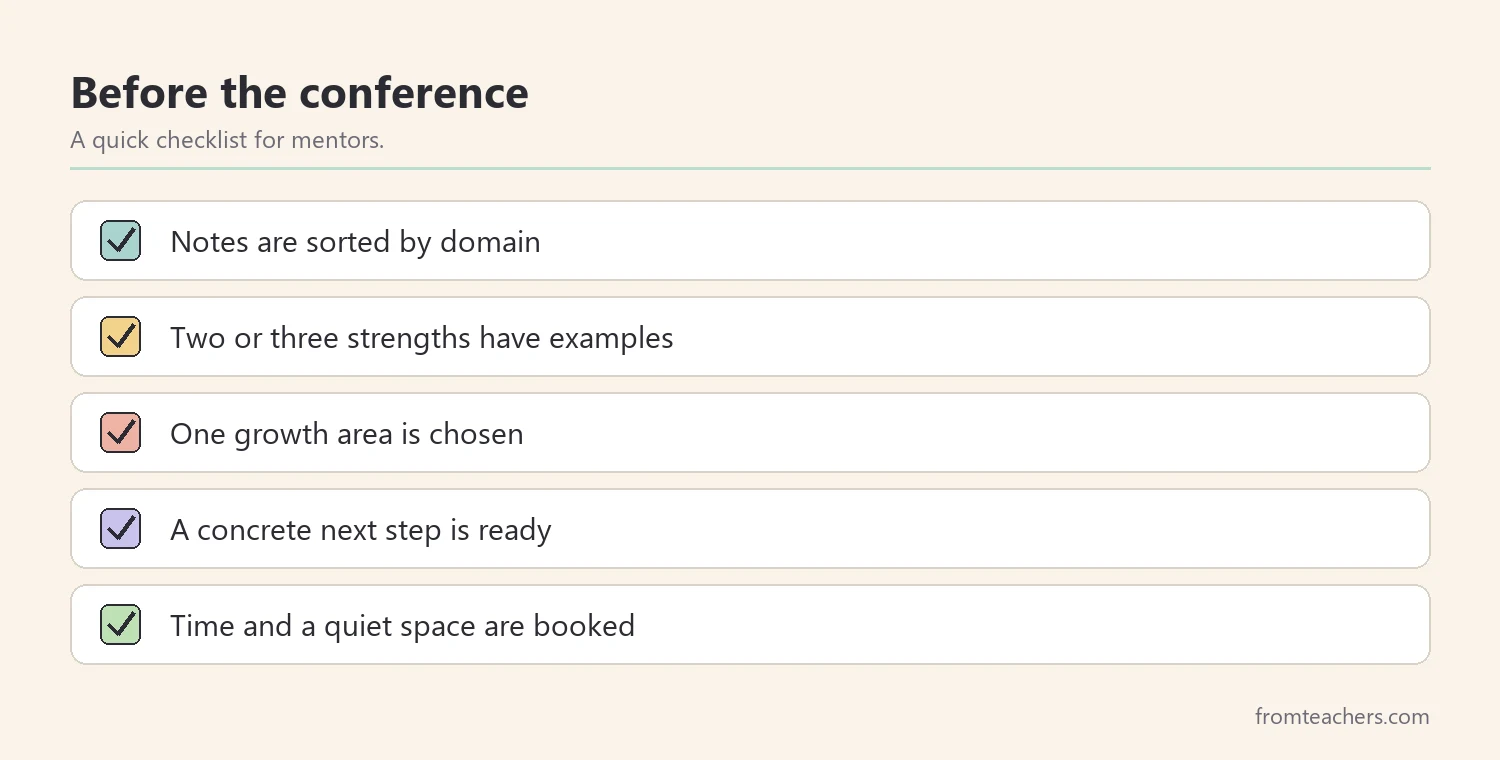
Next, sort your notes by the domains you are rating. Many special education observation tools group practice into areas such as instructional planning, classroom environment, teaching practice, and professional dispositions. When your notes are already sorted, the conference stays organized and nothing important is forgotten.
Then, choose your focus. A single lesson can reveal ten things to work on, but no new teacher can improve ten things at once. Pick one or two growth areas that will make the biggest difference for students. Also, pick two or three genuine strengths, with examples.
Meet Jordan (fictional), a teacher candidate in a K to 2 resource room, and his cooperating teacher, Mrs. Patel. After Jordan’s first formal observation, Mrs. Patel had notes on lesson objectives, accommodations, transitions, questioning, and professionalism. She chose two strengths (warm rapport and clear visual supports) and one growth area (checking for understanding during the lesson).
Finally, plan the timing. Feedback works best within a day of the lesson, in a quiet space, with enough time to talk. A rushed hallway chat rarely leads to change.
2. Open with reflection and real strengths
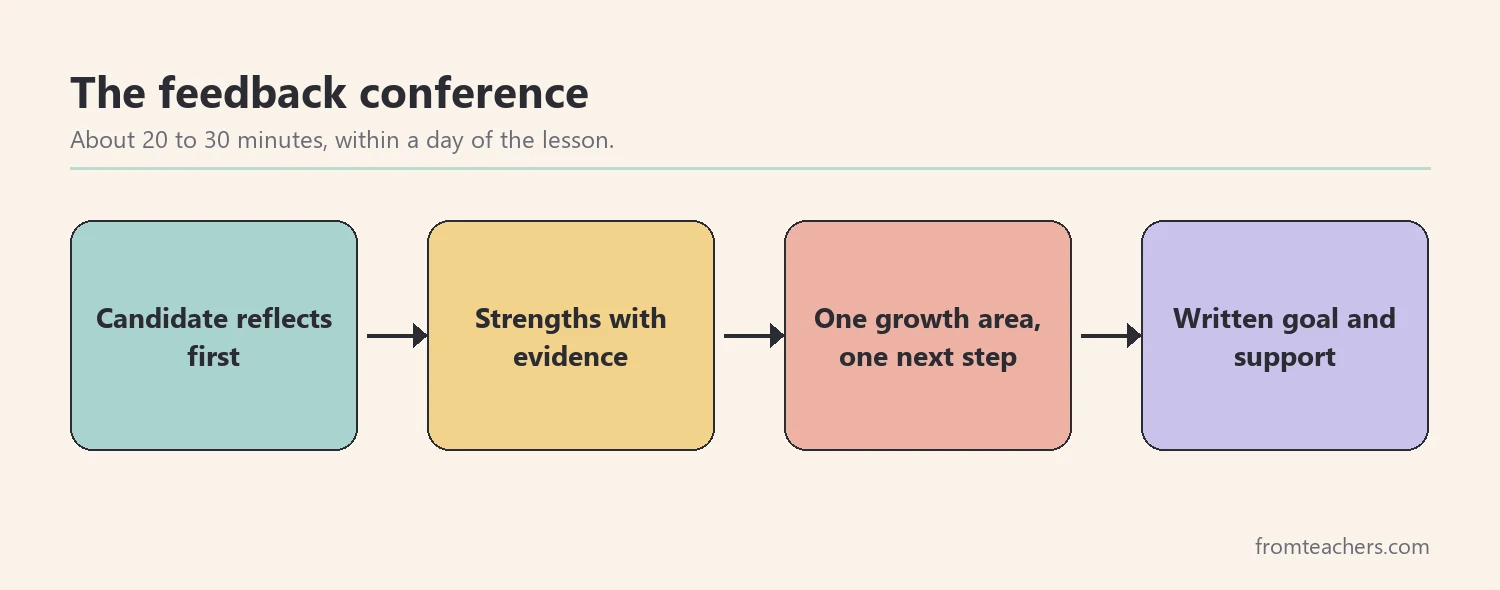
Start the conference by asking the candidate to reflect. Simple questions work well: “What went the way you planned?” and “If you taught this lesson again tomorrow, what would you change?” Because candidates often notice the same issues you did, this opening builds ownership and trust.
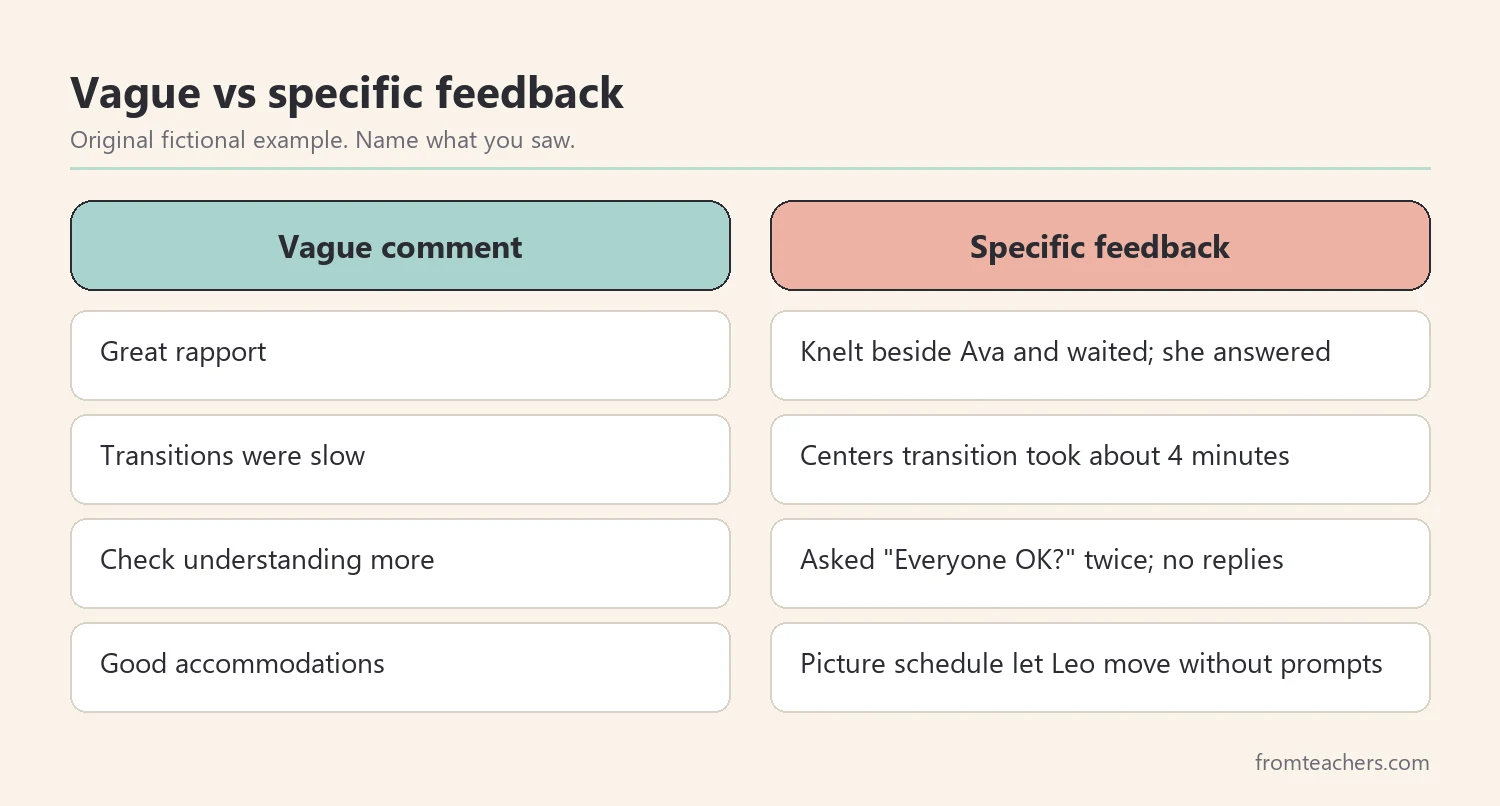
Then, share strengths with evidence. “You built great rapport” is pleasant but vague. Instead, try “When Ava hesitated, you knelt beside her, pointed to the visual, and waited. She answered within a few seconds.” Specific praise tells the candidate exactly what to keep doing.
In addition, connect strengths to students. Special education candidates need to see how their choices affect learners with different needs. For instance, “Your picture schedule helped Leo move to centers without prompting” links a teaching move to a student outcome.
Mrs. Patel opened by asking Jordan what he was proud of. He mentioned the visual supports, which matched her notes. She added two specific examples, and Jordan visibly relaxed. That made the next part of the conversation much easier.
Also, keep the balance honest. Strengths should be real and specific, not a soft cushion before criticism. Candidates quickly sense when praise is a formula, and it weakens trust in everything else you say.
A structured form helps here. The special education student teacher observation form for CCSE and ECSE placements includes a Successes and Strengths section next to Suggestions and Considerations, so both sides of the conversation have a clear, written place.
3. Give feedback for student teachers in special education that is specific and usable
Now move to growth areas. The goal is feedback the candidate can act on tomorrow. So, describe what you saw, explain why it matters for students, and suggest one concrete next step.
A simple pattern keeps this clear:
| Part | Example (fictional) |
|---|---|
| What I saw | You asked “Does everyone understand?” twice; no one answered. |
| Why it matters | Some students may not say when they are confused. |
| Try next time | Ask each student to show a thumbs signal or point to an answer card. |
Moreover, keep the focus small. One clear suggestion is more likely to show up in the next lesson than five. If you have more concerns, note them for later conferences rather than listing them all at once.
Use the rating scale with care. A rating alone tells the candidate little. However, a rating plus one example and one next step turns the score into a learning tool. For instance, “Checking for understanding: Emerging. You asked open questions but did not see each student’s response. Next time, use response cards.”
Also, invite questions. Candidates often hesitate to disagree with a mentor. Asking “Does that match what you noticed?” or “What might make that hard to try?” opens space for honest talk and practical problem solving.
Finally, model the language you want the candidate to use with students and families: objective, respectful, and focused on next steps. Good feedback teaches by example as well as by content.
Adjusting feedback for early childhood placements
Early childhood special education classrooms look different from K to 12 settings. Lessons are often play-based, routines carry much of the teaching, and much of the learning happens during snack, circle time, and free play. Therefore, feedback should follow the learning wherever it happens, not only during a formal lesson.
For example, a candidate might plan a strong circle time but miss chances to build language during snack. Useful feedback could sound like this: “During snack, Mia pointed at the crackers three times. Next time, try modeling the word ‘cracker’ and waiting a few seconds before handing them over.” The pattern is the same as before: what you saw, why it matters, and one thing to try.
In addition, pay attention to how the candidate works with other adults. Early childhood rooms often include paraprofessionals, therapists, and family members. Notes on how the candidate gives directions to a paraprofessional, or greets a parent at drop-off, are valuable evidence for the professional dispositions domain.
Also, keep observations shorter but more frequent. Young children’s attention shifts quickly, and so does the flow of the room. Several brief observations across different routines often give a fuller picture than one long formal visit.
4. Set goals the candidate owns
A conference should end with a goal, not just a list of comments. Ideally, the candidate writes the goal in their own words. As a result, they are far more likely to remember it and act on it.
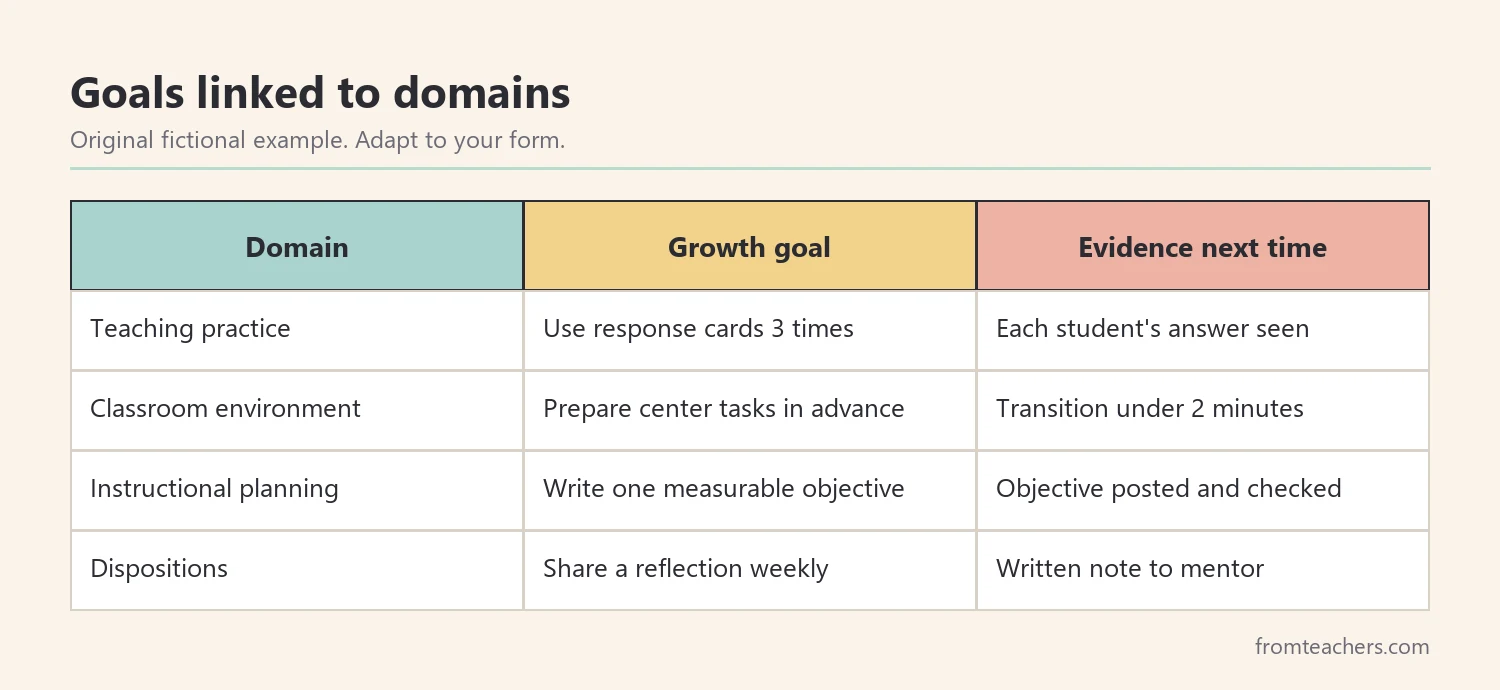
Good goals are small and observable. “Get better at checking understanding” is too broad. “In my next small-group lesson, I will use response cards at least three times and note which students need reteaching” is clear. You can see it, count it, and discuss it next time.
In addition, agree on support. What will you do to help? Mrs. Patel offered to model response cards in her own group the next day, so Jordan could see the strategy before trying it. She also gave him a set of cards she already used.
Then, record the goal in writing. Many observation forms include a section for the candidate’s goals for improvement and a conference documentation area with signatures from the supervisor, candidate, and cooperating teacher. Writing it down makes the agreement clear for everyone, including the university supervisor who may not have been in the room.
Also, link goals to the domains. If the goal sits under teaching practice, the next observation should look closely at that domain. That connection keeps feedback consistent from one visit to the next.
5. Track growth across the placement
One observation is a snapshot. Several observations, rated on the same domains, show a story of growth. Therefore, keep a simple summary table that lists each domain and the rating from each formal visit.
Here is Jordan’s summary across three observations:
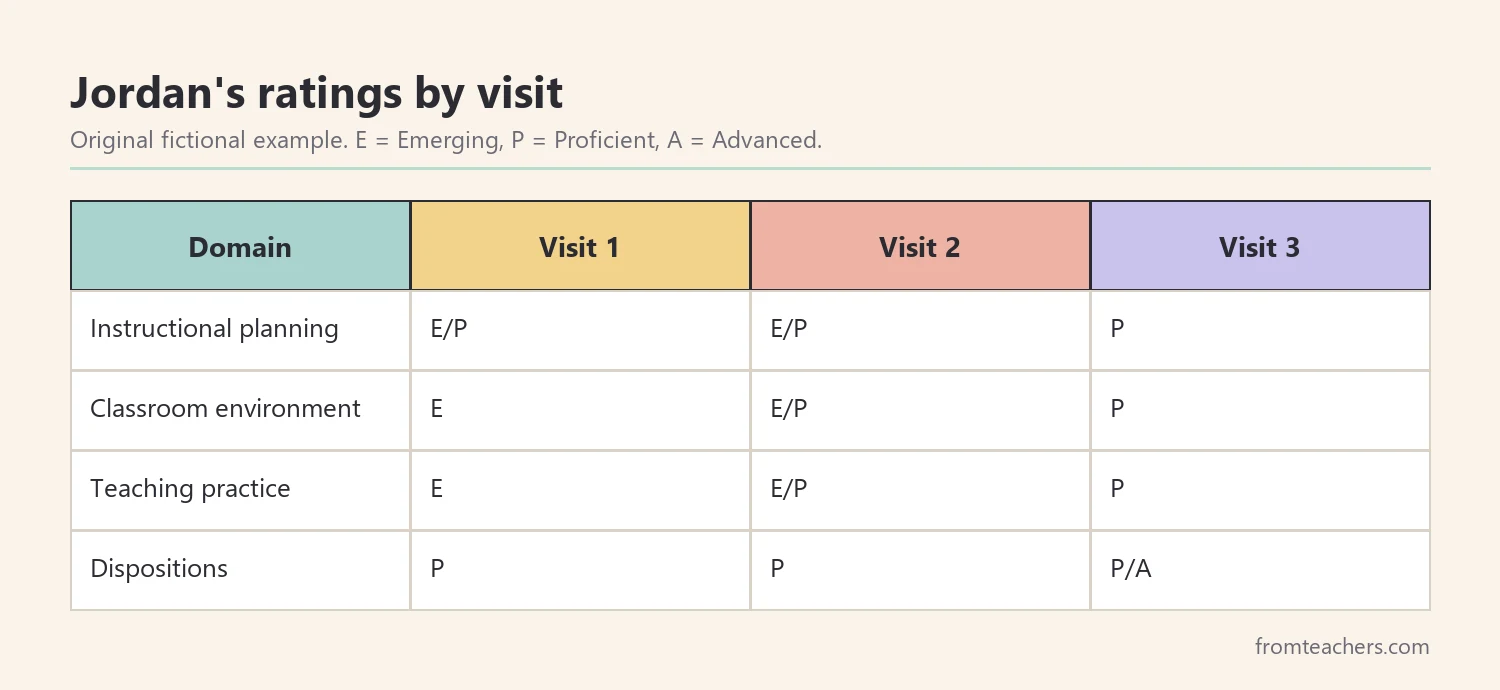
The table made progress easy to discuss. Teaching practice, which included checking for understanding, moved from Emerging to Proficient. Classroom environment grew steadily, one step on the scale per visit. Instructional planning stayed at Emerging/Proficient for two visits, so the team chose it as the focus for the final weeks.
Moreover, share the table with the candidate. Seeing growth over time is encouraging, especially during a demanding placement. It also helps candidates prepare reflections for their own portfolios or program requirements.
Keep informal notes between formal visits as well. Short notes from daily teaching, such as “used response cards in reading group, three students needed reteaching,” show whether goals are carrying over into everyday practice. That evidence makes the next formal conference richer.
Finally, end the placement with a reflective conversation. Ask the candidate which feedback helped most and what they will keep doing in their own classroom. Mentoring is most successful when the candidate leaves with habits they will use for years.
Common mistakes and how to avoid them
- Giving vague comments. “Good job” and “work on management” are hard to act on. Fix: name what you saw and one next step.
- Covering everything at once. Long lists overwhelm new teachers. Fix: choose one or two growth areas per conference.
- Talking more than listening. Candidates learn less when they only receive. Fix: ask for their reflection first.
- Skipping written goals. Spoken goals fade quickly. Fix: write the goal on the form and agree on support.
- Rating without evidence. A score with no example feels arbitrary. Fix: attach a short observed example to each rating.
Questions mentors ask about student teacher feedback in special education
How soon after an observation should I give feedback?
As soon as is practical, ideally within a day. Details fade fast for both of you. If a full conference must wait, share one or two quick strengths the same day so the candidate is not left wondering.
How do I give hard feedback without discouraging the candidate?
Be specific, focus on the impact on students, and offer a concrete next step and your support. Present it as a skill to build, not a judgment of character. Most candidates respond well when they can see a clear path forward.
Who should complete the observation form?
That depends on your program. In many placements, both the university supervisor and the cooperating teacher contribute, and the conference is documented with all three signatures. Follow your university’s guidance.
What if the candidate disagrees with my ratings?
Listen first and look at the evidence together. Sometimes the candidate noticed something you missed. If you still disagree, note both views and agree on what to look for in the next observation.
How many goals should a candidate work on at once?
One or two at a time is usually enough. When a goal is met, add the next one. Small, steady steps build confidence and lasting skills.
Related reading: The Crucial Role of Special Educators in the USA, Special Education Strategies: 10 Powerful Ways Teachers Can Succeed, and Addressing Challenges in Special Education.
You may also need: Teacher Observation Feedback Form: Classroom Walkthrough Rubric for Coaches.
A companion resource for feedback for student teachers in special education:
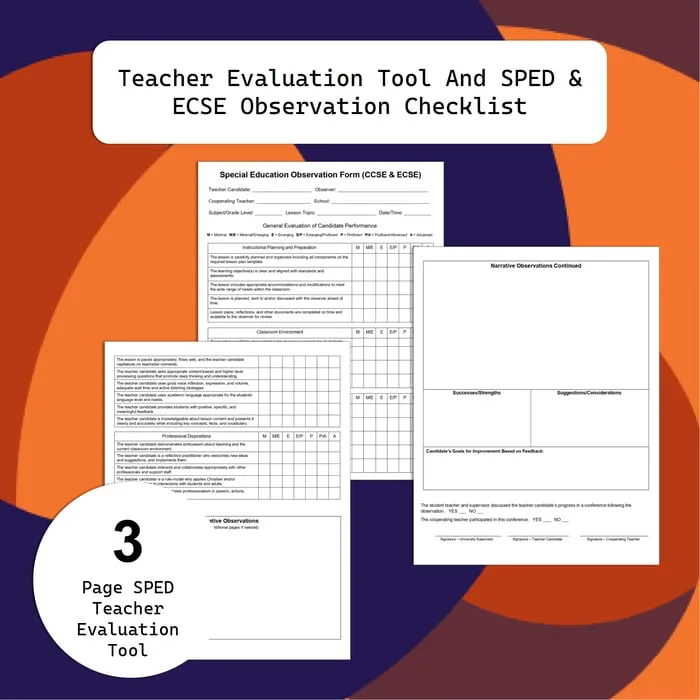
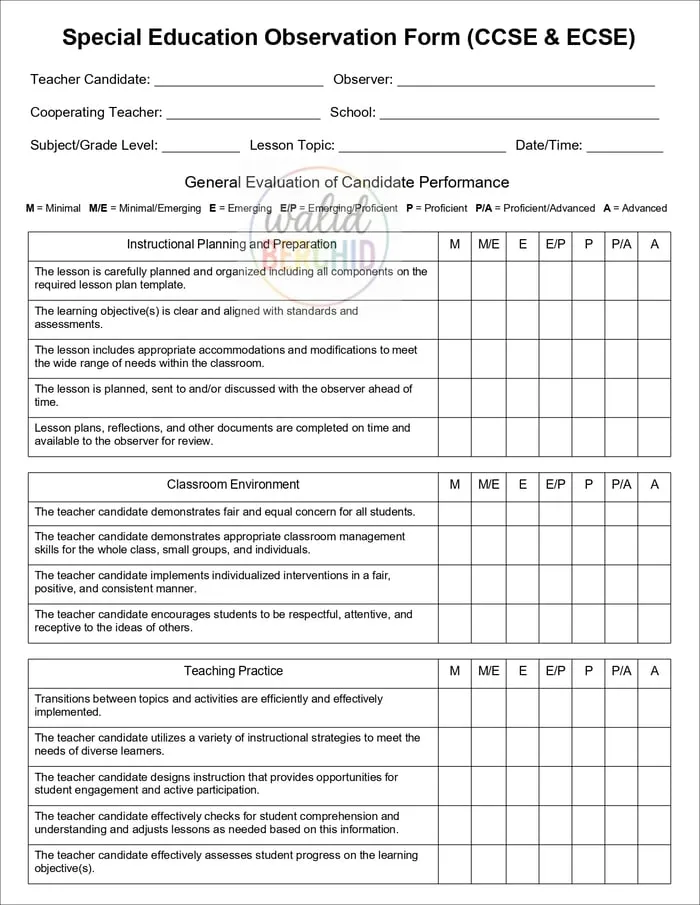
Special Education Student Teacher Observation Form: CCSE/ECSE Evaluation Tool: a three-page form with Minimal to Advanced rating scales for planning, environment, teaching practice, and professional dispositions, plus narrative notes, strengths, suggestions, candidate goals, and conference signatures.
Sources and scope
- Council for Exceptional Children (CEC): professional standards and resources for special education teacher preparation.
- IRIS Center, Vanderbilt University: free modules used in teacher preparation programs, including classroom management and instruction.
- CEEDAR Center: resources on preparing teachers and leaders to support students with disabilities.
- Individuals with Disabilities Education Act (IDEA), U.S. Department of Education: the federal framework that special education candidates learn to work within.
This guide covers mentoring conversations and goal setting during student teaching. It does not replace your university’s evaluation requirements, licensure rules, or district policies.
Key takeaways
- Feedback for student teachers in special education starts with evidence, not impressions.
- Candidate reflection and real strengths open the conversation well.
- One specific growth area with a clear next step beats a long list.
- Written goals, owned by the candidate, carry feedback into practice.
- A domain summary across visits shows growth and guides the final weeks.


Leave a Comment