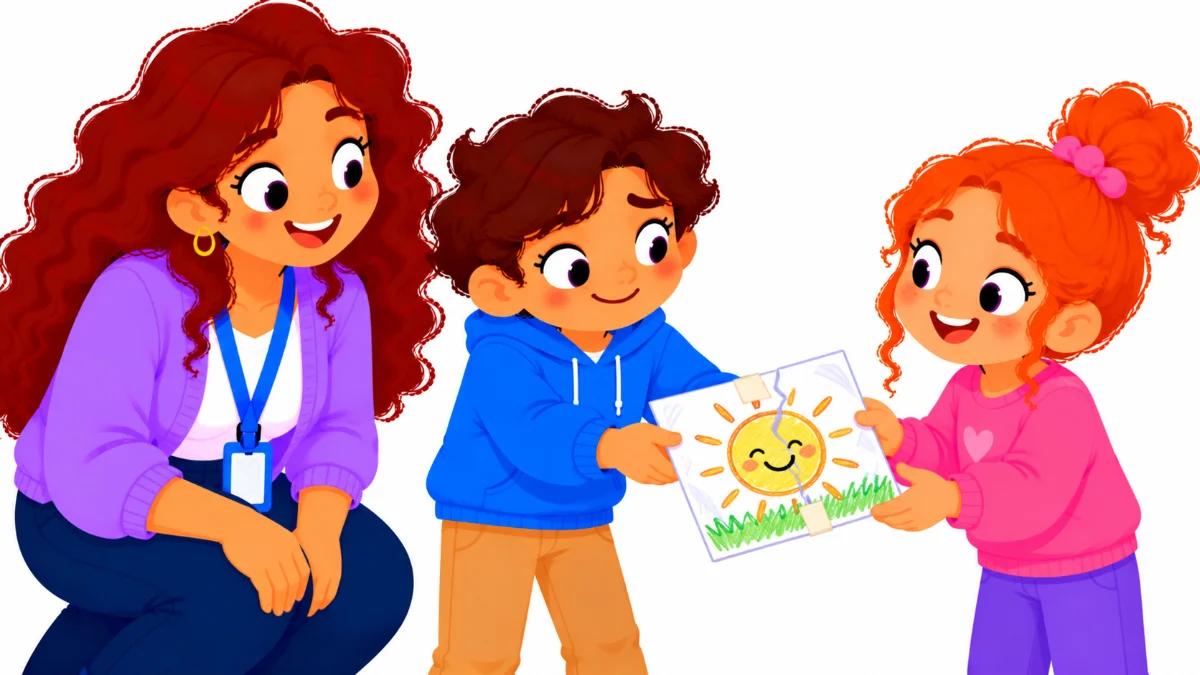

Teaching kids accountability starts in small, ordinary moments. Picture a seventh grader who knocks a classmate’s science model off a table. Before anyone asks, he says, “It was already falling,” and walks away. The model is broken, the classmate is upset, and the moment to make it right slips by.
This guide gives you a five-step way to change that pattern at school and at home. By the end, you will be able to make mistakes safer to admit, teach clear ownership language, guide a sincere apology, support real repair, and track growth over time.
Examples are fictional. Adapt to the student’s goals and agreed supports. This is guidance, not a diagnosis.
At a glance
- Most children dodge blame out of fear or shame, not because they are sneaky.
- Accountability is a skill, so it can be taught, modeled, and practiced.
- Short scripts help students move from excuses to clear ownership.
- A sincere apology names the action, the impact, and the repair.
- Consequences work best when they are calm, fair, and linked to repair.
1. Make mistakes safe to admit
First, look at why students avoid owning mistakes. Usually it is not about being sneaky. Instead, it is about fear. A child who expects yelling, public shame, or a harsh penalty will hide a mistake to protect himself.
Some students also believe a mistake means they are a bad person. So denying it feels like protecting who they are. Others simply lack the words, or they act on impulse and then panic. Therefore, the first step in teaching kids accountability is lowering the threat around mistakes.
Next, separate the person from the action. Say, “That choice caused a problem,” instead of “You are so careless.” Then model it yourself. When you make a small mistake in class, name it out loud: “I forgot to post the homework. That is on me, so I will post it now.”
In addition, think about your first reaction. The first few seconds after a mistake often decide whether a child tells the truth next time. A calm “Okay, let’s look at this” keeps the door open, which is the real starting point for teaching kids accountability.
| Why students avoid | What helps |
|---|---|
| Fear of punishment | Calm, predictable responses |
| Shame | Separate the child from the choice |
| No words to use | Teach short scripts |
| Acting on impulse | Pause first, talk later |
Worked example. Malik is a fictional student in grade 7. He often blames others when something goes wrong. His teacher, Ms. Grant, notices that he freezes when adults raise their voices. So she changes her tone. After the broken model, she waits until he is calm and says quietly, “Something happened at the table. Let’s figure out how to fix it.” Malik does not admit it yet, but he stays to talk instead of leaving.
Also, notice small wins at this stage. If a student stays in the conversation instead of running off, that is progress. Teaching kids accountability often begins with these quiet steps long before a full admission comes.
In short, safety comes before skills. As a result, students can start telling the truth without bracing for a fight.
2. Teach the language of ownership
Once mistakes feel safer, give students the words. Many children truly do not know what ownership sounds like. They have heard “say sorry” many times, but nobody showed them what comes after.
So, teach a few short scripts and practice them. Compare common excuses with clear ownership statements. Teaching kids accountability becomes much easier when students can hear the difference side by side.
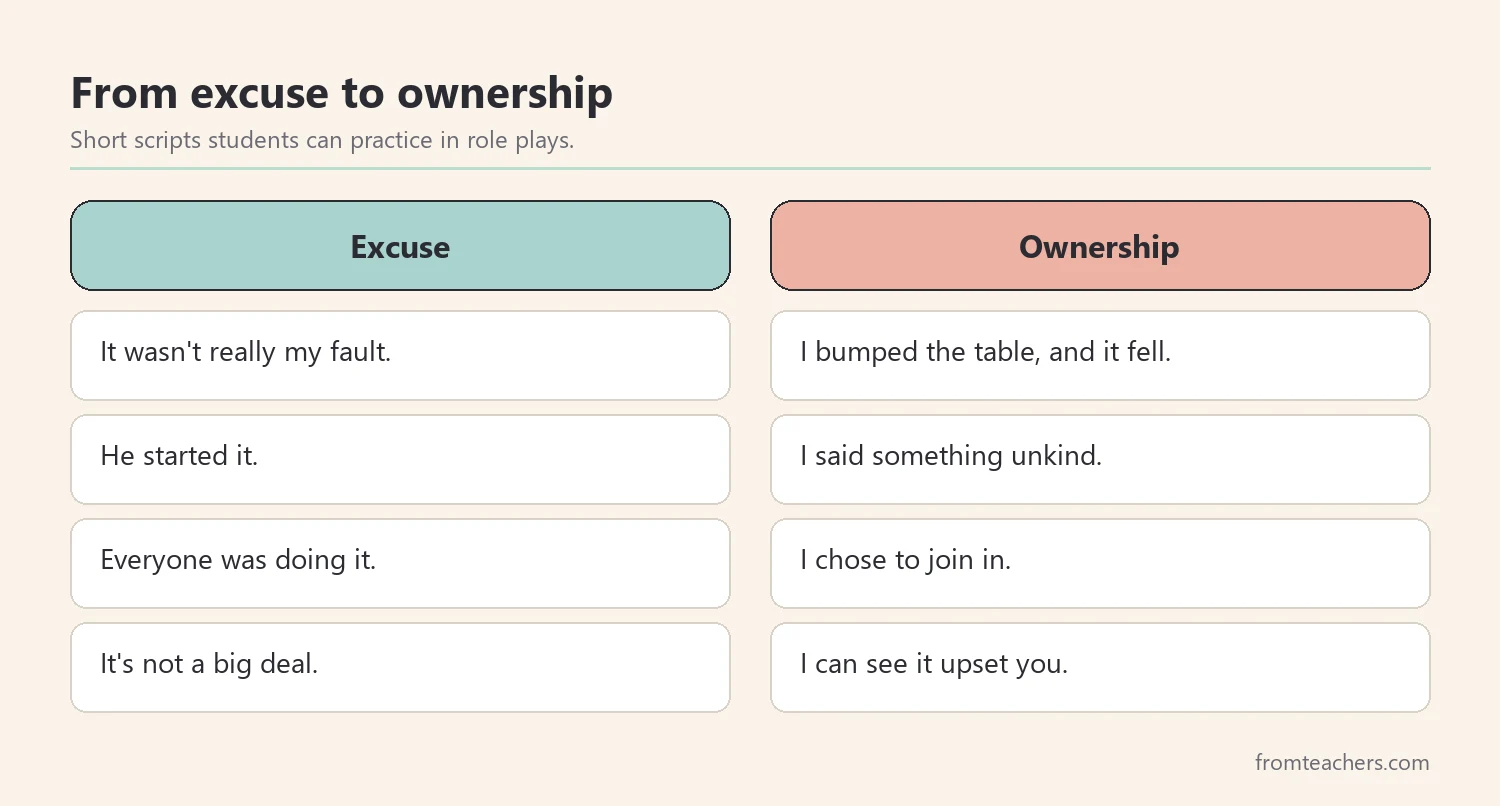
Next, practice in low-stakes moments. Use role plays with made-up situations, such as spilling paint or forgetting a partner’s materials. Students take turns saying the excuse, then the ownership version. Keep it light, because laughter lowers the pressure.
Also, keep role plays short and varied. Five minutes, two or three scenarios, and a quick debrief is plenty. Short, frequent practice is one of the simplest ways of teaching kids accountability without making students feel lectured.
In addition, post two or three starter phrases where students can see them: “I did that.” “That was my choice.” “I can fix it by…” These cues help in the moment, when feelings run high and words are hard to find.
Then connect the scripts to real classroom moments. When a student uses an ownership phrase on their own, notice it briefly and privately: “You said that clearly. That took courage.” Specific, low-key praise helps the new language become a habit, and it shows that teaching kids accountability is about growth rather than catching children out.
For students who struggle with language, offer sentence frames on a card. Similarly, let some students write their ownership statement before saying it aloud.
Worked example. Ms. Grant runs a ten-minute role play with Malik’s class. Malik reads the excuse, “It wasn’t really my fault,” then the ownership line, “I bumped the table, and the model fell.” He laughs at first, then says it again more seriously. Afterward, he keeps the phrase card in his binder.
3. Guide a sincere apology
Next, teach what a real apology includes. A quick “sorry” often sounds empty, and the other person can tell. A sincere apology has a clear shape, and students can learn it step by step.
A useful structure has four parts. First, name what you did. Second, say how it affected the other person. Third, offer to repair it. Fourth, say what you will do differently next time. Teaching kids accountability through this structure helps them focus on the other person, not just on getting out of trouble.
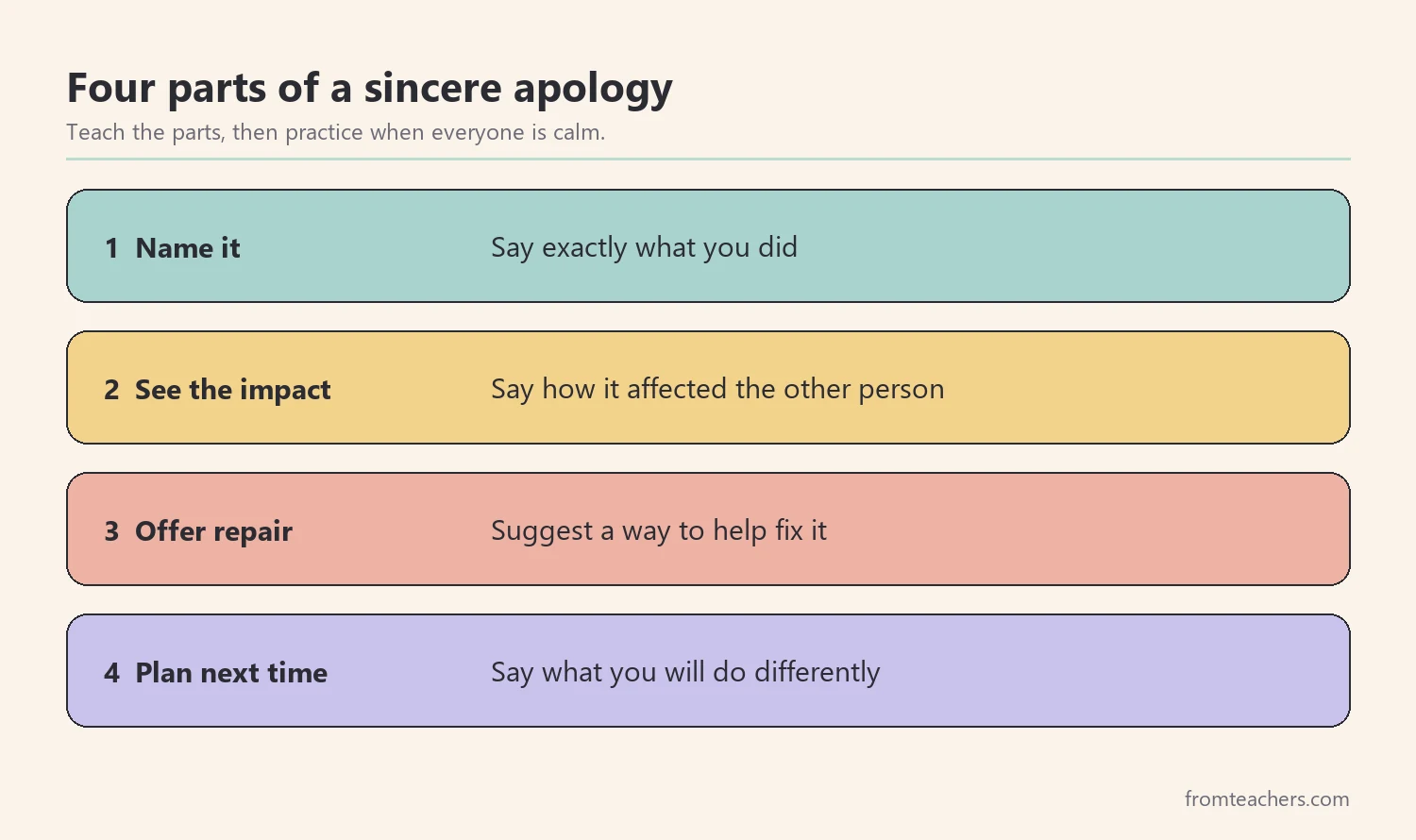
Then, avoid forced apologies. A student who is still angry cannot apologize sincerely. Instead, wait until both students are calm. Also, never require an apology in front of the whole class. Private or small-group settings feel safer.
Meanwhile, accept that some apologies will not be received well right away. The other student may need time. Teaching kids accountability means helping the child focus on what they can control: a clear apology and a real offer to repair.
If you want structured practice, the Taking Responsibility for Actions tables and scripts cover recognizing a mistake and apologizing sincerely, with prompts that fit a quick one-on-one check-in.
Worked example. The next day, Malik is ready to talk. With Ms. Grant nearby, he tells his classmate Rosa, “I bumped the table and broke your model. I know you worked on it for a week. I can help you rebuild the base at lunch. Next time I will walk around the tables.” Rosa is still a little upset, but she agrees to the lunch plan.
4. Support repair and calm consequences
An apology opens the door, and repair walks through it. Repair means taking an action that helps fix the harm. It might be cleaning up, replacing an item, helping rebuild, or checking in later.
Meanwhile, consequences still matter. However, they work best when they are calm, fair, and connected to the mistake. Missing recess for a broken model teaches less than spending recess helping fix it. Therefore, link consequences to repair whenever you can.
Also, prepare students for other people’s reactions. Sometimes the hurt person stays angry for a while. Teaching kids accountability includes helping them accept that without getting defensive. A short script helps: “I understand you are still upset. I am still going to help fix it.”
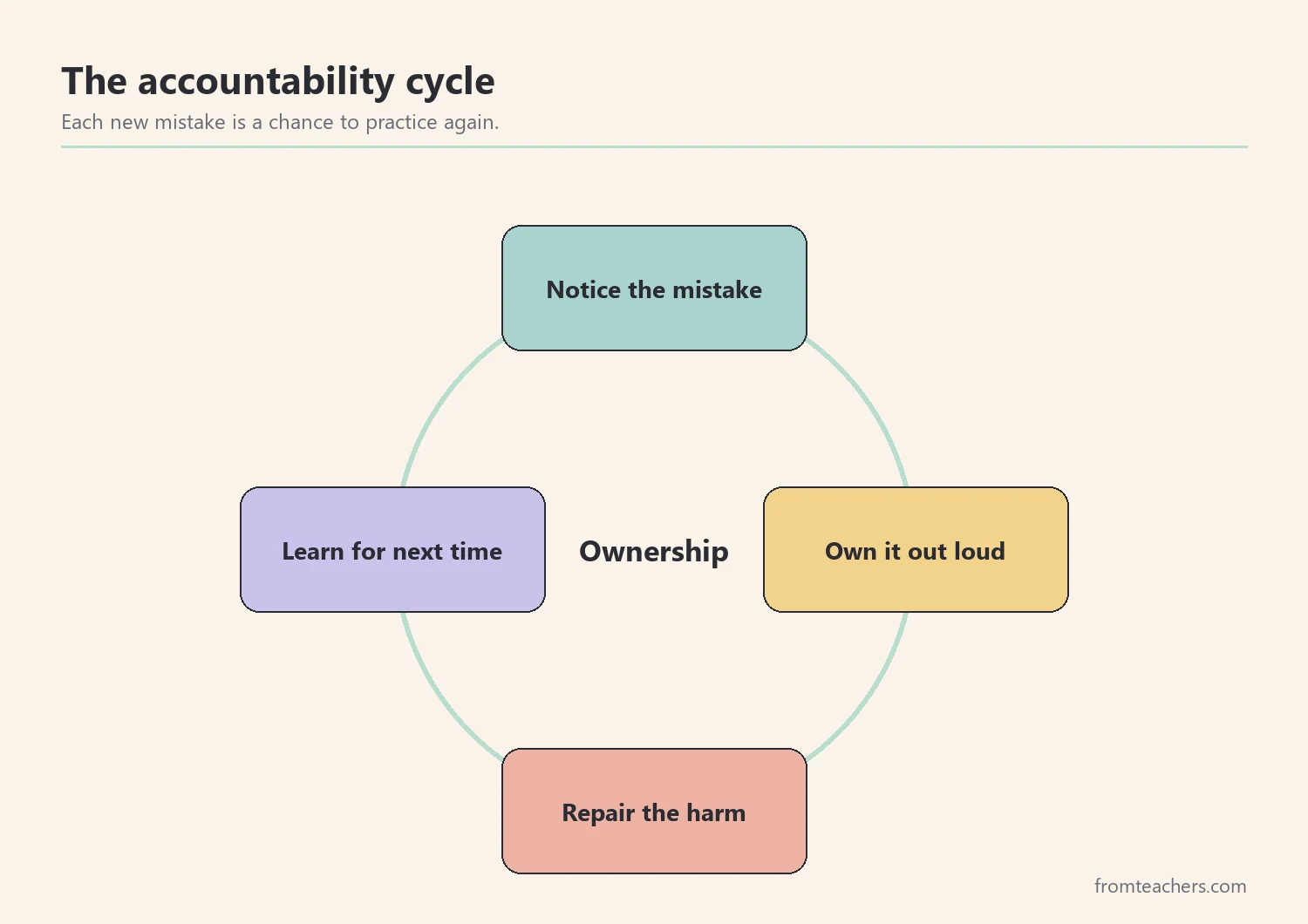
In addition, involve the hurt person when you plan repair. Ask, “What would help make this better?” Sometimes the answer is simple, like a replaced pencil or a chance to finish a game. When both students shape the repair, teaching kids accountability also builds empathy on both sides.
Repair checklist
- The repair fits the harm.
- The hurt person has a say in what helps.
- An adult supports, but the student does the work.
- Any consequence is calm and linked to the mistake.
- Someone checks in a day or two later.
Worked example. At lunch, Malik and Rosa rebuild the model base together. Ms. Grant also asks Malik to help set up tables safely for the next lab, which links the consequence to what went wrong. Two days later, she checks in with both students. Rosa says the new base is “actually stronger.”
5. Practice teaching kids accountability and track growth
Finally, build accountability into routines so it becomes a habit. One good conversation helps, but steady practice changes behavior. Restorative circles, weekly reflections, and short check-ins all give students regular chances to practice.
In addition, hold short restorative circles when a mistake affects the whole group. Each student says how they were affected and what would help. Teaching kids accountability in a circle shows that repair is a shared, normal part of classroom life.
Then track a few simple signs. For example, count how often a student owns a mistake without being prompted, and how often an excuse comes first. Write it down on the same days each week. Teaching kids accountability is gradual, so small gains count.
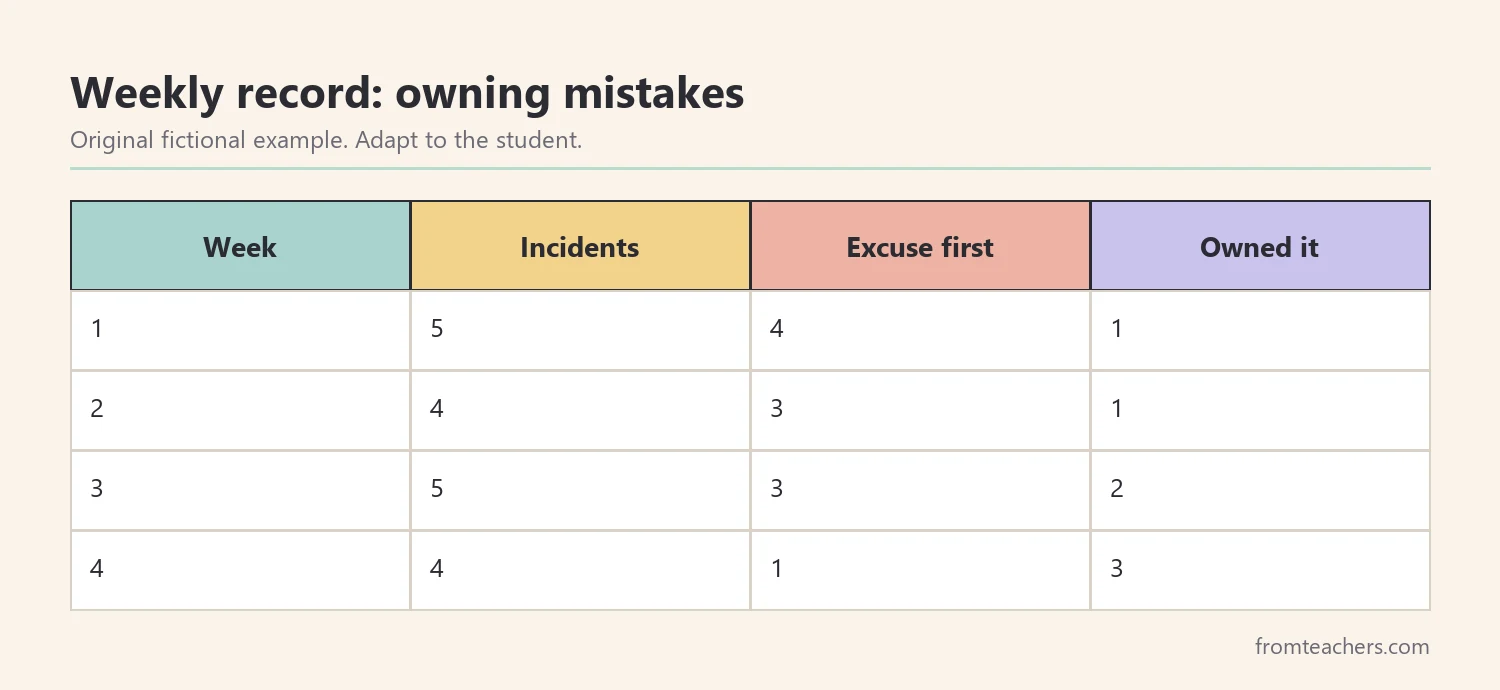
For older students, add a short written reflection once a week. Three prompts are enough: What happened? Who was affected? What did I do to repair it? Over time, these reflections show students their own progress, which can motivate them more than any adult praise.
Also, involve families. Share the same starter phrases with parents so the language matches at home. When adults at school and home respond the same way, students practice the skill far more often.
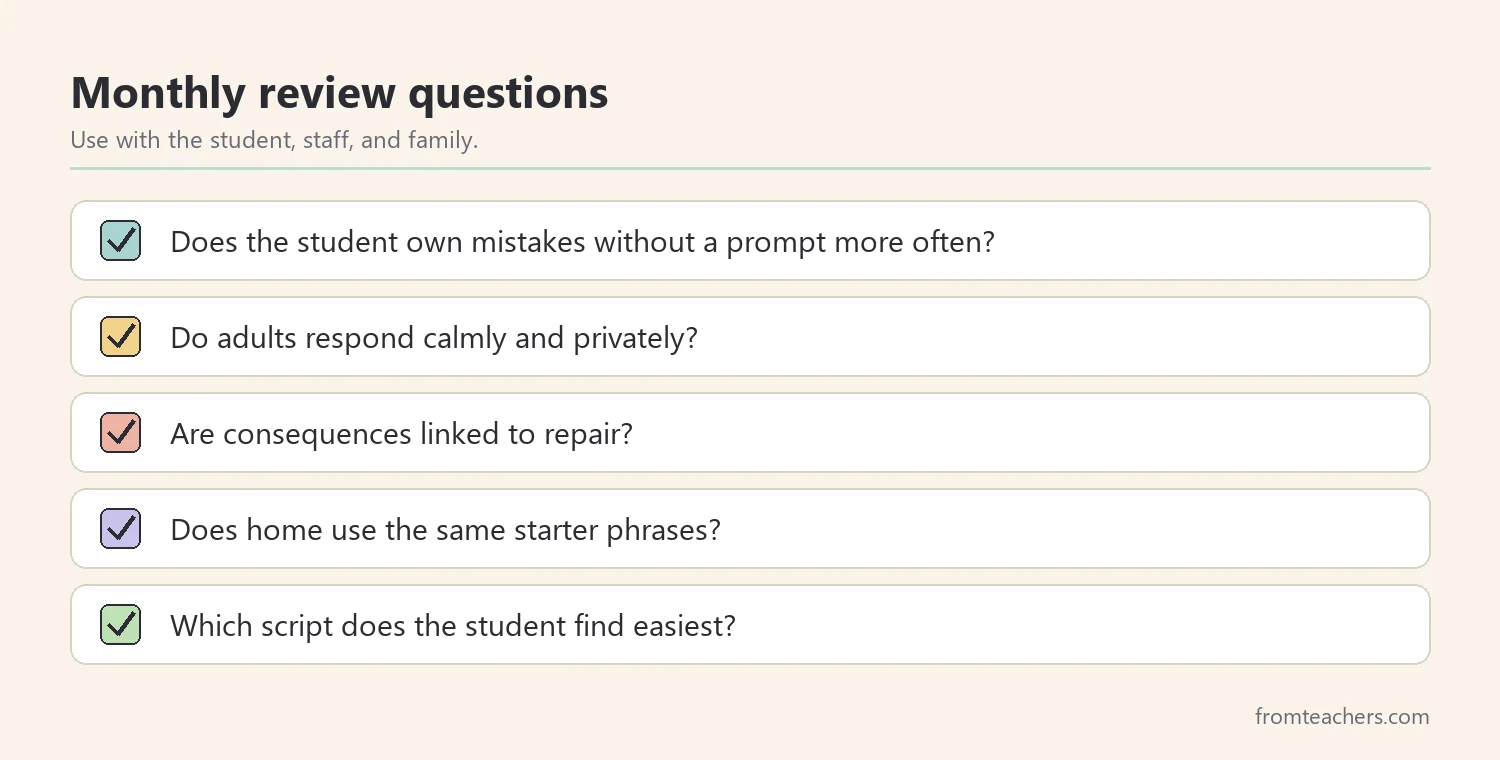
Worked example. Ms. Grant tracks Malik for four weeks. In week 1, he makes 4 excuses and 1 ownership statement, so 5 incidents in total. By week 4, he has 4 incidents: 1 excuse and 3 ownership statements. His parents start using the same phrase card at home, and Malik says, “It’s easier now. I just say it.”
Adapting the approach for different students
Every student brings a different history to these conversations. Some have been punished harshly for mistakes, while others have rarely been asked to reflect. So, adjust your pace. Teaching kids accountability with a student who has experienced a lot of shame may take longer, and that is normal.
For students with language or learning needs, use visuals, short sentence frames, and role plays more than long talks. Similarly, for students who act on impulse, practice the scripts often in calm moments so the words are ready when needed.
Finally, remember that consistency matters more than perfection. When every adult responds in a similar, calm way, teaching kids accountability becomes part of the school culture rather than a single lesson.
Common mistakes and how to avoid them
- Forcing an apology on the spot. Angry students give empty apologies. Fix: wait until everyone is calm.
- Public correction. Shame pushes students to hide mistakes. Fix: talk privately or in a small group.
- Labeling the child. “You are careless” attacks identity. Fix: name the action, not the person.
- Consequences without repair. Punishment alone teaches avoidance. Fix: connect each consequence to fixing the harm.
- Never modeling it. Students copy what adults do. Fix: own your own small mistakes out loud.
Questions teachers and parents ask about teaching kids accountability
At what age can I start teaching kids accountability?
You can start with young children using very simple words, such as “I did it, I can fix it.” Older students can handle full apology structures and restorative conversations. The core idea stays the same at every age.
Is accountability the same as punishment?
No. Punishment focuses on what happens to the child. Accountability focuses on owning the action and repairing harm. Consequences can be part of it, but repair is the heart of it.
What if a student refuses to admit a mistake?
First, check whether they feel safe. Give time to calm down, then try again privately. Offering a sentence frame often helps a student who wants to own it but cannot find the words.
How do I handle a student with ADHD who acts on impulse?
Expect the impulse, and focus on what happens after. Teach a short pause routine and practice ownership scripts often. Keep the tone calm, because shame makes impulsive students more likely to deny.
How can parents support this at home?
Use the same phrases the school uses and model your own ownership. Also, link consequences at home to repair, such as helping clean up or replacing a broken item with allowance.
Related reading: Moving Beyond Shame and Behavior Charts: Positive Alternatives for Effective Classroom Management, Essential Trauma-Informed Teaching Strategies for Modern Classrooms, and Building Stronger School Counseling Programs: A Framework for Student Success.
A companion resource for teaching kids accountability:
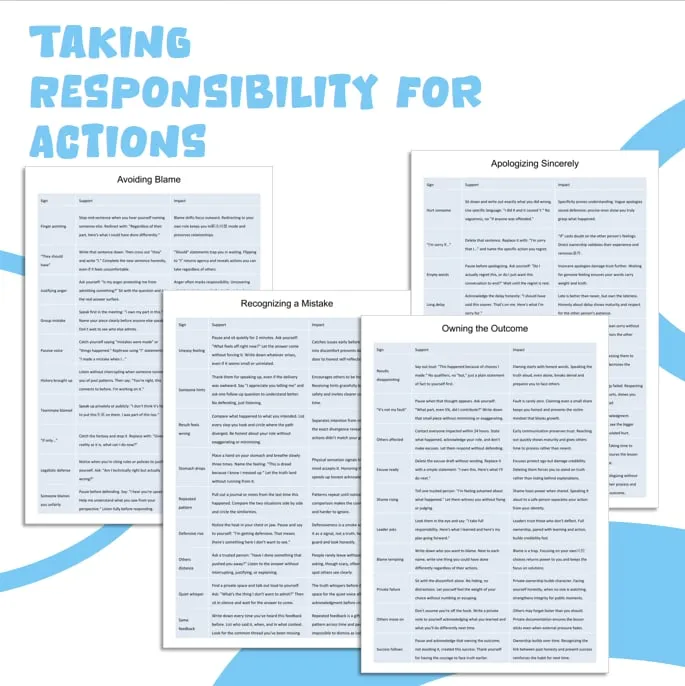
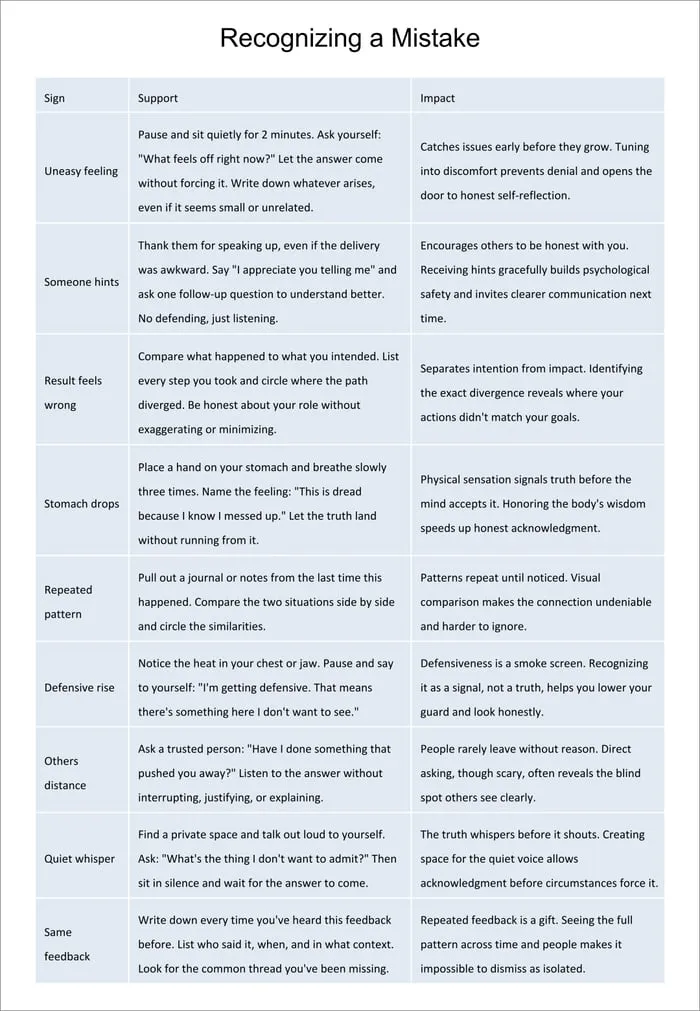
Taking Responsibility for Actions: 12 pages of Sign, Support, and Impact tables on avoiding blame, recognizing mistakes, and apologizing sincerely, plus honest scripts and a section on facing consequences, for middle and high school teachers and counselors.
Sources and scope
- CASEL: a widely used framework for social and emotional learning, including responsible decision-making.
- Responsive Classroom: practical approaches to classroom community and discipline.
- Greater Good Science Center, UC Berkeley: articles on empathy, forgiveness, and relationships.
- American Psychological Association: general information on child development and parenting.
This guide covers everyday strategies for helping students own mistakes and repair harm. It does not replace school discipline policies, counseling, or individual behavior plans.
Key takeaways
- Teaching kids accountability starts with making mistakes safe to admit.
- Short scripts turn excuses into clear ownership.
- A sincere apology names the action, the impact, and the repair.
- Calm consequences work best when linked to fixing the harm.
- Steady routines and matching language at home build the habit.
Leave a Comment