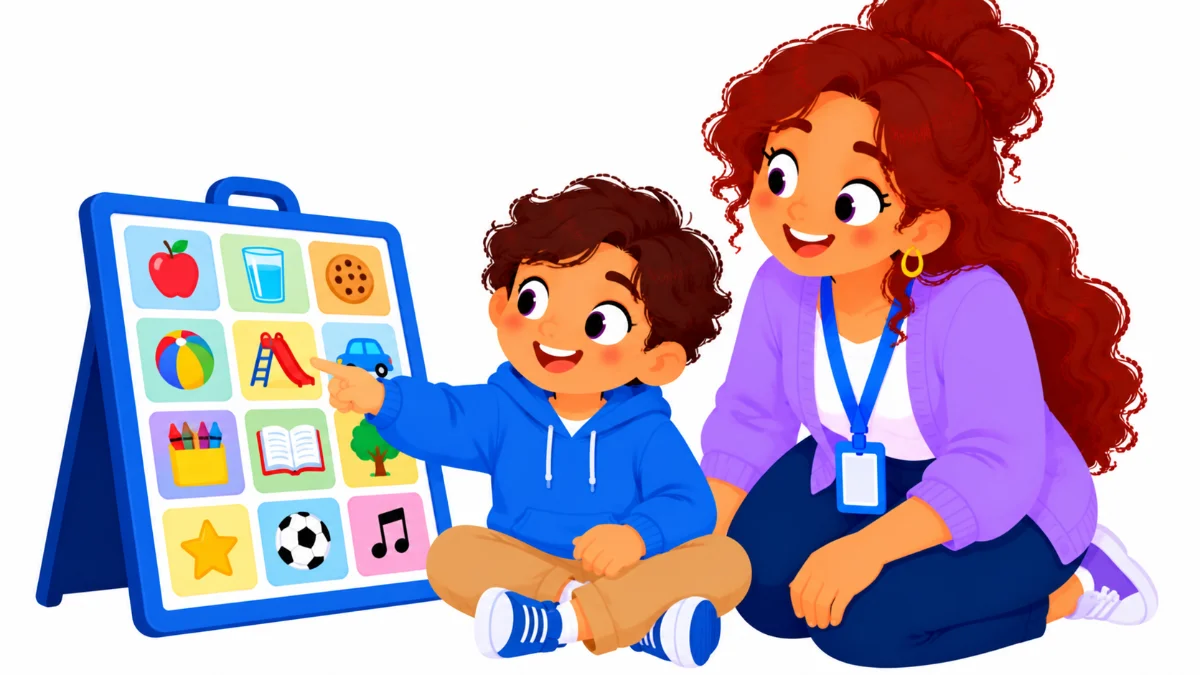

Nonverbal autism communication often becomes visible in small, hard moments. A child pulls an adult by the hand toward the kitchen, then cries when the adult opens the wrong cupboard. He knows exactly what he wants. What he does not yet have is a clear, reliable way to say it that every adult around him understands.
This guide gives teachers and parents a five-step plan for building functional communication with visual supports and AAC (augmentative and alternative communication). You will learn how to observe how a child already communicates, choose a first message, set up visuals and AAC, teach through daily routines, and expand while tracking progress. By the end, you will have a small, practical plan you can start this week with the child’s team.
Examples are fictional. Adapt to the student’s goals and agreed supports. This is guidance, not a diagnosis.
At a glance
- Every child communicates already; start by noticing how.
- Teach one useful message first, such as asking for help or a favorite item.
- Pair each message with a visual or AAC option the child can reach every time.
- Model the message yourself, in real routines, many times a day.
- Track a simple count and expand to new messages as the first one becomes reliable.
1. Observe how the child already communicates
Children who speak few or no words still communicate. They lead adults by the hand, reach, look, push items away, make sounds, or show distress. Nonverbal autism communication starts by treating these signals as real messages and learning what each one means.
First, watch the child across a few ordinary days. Note the situation, what the child did, and what seemed to happen next. For example, “Snack time: reached toward the cracker box and whined. Calmed when given a cracker.” After a few days, patterns appear.
Next, group what you see into common purposes: asking for something, asking for help, refusing, showing discomfort, greeting, and sharing feelings. Then, choose the purposes that cause the most frustration. Those are your best starting points.
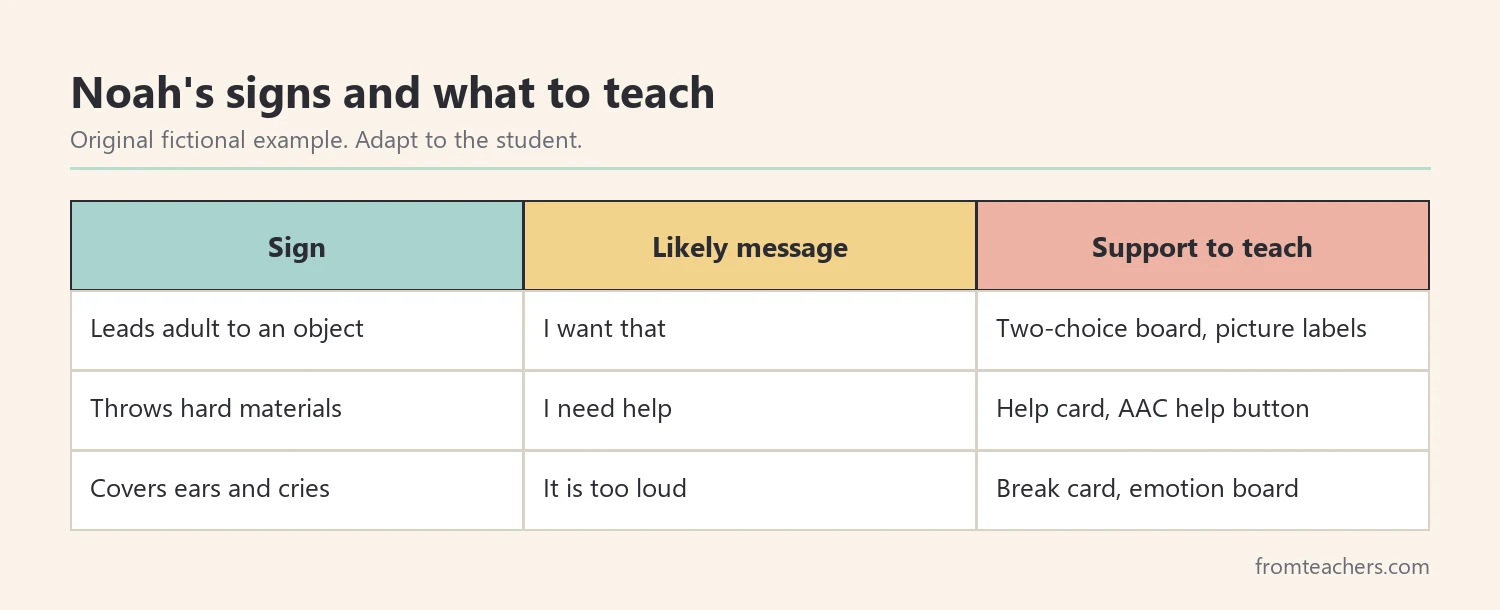
Worked example. Noah is a fictional seven-year-old autistic student in a first grade special education classroom. He uses a few sounds and no consistent words. Over three days, his teacher and speech-language pathologist notice that he leads adults to objects when he wants them, throws materials when a task is too hard, and covers his ears and cries when the room is loud.
Finally, share these notes with the family. Good nonverbal autism communication plans are built on what happens at home as well as at school. Parents often know signals that school staff have not seen, and the full picture makes the plan stronger.
In addition, notice what the child is drawn to: favorite snacks, toys, songs, or activities. These interests become the most motivating things to request, and they give nonverbal autism communication a strong reason to happen.
2. Choose a first message for nonverbal autism communication
It is tempting to teach many symbols at once. However, a child learns faster when the first message is powerful, frequent, and quickly rewarded. Requesting a favorite item or asking for help are common first choices, because the child sees an immediate result.
To choose, ask three questions. How often does this situation happen each day? Will the child care about the result right away? Can every adult respond the same way? A message that scores well on all three is a good first target.
Then, write the target clearly. For instance, “During work time, Noah will touch his help card or AAC button to ask for help.” A precise target lets everyone teach the same thing and count the same thing.
Worked example. Noah’s team picks “help” as the first message. Hard tasks happen many times a day, he clearly wants assistance, and every adult can respond by helping right away. As a result, the team expects that a reliable help message may also reduce the times he throws materials, because he will have a faster way to get the same result.
Meanwhile, keep responding to his other signals kindly. In nonverbal autism communication, every signal still counts. Choosing one target to teach does not mean ignoring everything else he communicates.
3. Set up visual supports and AAC for daily use
Now give the child a way to send the message. Visual supports and AAC range from simple paper tools to speech-generating devices. Many children use a mix, and the right options depend on the child, so decide with the speech-language pathologist and the family.
Common options include:
- Single message cards, such as a help card on the desk.
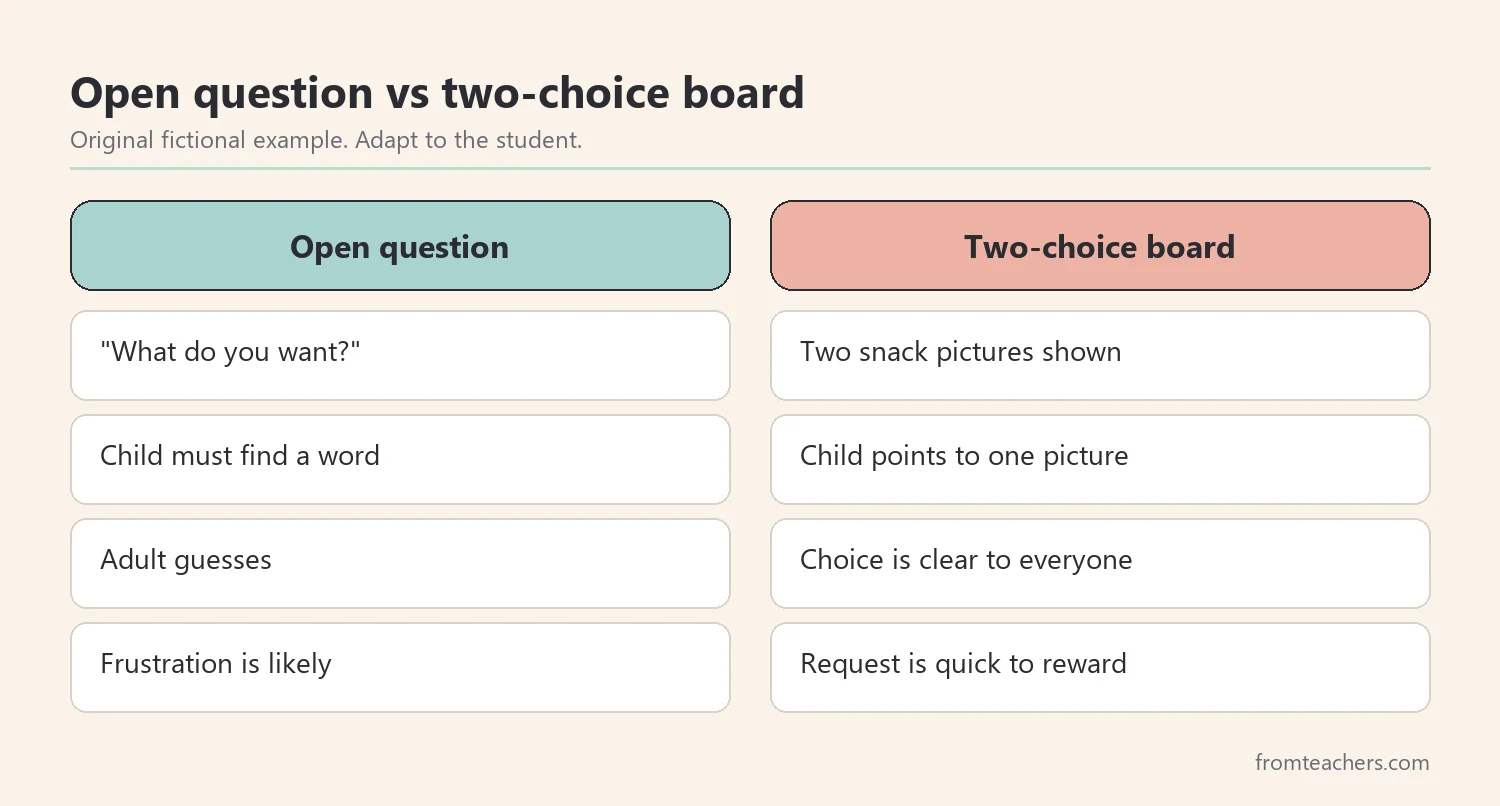
- Two-choice boards showing two pictures, so the child can point to the one they want.
- Choice boards and eye gaze boards for children who find pointing difficult.
- Picture labels on shelves and bins that show where things are.
- AAC buttons or devices that speak a word or phrase when pressed.
Most importantly, the tool must be available every time the message is needed. A help card stored in a drawer cannot be used when the math page becomes hard. Therefore, place it where the child works, and make a copy for home.
If you want a structured starting point, the Functional Communication Strategies for Nonverbal Autism toolkit organizes supports by situation. Its tables connect an observed communication sign to a specific support tool and its intended impact, covering asking for help, requesting needs and wants, expressing discomfort or pain, greeting, choices, emotions, and yes/no questions.
Next, keep pictures simple and consistent. Use the same photo or symbol for the same message in every place, and add the written word under it. Consistent visuals make nonverbal autism communication easier for the child to learn and for new adults to understand.
Worked example. Noah’s team tapes a help card to the corner of his desk and adds a “help” button to his speech-generating device. At home, his parents put a matching card on the refrigerator. In addition, his teacher starts offering two-choice boards at snack time, so he can practice pointing to a picture to request.
4. Teach nonverbal autism communication inside daily routines
Nonverbal autism communication grows through practice in real situations, not in a separate drill session. The child needs many chances each day to use the message and see it work.
A simple teaching loop helps every adult respond the same way. First, create or notice a moment where the message is needed. Next, model it: touch the help card yourself and say “help.” Then, wait a few seconds with an expectant look. Finally, respond right away when the child uses the card, even with a prompt, by giving the help.
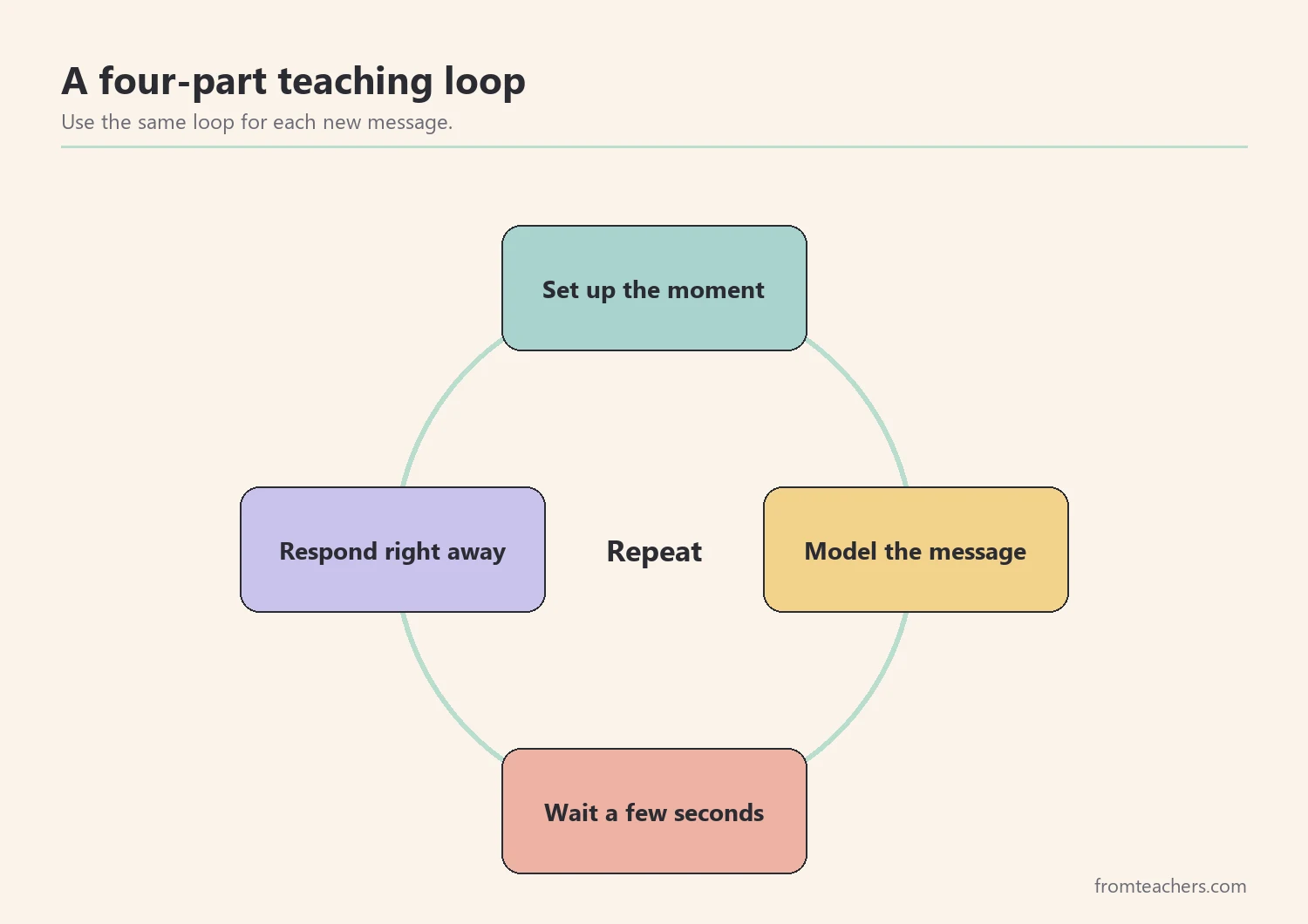
Keep the wait short and friendly. A few seconds is often enough, and a calm, expectant look tells the child that you are ready to listen. If no response comes, model again and help anyway, because nonverbal autism communication should never turn into a test the child can fail. With repeated success, the child learns that this new tool works.
Modeling is especially important. Adults who touch the symbols while talking show the child how the system works, just as we speak to babies long before they talk. Moreover, model without requiring the child to copy every time, so practice stays relaxed.
Also, fade prompts gradually. Start with a gentle hand gesture toward the card, then just a point, then only a pause. Record which level of prompt the child needed, so you can see independence grow.
Worked example. During math, Noah’s teacher gives him a puzzle that is slightly too hard. She touches the help card and says “help,” then waits. Noah touches the card after a point prompt, and she helps him immediately. Later that week, he touches the card after only a pause.
Similarly, plan which routines give the most practice. Snack, arrival, play, and work time each offer natural chances to request, refuse, greet, or ask for help. Spreading nonverbal autism communication across the whole day turns a few practice moments into dozens.
5. Expand messages and track progress
Once the first message is reliable, add the next one. Good next steps often include requesting specific items, refusing politely with a “stop” or “all done” card, greeting with a hello board, sharing feelings with an emotion choice board, and answering yes/no questions with visual cards.
As you expand, add one new message at a time and keep the earlier ones available. That way, nonverbal autism communication keeps growing without the child losing tools that already work.
Track progress with one simple count. For example, during work time, count how many chances the child had to ask for help and how many times he used the card or button on his own. Write down the numbers each week.
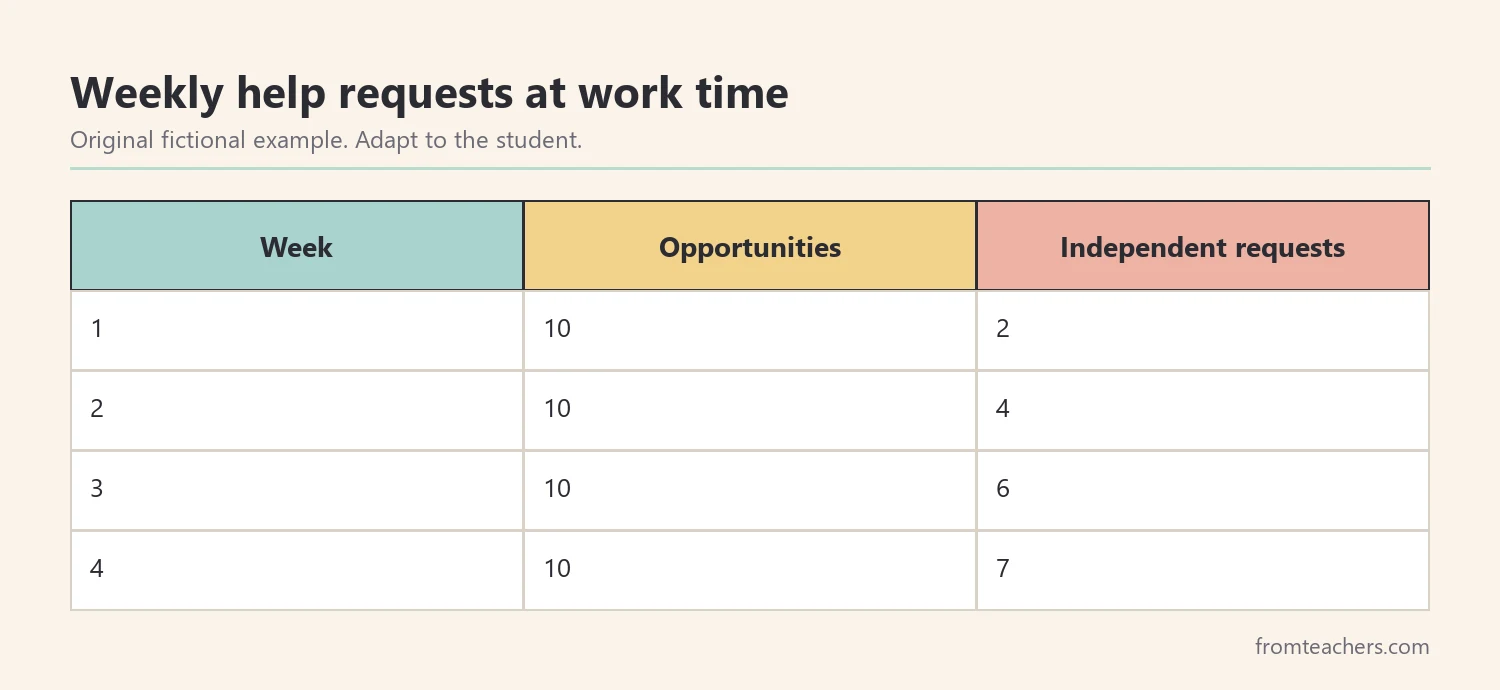
Worked example. Noah’s teacher records 10 help opportunities during work time each week. He asks independently 2 times in week 1, 4 times in week 2, 6 times in week 3, and 7 times in week 4. Because the help message is now more consistent, the team adds a two-choice board for break activities and starts modeling “all done.”
Finally, review the plan with the family and team every few weeks. Bring the counts, notes on what works at home, and one question: what message would make the biggest difference next? For more on working together, see our guide to teacher and parent communication in special education.
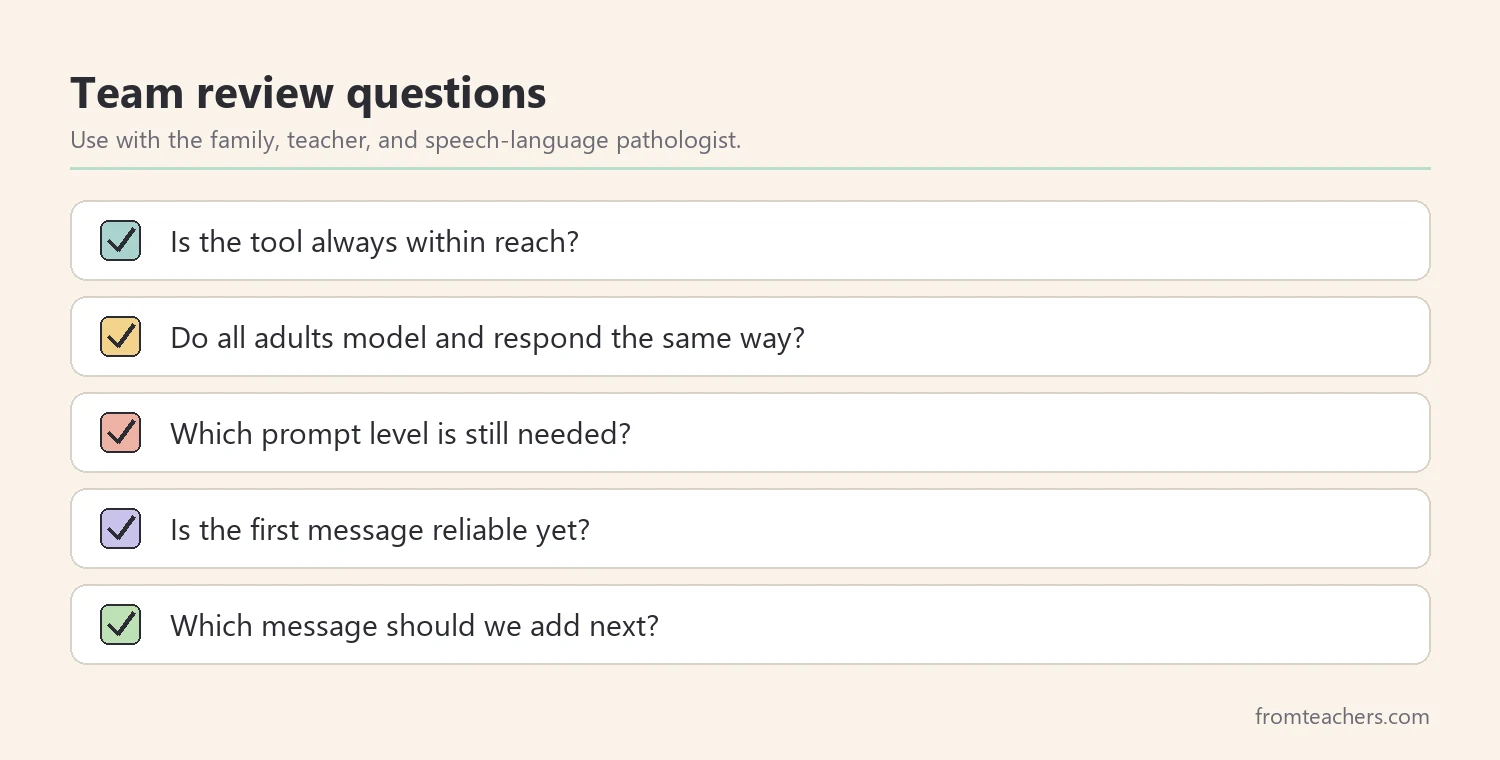
Over time, the counts tell a clear story for the IEP team. They show which messages are reliable, which prompts are still needed, and where nonverbal autism communication should grow next, so decisions rest on evidence rather than impressions.
Common mistakes and how to avoid them
Most setbacks in nonverbal autism communication come from small, fixable habits in the adults’ routines.
- Teaching many symbols at once. Fix: start with one powerful message and add more as it becomes reliable.
- Tools out of reach. Fix: keep the card, board, or device where the child needs it, every time.
- Waiting for the child to copy before helping. Fix: respond to any real attempt, then fade prompts.
- Using AAC only in therapy. Fix: model it in every routine, at school and at home.
- Different responses from different adults. Fix: share one short teaching loop with the whole team.
- Ignoring other signals. Fix: keep responding kindly while you teach the target message.
Questions teachers and parents ask about nonverbal autism communication
Will AAC stop my child from learning to talk?
This is a common worry. AAC is meant to add a way to communicate, not to replace speech. Talk with your child’s speech-language pathologist about how speech goals and AAC fit together in the plan.
Which AAC system is best for nonverbal autism communication?
There is no single best system. The right choice depends on the child’s motor skills, vision, interests, and environment. A speech-language pathologist can assess and recommend options, often starting with simple visuals.
How long before a child uses a new symbol independently?
It varies widely between children and messages. Some children use a highly motivating symbol within days, while others need many weeks of modeling. Your weekly counts will show progress better than any fixed timeline.
What should I do during a meltdown?
A meltdown is not a teaching moment. Focus on safety and calm, and reduce demands and noise. Later, when the child is regulated, practice tools such as an emotion choice board or a break card.
Can parents use the same visuals at home?
Yes, and it helps a lot. Matching cards and boards at school and home show the child that the message works everywhere. Share copies and agree on the same words for each symbol.
Related reading: Autism Spectrum Disorder: A Guide to Early Signs and Support, Best Assistive Technology for Special Education Classrooms, and Meltdowns vs Tantrums.
A companion resource for nonverbal autism communication:
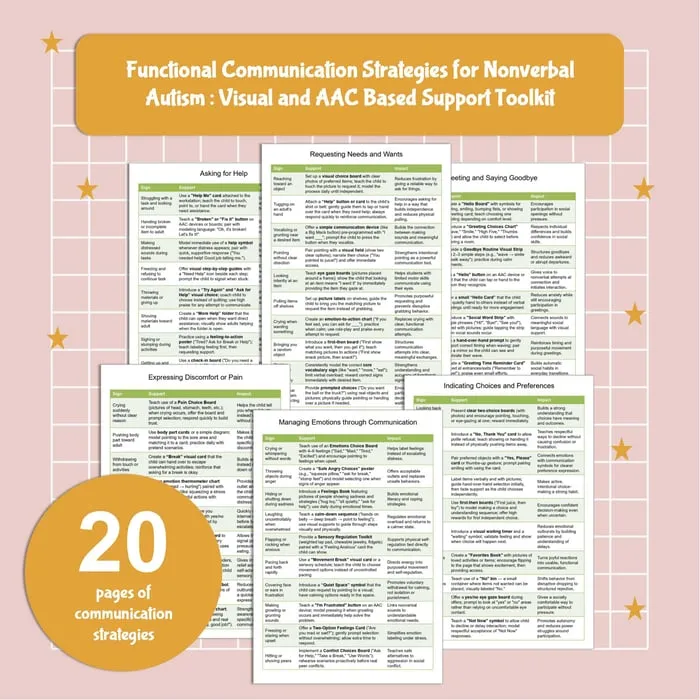
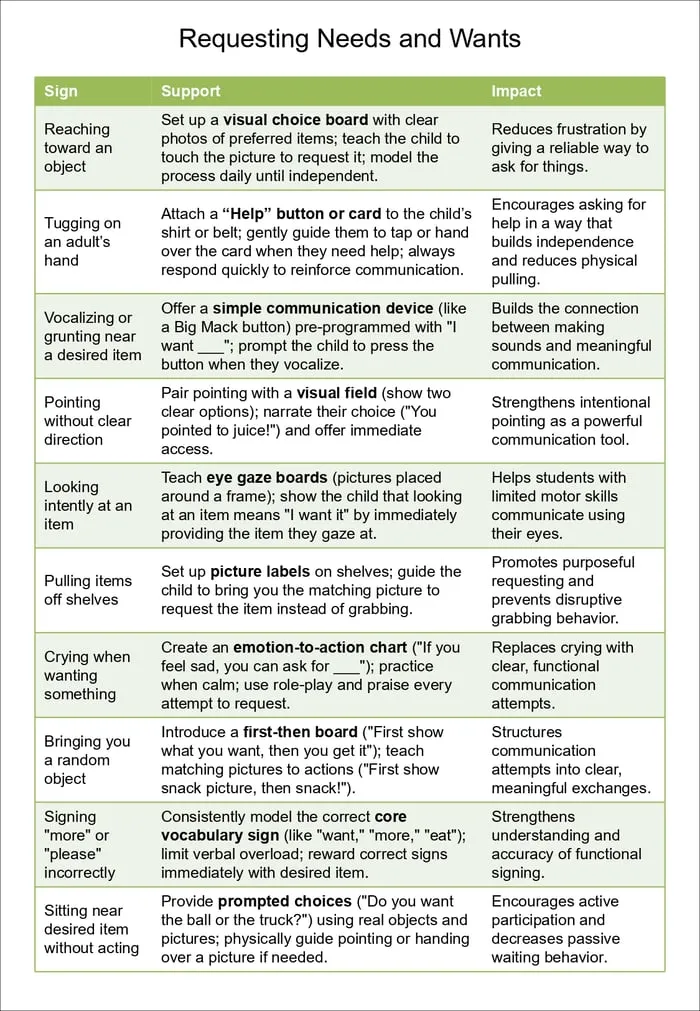
Functional Communication Strategies for Nonverbal Autism: Visual and AAC Support Toolkit: a 20-page Sign/Support/Impact toolkit for teachers, therapists, and parents, covering asking for help, requesting, expressing pain, greetings, choices, emotions, and yes/no questions.
Sources and scope
- ASHA: the American Speech-Language-Hearing Association, with information on AAC and communication supports.
- IRIS Center, Vanderbilt University: free modules on autism, evidence-based practices, and classroom supports.
- CDC autism information: general background on autism spectrum disorder for families and educators.
- IDEA, U.S. Department of Education: the law behind special education services, including assistive technology.
This guide covers everyday strategies for building functional communication at school and home. It does not replace assessment or AAC recommendations from a speech-language pathologist and the child’s team.
Key takeaways
- Nonverbal autism communication starts with noticing the signals a child already uses.
- Teach one powerful message first and keep the tool always within reach.
- Model, wait, and respond right away in real routines.
- Count independent uses weekly and expand when the message is reliable.
- Use the same communication visuals and words at school and at home, so nonverbal autism communication works everywhere.








Leave a Comment