

Task switching strategies matter most in the minutes between activities. The timer rings, the class moves from reading to math, and one student is still on page twelve, upset that the chapter is not finished. Ten minutes later, she has barely started the first problem. Every change in the day seems to cost her time, focus, and calm.
This guide gives you five steps to make those changes easier: spot where switching breaks down, warn before the change, teach a short closing routine, give a clear first step for the new task, and review what works. By the end, you will have a simple plan you can test with one student or with the whole class.
Examples are fictional. Adapt to the student’s goals and agreed supports. This is guidance, not a diagnosis.
At a glance
- Find the exact switches that are hard, such as stopping a favorite task or starting writing.
- Give a clear warning before the change, using time, sound, or a visual cue.
- Teach a short closing routine so the student can stop without losing their place.
- Make the first step of the new task small and obvious.
- Track minutes to start and review the plan every few weeks.
1. Spot where task switching breaks down
First, notice that not every switch is hard. Most students with switching difficulties manage some changes easily and struggle with others. Good task switching strategies start with knowing which switches cause trouble and why.
For one week, jot down each difficult change. Write the time, the task the student was leaving, the task they were starting, and what happened. A simple tally on a sticky note is enough. You are looking for patterns, not perfect data.
Meet our fictional student, Maya, a third grader. Maya loves reading and art. However, she often keeps reading after the class has moved on, and she needs a long time to settle into math. Her teacher logged five hard moments in one week.
| Leaving | Starting | What happened |
|---|---|---|
| Silent reading | Math | Kept reading for 6 minutes |
| Art | Lunch line | Upset, asked to finish drawing |
| Recess | Spelling | Slow to sit, talked to friends |
| Group work | Independent writing | Stared at blank page |
| Math | Science | Smooth, no problem |
As a result, a pattern appeared. Maya struggled most when she had to stop something she enjoyed, or when the new task had no obvious starting point. The math-to-science switch went well because science always began with the same hands-on warm-up. That detail turned out to be important.
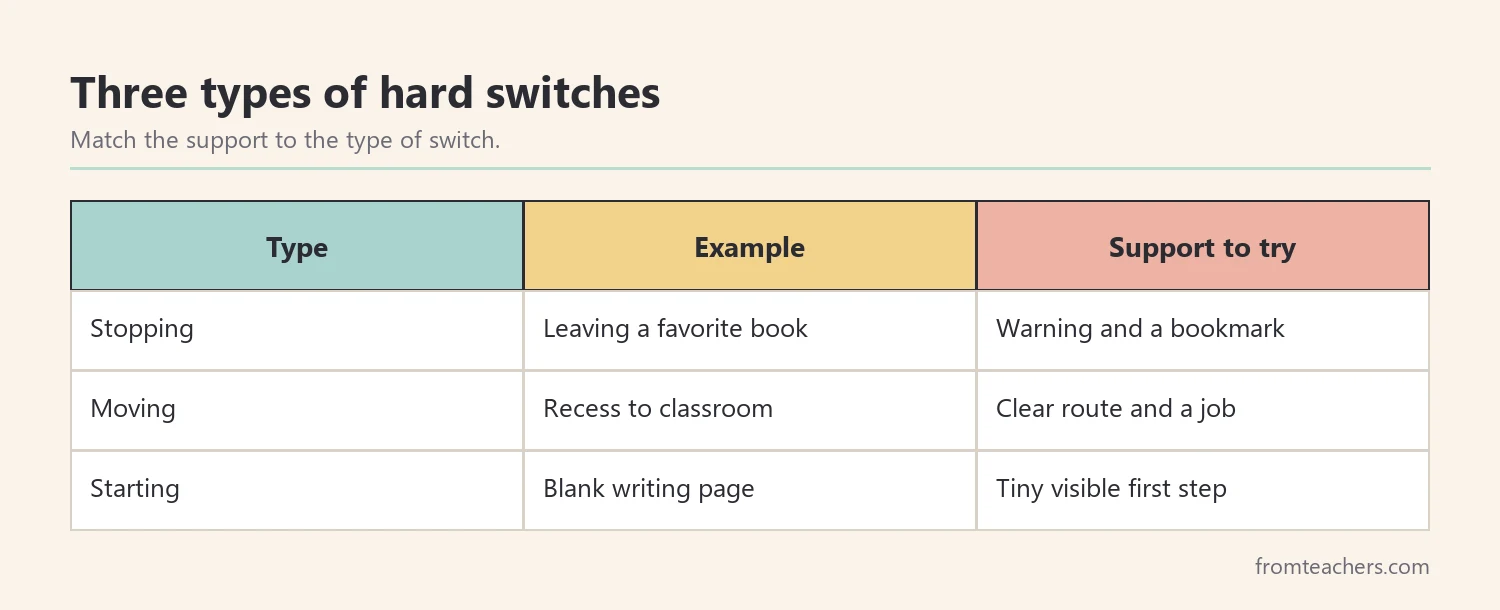
Three common types of hard switches
- Stopping: leaving a preferred or unfinished activity.
- Moving: changing rooms, seats, or groups.
- Starting: beginning a task with an unclear first step.
Each type calls for different task switching strategies. Stopping problems need warnings and a way to save progress. Moving problems need a clear route and a job. Starting problems need a tiny, visible first step. Knowing the type keeps you from using one tool for every situation.
Also, talk with the student. Ask, “Which changes in the day feel hardest?” Even young students can often point to one or two moments on a visual schedule. Their answer adds an inside view that your notes cannot capture, and it makes them a partner in choosing task switching strategies rather than someone the plan is done to.
2. Warn before the change with task switching strategies
Next, reduce surprise. Many students find a sudden stop much harder than a planned one. A warning gives the brain time to prepare for what comes next. Simple task switching strategies like a two-minute warning or a visual timer can make a big difference.
Choose a warning that fits the student and the class. Some students respond well to a spoken “two more minutes.” Others need something they can see, such as a timer on the board or a card placed on the desk. A few prefer a quiet signal, like a soft chime, so they are not singled out.
- Give the warning at the same point before each change.
- Say what is coming next, not only that time is up.
- Use the same words every time, such as “Two minutes, then math.”
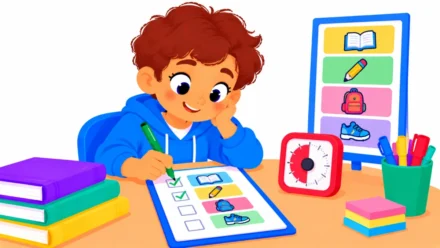
- Pair the warning with a visual schedule when possible.
For Maya, her teacher used a small sand timer plus a quiet tap on the desk. She also pointed to the next activity on the visual schedule. Within a week, Maya was closing her book closer to the end of the timer.
In addition, preview the day each morning. A short look at the schedule tells the student how many changes are coming and when. Also, flag any unusual events, such as an assembly or a substitute. Predictable days need fewer warnings, and unusual days get extra support.
Choosing a warning that fits
| Warning type | Works well when |
|---|---|
| Spoken countdown | The student listens well to adult voice |
| Visual timer | The student needs to see time passing |
| Card on the desk | A private cue avoids attention from peers |
| Soft chime | The whole class needs the same signal |
Try one warning type for at least a week before you judge it. Many task switching strategies seem to fail at first simply because the student has not yet learned what the signal means.
If you want ready-made ideas for these moments, the task switching strategy tables describe common switching behaviors, a response for each, and the result you can expect to look for.
3. Teach a short closing routine
Then, give the student a way to stop without feeling that the work is lost. A closing routine is a small set of actions that marks the end of one task. It turns “stop now” into “save and close,” which feels very different.
Maya’s closing routine has four parts. She puts a bookmark where she stopped, writes one word on a sticky note about what comes next, puts the book in its bin, and takes a slow breath. The routine takes about thirty seconds. Because she knows she can return to the story, stopping feels less like losing something.
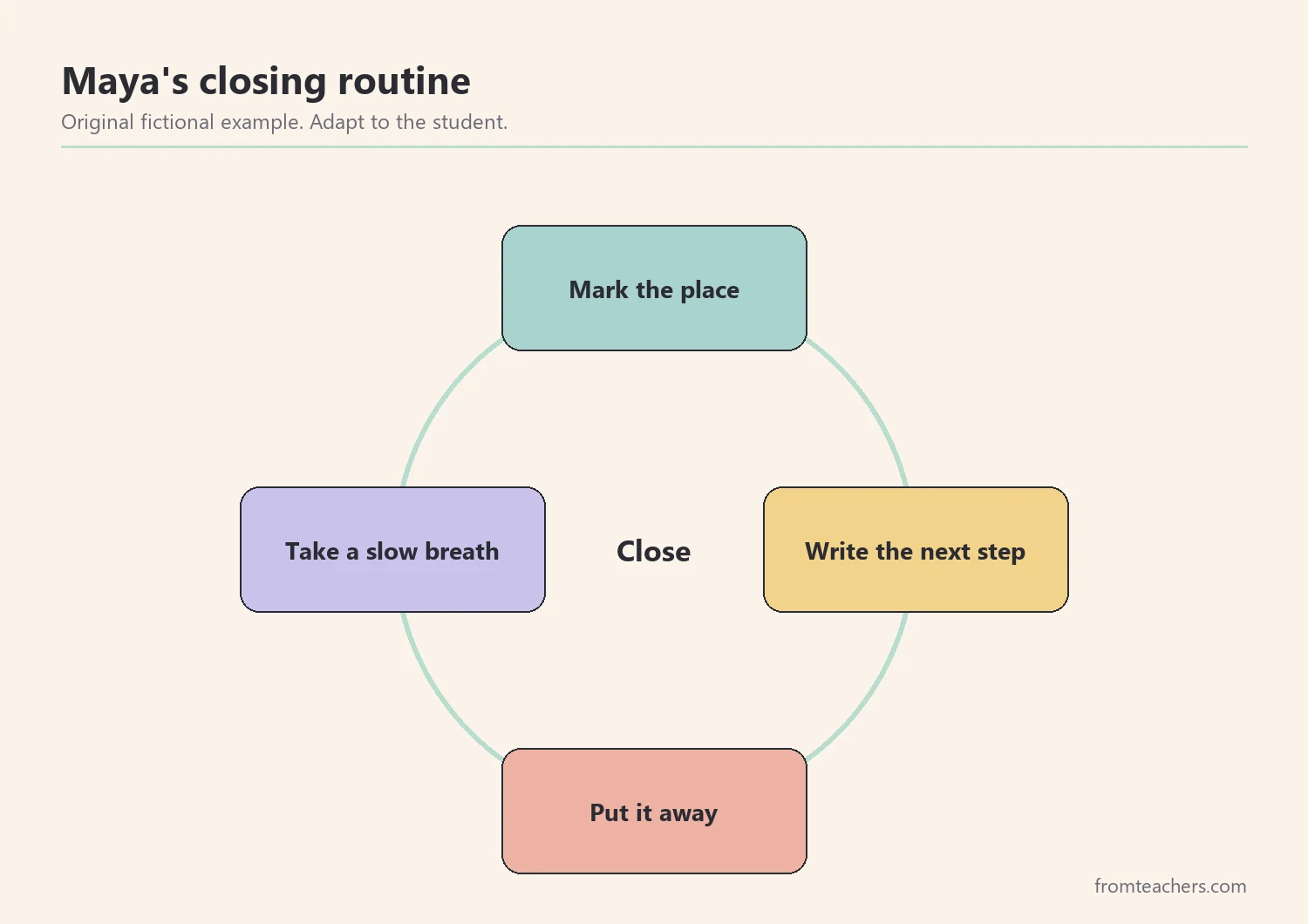
Teach the routine directly. Model it, practice it during easy changes, and praise it when it happens. Over time, the routine becomes a habit that works across subjects. Strong task switching strategies always include a clear ending for the old task, not only a start for the new one.
Also, think about unfinished work. If a task truly cannot be finished, tell the student when they will come back to it. For example, “You can finish your drawing after lunch.” A specific return time is more calming than a vague “later.”
Finally, keep the routine the same in every room. If art, music, and the main classroom all use the same closing steps, the student does not have to learn three systems. Share a copy with specialists and support staff so everyone gives the same cues.
In addition, plan for the moments when the routine breaks down. If the student refuses to stop, avoid a power struggle. Calmly restate the warning, point to the bookmark, and give a short choice, such as “Bookmark now or after one more page?” Small choices keep task switching strategies supportive rather than punitive.
4. Make the first step of the new task obvious
Many students do not struggle with leaving; they struggle with starting. A blank page or a long set of directions gives them nothing to hold onto. Therefore, the next set of task switching strategies focuses on a tiny, visible first step.
Write the first step on the board or on a sticky note. Make it so small that the student can do it in under a minute. For writing, it might be “Write your name and the date.” For math, “Do problem one.” Once the student has started, momentum often carries them forward.
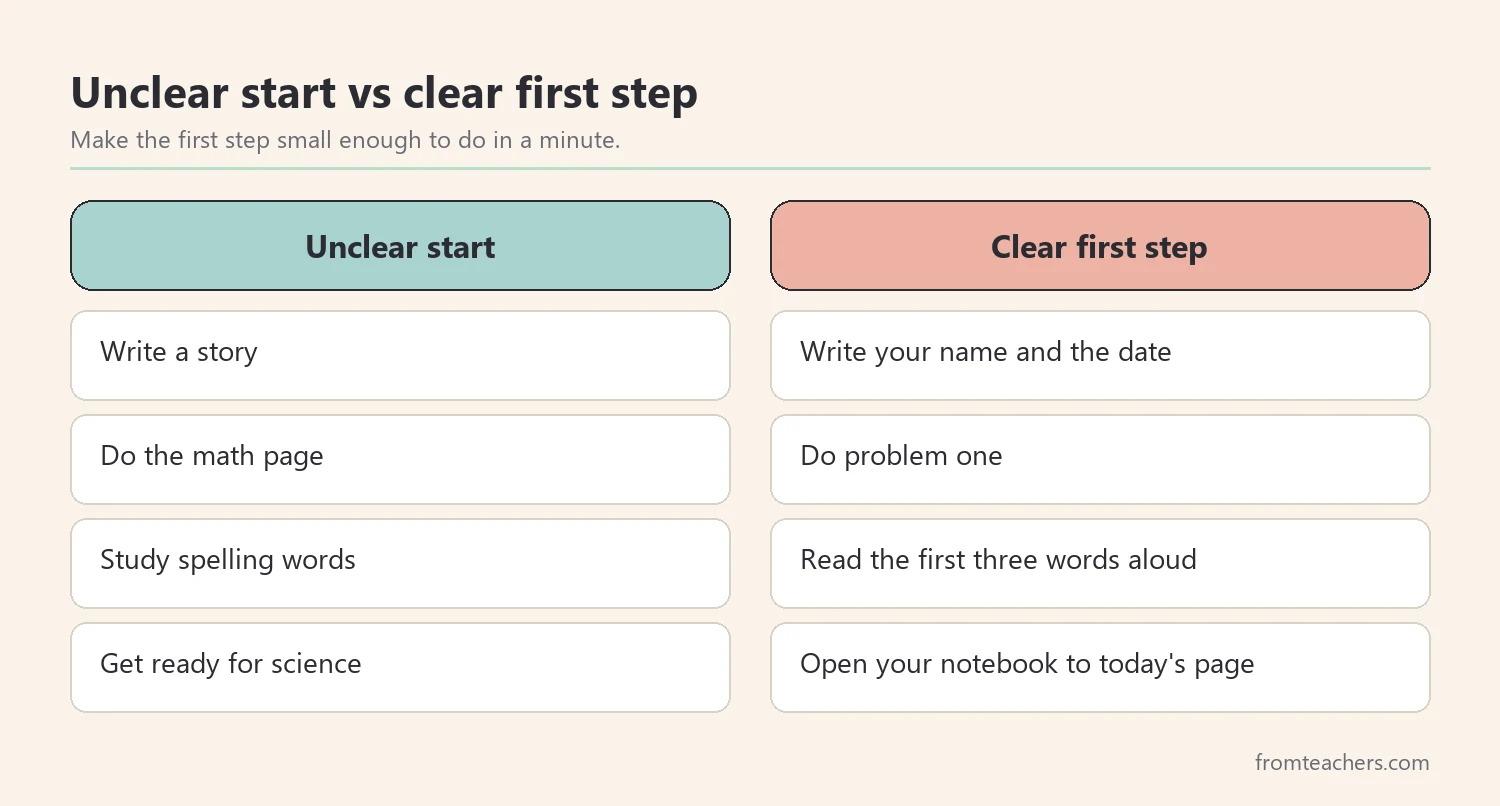
For Maya, her teacher placed a “first step” card on her desk before each change. The card named one small action. Maya’s average time to start writing dropped noticeably over the following weeks. In addition, she began asking “What is my first step?” on her own, which showed the skill was growing.
Consider a short entry task for subjects that are hard to start. Science already had one in Maya’s class, and it explained why that switch was smooth. A two-minute warm-up with a predictable format gives every student a calm on-ramp. Entry tasks are among the most practical task switching strategies, because they help the whole class, not just one student.
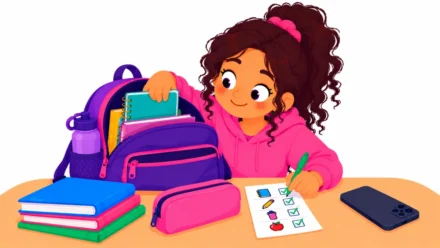
Also, keep the materials for the next task ready. Searching for a pencil or the right notebook adds another small switch. When everything is in place, the student can move straight to the first step.
Moving between rooms deserves its own plan. For these changes, task switching strategies often include a simple job, such as carrying the class basket or holding the door. A job gives the student a purpose during the walk and a natural end point when they arrive. Pair it with a seat that is always the same, so there is no extra decision on arrival.
5. Track progress and review the task switching strategies
Finally, measure one simple thing. For switching, minutes to start is often the clearest number. Use a timer or glance at the clock when the class begins, and write down when the student starts the first step. Do this for one or two key changes each day.
Review the numbers every three to four weeks with the student and family. Ask which task switching strategies feel helpful and which feel annoying. Students often know exactly what works for them. Their answers can save you weeks of guessing.
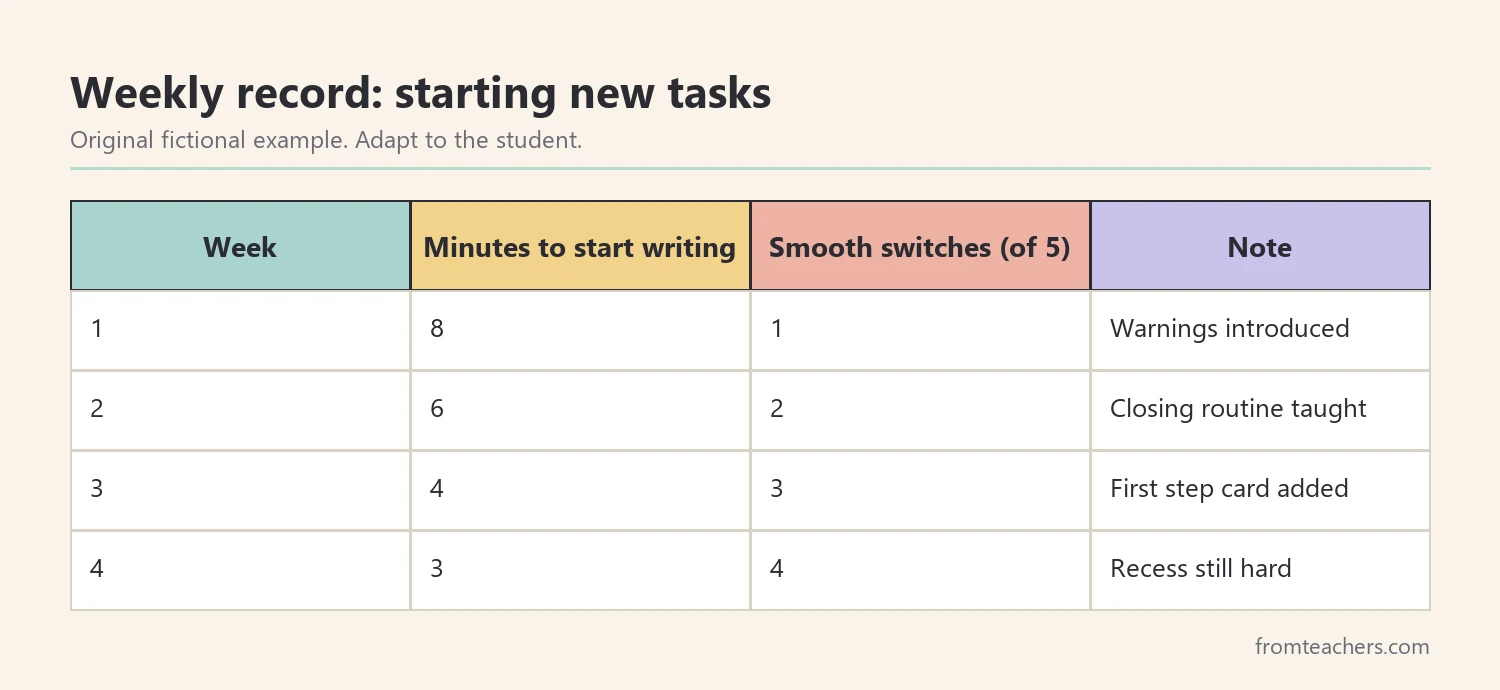
In Maya’s case, the record showed clear progress for writing. However, the recess-to-spelling change stayed hard. The team added a short water break and a calm entry task after recess. Change one support at a time, so you can see what helped.
When a switch becomes smooth, start fading the support. Move from a personal warning to a whole-class warning, then to the schedule alone. Keep the closing routine, since it is a skill the student will use for years. Also, share progress with the family so they can use similar cues at home, for example when screen time ends.
Finally, write down what worked. A short note in the student’s file, such as “two-minute sand timer, bookmark routine, first step card,” helps next year’s teacher start strong. Task switching strategies that are passed on clearly save the student from relearning everything with a new adult.
Common mistakes and how to avoid them
- Stopping a task with no warning. Give a consistent warning and name what comes next.
- Treating slow starts as defiance. First check whether the first step is clear.
- Using one tool for every switch. Match the support to stopping, moving, or starting.
- Forgetting unfinished work. Tell the student when they can return to it.
- Removing supports too fast. Fade slowly and keep the closing routine.
Questions teachers and parents ask about task switching strategies
Why is switching tasks so hard for some students?
Switching asks the brain to stop one plan, hold the new instructions, and start again. Some students, including many with ADHD or autism, find this harder than their peers. Only qualified professionals can evaluate a student, but classroom supports can help right away.
How long should a warning be?
Many teachers use one to five minutes. Start with two minutes and adjust. Some students also benefit from a second, shorter warning just before the change.
Do task switching strategies work for a whole class?
Yes. Warnings, visual schedules, and entry tasks help most students. You can then add individual supports, such as a first step card, for students who need more.
What can parents do at home?
Parents can give warnings before changes, use a simple visual schedule, and name what comes next. For example, “Five minutes of tablet, then dinner.” A consistent closing routine helps at home too.
Can these supports go into an IEP or 504 plan?
Teams often include supports like transition warnings or visual schedules. Talk with the student’s team about which ones fit their plan.
Related reading: Effective ADHD Classroom Strategies to Support Student Success, 5 Practical Teaching Tips to Boost Classroom Focus and Learning, and Meltdowns vs Tantrums: A Guide to Understanding and Responding.
A companion resource for task switching strategies:
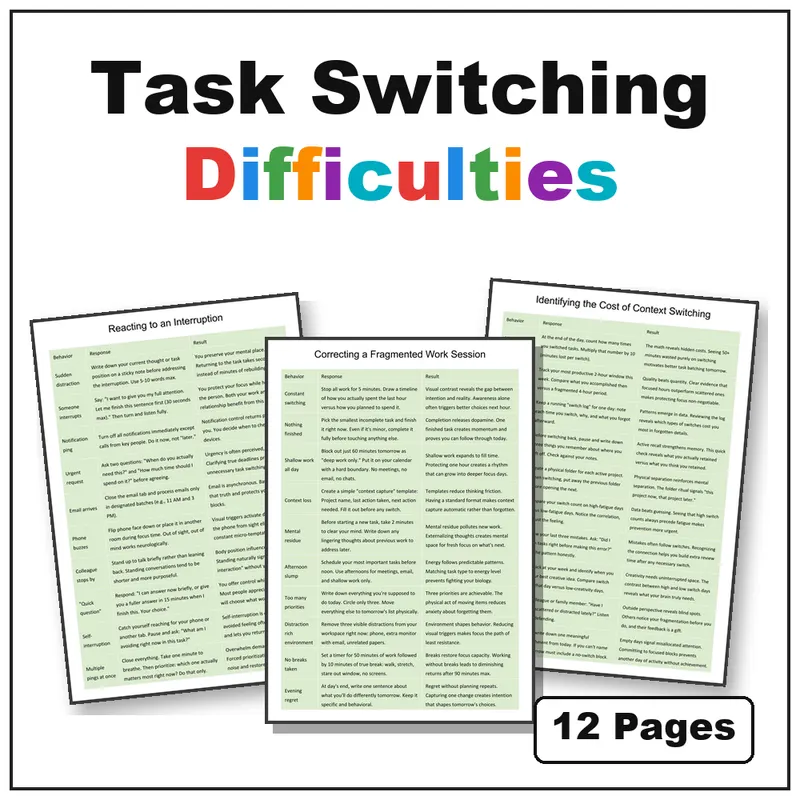
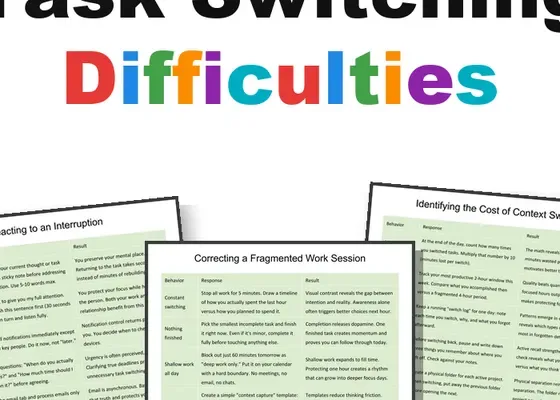
Task Switching Difficulties | Transition and Focus Strategies: 12 printable strategy tables that show a behavior, a response, and the result for common problems students have when moving from one task to another.
Sources and scope
- Center on the Developing Child, Harvard University: background on executive function skills, including cognitive flexibility.
- IRIS Center, Vanderbilt University: free modules on classroom routines, transitions, and behavior.
- Understood.org: practical articles for families and teachers on focus and learning differences.
- CDC ADHD information: general background on ADHD in children, including school supports.
This guide covers everyday classroom and home strategies for moving between tasks. It does not cover diagnosis or formal evaluation, which belong to qualified professionals and the student’s team.
Key takeaways
- Find which switches are hard: stopping, moving, or starting.
- Give consistent warnings and name what comes next.
- Teach a short closing routine so stopping does not feel like losing.
- Make the first step of each new task tiny and visible.
- Track minutes to start and review your task switching strategies every few weeks.




Leave a Comment