

SLP progress monitoring often breaks down on a busy Thursday afternoon. You have just finished a great session with a second grader, the next student is at the door, and your notes are a scribble on the back of a worksheet. Two weeks later, the IEP progress report is due, and you are trying to remember whether he hit 60 percent or 70 percent.
This guide walks you through a five-step routine that keeps communication goal data simple, consistent, and easy to explain. By the end, you will know how to write goals you can actually measure, collect data in a few seconds per trial, read a trend, and turn your numbers into a clear summary for the team and the family.
Examples are fictional. Adapt to the student’s goals and agreed supports. This is guidance, not a diagnosis.
At a glance
- A goal you cannot count is a goal you cannot monitor, so tighten the wording first.
- Pick one data method per goal and use it the same way every session.
- Record the prompt level next to the accuracy score, or the number can mislead you.
- Look at the trend across several sessions, not at one good or bad day.
- Write the summary in plain language the family can read in one minute.
1. Write communication goals you can actually measure
First, look closely at the goal itself. Many tracking problems start with wording like “Leo will improve his articulation skills.” That sentence describes a hope, not a behavior. As a result, two adults could watch the same session and record two different scores.
A measurable communication goal names four things: the skill, the level (word, phrase, sentence, conversation), the support allowed, and the criterion. For example, “Leo will produce /s/ in the initial position of words at the sentence level with 80% accuracy across three consecutive sessions, given no more than an indirect cue.” Now everyone knows what counts as correct and when the goal is met.
Next, check whether the goal fits the setting where you will collect data. A conversation-level goal is hard to score during a 20-minute pull-out session with picture cards. In that case, plan a short structured conversation probe or ask the classroom teacher for a quick observation.
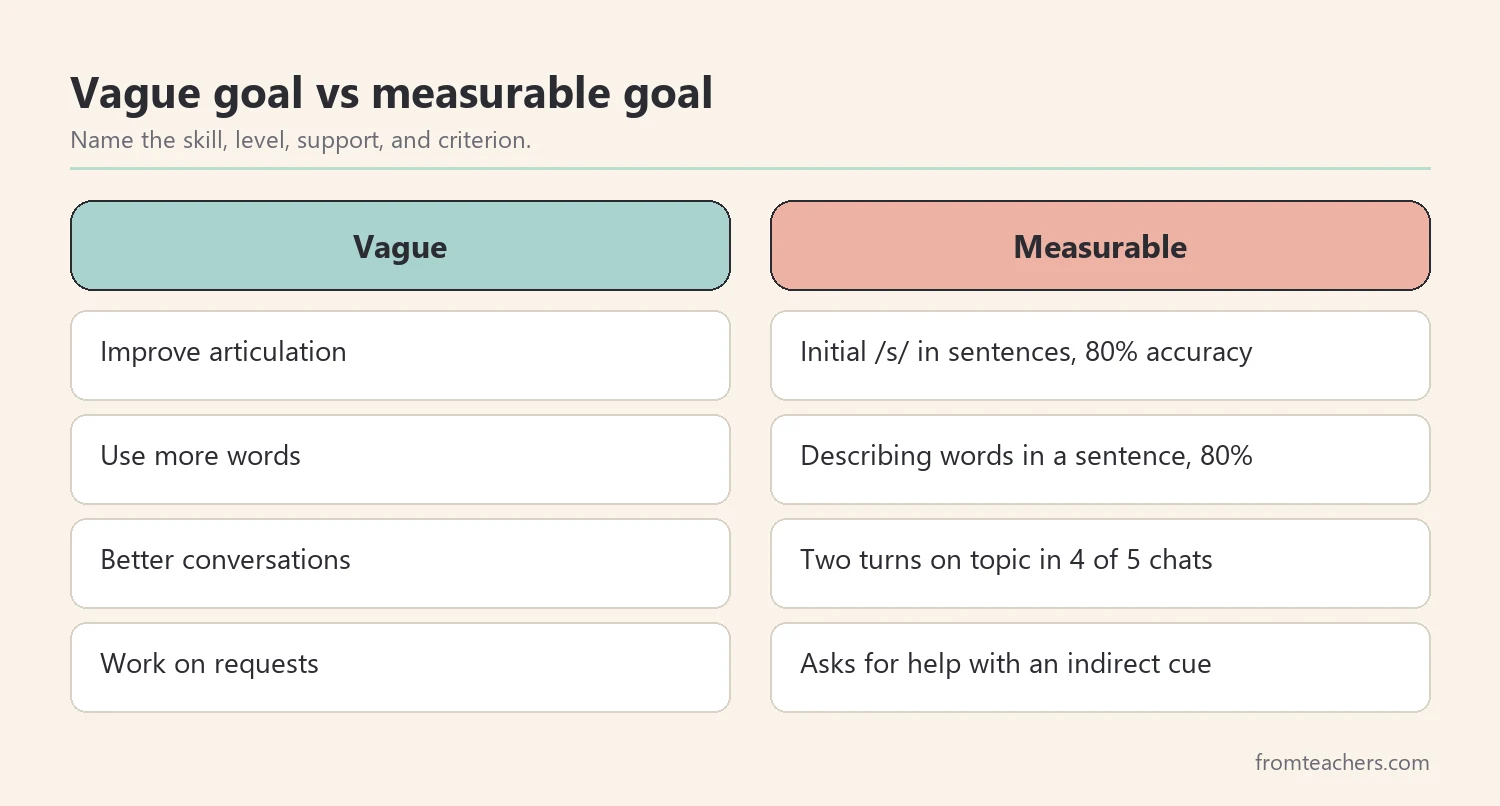
Worked example. Leo is a fictional student in grade 2 with two communication goals. Goal 1 targets initial /s/ in sentences. Goal 2 targets vocabulary: Leo will use describing words (size, color, shape) in a sentence when talking about a picture, with 80% accuracy. His SLP rewrites both goals so the level and criterion are stated before the first data session.
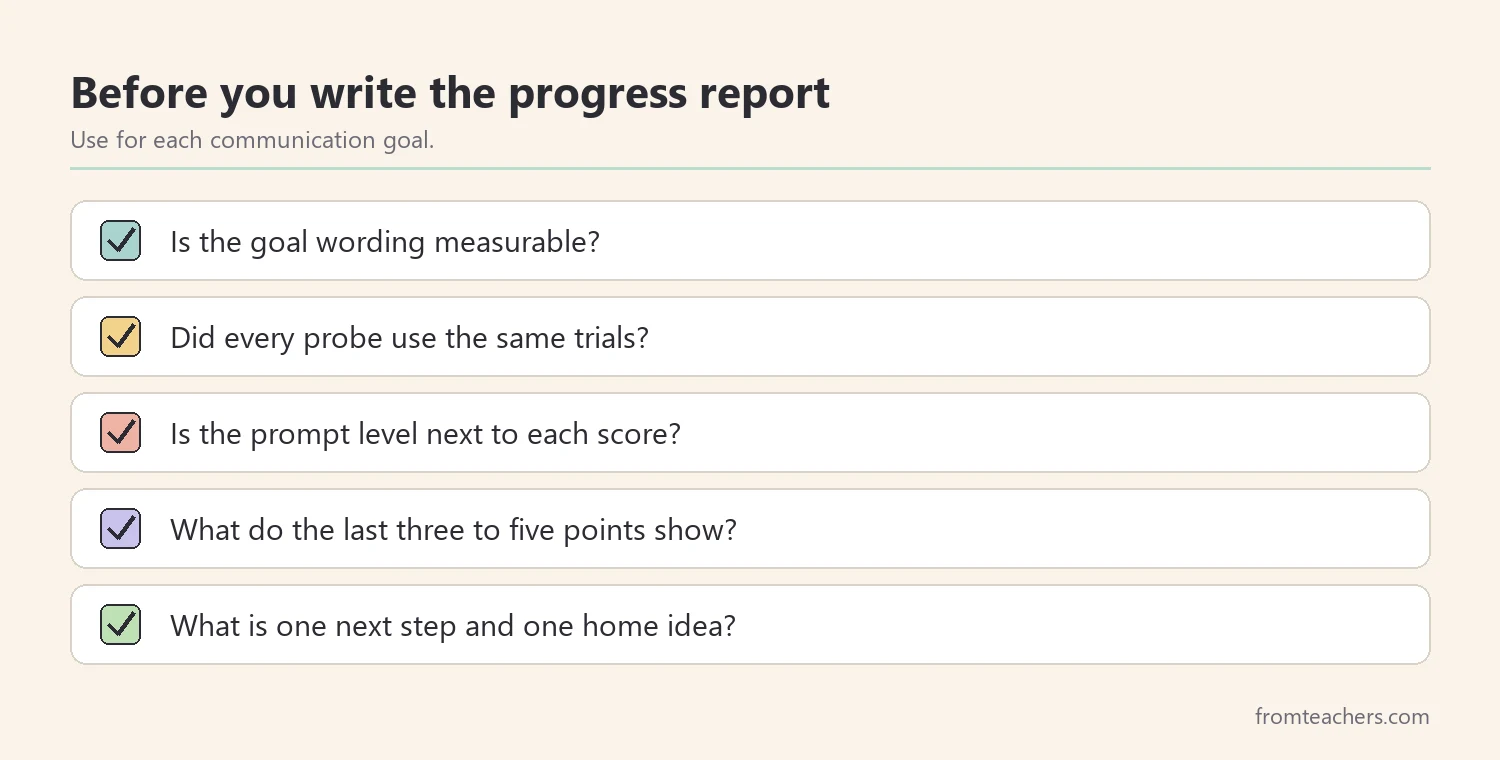
In short, clear goals make every later step faster. If you cannot imagine scoring a goal in your head during a session, rewrite it before you start counting.
2. Choose a simple data method for each goal
Once the goal is clear, decide how you will count it. Effective SLP progress monitoring does not need a complicated system. Instead, it needs one method per goal, used the same way every time, so this week’s number can be compared with last month’s.
The most common methods are easy to match to the goal type:
| Method | Best for | What you record |
|---|---|---|
| Trial count | Sounds, word tasks | Correct out of 10 or 20 |
| Frequency count | New words, requests | How many times it happened |
| Prompt level | Skills still being taught | Least support needed |
| Short rating | Conversation, pragmatics | A 1 to 4 score with a note |
For trial counts, keep the number of trials the same every session. Ten trials is a practical number for many articulation tasks because it turns into a percentage quickly: seven correct out of ten is 70%. Moreover, a fixed trial count stops a strong start from hiding a weak finish.
Prompt level matters as much as accuracy. A student who scores 80% with a full model is not in the same place as a student who scores 80% on their own. Therefore, record the highest support you gave during the probe, using the same short codes every time.
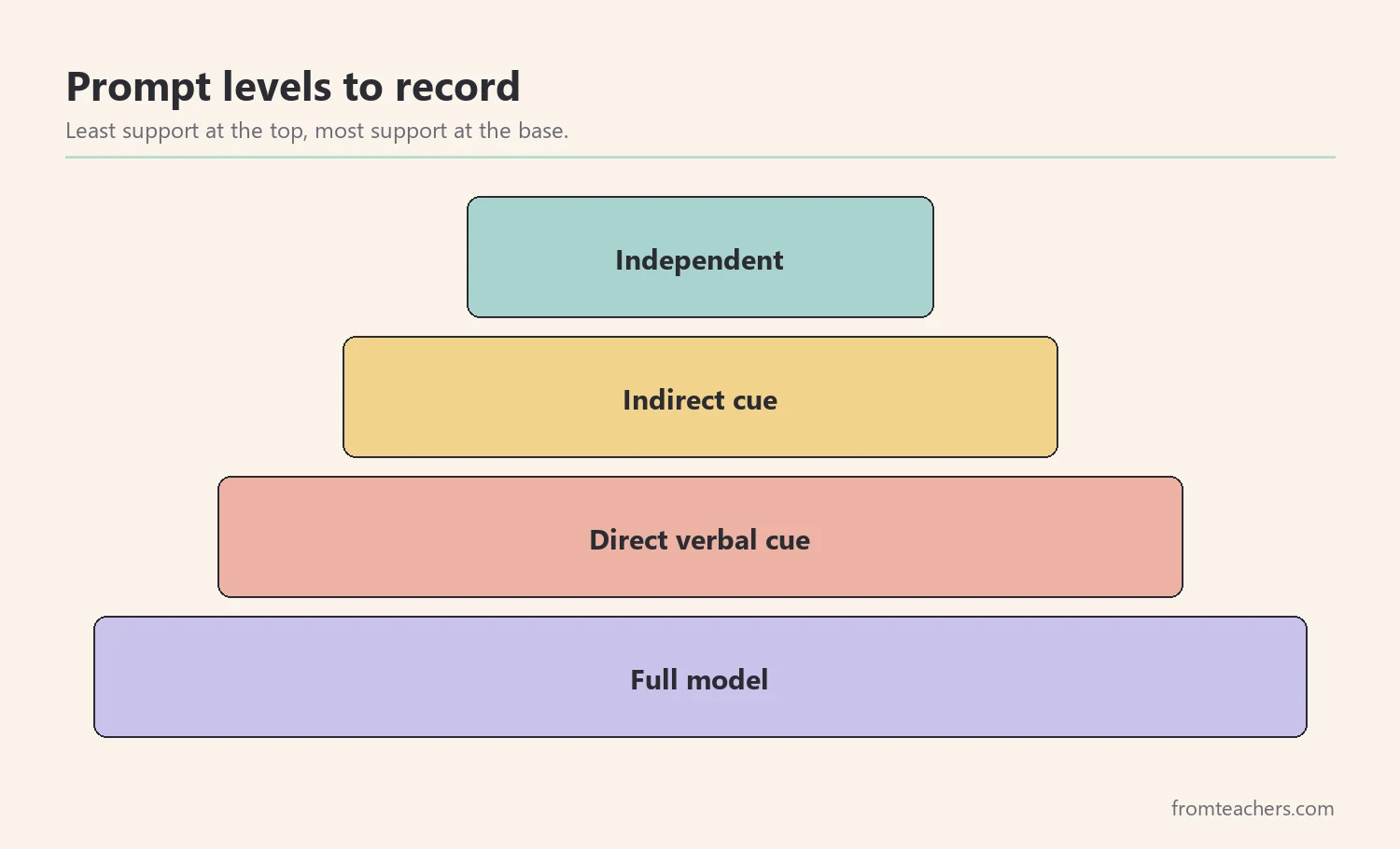
Worked example. For Goal 1, Leo’s SLP uses ten sentence trials at the start of each session and notes the prompt level. For Goal 2, she counts how many different describing words Leo uses while talking about three picture scenes, and she scores accuracy on ten sentence attempts.
3. Collect SLP progress monitoring data during the session
The next challenge is time. You want therapy, not a session that turns into paperwork. The solution is a short probe at a predictable point, usually the first five minutes, before teaching and practice begin. That way, the score reflects what the student can do before your support in that session.
Keep the sheet within reach and mark each trial as it happens. A simple plus or minus per trial is enough. Then, at the end of the probe, count the pluses and write the percentage. Writing it right away prevents the “I will fill it in later” problem that ruins so much data.
A good one-page sheet makes this routine easy. If you want a ready-made format, the Communication Goals Progress Sheet for SLPs has a tracking table for each of two goals with columns for date, activity, prompt level or new words used, percent accuracy, and notes.
Use the notes column for context that explains the number. For example, “new picture set,” “tired after recess,” or “first session after a week off.” Without those notes, a dip in the data can look like a problem when it was really a change in the task.
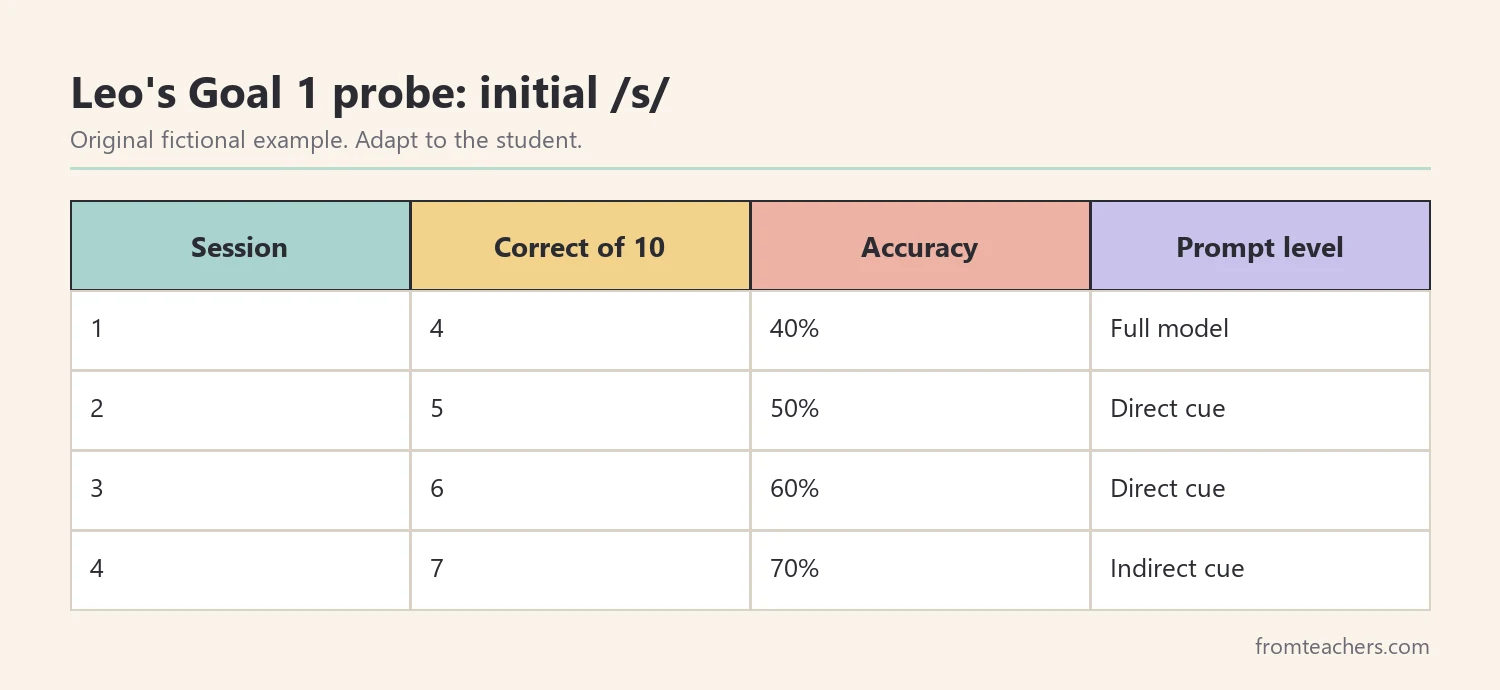
Worked example. Over four sessions, Leo’s Goal 1 probe goes from 4 out of 10 (40%) with a model, to 5 out of 10 (50%) and 6 out of 10 (60%) with a direct verbal cue, to 7 out of 10 (70%) with only an indirect cue. Each score takes under a minute to record.
4. Graph the data and read the trend
A column of numbers is hard to read at a glance. A simple line graph, even one drawn by hand on graph paper, shows the direction of change in seconds. Plot sessions along the bottom and percent accuracy up the side, then draw a horizontal line at the goal criterion.
Next, read the trend, not the single points. One high score can come from an easy picture set. One low score can come from a hard morning. Most SLPs look at the last three to five data points and ask three questions: is the line rising, flat, or falling, and how close is it to the criterion line?
It also helps to agree on simple decision rules before you look at the graph. For example, if the last three points are flat, change one part of the teaching. If the last three points meet the criterion with the agreed support, move to the next level. These rules keep SLP progress monitoring honest, because you decide what counts as progress before you see the data.
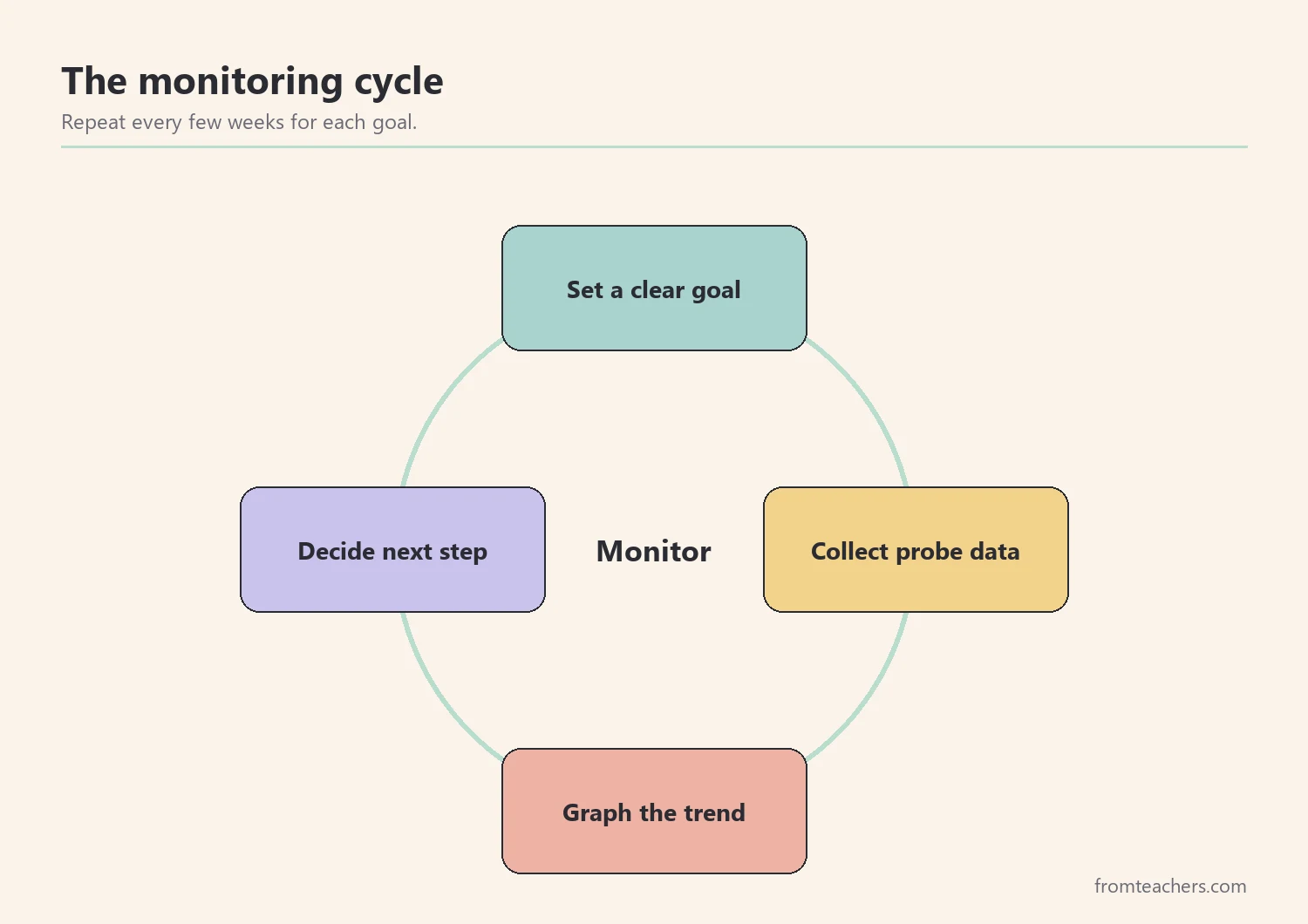
Worked example. Leo’s last three Goal 1 scores are 50%, 60%, and 70%. That is 18 correct out of 30 trials, an average of 60%. The line is rising, and the prompt level is fading. Therefore, his SLP keeps the current approach and plans to check again after three more sessions. For Goal 2, Leo used 2, 3, 3, and 4 different describing words across four sessions, a slow but steady climb.
In addition, compare the graph with your notes. If the one flat stretch lines up with a new picture set, the plan may be fine and the task simply got harder.
Also, keep the graph simple enough to share. One goal per graph, one line, and one criterion line is usually all a team needs. When a parent can see the line climbing toward the goal, the conversation at the meeting becomes easier and more hopeful. Similarly, a flat line gives everyone a shared, neutral starting point for problem solving instead of a debate about impressions.
5. Turn your data into a clear progress summary
Finally, the numbers need to become a few sentences that a teacher, an administrator, and a parent can all understand. A useful summary answers three questions: where did the student start, where are they now, and what will happen next?
Write in plain language. Instead of “Student demonstrated emerging generalization of target phoneme,” try “Leo now says /s/ correctly at the start of words in sentences about 7 out of 10 times with a small reminder. In September, he did this 4 out of 10 times with a full model.” Families can picture that.
Then, add next steps that follow from the trend. If the line is rising, name what you will keep doing. If it is flat, name the one change you will try. Also, mention anything the family could practice at home, kept short and specific.
| Part of the summary | Example for Leo, Goal 1 |
|---|---|
| Starting point | 4 of 10 correct with a model |
| Current level | 7 of 10 correct with an indirect cue |
| Trend | Rising over four sessions |
| Next step | Keep sentence practice, fade cues |
| Home idea | Five /s/ words at dinner |
Good SLP progress monitoring makes this part almost automatic. Because the data, notes, and trend are already on one page, the summary is mostly a matter of reading what is there.
Common mistakes and how to avoid them
- Changing the probe every session. Different word lists make scores hard to compare. Fix: keep a stable probe set and use new materials for practice instead.
- Recording accuracy without support level. An 80% score with a model can look like mastery. Fix: always write the prompt code next to the percentage.
- Filling in data from memory. Scores written later tend to drift. Fix: record each trial as it happens and total it before the student leaves.
- Reacting to one data point. A single dip rarely means the plan failed. Fix: look at the last three to five points and your notes.
- Writing reports in jargon. Families may nod without understanding. Fix: describe what the child can now do in everyday words.
Questions teachers and parents ask about SLP progress monitoring
How often should SLP progress monitoring happen?
Many SLPs collect a short probe every session or every other session for each goal. The key is consistency. Regular data points give you a trend you can trust when progress reports are due.
How many trials do I need for a reliable score?
Ten trials is a common, practical choice because it converts easily to a percentage. Some goals need more, especially when the skill is inconsistent. Whatever number you choose, keep it the same from session to session.
Can classroom teachers help with data collection?
Yes, especially for goals that should appear in class, such as asking for help or answering questions. Give the teacher one simple thing to count and a short form. Then compare their observations with your session data.
What if the data shows no progress after several weeks?
First, check the goal wording and the probe for consistency. Then, change one part of the teaching, such as the cue, the materials, or the practice amount. If the trend stays flat, bring the data to the IEP team to discuss next steps.
How do I explain progress data to parents?
Use a starting point, a current level, and one sentence about what comes next. Show the simple graph if it helps. Above all, give them one concrete thing they can practice at home.
Related reading: The Power of Data Tracking in Special Education, Special Education Tracking Tools, and How Teachers Communicate With Parents in Special Education.
A companion resource for SLP progress monitoring:
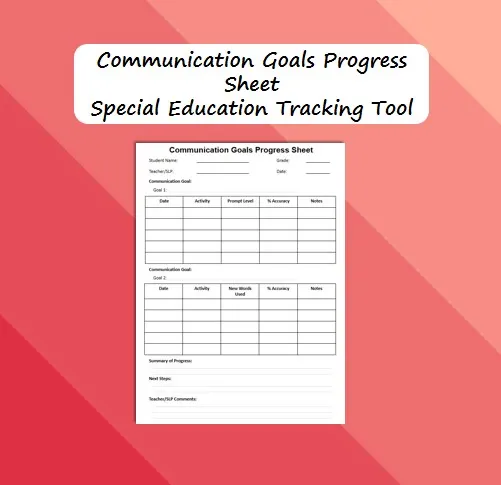
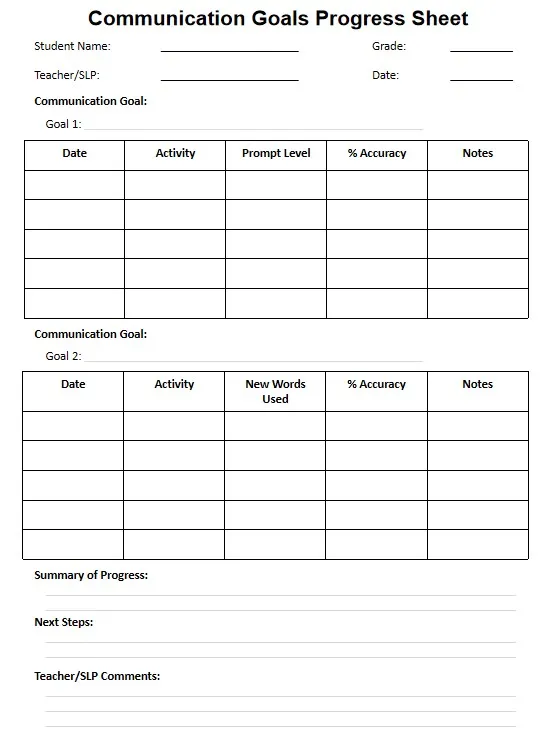
Communication Goals Progress Sheet SLP IEP Progress Monitoring Tool: a one-page tracking sheet with student details, space for two communication goals, a tracking table for each goal (date, activity, prompt level or new words used, percent accuracy, notes), and sections for summary of progress, next steps, and comments.
Sources and scope
- American Speech-Language-Hearing Association (ASHA): professional guidance for SLPs, including school-based practice and documentation.
- IDEA, U.S. Department of Education: the law behind IEPs, including reporting progress toward annual goals.
- IRIS Center, Vanderbilt University: free modules on progress monitoring and data-based decision making.
- National Center on Intensive Intervention: resources on using data to adjust instruction.
This guide covers practical data collection and reporting for school-based communication goals. It does not cover formal speech and language evaluation or eligibility decisions, which belong to qualified professionals and the IEP team.
Key takeaways
- SLP progress monitoring starts with goals that name the skill, level, support, and criterion.
- Use one consistent data method per goal, and record prompt level with accuracy.
- Collect a short probe at the same point in each session and write it down right away.
- Read the trend across three to five sessions before changing the plan.
- Share progress in plain language with a clear next step and a home idea.










Leave a Comment