

A special education observation checklist solves a problem every teacher knows. You sit down to write an IEP progress note, and you remember that a student “seemed more focused lately,” but you have nothing written down to show it. The moment happened, and the evidence is gone.
This guide walks you through five steps: connect the checklist to a goal, pick the right form for the lesson, observe and check in real time, turn the checks into a weekly summary, and use that summary in progress notes and meetings. By the end, you will be able to collect quick, honest daily data without stopping your lesson.
Examples are fictional. Adapt to the student’s goals and agreed supports. This is guidance, not a diagnosis.
At a glance
- Start from the IEP goal, then choose what to observe.
- Use one short form per lesson so recording takes about two minutes.
- Check boxes during the lesson and add a few words of notes.
- Summarize the week on Friday, so patterns are easy to see.
- Bring the summary to progress notes, team talks, and family meetings.
1. Connect your special education observation checklist to a goal
First, decide why you are observing. A checklist without a purpose collects lots of boxes and very little meaning. Therefore, start with the student’s IEP goal or the specific concern the team wants to understand.
Next, turn the goal into things you can actually see. “Improve attention” is hard to observe. By contrast, “begins the task within two minutes” or “stays with the group activity until the end” are clear. These observable behaviors become the rows you focus on.
Then, decide how often you will use the special education observation checklist. Daily data during the same lesson is easier to compare than random snapshots. For example, observing during independent reading every morning gives you a steady picture across the week.
| IEP goal area | Observable behavior |
|---|---|
| Attention and focus | Starts task within two minutes |
| Task independence | Uses checklist without adult prompt |
| Social interaction | Takes turns in a partner activity |
| Emotional regulation | Uses calm-down card when upset |
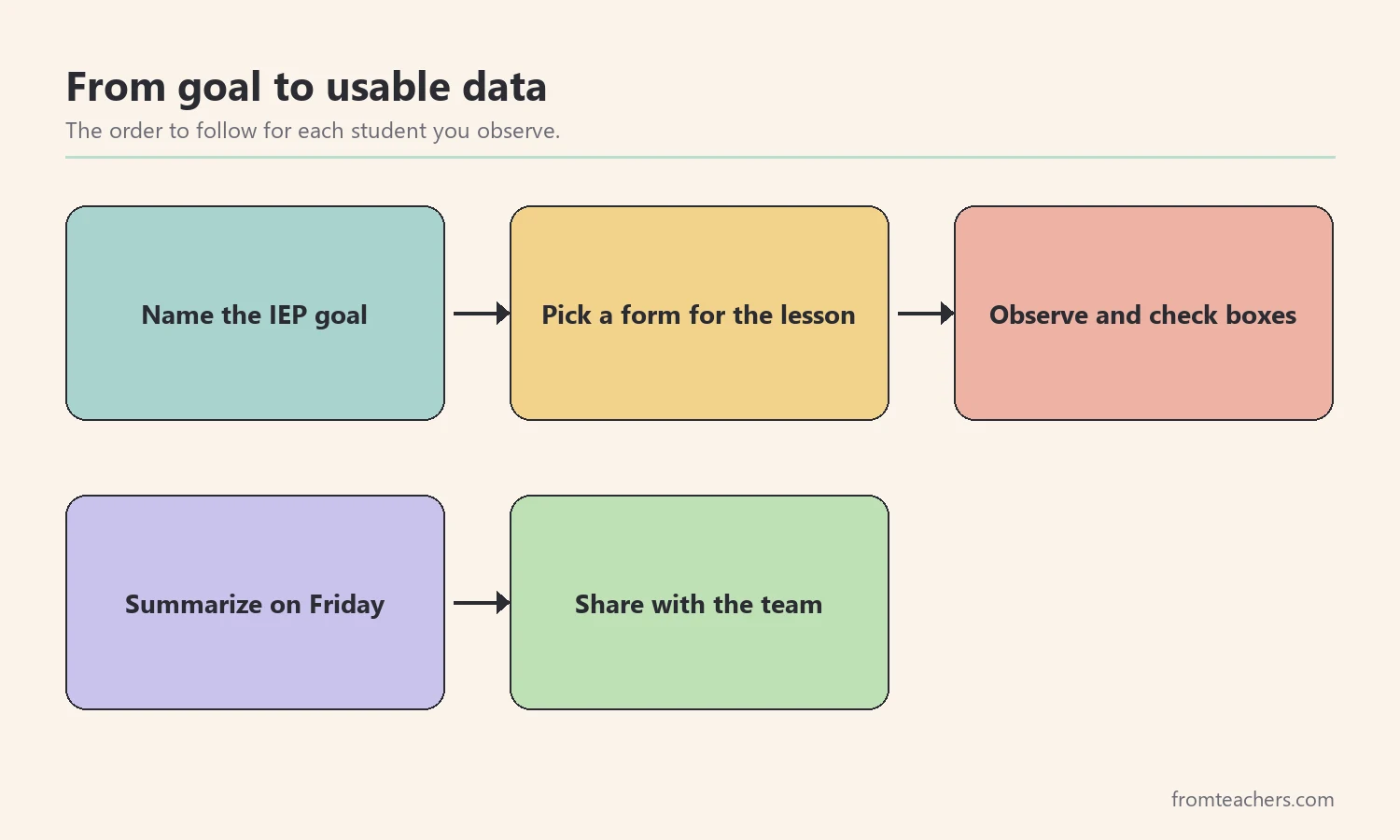
Worked example. Theo is a fictional third grader. One of his IEP goals targets starting independent work without repeated prompts. His teacher decides to observe him during the 20-minute independent reading block each morning. She writes down two behaviors to watch: starting within two minutes, and asking for help with a signal card instead of calling out.
2. Pick the right form for the lesson
Different lessons show different skills. A partner game reveals social interaction, while a writing block reveals independence and focus. So, match the form to what the lesson actually asks of the student.
In addition, avoid using the exact same generic form every day for every purpose. When a special education observation checklist is too broad, teachers start ticking boxes out of habit. A form built around one area, such as engagement or executive functioning, keeps your attention on what matters.
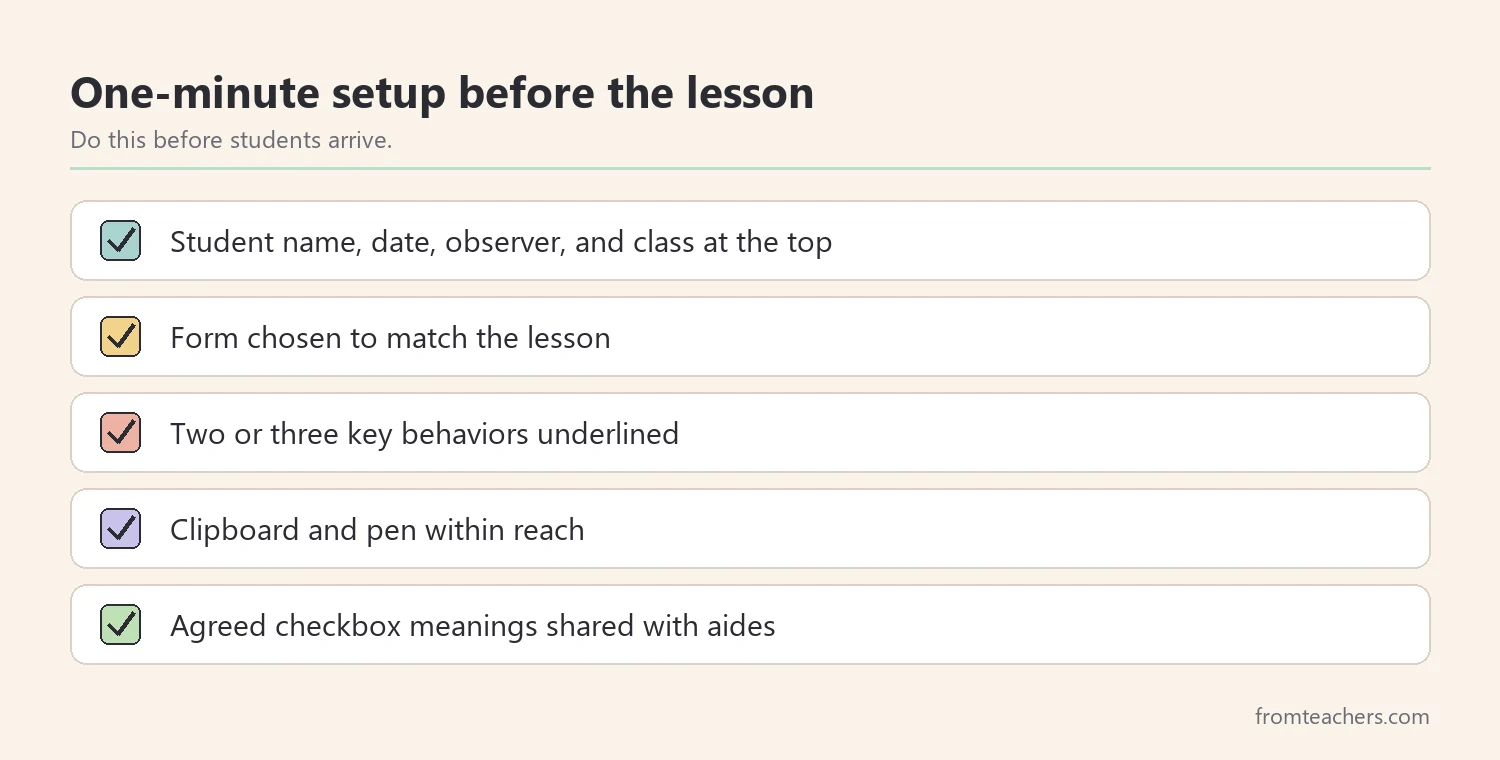
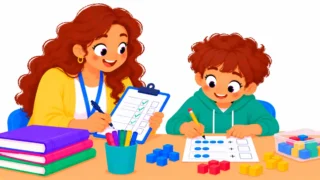
Before the lesson, write the student’s name, the date, your name, and the class at the top. Then, put the form where you can reach it quickly, such as on a clipboard at your teaching table.
If you want a ready-made set, the 12 daily classroom observation forms cover areas such as engagement, attention, emotional and behavioral regulation, peer interaction, task independence, communication, academic progress, motor skills, and executive functioning. Each one uses the same check-box layout with a notes column, and the PowerPoint version can be edited to match a specific goal.
Choosing between forms during a busy week
Some weeks, every lesson seems to need its own form. In that case, pick the area most closely tied to the goal you are reporting on soon. A special education observation checklist works best when it answers one question well, rather than many questions poorly.
Also, think about who else is in the room. If an aide supports the student during math, that adult may be better placed to fill in the form for that block. Meanwhile, you can take the reading block yourself. Sharing the work this way keeps the data steady without adding to anyone’s load.
Finally, keep a simple schedule taped inside your planner: which form, which lesson, which days. When the plan is written down, the special education observation checklist becomes part of the routine instead of one more thing to remember.
Worked example. For Theo’s reading block, his teacher uses an attention and focus form on Monday, Wednesday, and Friday. On Tuesday and Thursday, the class does partner reading, so she uses a peer interaction form instead. Each form takes a minute to set up.
3. Observe and check boxes in real time
The best data is recorded while it happens. Memory blurs quickly, especially on busy days. Therefore, fill in your special education observation checklist during the lesson or right after it, not at the end of the day.
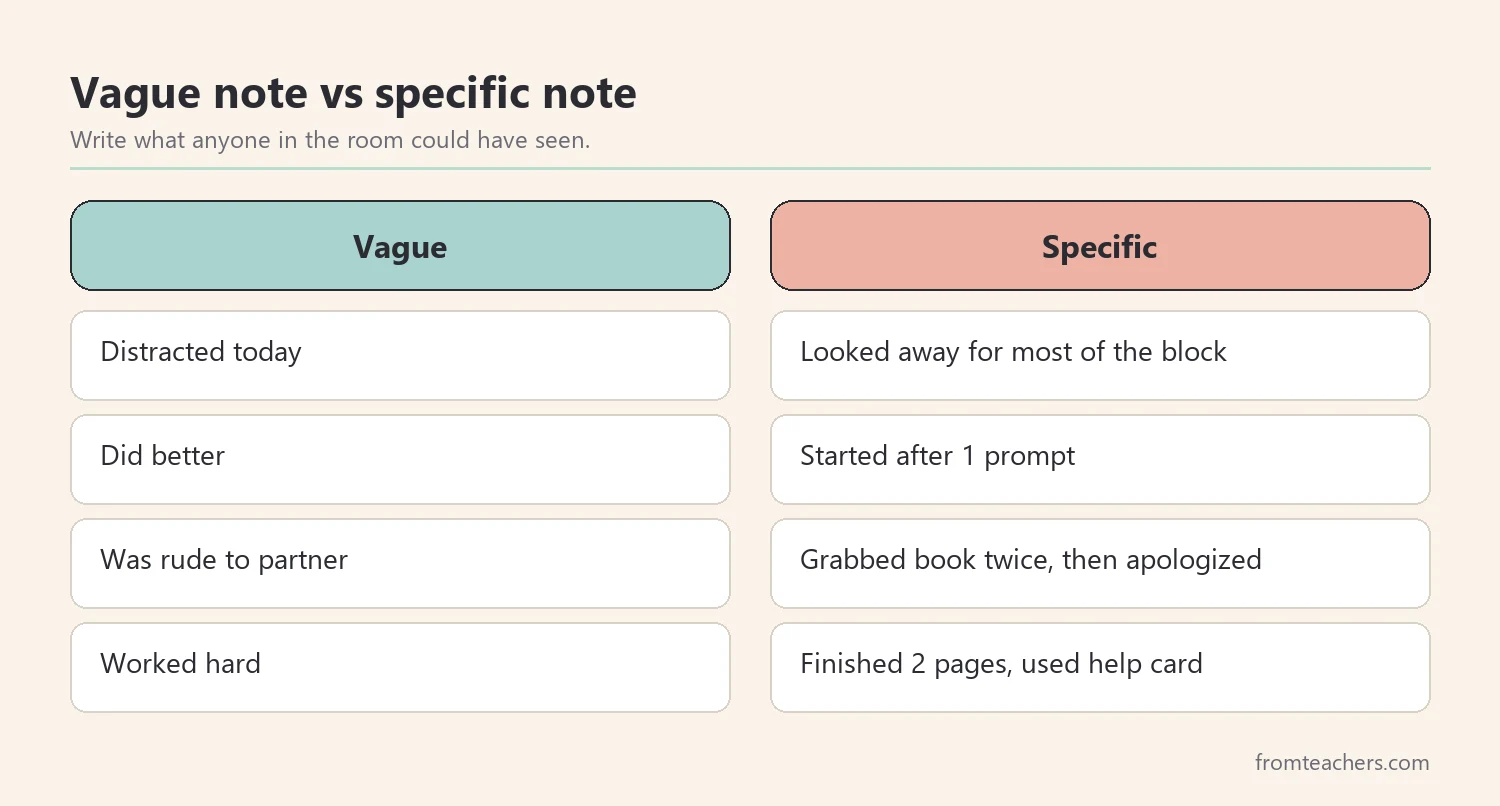
Keep the special education observation checklist fast. Watch for a few minutes, check the box that matches what you saw, and write two to five words in the notes column. Short notes like “started after 1 prompt” or “used help card” are enough. As a result, you stay present for teaching instead of writing paragraphs.
Also, describe behavior, not character. “Looked out the window for most of the block” is useful. “Lazy today” is not, and it can harm trust if a family reads it. Stick to what anyone in the room could have seen.
Tips for staying consistent
- Observe during the same part of the lesson each day.
- Use the same meaning for each checkbox every time.
- Ask aides to use the form the same way you do.
- Note unusual events, such as a fire drill or a substitute.
Sometimes you will miss a day, and that is fine. Simply mark the form “not observed” rather than guessing from memory. A blank that is labeled honestly is far more useful than a box filled in later. Over a week, you will still have enough real observations to see a pattern, and your counts will show exactly how many days you actually watched.
Worked example. On Wednesday, Theo starts reading after one reminder and uses his help card once. His teacher checks the matching boxes and writes “1 prompt, card used, finished 2 pages.” The whole entry takes under two minutes.
4. Turn your special education observation checklist into weekly data
Single days can mislead. A great Monday or a hard Thursday says little on its own. So, at the end of each week, gather each special education observation checklist and count what you saw.
Start with one simple question for each behavior: on how many observed days did it happen? Then, write the total next to the number of days you observed. For example, “started within two minutes on 3 of 5 days.” These counts are honest, easy to explain, and easy to compare from week to week.
Next, read the notes column of your special education observation checklist for patterns. Perhaps the hard days were all after recess, or a certain partner made things easier. Patterns like these help the team choose the next support. In other words, the notes explain the numbers, and the numbers show whether the notes describe a real trend or a single unusual day.
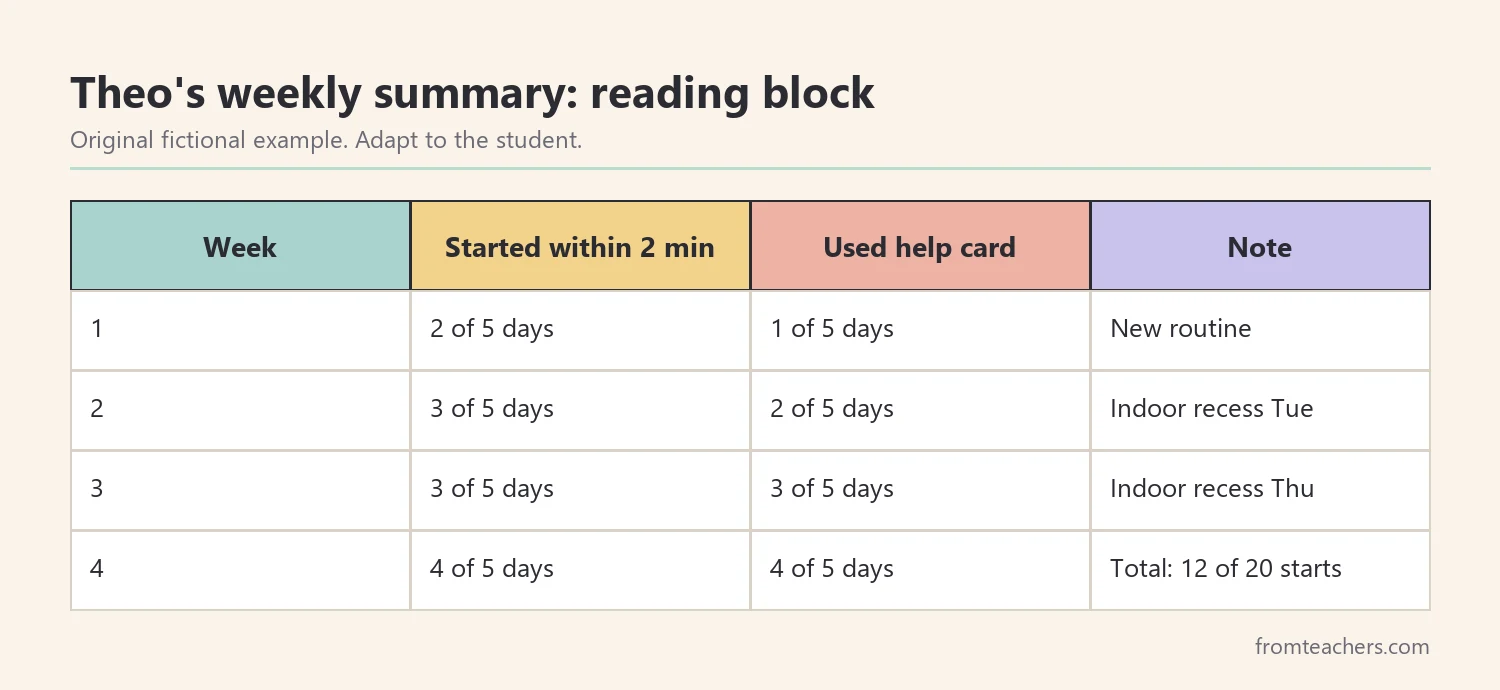
Also, keep the weekly summaries together in one folder or file. Over a grading period, they become a clear trend line instead of a pile of loose papers. In addition, they make the next IEP meeting much easier to prepare.
Worked example. Theo starts reading within two minutes on 2 of 5 days in week one, 3 of 5 in week two, 3 of 5 in week three, and 4 of 5 in week four. Across the four weeks, that is 12 of 20 observed days. His teacher also notices that his slowest starts came on days with an indoor recess.
5. Use the data in progress notes and meetings
Data matters most when it helps people make decisions. Therefore, bring your weekly summaries into progress reports, team conversations, and meetings with families. A special education observation checklist gives everyone the same facts to discuss.
In progress notes, write one or two plain sentences backed by numbers. For example: “Theo started independent reading within two minutes on 12 of 20 observed days this period, up from 2 of 5 days in the first week.” Then, add one sentence about what seems to help.
In meetings, show the trend, not every form. A short table or the weekly summary page is enough. Also, invite the family to share what they see at home. Their view often explains patterns the classroom data cannot.
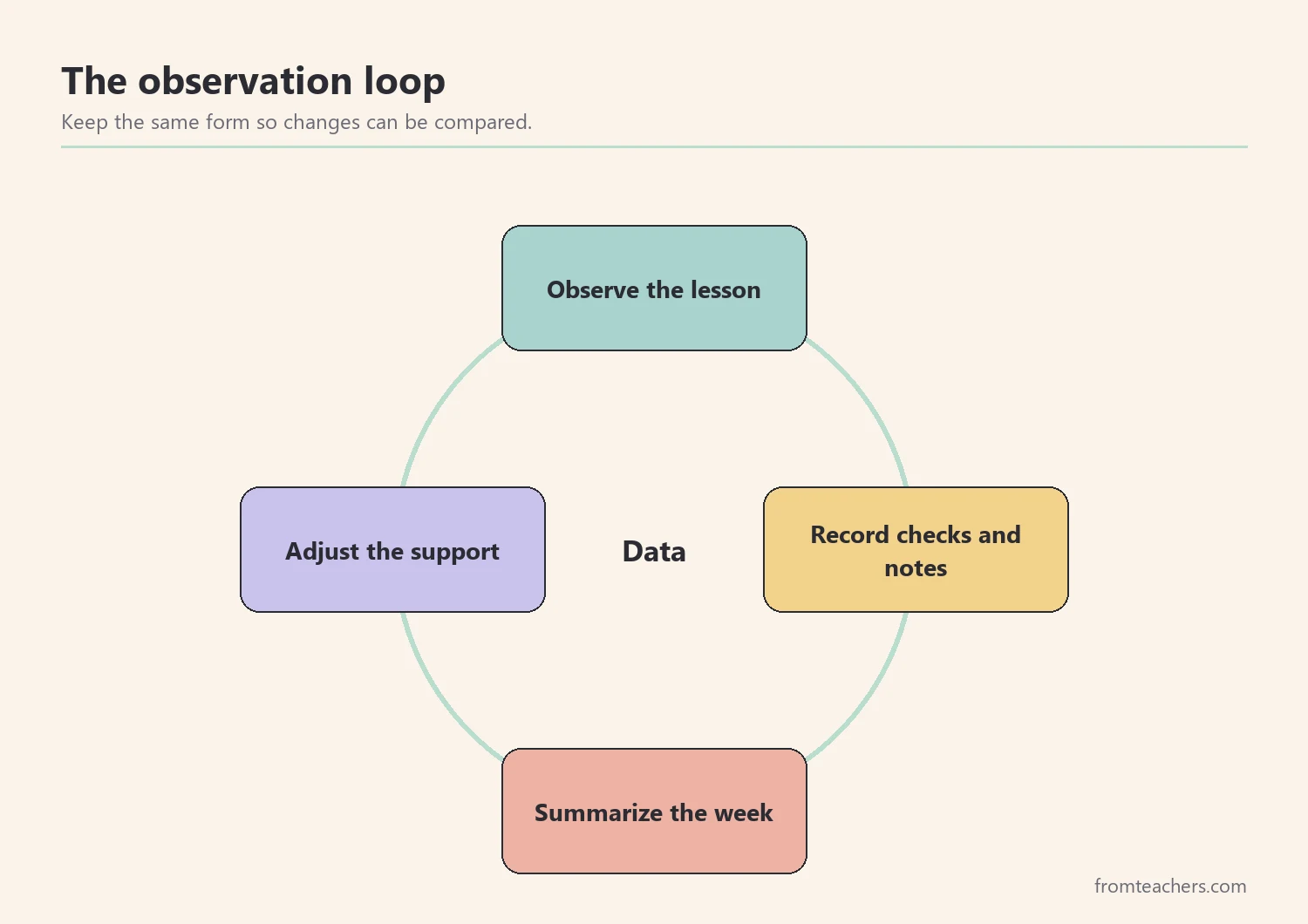
Writing a progress note from the summary
A good progress note has three parts: what the goal is, what the data shows, and what the team will do next. Keep each part to one sentence. Because your special education observation checklist already gives you counts, the middle sentence almost writes itself.
In addition, avoid overstating the trend. Four weeks of data can show a direction, but it cannot prove a cause. Words like “suggests” and “so far” keep the note honest, and families tend to trust careful language more than big claims.
Finally, use the data to adjust support. If a behavior improves steadily, the team might fade a prompt. If it stays flat, the team might try a new strategy and keep observing. Either way, the next decision rests on evidence.
Worked example. At a team check-in, Theo’s teacher shares the four-week summary. The team notices the indoor recess pattern and agrees to give Theo a short movement task before reading on those days. His teacher keeps using the same form, so the team can see whether the change helps.
Common mistakes and how to avoid them
- Observing without a goal. Boxes pile up with no meaning. Fix: link every special education observation checklist to a specific goal or concern.
- Filling forms in at the end of the day. Memory changes details. Fix: record during the lesson or right after it.
- Writing judgments instead of behavior. Words like “lazy” or “defiant” are not data. Fix: describe what anyone could have seen.
- Changing the meaning of checkboxes. Inconsistent use makes weeks impossible to compare. Fix: agree on definitions with every adult who uses the form.
- Collecting data nobody reads. Forms sit in a drawer. Fix: summarize every Friday and share the trend with the team.
Questions teachers and parents ask about a special education observation checklist
How long should an observation take?
For daily classroom use, aim for about two minutes of recording. The observation itself happens while you teach. Longer, formal observations are a different tool, usually done by a specialist.
Can aides and co-teachers use the same form?
Yes, and it often helps. However, agree first on what each checkbox means. A quick practice round where two adults observe the same lesson makes the data more reliable.
Should parents see the daily forms?
Weekly summaries are usually more useful to families than daily forms. They show the trend without overwhelming detail. Follow your school’s rules on sharing student records.
How many areas should I observe at once?
Keep it small. One area per lesson, with two or three key behaviors, is usually enough. Watching everything at once leads to rushed, shallow notes.
Does a special education observation checklist replace formal assessment?
No. It adds everyday classroom evidence to the picture. Formal evaluations and assessments are separate processes led by qualified professionals and the IEP team.
Related reading: The Power of Data Tracking in Special Education, Special Education Accommodation and Modification Tracker, and How Parents and Teachers Can Team Up for Special Education Success.
A companion resource for a special education observation checklist:
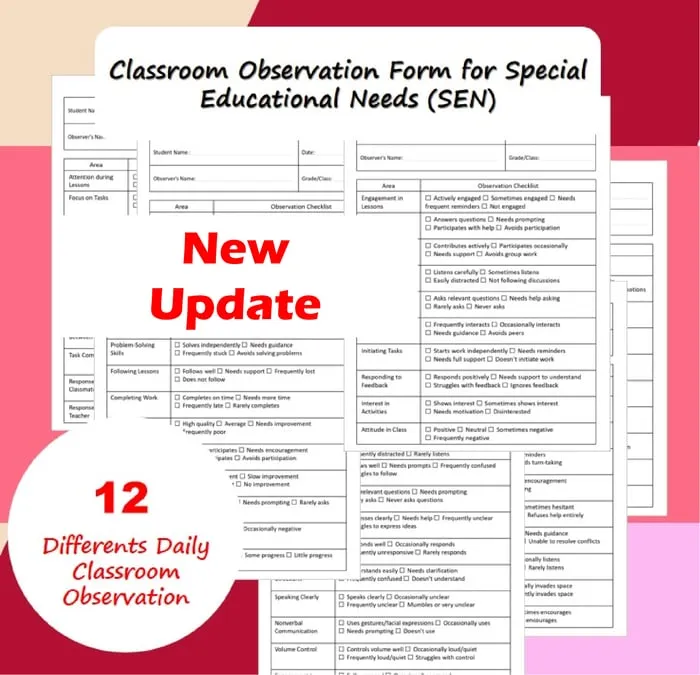
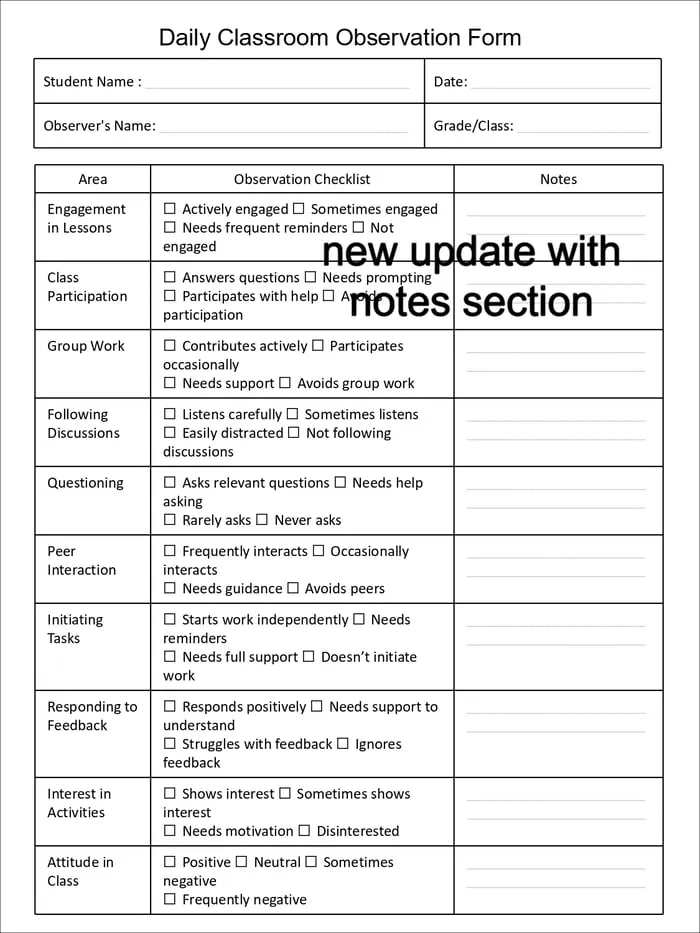
Classroom Observation Forms for Special Education: 12 Daily Checklists: twelve check-box observation forms in print-ready PDF and editable PowerPoint, covering areas such as engagement, attention, regulation, social interaction, independence, communication, and executive functioning, each with a notes column.
Sources and scope
- IRIS Center, Vanderbilt University: free modules on progress monitoring and classroom data.
- IDEA, U.S. Department of Education: the law behind IEPs, including reporting on progress toward goals.
- National Center on Intensive Intervention: resources on data-based decision making.
- Understood.org: practical articles for families and teachers on IEPs and school supports.
This guide covers informal, everyday classroom observation for teachers. It does not cover formal evaluations or functional behavior assessments, which follow separate procedures led by qualified professionals.
Key takeaways
- Link every special education observation checklist to a clear goal.
- Match the form to the lesson and keep recording to about two minutes.
- Write short, observable notes, never judgments.
- Summarize the week as “days observed” counts to show trends.
- Use the trend in progress notes and team decisions, then keep observing.







Leave a Comment