

IEP data collection usually feels hardest the night before progress reports are due, when a teacher searches through folders for any evidence that a goal moved. The notes exist somewhere, but they are scattered, uneven, and hard to summarize. A small weekly system prevents that scramble.
By the end of this guide, you will be able to make a goal measurable, pick a simple data method, set up one sheet per goal, collect data in a few minutes a week, read the trend, and write progress reports from real evidence. Examples are fictional. Adapt to the student’s goals and agreed supports. This is guidance, not a diagnosis.
At a glance
- Start from a goal you can count or observe.
- Match the data method to the goal, and keep it the same each week.
- Use one sheet per goal with a row for every week.
- Collect briefly and often, at a planned time.
- Look at the trend every few weeks and make one decision.
1. Make the goal measurable before IEP data collection starts
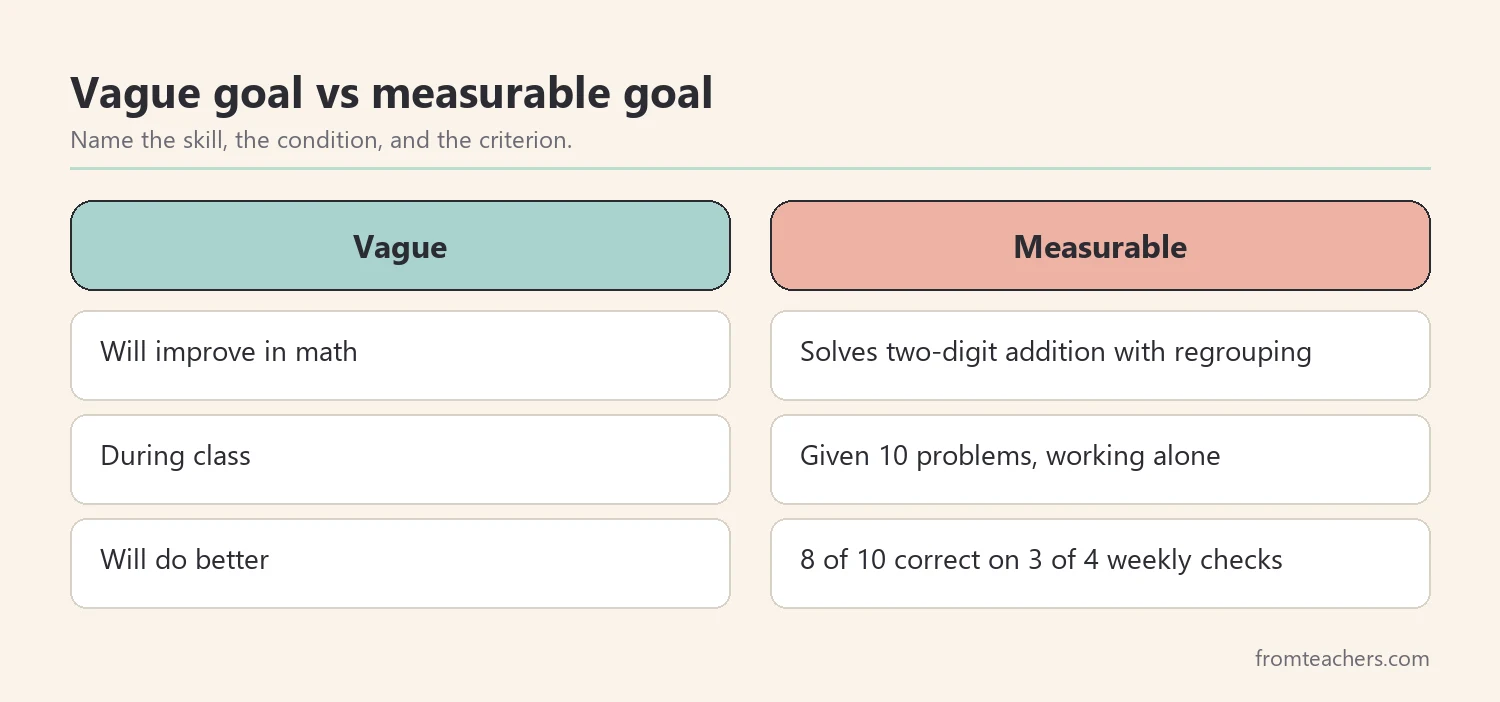
First, read the goal and ask: could two adults watch the same student and agree on the score? If not, IEP data collection will be messy no matter how often you record. A measurable goal names the skill, the condition, and the criterion.
For example, “Marcus will improve in math” cannot be measured. However, “Given 10 two-digit addition problems with regrouping, Marcus will solve 8 correctly on 3 of 4 weekly checks” can. The second version tells you exactly what to give, what to count, and what success looks like.
If the goal in the IEP is vague, talk with your case manager or team about how it will be measured. In the meantime, write down your measurement plan so every adult uses the same one.
Also, decide the conditions in advance. Will the student work alone or with a prompt? Will directions be read aloud? Writing these details down keeps IEP data collection fair from week to week, because the task stays the same and only the student’s skill changes.
Worked example. Marcus is a fictional student in grade 3 with a math goal. His IEP goal says he will solve two-digit addition with regrouping, 8 of 10 correct, on 3 of 4 weekly checks. His teacher writes one line under the goal: “Weekly 10-problem probe, Friday, independent, no calculator.” Now the plan is clear for anyone who covers the class.
2. Choose a simple method for IEP data collection
Next, choose how you will measure. The method should match the goal. Accuracy goals use percent or number correct. Behavior goals often use frequency or duration. Independence goals often use prompt level. Picking the wrong method makes IEP data collection slow and the results hard to read.
| Goal type | Method | What you record |
|---|---|---|
| Accuracy | Number or percent correct | 8 of 10 correct |
| Behavior | Frequency count | Times per class period |
| Time on task | Duration | Minutes engaged |
| Independence | Prompt level | Independent, gesture, verbal |
| Multi-step skill | Task analysis | Steps done alone |
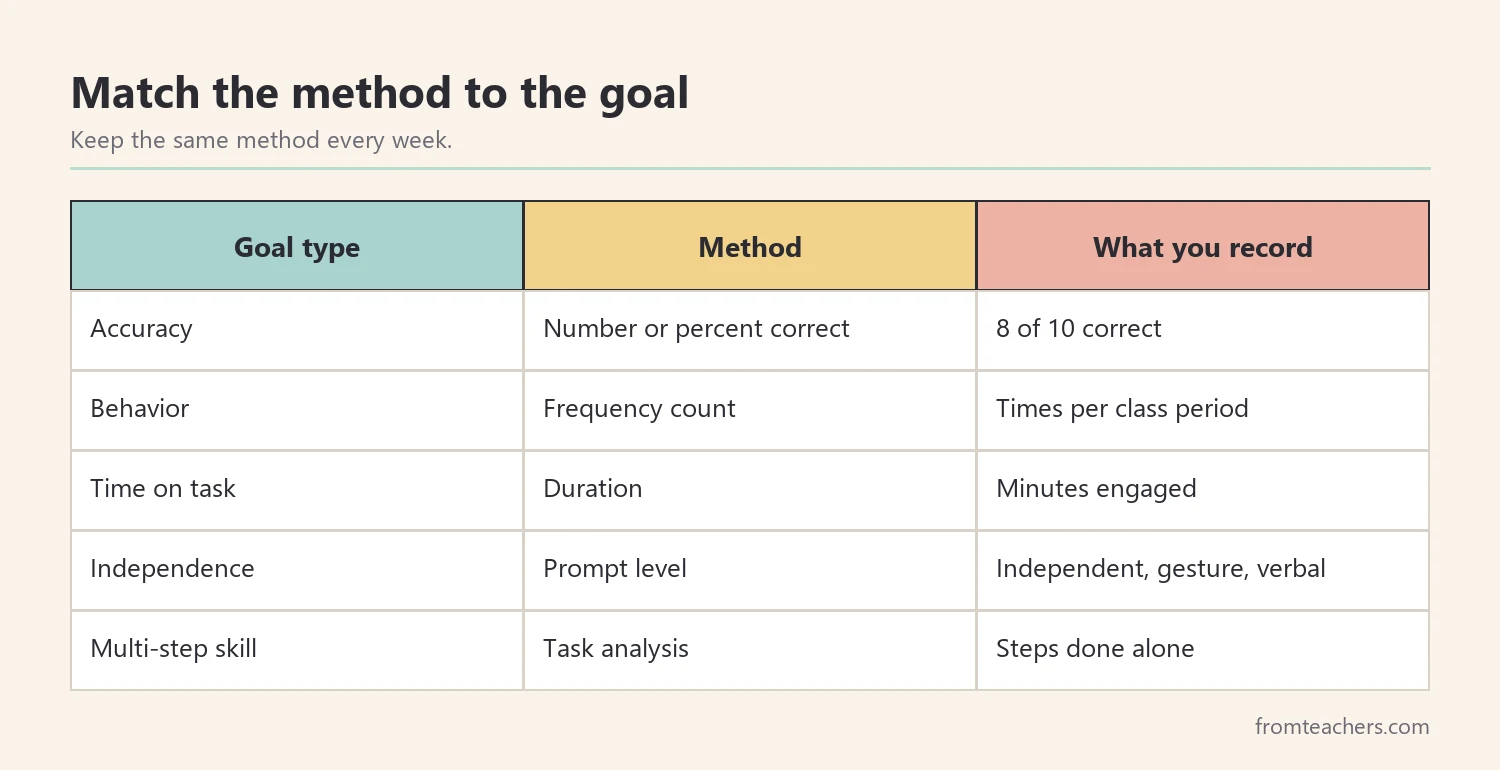
For behavior goals, define the behavior clearly before counting. For example, “leaves seat without permission” is easier to count than “off task.” When every adult counts the same thing, IEP data collection becomes reliable across staff and settings.
Then, keep the method the same every week. If the probe changes from 10 problems to 20, or from independent to supported, the numbers stop being comparable. Consistency matters more than precision.
In addition, collect a baseline before you change anything. Two or three checks at the start show where the student really begins. Without a baseline, it is hard to tell later whether a new strategy made a difference.
Worked example. For Marcus, the teacher uses number correct out of 10. She writes five versions of the probe at the same difficulty level and rotates them, so he does not memorize answers.
3. Set up one IEP data collection sheet per goal
Now build the sheet. One goal per sheet keeps things simple. At the top, write the student’s name, the yearly IEP due date, the goal title, and the full goal statement. Below that, add one row per week with space for the date, the score, and a short note.
A sheet with a row for every week of the reporting period shows gaps at a glance. If a row is empty, you know a week was missed. In addition, a short feedback note in each row records what happened, such as “absent Monday” or “new strategy started.”
If you prefer not to build your own, this 13-week IEP goal data collection sheet includes header fields for the student and goal, a trimester selector, 13 weekly feedback rows, and one filled-in example.
- One goal per sheet, with the full goal statement at the top.
- One row per week, even if you collect more than once.
- A short note in every row, including missed weeks.
- Keep the sheets together in a data binder or shared folder.
Then, decide where the sheets live. A paper binder works well when several adults collect data in the same room. A shared digital folder works better when staff move between rooms. Either way, one agreed home for every sheet keeps IEP data collection from scattering again.
Worked example. Marcus has three IEP goals, so his teacher keeps three sheets in his binder: math, reading fluency, and work completion. Each sheet covers one trimester.
4. Build a five-minute weekly routine
Next, put IEP data collection on the calendar. Data that depends on remembering rarely happens. Instead, choose a fixed day and time for each goal, such as Friday warm-up for math probes or the last ten minutes of small group for reading.
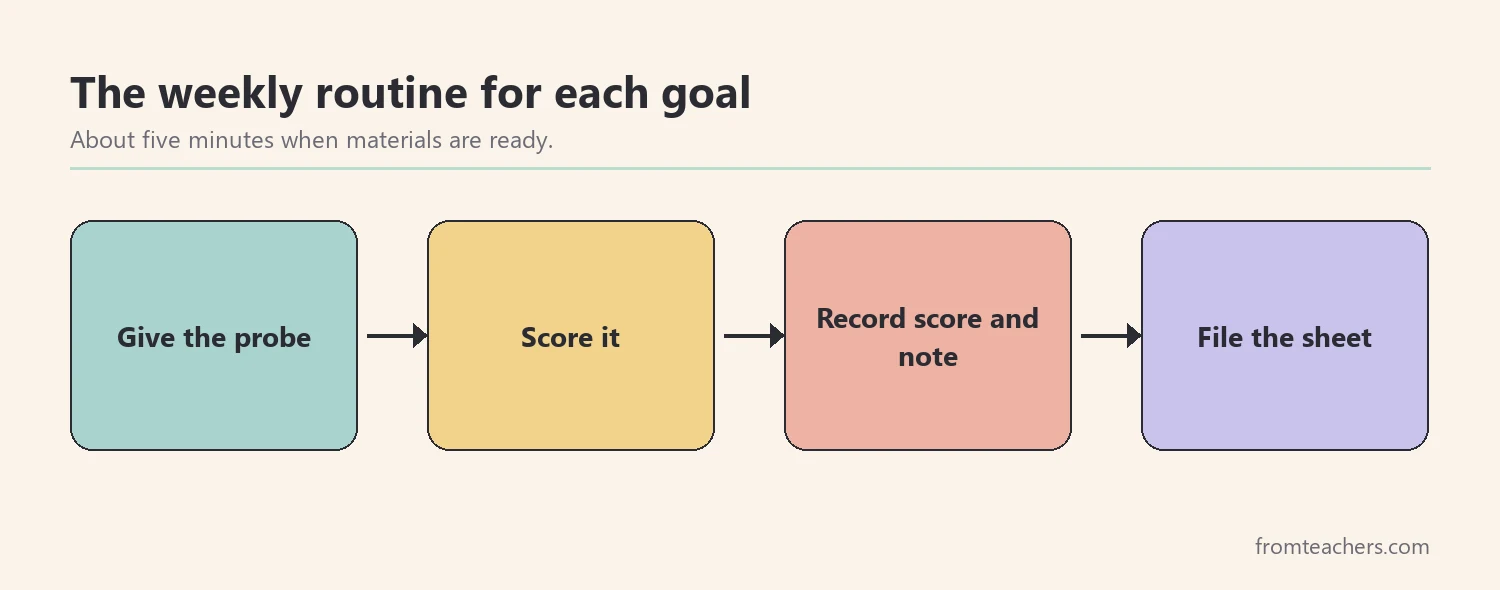
Keep the routine short and repeatable. Give the probe, score it, write the number and a one-line note, and file the sheet. Most single-goal checks take a few minutes when the materials are ready ahead of time.
Also, share the load. A paraprofessional can give and score many probes if the directions are written down. Meanwhile, the teacher reviews the sheets and makes decisions.
However, plan for missed weeks. Assemblies, field trips, and absences will happen. When a check is missed, write the reason in that week’s row and collect on the next school day if possible. A short note is better than an empty row, because it explains the gap later.
Worked example. Every Friday, Marcus completes his 10-problem probe during warm-up. His teacher scores it in about two minutes and writes the score and a note on his math sheet. The paraprofessional runs his reading check on Thursdays using written directions.
5. Read the trend in your IEP data collection
Then, look at the data every three to four weeks. One score tells you little, because students have good and bad days. However, several weeks together show a trend: rising, flat, or falling.
| Week | Correct (of 10) | Note |
|---|---|---|
| 1 | 4 | Baseline |
| 2 | 5 | Place value mat added |
| 3 | 5 | Absent Wednesday |
| 4 | 6 | Regrouping steps card added |
| 5 | 7 | Fewer carrying errors |
| 6 | 7 | Steady |
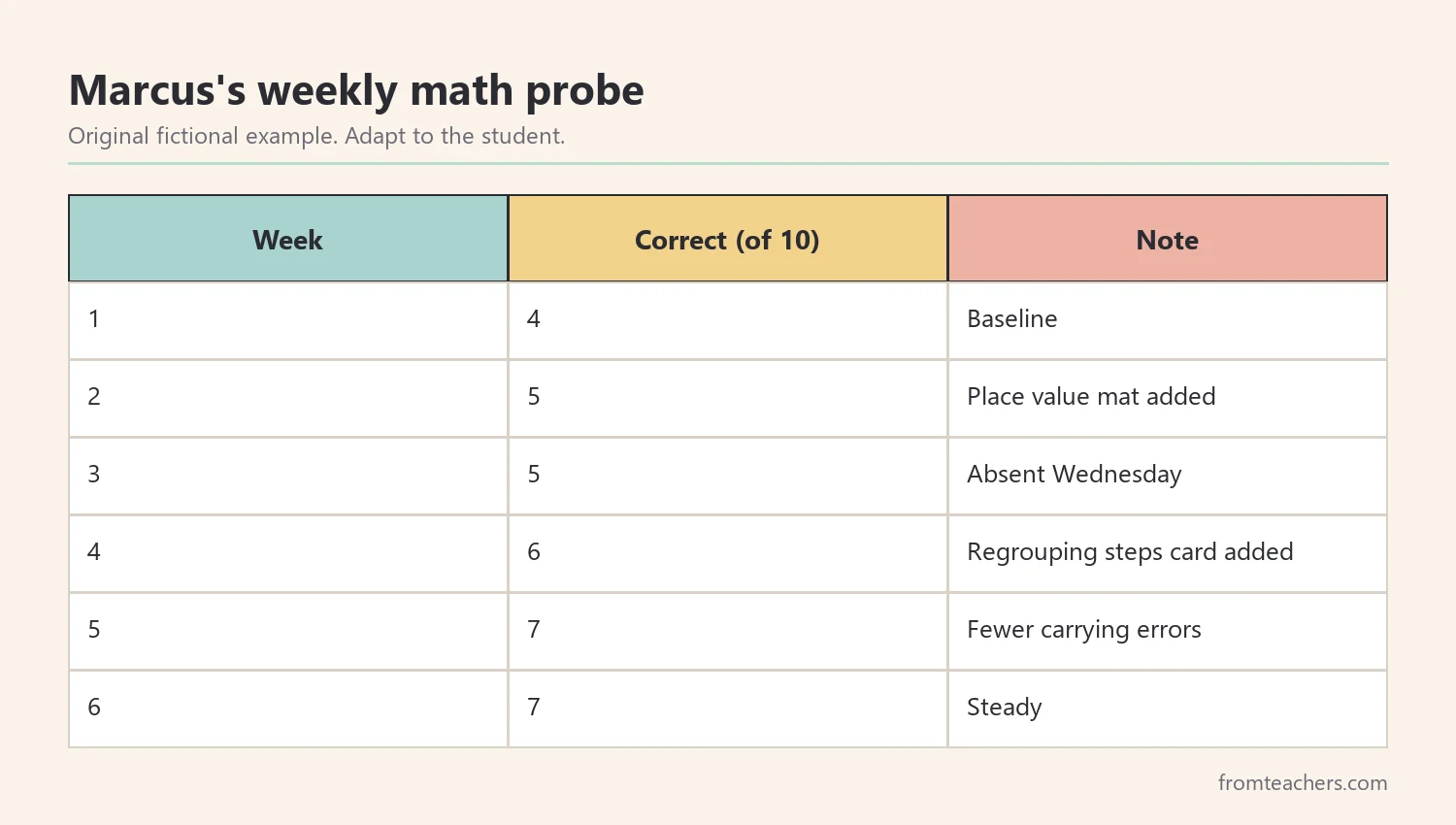
Use simple decision rules agreed with your team. For example, if the trend is rising toward the goal, keep the plan. If it is flat for three or four checks, change one part of instruction. If the goal is met on the required number of checks, talk with the team about a next goal.
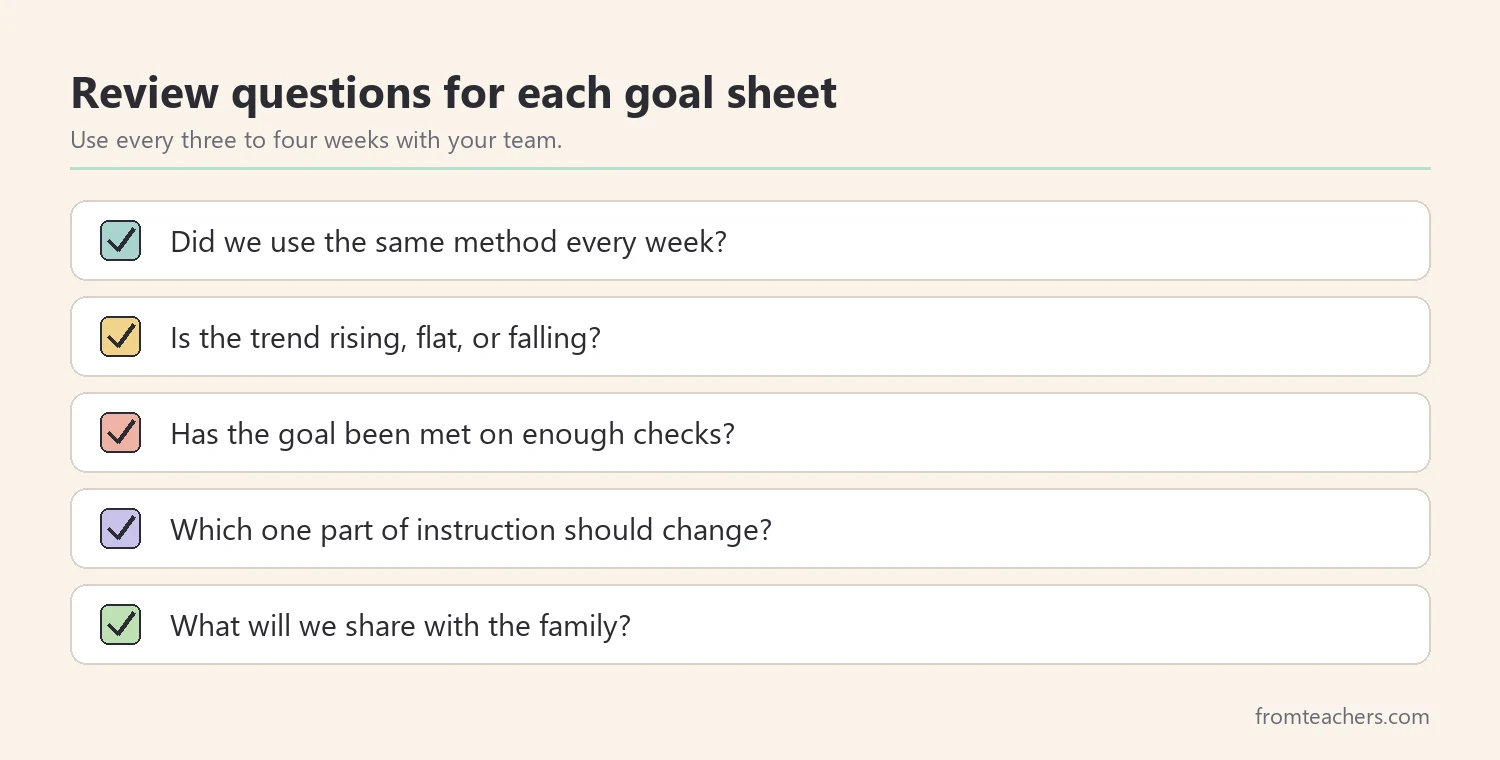
Next, write the decision on the sheet itself. A short line such as “Week 6: keep plan, add Tuesday practice” links the data to the action. Over a trimester, these lines tell the story of what you tried and what worked.
Worked example. After six weeks, Marcus’s scores have risen from 4 to 7 correct. He has not yet reached 8 of 10, but the trend is rising. Therefore, his teacher keeps the strategy and adds one short regrouping practice on Tuesdays.
6. Turn IEP data collection into progress reports
Finally, use the sheets when reports are due. Because every week is already recorded, the report becomes a summary, not a search. State the goal, the starting point, the current level, and the trend, in plain language.
For example: “Marcus began the trimester solving 4 of 10 two-digit addition problems with regrouping. In week 6, he solved 7 of 10. His scores are rising, and he is making progress toward his goal of 8 of 10.” That sentence is short, specific, and easy for families to understand.
In addition, bring the sheet to IEP meetings and family conferences. A one-page record lets everyone see the same evidence. As a result, conversations focus on what to do next rather than on memory.
Also, share short updates between formal reports. A quick note to the family every few weeks, based on the sheet, keeps everyone informed. Because the numbers are already recorded, this takes only a few minutes and builds trust in your IEP data collection.
- State the baseline and the latest score.
- Describe the trend: rising, flat, or falling.
- Name any change in instruction and when it started.
- Avoid jargon, and explain numbers in words.
Common mistakes and how to avoid them
Even a simple system can drift over a long school year, especially when schedules change or new staff join the team. Most problems with IEP data collection come from a few habits. Fortunately, each one is easy to fix.
- Collecting only before reports. Fix: schedule a weekly time for each goal.
- Changing the probe every week. Fix: keep the same format and difficulty.
- Tracking too many goals on one page. Fix: one goal per sheet.
- Numbers without notes. Fix: add a one-line note, including absences and changes.
- Never looking at the trend. Fix: review every three to four weeks and make one decision.
- Judging from a single bad day. Fix: decide from several weeks, not one score.
Questions teachers and parents ask about IEP data collection
How often should I collect data on each goal?
Weekly works well for many academic goals, and it fits a 13-week trimester sheet. Some behavior goals need more frequent data. Follow the schedule written in the IEP and agreed with your team.
What counts as good evidence?
Evidence should match the goal and be collected the same way each time. Probe scores, frequency counts, and work samples are common. Notes about conditions, such as absences, help explain the numbers.
Can a paraprofessional collect IEP data?
Often, yes, when the directions are clear and the teacher reviews the results. Check your school’s policies and make sure the method is written down so it stays consistent.
What should I do if the data shows no progress?
First, check that the method stayed consistent. Then change one part of instruction and keep collecting. If progress stays flat, share the data with the IEP team to discuss next steps.
How can parents use IEP data collection records?
Parents can ask to see the weekly sheets during conferences or IEP meetings. They can also ask how the goal is measured and what the next step will be if progress slows. Simple records make it easier to ask good questions and to support the same goal at home.
Related reading: The Power of Data Tracking in Special Education, Special Education Accommodation and Modification Tracker, and How Teachers Communicate With Parents in Special Education.
A companion resource for IEP data collection:
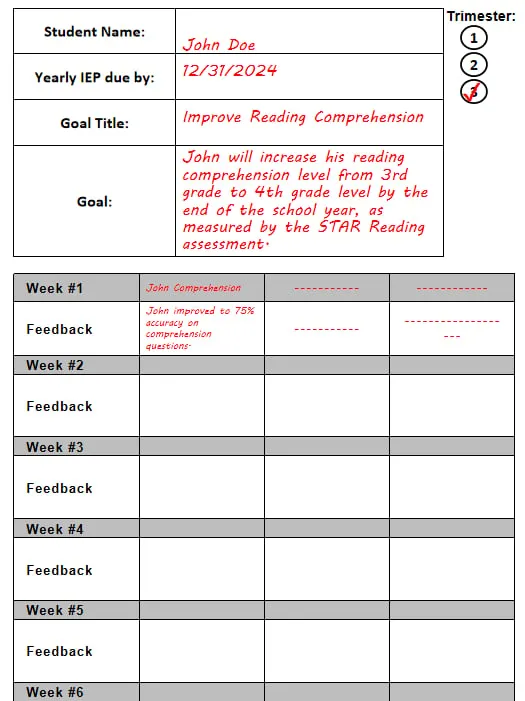
IEP Goal Data Collection Sheet: 13-Week Tracker: a single-goal sheet with header fields for the student and goal, a trimester selector, 13 weekly feedback rows, and one filled-in example.
Sources and scope
- IDEA, U.S. Department of Education: the law behind IEPs, including measurable goals and progress reporting.
- IRIS Center, Vanderbilt University: free modules on progress monitoring and data-based decisions.
- What Works Clearinghouse: reviews of education research and practice guides.
- Understood.org: plain-language articles for families on IEPs and progress reports.
This guide covers practical classroom systems for recording and using IEP goal data. It does not replace your district’s procedures, legal guidance, or the decisions of the IEP team.
Key takeaways
- IEP data collection starts with a goal you can measure.
- Match the method to the goal and keep it the same every week.
- Use one sheet per goal and a fixed weekly time.
- Review the trend every three to four weeks and change one thing at a time.
- Write progress reports from the sheet: baseline, current level, and trend.










Leave a Comment