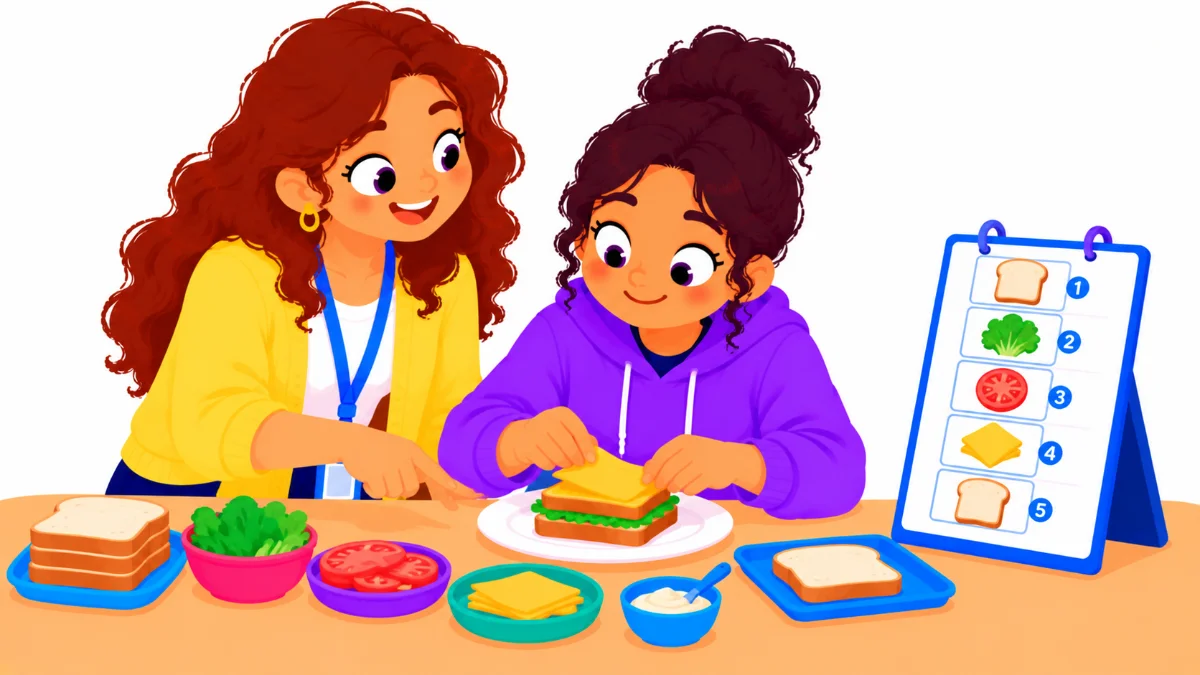

Teaching functional life skills often stalls in a familiar place: a student can make a sandwich during a lesson, but at lunch the next day she waits for an adult to open the bread. The skill was taught, yet it never became part of her day. The fix is rarely a new worksheet. Instead, it is a clear plan that places instruction inside the routines the student already lives.
By the end of this guide, you will be able to choose the right skills, write a task analysis, plan prompts you can fade, embed practice in daily routines, and track progress in a few minutes a week. Examples are fictional. Adapt to the student’s goals and agreed supports. This is guidance, not a diagnosis.
At a glance
- Pick skills the student needs now, in real places, with real materials.
- Break each skill into small, observable steps with a task analysis.
- Plan the least help needed, then fade it on purpose.
- Practice inside existing routines, several times a day, not only in a lesson.
- Record independent steps weekly and review the plan every few weeks.
1. Choose functional life skills that matter right now
First, start with the student’s day, not a skills list. Teaching functional life skills works best when the skill is needed often and in places the student already goes. A skill used once a month is hard to maintain. However, a skill used every morning gets natural practice without extra planning.
Next, walk through one school day with the student’s schedule in hand. For each routine, ask three questions. What does the student already do alone? Where does an adult step in? Which step, if learned, would make the biggest difference to independence or dignity?
Then, check the list against the IEP and the family’s priorities. A parent may care most about packing a backpack, while the IEP targets following a multi-step sequence. Often one routine serves both. As a result, your first targets are practical and agreed.
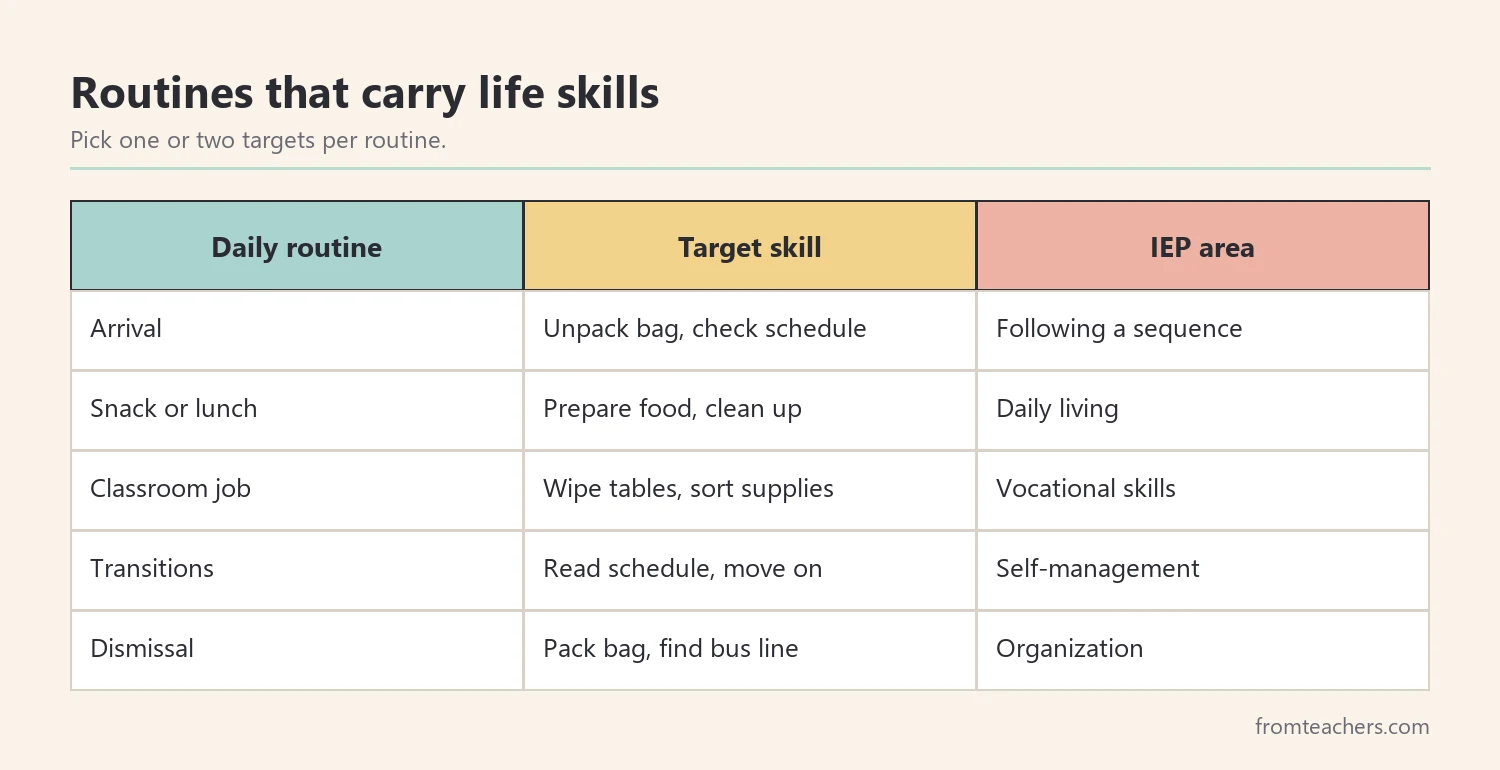
| Daily routine | Possible target skill | IEP area it can support |
|---|---|---|
| Arrival | Unpack bag, hang coat, check schedule | Following a sequence |
| Snack or lunch | Prepare food, open containers, clean up | Daily living |
| Classroom job | Deliver mail, wipe tables, sort supplies | Vocational skills |
| Transitions | Read schedule, move to next area | Self-management |
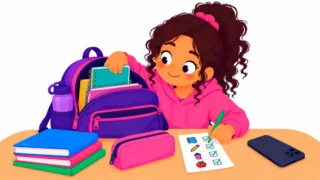
| Dismissal | Pack bag, check list, find bus line | Organization |
Worked example. Lena is a fictional student, age 15, in a self-contained high school class. Her team notices that she waits for help at snack time every day, even though she can name each step. Her family says making a simple lunch at home is their top wish. Therefore, the team picks “prepare a simple sandwich” as the first target, practiced daily at snack.
In short, choose fewer skills and practice them more often. In teaching functional life skills, two well-chosen targets beat ten scattered ones.
2. Break each skill into a task analysis
Next, turn the skill into a list of small steps. A task analysis is simply a written sequence of observable actions, in order. It gives every adult the same script, and it shows exactly where the student needs help. Without it, teaching functional life skills turns into “do the whole thing” or “watch me,” and progress is hard to see.
To write one, do the task yourself and note each action. Then watch a peer do it, because adults often skip steps they no longer notice. Each step should start with a verb and be something you can see: “Place two slices of bread on the plate,” not “Get ready.”
Also, size the steps to the learner. Some students need ten small steps. Others manage with five larger ones. If a student is stuck on one step, split that step further instead of rewriting the whole list.
- Write steps as short actions starting with a verb.
- Keep the order the student will use in the real setting.
- Add a picture or symbol for each step if the student reads images more easily than words.
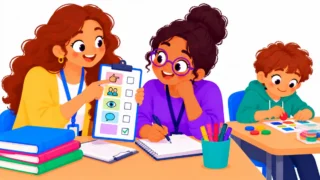
- Share one copy with every adult who supports the routine.
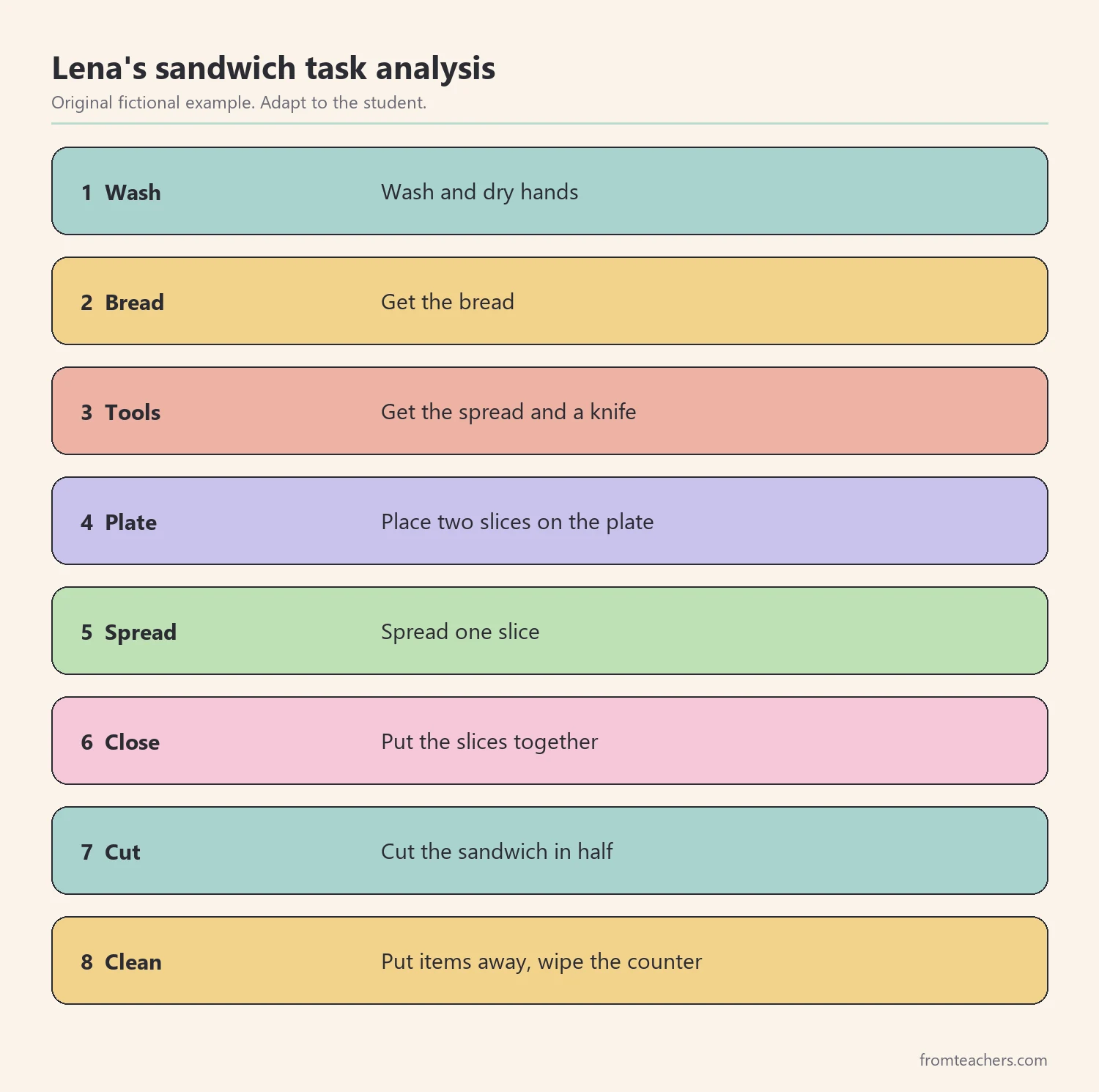
Worked example. Lena’s teacher writes an eight-step task analysis for making a sandwich: wash hands, get the bread, get the spread and a knife, place two slices on a plate, spread one slice, put the slices together, cut the sandwich in half, and clean up. On the first day, Lena completes steps 1 and 2 alone and needs help with the other six. That gives a clear starting line: 2 of 8 steps independent.
Because the list is short and visible, the paraprofessional at snack uses the same steps as the teacher. As a result, Lena hears the same words every day. In short, a task analysis makes teaching functional life skills consistent across adults.
3. Plan prompts for teaching functional life skills, then fade them
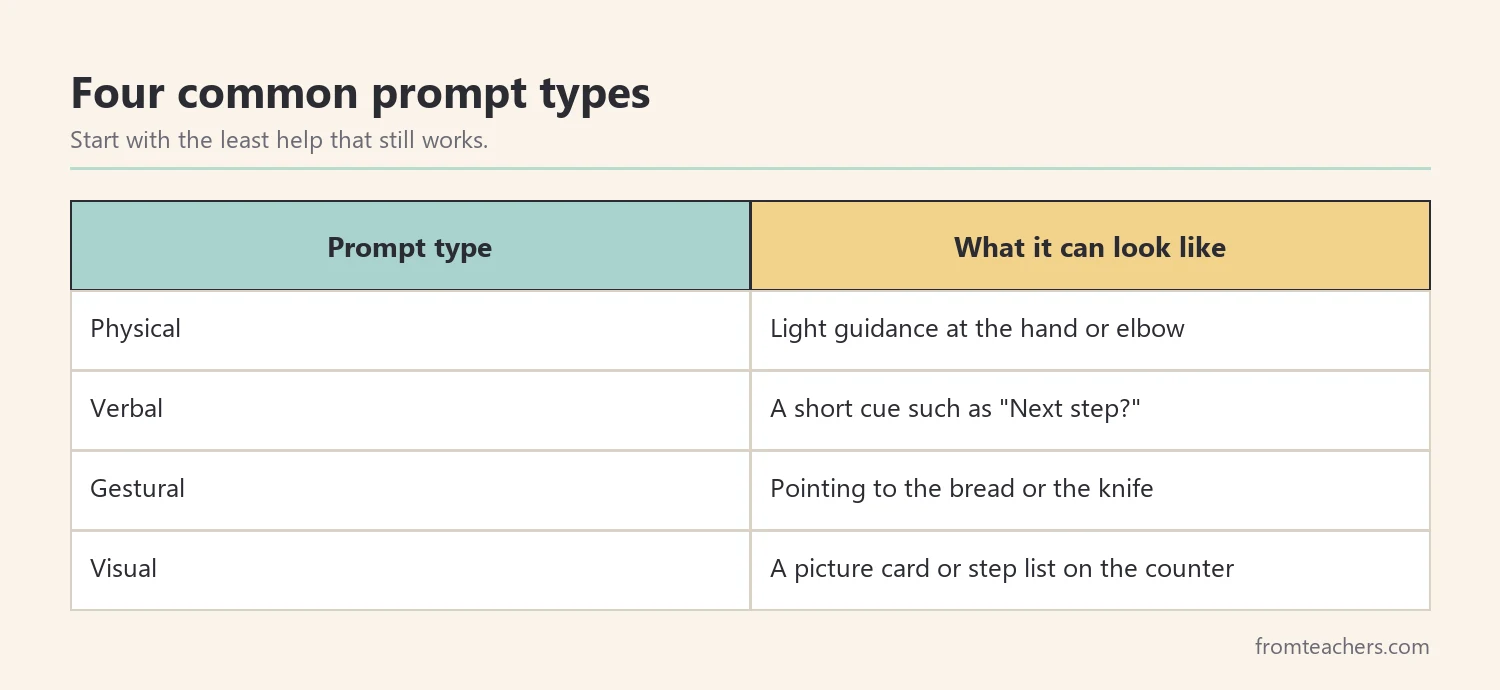
Then, decide how you will help when the student gets stuck. Prompting is a core part of teaching functional life skills. Prompts are the supports adults give so a student can complete a step correctly. Common types include physical, verbal, gestural, and visual prompts. The goal is to give enough help for success, then remove it step by step so the student does not depend on an adult.
A practical rule is to start with the least help that still works for that step. For example, if pointing to the picture is enough, do not take the student’s hand. In addition, wait a few seconds before prompting. That short pause gives the student a chance to start alone.
| Prompt type | What it can look like |
|---|---|
| Physical | Light guidance at the hand or elbow |
| Verbal | A short cue such as “Next step?” |
| Gestural | Pointing to the bread or the knife |
| Visual | A picture card or step list on the counter |
Next, plan the fade before you start. Write down which prompt each step needs now and what you will try next. When the student succeeds with a prompt on most days in a week, try the next lighter support. Above all, avoid repeating verbal reminders, because students can come to wait for the adult’s voice.
Worked example. For Lena, the visual step list stays on the counter for all eight steps. Her paraprofessional uses a gesture for steps 3 to 7 and a light touch only for spreading. After two weeks, the touch is replaced with a gesture. Meanwhile, the step list stays, since it is a support Lena can use for life.
4. Embed practice in daily routines
Now move the skill out of the lesson and into the day. Embedding means practicing at the moment the skill is naturally needed. For example, the student packs a bag at dismissal, not during a pretend packing lesson at 10 a.m. Teaching functional life skills this way multiplies practice without adding a new block to the schedule.
Start by listing every routine where the target skill, or part of it, shows up. Then assign who prompts, which steps they target, and how they record. Classroom jobs, cafeteria routines, and small vocational tasks are rich places for practice because they repeat daily and have a clear purpose.
Also, treat transitions as teachable skills. Moving between areas, handling a substitute day, or adjusting to a fire drill all involve planning and flexibility. A short preview, a visual schedule, and a practiced script help students handle change with less stress. If you want a ready structure for this, the transition and life skills guide for special education teachers includes example transition scenarios and a chart linking routines to target skills.
- Practice at the real time and place the skill is needed.
- Use the same task analysis in every routine.
- Give each adult one clear role.
- Keep extra practice short and purposeful.
- Celebrate small gains, because teaching functional life skills is a long game.
Worked example. Lena now practices sandwich steps at snack each day. In addition, she spreads crackers during a class cooking activity once a week and cleans up after lunch. Her classroom job, wiping the snack table, gives her daily practice with step 8. As a result, she practices parts of the skill several times a day.
In short, the routine becomes the lesson. Consequently, students learn the skill where they will actually use it.
5. Plan for generalization across people, settings, and materials
Next, plan for the skill to work outside one room with one adult. Generalization means the student can use the skill with different people, in different places, and with different materials. Teaching functional life skills is not finished until this happens, because adult life rarely looks like the classroom.
Change one thing at a time, which keeps teaching functional life skills easy to troubleshoot. First, change the person: another staff member runs the routine. Then change the setting: the school kitchen, a family kitchen, or a community space. Finally, change the materials: a different bread, a squeeze bottle instead of a jar, a new plate.
| Dimension | Change to try | What to watch |
|---|---|---|
| People | A different adult leads | Does the student wait for the usual adult? |
| Settings | Another room or home kitchen | Does the order of steps hold? |
| Materials | New container or tool | Which step breaks down? |
When a step breaks down, return to more support for that step only. Then fade again. In addition, ask the family to try the same task analysis at home. Even a few home practices each week strengthen the skill.
Worked example. After four weeks, Lena makes her sandwich with a different paraprofessional. She completes all steps except opening a new jar of spread, which uses a twist lid she has not seen. The team adds a short practice with that lid. Meanwhile, her family uses the printed step list at home on weekends.
6. Record progress in teaching functional life skills and review
Finally, collect simple data and use it. The easiest measure is the number of task analysis steps completed independently. Record it a few times a week, then look at the weekly pattern. A clear number tells you when to fade prompts, when to add practice, and when to move to a new skill.
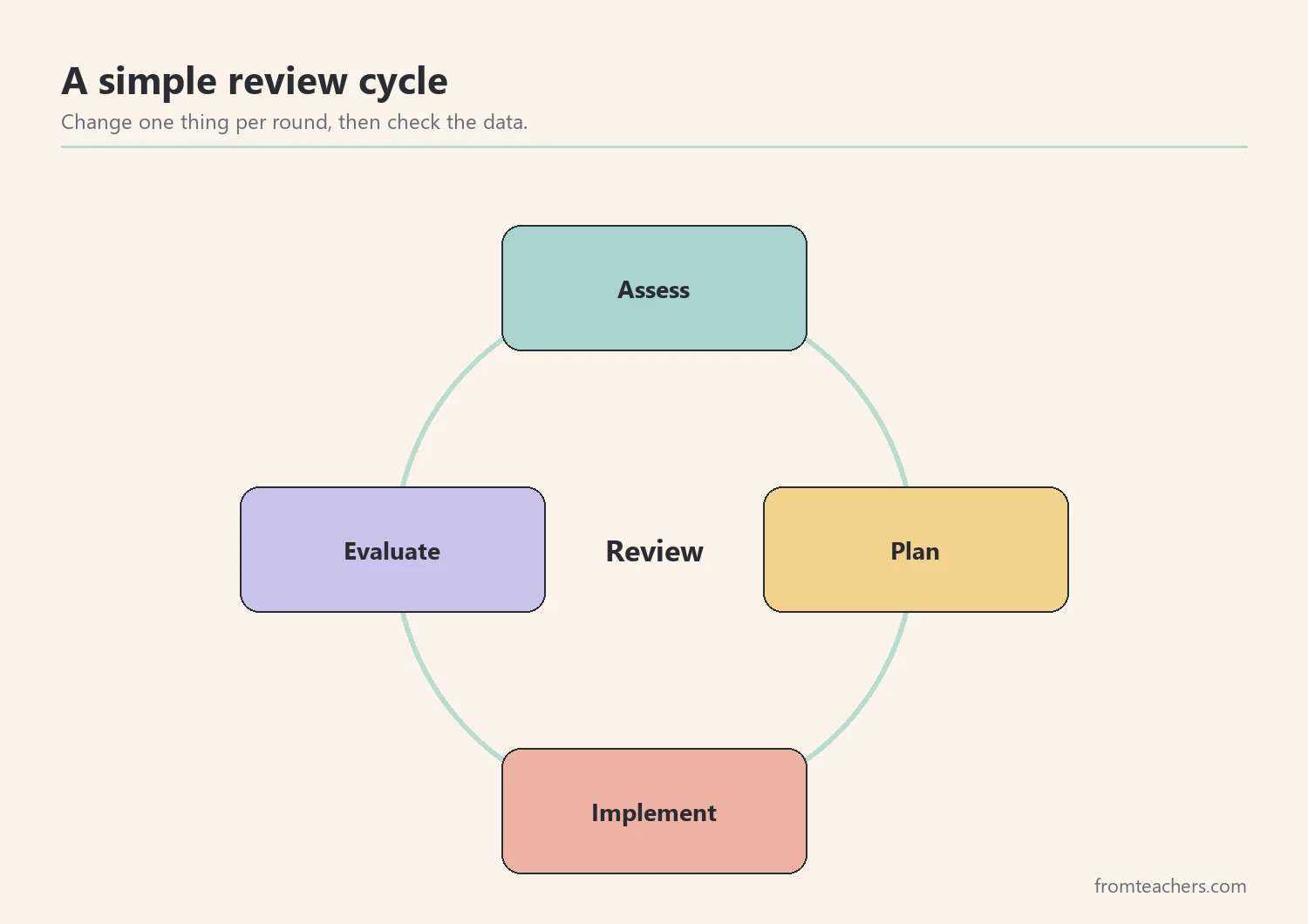
Use a short review cycle: assess where the student is, plan the next change, implement it consistently, and evaluate the results. Then repeat. This keeps teaching functional life skills focused on one change at a time, so you can see what helped.
| Week | Steps done alone (of 8) | Change made |
|---|---|---|
| 1 | 2 | Task analysis introduced |
| 2 | 3 | Wait time added before prompts |
| 3 | 5 | Touch prompt replaced with gesture |
| 4 | 6 | New adult runs snack routine |
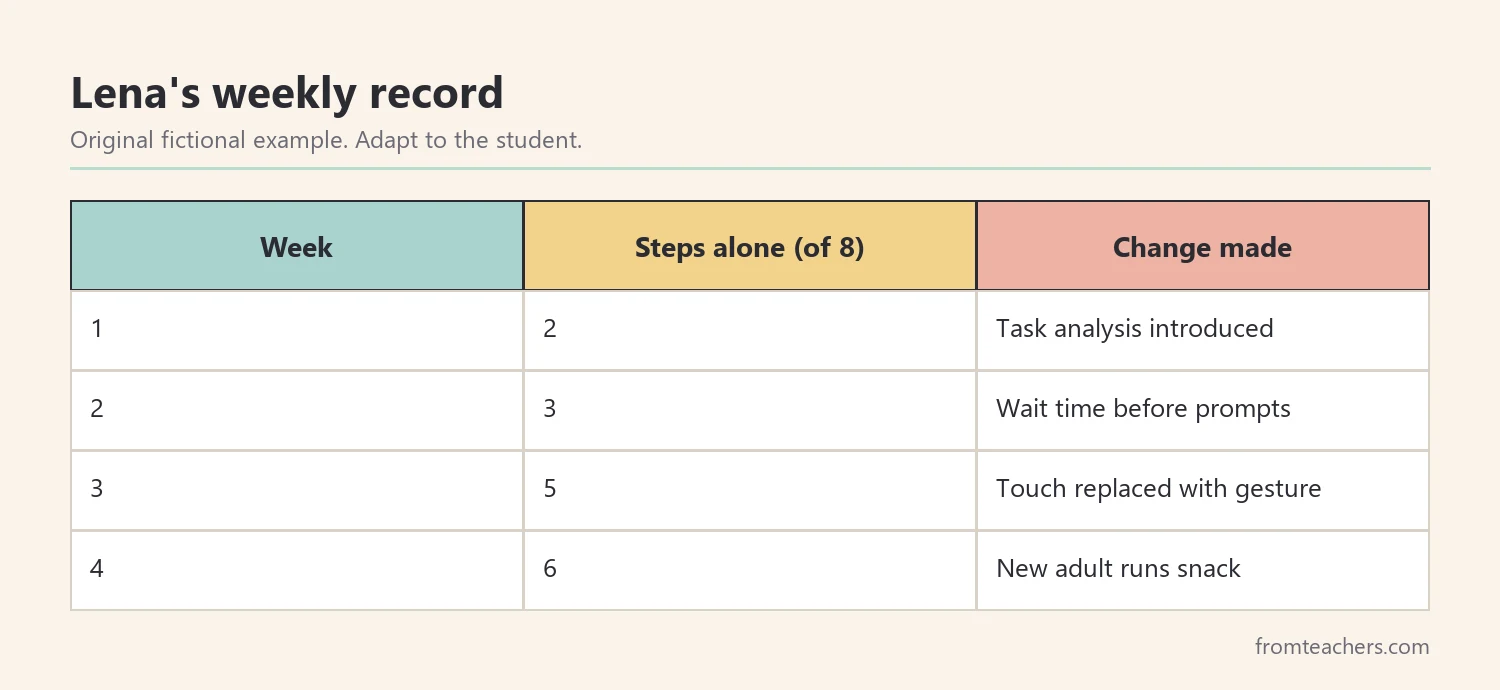
Worked example. Lena’s independent steps rise from 2 to 6 of 8 over four weeks. The two remaining steps are spreading and cutting, both fine motor steps. Therefore, the team adds a short daily practice with a soft spread and a safety knife. They will review again in three weeks and share the chart with her family.
Common mistakes and how to avoid them
Most problems in teaching functional life skills come from a few predictable habits. Fortunately, each one has a simple fix.
- Teaching skills only in isolated lessons. Fix: practice at the real time and place the skill is needed.
- Vague steps such as “make lunch.” Fix: write a task analysis with short, observable actions.
- Prompting too much or too fast. Fix: pause a few seconds, then give the least help that works.
- Never fading support. Fix: plan the fade in writing before teaching starts.
- Stopping when it works in one room. Fix: change people, settings, and materials one at a time.
- Collecting data nobody reads. Fix: review the weekly numbers and make one decision each time.
Questions teachers and parents ask about teaching functional life skills
Which skills should come first?
When teaching functional life skills, start with skills the student needs every day and that the family values. Daily use gives natural practice. In addition, early wins in a frequent routine build confidence for harder skills.
How long should practice last each day?
Short and frequent works well for teaching functional life skills. A few minutes inside each natural routine often adds up to more practice than one long lesson. However, follow the student’s IEP and your team’s plan.
What if the student does well at school but not at home?
That is a generalization gap, and it is common in teaching functional life skills. Send home the same step list and the same words you use at school. Then ask the family which step breaks down so you can practice it at school.
Is teaching functional life skills only for older students?
No. Younger students can work on hanging a coat, opening lunch containers, or following a picture schedule. The skills grow with the student, from simple routines toward cooking, shopping, and work tasks.
How do I know when to move to a new skill?
Move on when the student completes the steps alone across several days, with different adults and materials. Keep a light maintenance check, such as one observation every few weeks, so the skill stays strong.
Related reading: Navigating the Path to Adulthood: Building Essential Life Skills, Building Workplace Readiness: Essential Skills for Career Success, and The Power of Data Tracking in Special Education.
A companion resource for teaching functional life skills:
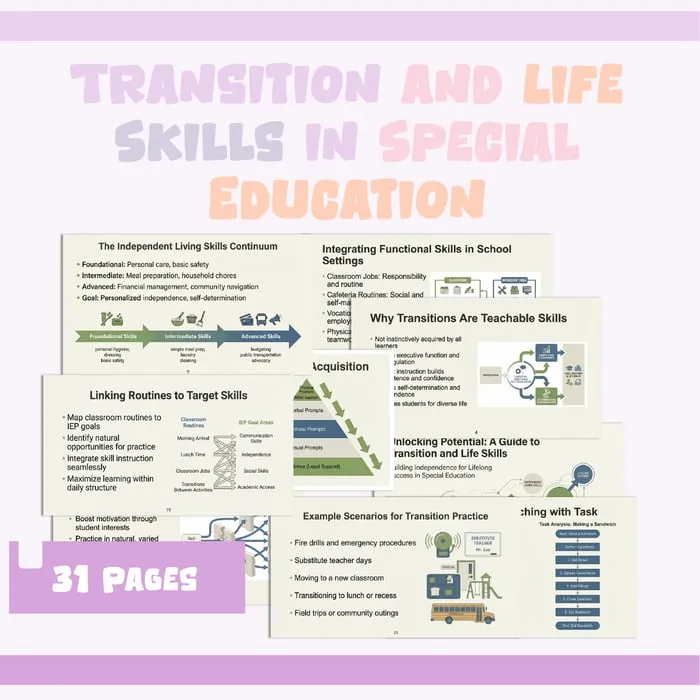
Unlocking Potential: A Guide to Transition and Life Skills: a classroom-ready framework with an independent living skills continuum, a chart linking routines to target skills, a prompting hierarchy, task analysis examples, transition scenarios, and a generalization planning flowchart.
Sources and scope
- IRIS Center, Vanderbilt University: free modules on evidence-based practices, including systematic instruction and prompting.
- IDEA, U.S. Department of Education: the law behind IEPs and transition services for students with disabilities.
- Understood.org: practical articles for families and teachers on learning differences and independence.
- What Works Clearinghouse: reviews of education research and practice guides.
This guide covers teaching functional life skills through classroom and home routines. It does not replace evaluation, therapy, or the decisions of the student’s IEP team.
Key takeaways
- Teaching functional life skills starts with the student’s real day and the family’s priorities.
- A task analysis gives every adult the same clear steps.
- Use the least prompt that works, and plan how to fade it.
- Practice inside routines, then generalize across people, places, and materials.
- Track independent steps weekly and change one thing at a time.






Leave a Comment