

An ABC behavior data sheet is one of the simplest tools a teacher can use to understand why a challenging behavior keeps happening. Instead of guessing, you write down what happened right before the behavior, the behavior itself, and what happened right after. Over a week or two, patterns start to appear that were invisible in the rush of a school day.
This guide walks you through how ABC recording works, how to fill it in quickly, and how to turn your notes into a plan. It is written for teachers, behavior specialists, and parents who want clear answers instead of more frustration.
What Is an ABC Behavior Data Sheet?
ABC stands for Antecedent, Behavior, and Consequence. First, the antecedent is what happened just before the behavior. Next, the behavior is what the student actually did, described in observable terms. Finally, the consequence is what happened immediately afterward.
Because the form captures all three pieces at once, it shows the context around a behavior. As a result, it is often the first step in a functional behavior assessment (FBA). It also helps teams talk about facts rather than feelings.
Why ABC Recording Matters for Behavior Support
Every behavior serves a purpose for the student. For example, a child may tear up a worksheet to escape a hard task, or call out to get adult attention. However, the same behavior can serve different purposes for different children.
ABC data helps you find that purpose, often called the function. In addition, it protects students from plans built on assumptions. The Individuals with Disabilities Education Act (IDEA) expects teams to consider positive behavioral supports, and good data makes those supports far more effective.
How to Fill In an ABC Behavior Data Sheet
The most useful entries are short, specific, and written as soon as possible. Here is a simple routine that works in a busy classroom.
Step 1: Define the Target Behavior
Write one clear definition before you start. For example, “leaves seat without permission during independent work” is better than “off task.” Also, make sure every adult uses the same definition.
Step 2: Record the Antecedent
Note the setting, the activity, who was nearby, and what was asked. Small details matter. A transition, a new adult, or a noisy hallway can all be triggers.
Step 3: Describe the Behavior
Write only what you saw or heard. Avoid labels like “defiant” or “lazy.” Instead, describe actions: “pushed materials off desk and put head down.”
Step 4: Record the Consequence
Next, write what happened right after. Did the student get sent to the hallway? Did peers laugh? Did the task go away? These details often reveal the function.
Spotting Patterns in Your ABC Data
After five to ten entries, look across the rows. First, check whether the behavior clusters at certain times of day or during specific subjects. Then, look for repeated antecedents such as written tasks, group work, or waiting.
Next, look at consequences. If the behavior usually ends with the student leaving the room, escape may be the function. On the other hand, if it usually ends with adult attention, attention may be what the student is seeking. As a result, your intervention can target the real need.
- Escape or avoidance: demands are removed or delayed after the behavior.
- Attention: adults or peers respond quickly and strongly.
- Access to items: the student gains a preferred object or activity.
- Sensory: the behavior happens across settings regardless of what others do.
Common Mistakes With an ABC Behavior Data Sheet
Even experienced staff fall into a few traps. Because ABC forms are simple, it is easy to rush them.
- Writing hours later: memory fades quickly, so details get lost or changed.
- Using opinions: words like “angry” or “manipulative” are interpretations, not data.
- Too few entries: one or two incidents rarely show a reliable pattern.
- Skipping good moments: also note times the behavior did not happen, because they show what works.
Turning ABC Data Into a Behavior Plan
Once you have a likely function, you can plan supports. For example, if a student escapes hard writing tasks, you might break tasks into smaller chunks and teach a “break please” card. That way, the student gets the same need met in a safer way.
In addition, change the antecedents you can control. Preview transitions, adjust seating, or offer choices. Finally, keep collecting data so you can see whether the plan is working. If you are deciding between support types, our guide on accommodations vs modifications can help.
If you want a ready-made form that guides observers through each column, the printable ABC recording form for FBA observations saves time and keeps every staff member consistent.
Keeping ABC Data Collection Manageable
Busy teachers worry that data takes too much time. However, a few habits keep it simple. First, keep forms on a clipboard in a fixed spot. Next, use short codes for common antecedents, such as “T” for transition. Finally, agree on who records data during each part of the day so the work is shared.
Frequently Asked Questions
How many ABC entries do I need before an FBA?
Most teams aim for at least five to ten recorded incidents across different days. More data across settings gives a clearer picture of the function.
Can parents use ABC recording at home?
Yes. Parents can use the same three columns for behaviors at home. Sharing home and school data helps the whole team see patterns.
Who should fill in the ABC form?
Anyone who directly observes the behavior can complete it. However, all observers should agree on the behavior definition first.
Ready-to-use resource:
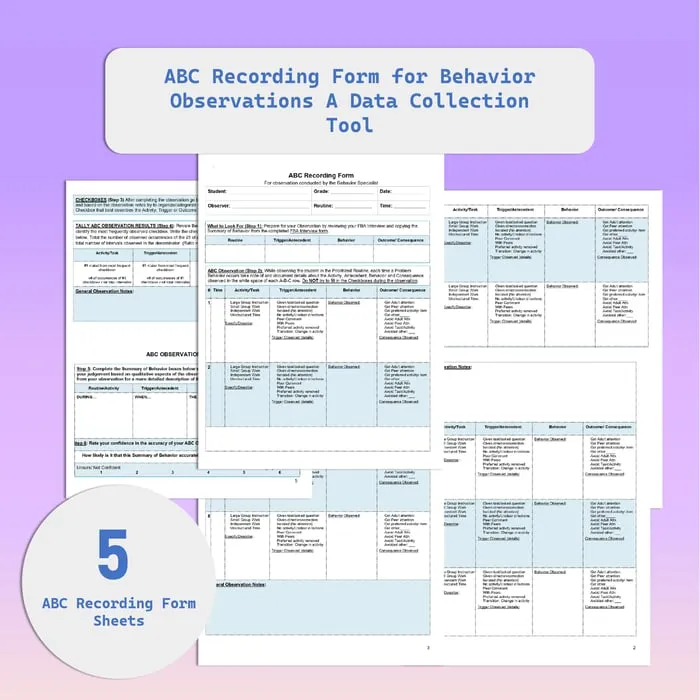
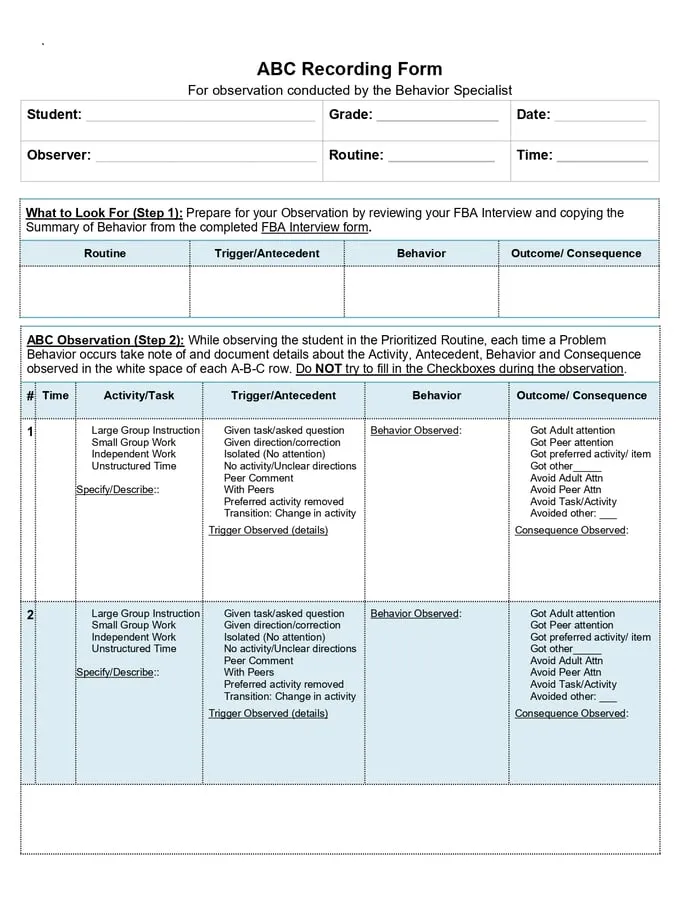
ABC Behavior Recording Form: FBA Antecedent-Behavior-Consequence Data Sheet: Turn classroom observations into clear antecedent-behavior-consequence data that reveals what is driving a student’s behavior.
Related reading: Positive alternatives to behavior charts and the power of data tracking in special education.
Also on FromTeachers:
Key Takeaways
- An ABC behavior data sheet records the antecedent, behavior, and consequence of each incident.
- Write entries right away, using observable facts instead of labels.
- Patterns across many entries point to the function of the behavior.
- Use the function to teach a replacement skill and adjust triggers.









Leave a Comment