

The signs of special education teacher overload are often hiding in plain sight. Picture a principal walking past a resource room at 4:45 p.m. The lights are on, the teacher is typing progress notes, and a stack of IEP folders sits on the desk. She smiles and says “I’m fine, just catching up.” The principal moves on. Three months later, she asks about a transfer.
This list is written for principals, assistant principals and district leaders. It covers seven signs that a special educator’s workload has outgrown the schedule, ordered by how quickly you can check each one. For each sign, you will find what it looks like, why it matters, where to look, and one practical response.
Examples are fictional. Adapt them to your school, your contracts and local rules. This is guidance, not legal or HR advice.
At a glance
- Overload rarely announces itself; it shows up in schedules, paperwork and email times.
- Lost planning periods are the earliest and easiest sign to check.
- Compare caseload tasks with protected planning minutes, not just student counts.
- Ask the teacher before assuming: a short, private check-in works better than a survey.
- Respond with schedule changes, not only appreciation.
Why these signs matter
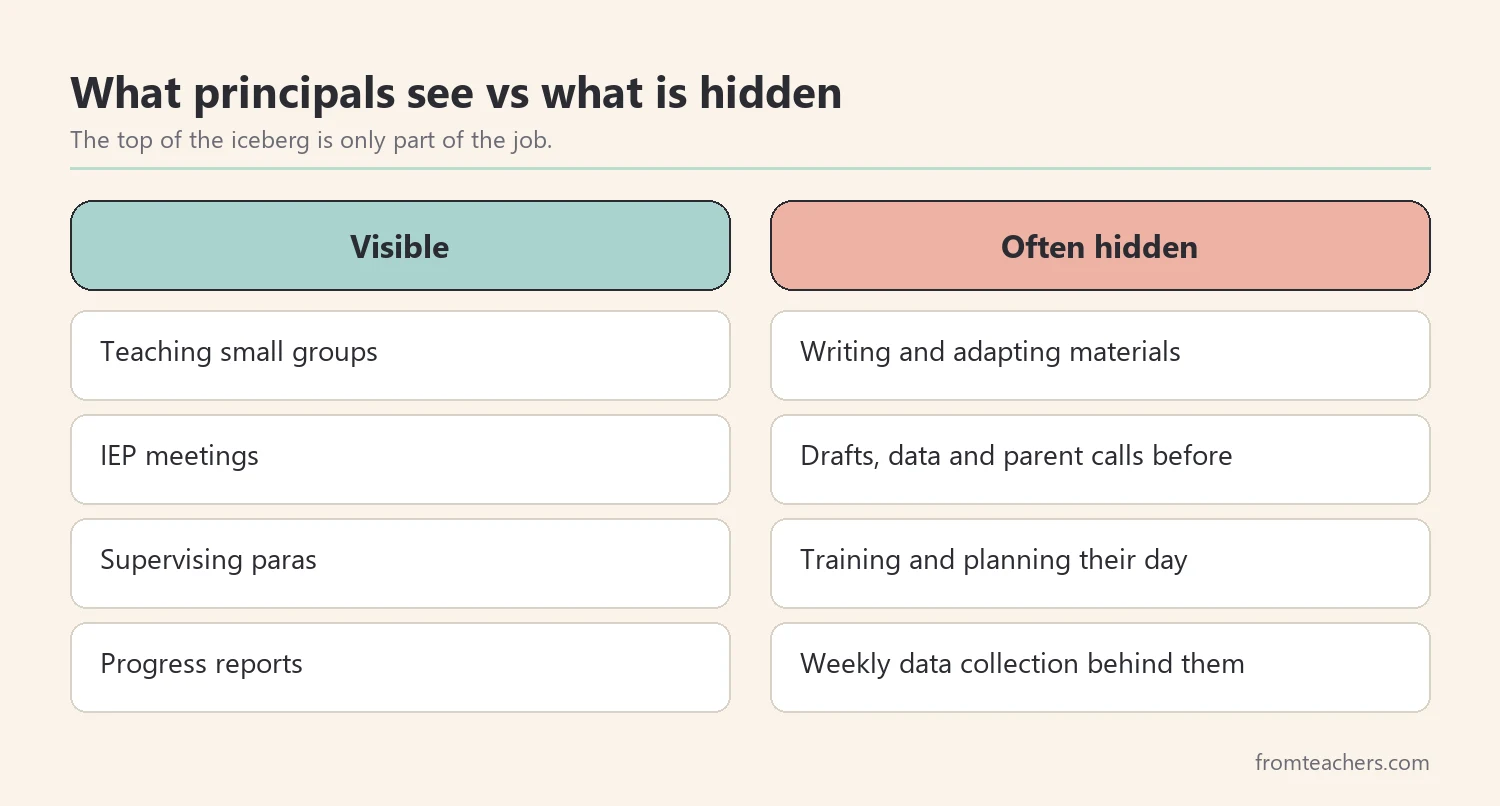
Special education teachers carry two jobs at once: teaching and case management. Beyond lessons, they write IEPs, collect progress data, coordinate services, train paraprofessionals and talk with families. Much of this work does not appear on a master schedule.
National organizations such as the Council for Exceptional Children and the CEEDAR Center have long described special education staffing shortages and the role of working conditions in retention. Therefore, noticing overload early is not only kind; it protects services for students with IEPs.
Throughout this list, you will follow Ms. Rivera, a fictional K to 5 resource teacher with a caseload of 22 students, and her principal, Mr. Okafor.
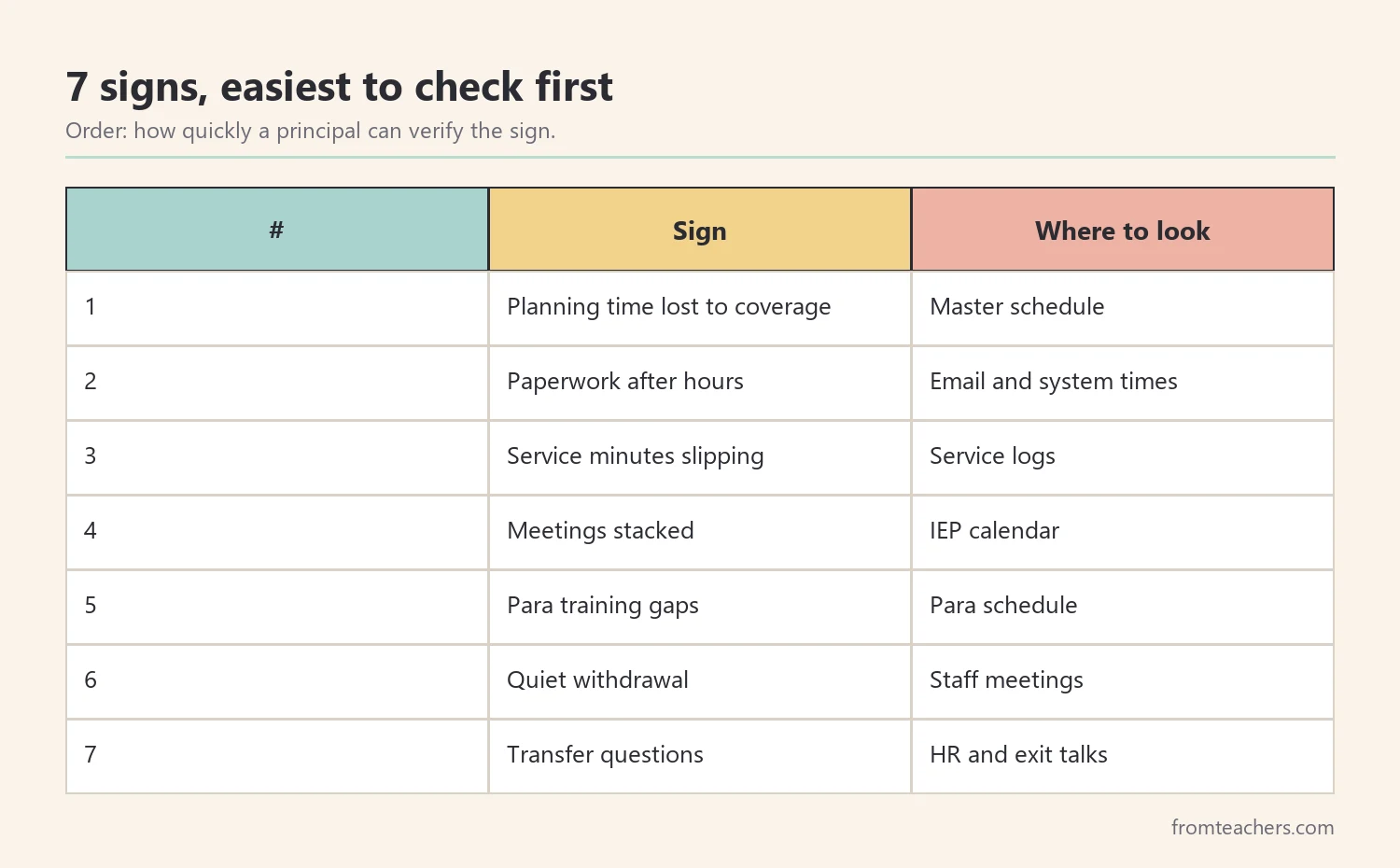
1. Planning time keeps disappearing into coverage
What it looks like: the special educator’s planning period is regularly used for lunch duty, substitute coverage or emergency meetings.
Why it matters: planning time is when special educators adapt materials, analyze data and prepare IEP drafts. When it vanishes, that work moves to evenings or does not happen.
Where to look: compare the master schedule with coverage requests for the last month. Count how many planning periods were actually free.
Example: Mr. Okafor checked Ms. Rivera’s week. She had five 45-minute planning blocks scheduled but used only 75 of 225 minutes for planning.
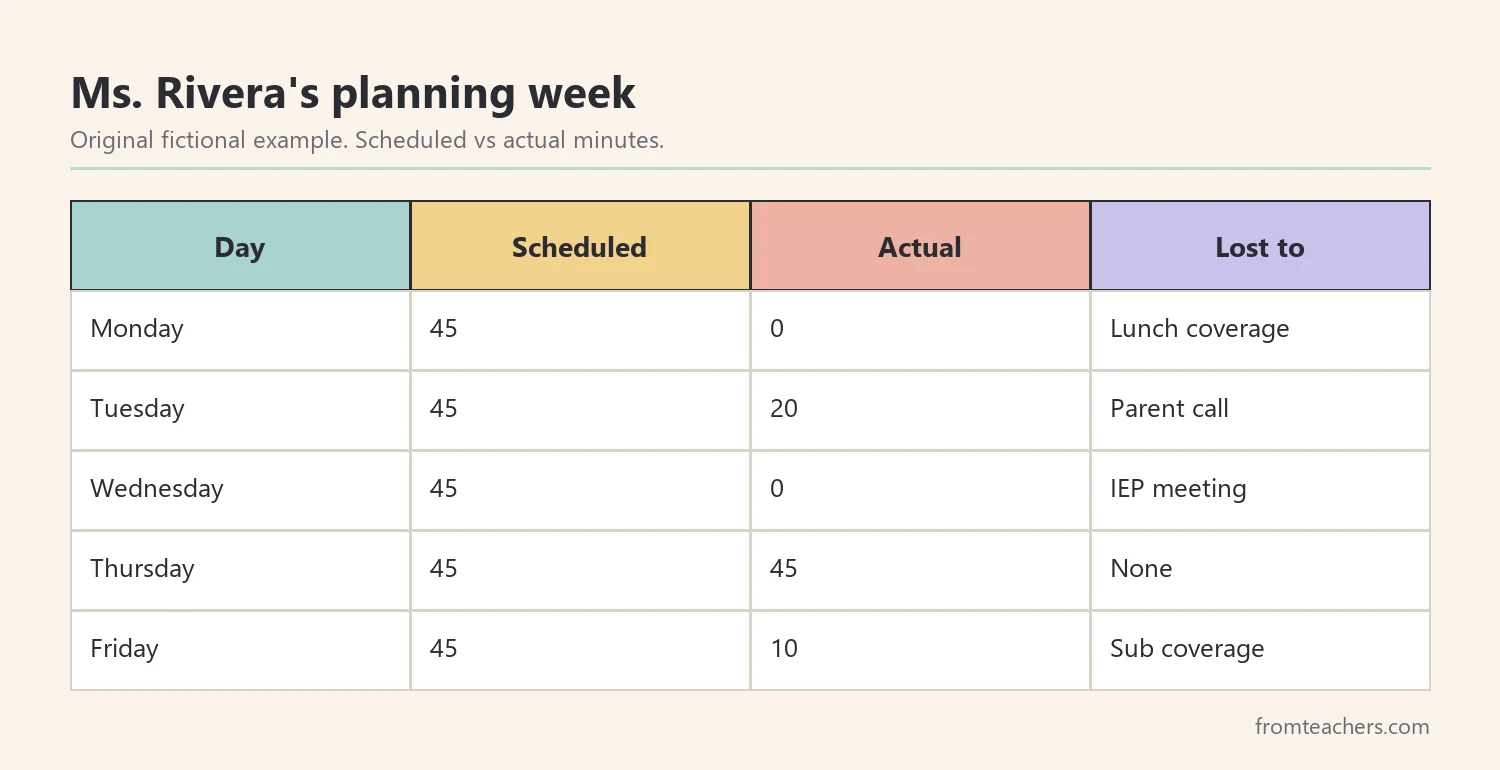
Response: protect at least some planning blocks from coverage, for example by placing special educators last on the coverage list. The Unseen Workload guide on why special education teachers lack planning time includes a caseload versus planning comparison and a coverage and service minutes flowchart you can use in that conversation.
2. Paperwork is done after hours
What it looks like: IEP drafts, progress reports and emails are sent late at night or on weekends.
Why it matters: after-hours paperwork is one of the clearest warning signs a workload has outgrown the day. Over time, it drains energy and leaves less patience for the school day.
Where to look: notice the timestamps on emails and IEP system entries. Avoid surveillance; you are looking for patterns, not policing.
Example: most of Ms. Rivera’s IEP drafts were saved after 8 p.m. She had never mentioned it, because she assumed it was part of the job.
Response: offer protected paperwork time during IEP season, such as a half-day with substitute coverage once a quarter.
3. Service minutes start slipping
What it looks like: students receive fewer minutes of specialized instruction than their IEPs list, or sessions are often shortened.
Why it matters: under IDEA, schools must provide the services written in each IEP. Missed minutes are a compliance problem and a learning problem.
Where to look: service logs or schedules compared with IEP service pages.
Example: Ms. Rivera’s reading group was cut short twice a week because she was pulled to cover a class.
Response: treat service minutes as fixed blocks that are not used for coverage. If the schedule cannot hold them, that is a staffing question for the district.
4. IEP meetings are stacked back to back
What it looks like: several IEP meetings in one week, often during planning time or before school.
Why it matters: each meeting needs preparation: data, drafts, invitations and follow-up. Stacking them multiplies the hidden work.
Where to look: the IEP meeting calendar for the past two months.
Example: in April, Ms. Rivera had four annual reviews in one week, plus one reevaluation meeting.
Response: spread annual review dates across the year when possible, and agree on a weekly meeting limit with the case manager.
5. Paraprofessionals do not have a clear plan
What it looks like: paraprofessionals wait for instructions, or the special educator spends breaks explaining the next task.
Why it matters: supervising and training paras is real work. Without time to plan it, the teacher becomes a constant dispatcher.
Where to look: ask the para, kindly, “How do you know what to do each day?”
Example: Ms. Rivera’s para said, “I usually ask her in the hallway.” Both of them felt rushed.
Response: schedule a short weekly planning meeting between the teacher and paras during paid time.
6. The teacher goes quiet
What it looks like: a usually active teacher stops speaking at staff meetings, skips optional events, or answers “fine” to everything.
Why it matters: withdrawal is a human sign, not a data point, and it is easy to miss. It can mean exhaustion or a feeling that speaking up does not change anything.
Where to look: your own notes from meetings and informal conversations.
Response: hold a private, unhurried check-in. Ask one open question: “What part of your week takes the most time that I might not see?”
7. Questions about transfers or other roles
What it looks like: the teacher asks HR about general education openings, district roles, or other schools.
Why it matters: by this point, overload may already be affecting the decision to stay. However, it is not too late to listen.
Where to look: conversations with HR and, when someone leaves, exit interviews.
Example: when Mr. Okafor finally asked Ms. Rivera directly, she listed lost planning time and stacked meetings as her two biggest problems. Neither was about students.
Response: ask what would make staying realistic, then commit to one concrete change and a date to review it.
How to start the check-in conversation
Many principals know something is wrong but are unsure how to raise it without sounding critical. A short, private meeting with a clear purpose usually works best. Hold it during the school day, not as an add-on after dismissal.
First, name your intention: “I want to make sure your schedule matches the work you actually do.” Next, share what you noticed, using facts rather than judgments, such as “Your planning period was used for coverage on six days this month.” Then ask, and listen more than you talk.
These open questions often help:
- “What takes the most time in your week that I might not see?”
- “Which task would you most like protected time for?”
- “What is one change that would make next month easier?”
- “Is there anything about IEP meetings or para support that we should plan differently?”
Finally, end with one agreed action and a review date. Write it down and share it with the teacher by email the same day. That simple record shows the conversation was not just a formality.
In Ms. Rivera’s case, the most useful question was the first one. She described the hours spent rewriting reading passages for three different levels, which never appeared on any schedule. As a result, Mr. Okafor began asking the same question in every special educator’s mid-year check-in.
What changed for Ms. Rivera
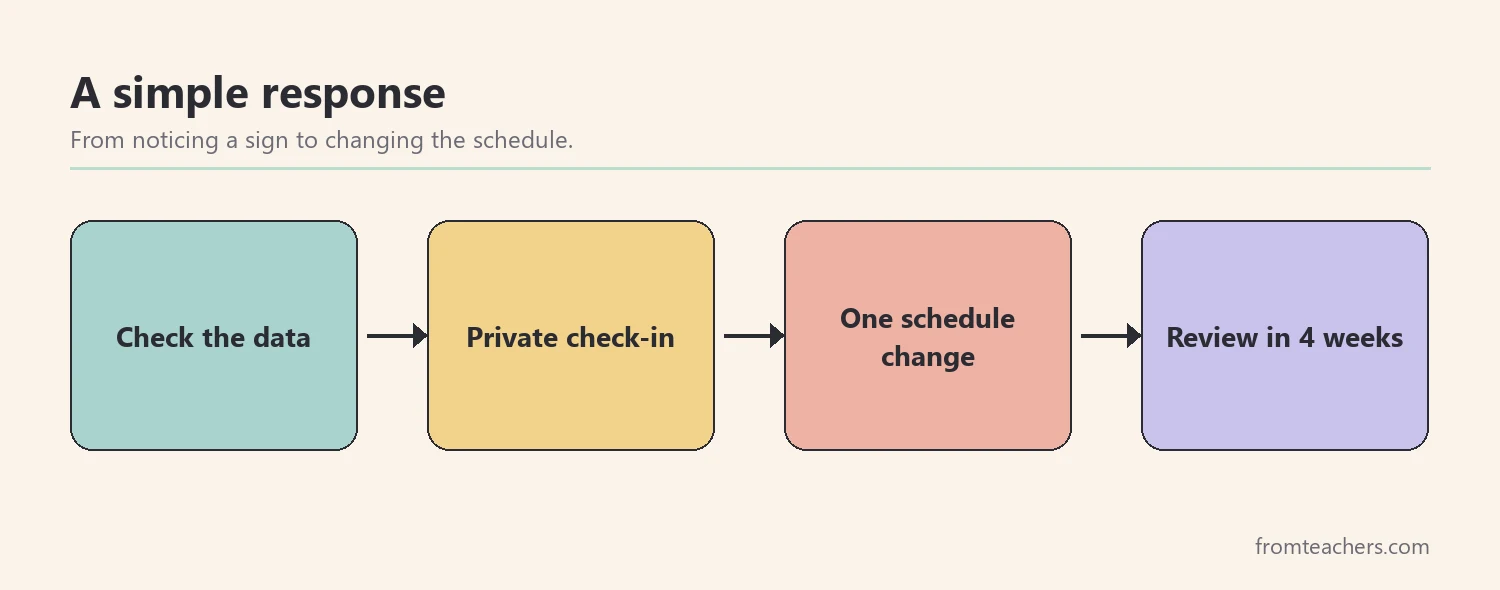
Mr. Okafor did not fix everything at once. Instead, he made two changes. First, he took Ms. Rivera off the regular coverage list for three of her five planning blocks. Second, he and the case manager agreed to a limit of two IEP meetings per week, except in emergencies.
After four weeks, they met again. Ms. Rivera reported fewer late nights and more time to train her para. She still had a full caseload. However, the schedule now matched more of the real work.
The lesson is simple: noticing the signs of special education teacher overload only helps when it leads to a schedule change, even a small one.
Comparing typical responses
| Response | Effort | Effect on workload |
|---|---|---|
| Thank-you notes and treats | Low | Kind, but no time freed |
| Protect planning from coverage | Medium | Direct time back |
| Limit IEP meetings per week | Medium | Spreads preparation work |
| Quarterly paperwork half-day | Medium | Moves work into the school day |
| Review caseload size with district | High | Long-term change |
Appreciation still matters. Nevertheless, teachers notice when appreciation replaces practical changes.
Common mistakes and how to avoid them
- Judging workload by student count only: include IEP meetings, evaluations and para supervision.
- Waiting for complaints: many special educators will not complain; check the schedule yourself.
- Running an anonymous survey and stopping there: follow it with individual conversations and one change.
- Using special educators as default coverage: place them last on the coverage list.
- Promising everything: commit to one or two changes you can actually keep.
Questions administrators ask about signs of special education teacher overload
How is overload different from a normal busy season?
Busy seasons, such as IEP season, end. Overload continues week after week, and the teacher has no protected time to recover. Look for patterns over a month or more.
Should I compare special educators with general education teachers?
Their roles differ. Special educators often teach several grade levels and also manage compliance tasks. Compare their actual tasks with their scheduled time instead.
What if the district sets caseloads, not me?
You can still protect planning time, spread meetings and support paras. Additionally, documented data on lost planning minutes helps when you ask the district for staffing changes.
Is it appropriate to look at email timestamps?
Use them only to notice general patterns, and say so openly. The goal is support, not monitoring. A direct conversation is always better than assumptions.
How often should I check?
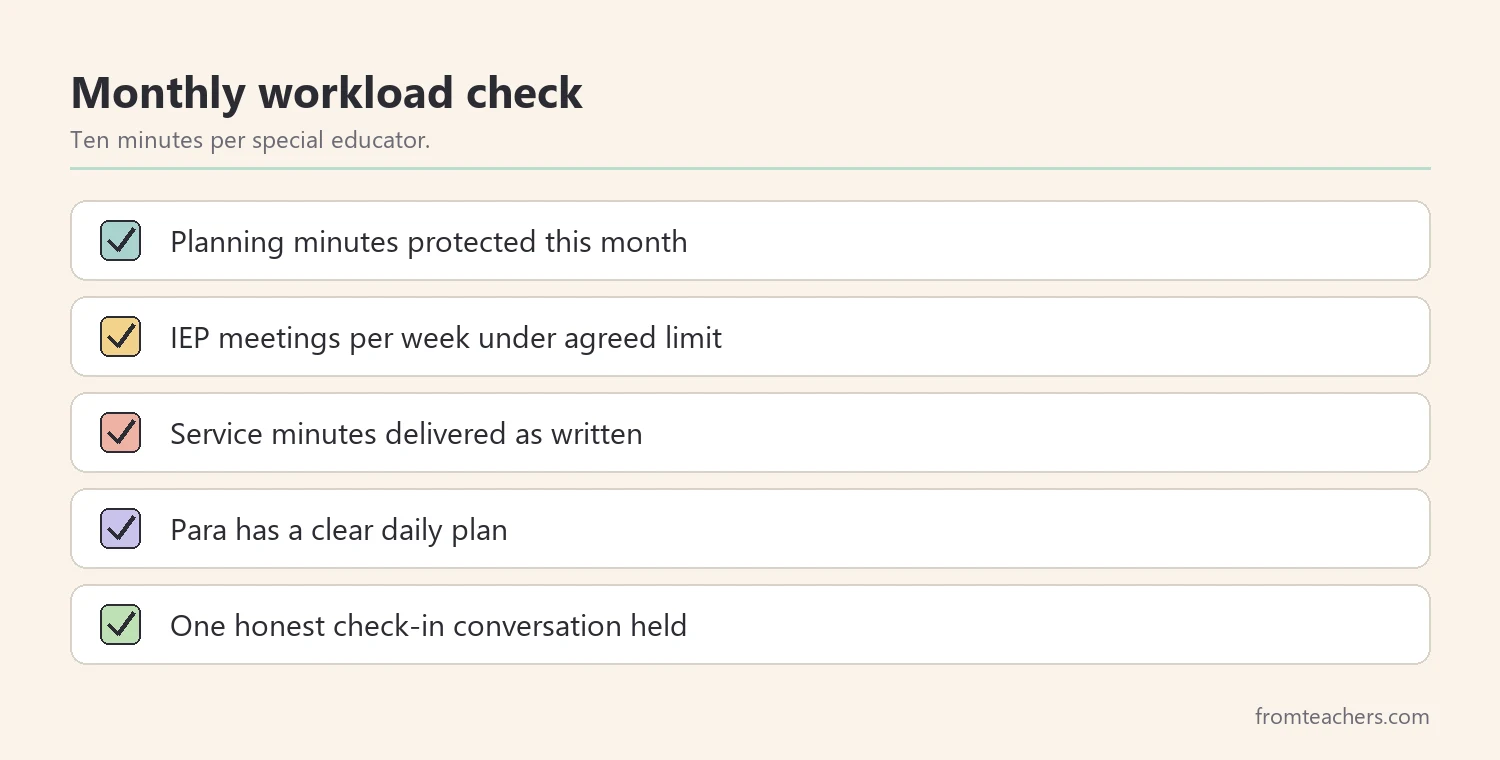
A short monthly check works for most schools, with extra attention during IEP season and the first weeks of the year.
Related reading: addressing challenges in special education, the crucial role of special educators.
A companion resource for signs of special education teacher overload:
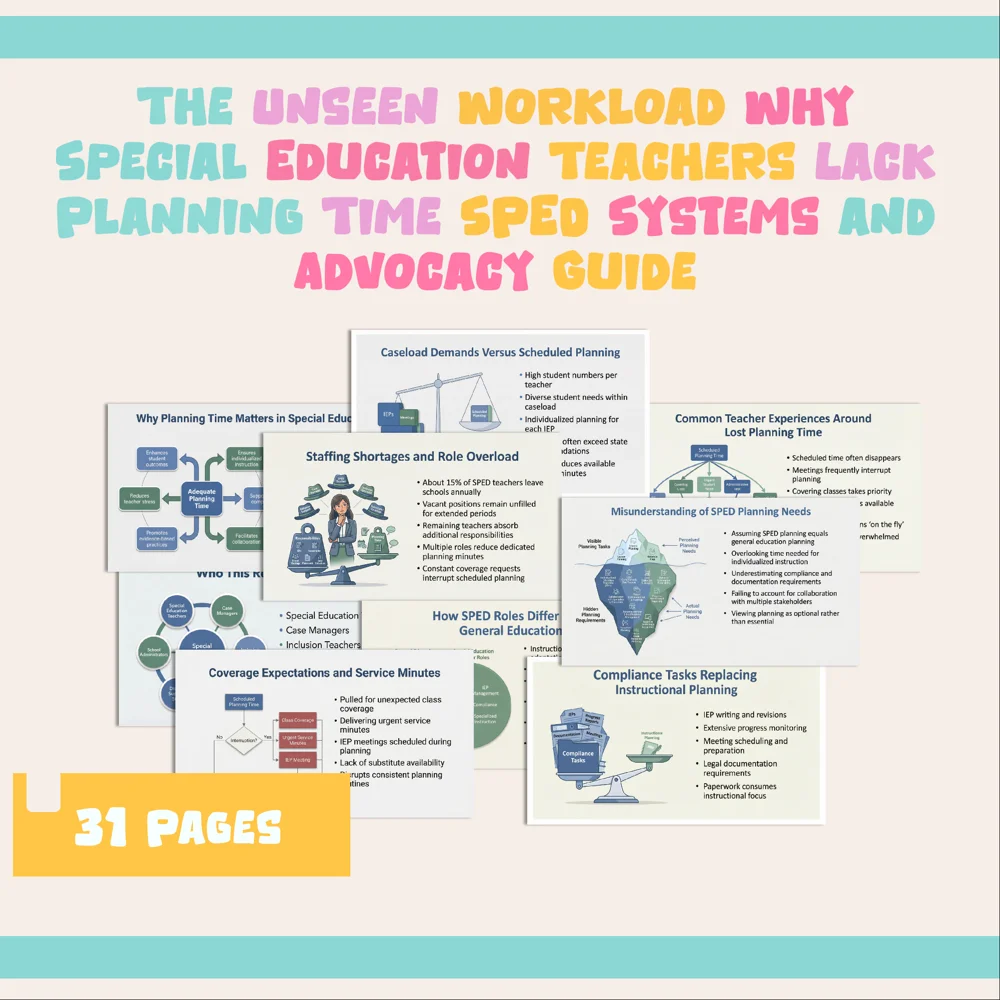
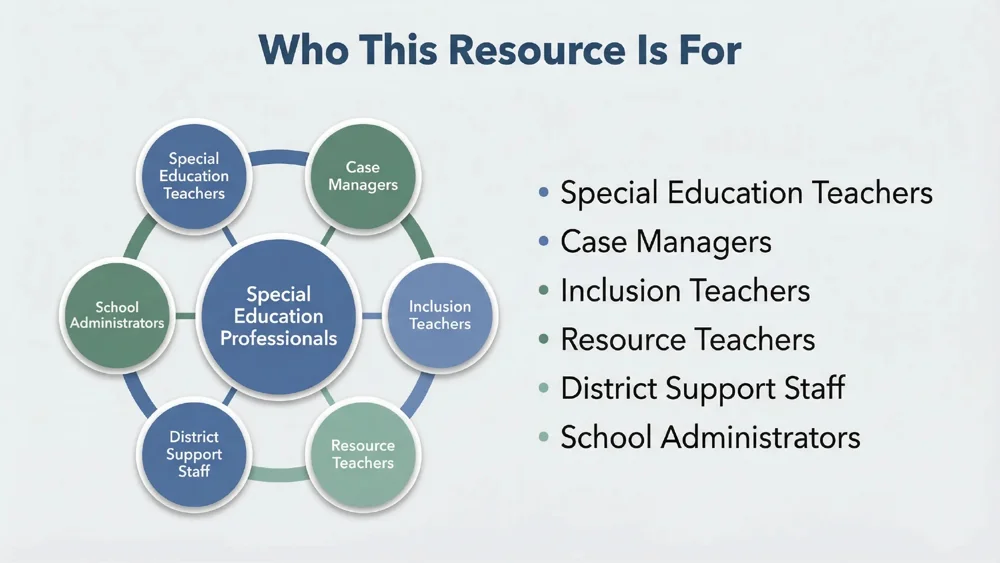
The Unseen Workload: Why Special Education Teachers Lack Planning Time: a SPED systems and advocacy guide with a Caseload Demands Versus Scheduled Planning comparison, data on staffing shortages and role overload, an iceberg model of visible and hidden planning tasks, a coverage expectations and service minutes flowchart, a comparison with general education roles, and a burnout and retention risks cycle, written for teachers, case managers, administrators and district leaders.
You may also need: SPED Teacher Burnout: Understanding and Recovery.
Sources and scope
- IDEA (U.S. Department of Education): the federal law and regulations on IEPs and services.
- Council for Exceptional Children: professional organization for special educators, with resources on working conditions and the profession.
- CEEDAR Center: resources on preparing and retaining special education teachers.
- IRIS Center: training modules for educators, including on working with paraprofessionals.
This list helps school leaders notice and respond to workload problems for special educators. It does not replace contract terms, district staffing policies or legal advice.
Key takeaways
- The signs of special education teacher overload show up in schedules, logs and email times.
- Lost planning periods are the fastest sign to check.
- Missed service minutes are both a learning and a compliance problem.
- Talk privately with the teacher before deciding what to change.
- Respond with at least one concrete schedule change and review it in four weeks.






Leave a Comment