

Summer life skills give children with disabilities a chance to build real independence while the pace of the school year slows down. Picture an eleven-year-old who has the whole summer at home, a parent who wants him to help more, and a kitchen that ends up messier every time he tries. The will is there on both sides. What is missing is a clear plan, a few steps at a time.
This guide walks you through five practical steps. By the end, you will be able to choose a small set of goals, break each skill into a simple checklist, teach it with the right amount of help, handle mistakes and changes calmly, and track progress so the skills carry into the new school year.
Examples are fictional. Adapt to the student’s goals and agreed supports. This is guidance, not a diagnosis.
At a glance
- Pick two or three summer life skills goals instead of trying to teach everything.
- Break each skill into short, visible steps on a checklist the child can follow.
- Use the least help needed, and fade it gradually as the child succeeds.
- Plan calm responses to mistakes, frustration, and changes in routine.
- Track independent steps each week and celebrate real progress.
1. Choose a few summer life skills goals
First, keep the list small. Summer feels long in June, but it passes quickly. Choosing two or three summer life skills goals lets the child practice each one often enough to make progress, rather than touching ten skills once each.
Next, look at four common areas: self-care, household chores, kitchen tasks, and community skills. Within each area, choose a skill that is useful every day and slightly beyond what the child can do alone now. Daily usefulness matters, because a skill practiced every day grows much faster than one practiced once a week.
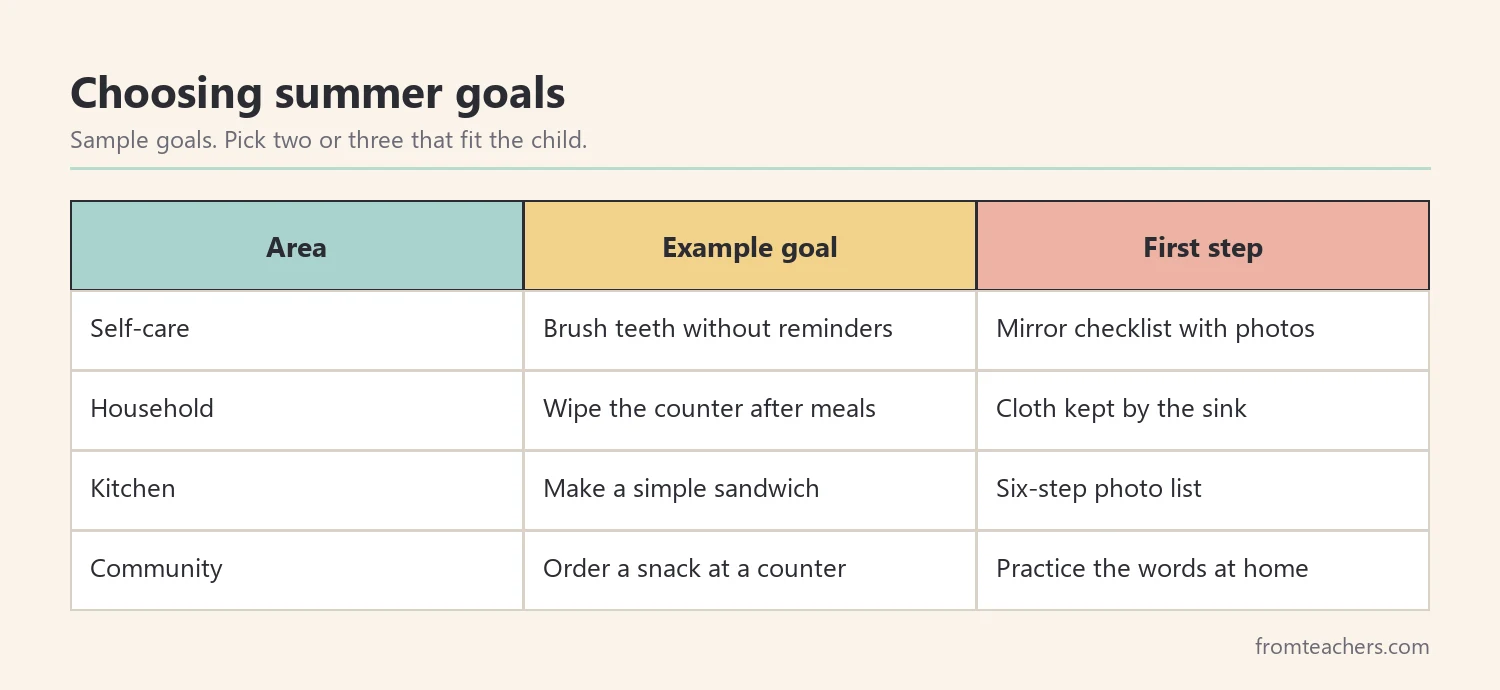
Also, connect your choices to the child’s school goals. If the child has an IEP with daily living or independence goals, summer is a natural time to keep practicing them. Ask the teacher which skills matter most and what wording or pictures the school already uses.
Then, involve the child. Ask, “What would you like to do by yourself this summer?” A child who chooses a goal, such as making his own snack, is often more motivated to practice it.
Questions to ask before you choose
- Will the child use this skill almost every day?
- Can the child already do part of it alone?
- Is it safe to practice with the supervision available at home?
- Does it matter to the child, not only to the adults?
Finally, write each goal in one plain sentence that describes what the child will do. For example, “Jonah will wipe the counter after lunch using his checklist.” A clear sentence makes it easy for every adult in the house to support the same summer life skills goal in the same way, even when the usual parent is at work.
Worked example. Jonah is a fictional eleven-year-old with an intellectual disability. His parents choose three summer life skills goals: brushing teeth without reminders, wiping the kitchen counter after meals, and making a simple sandwich. Jonah picks the sandwich himself, because he wants to make lunch for his younger sister.
2. Break each skill into a simple checklist
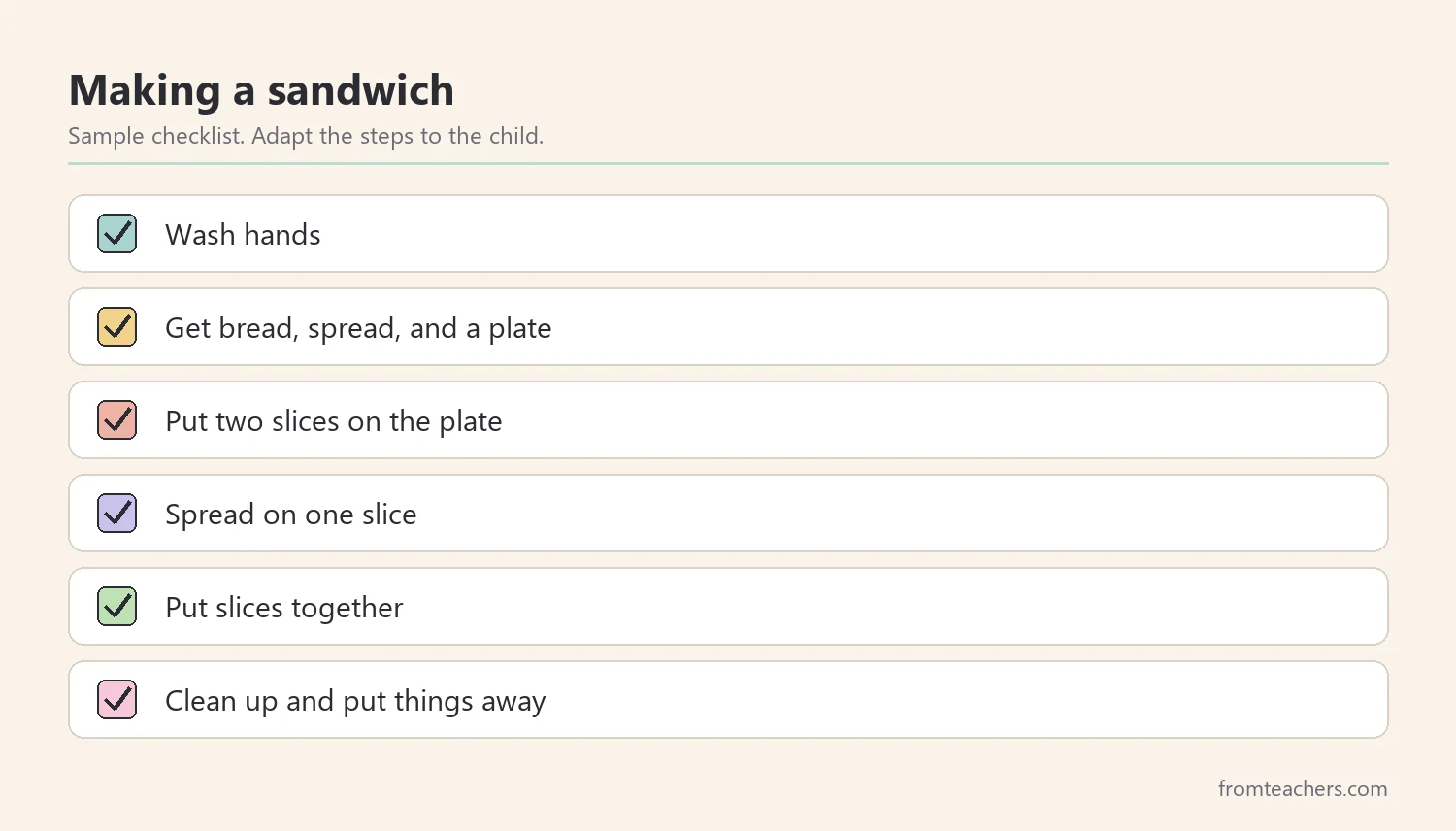
Once goals are set, break each one into short steps. This is called a task analysis, and it simply means listing every small action in order. A clear list shows exactly where the child succeeds and where support is needed.
Watch the child try the task first. Then, write down each step in plain words. Add a small picture or photo next to each step if the child benefits from visual support. Keep the list to about five to eight steps, and split longer tasks into two parts.
Checklist tips
- Use the child’s own words where possible, such as “spread” instead of “apply.”
- Place the checklist where the task happens, such as on the fridge or bathroom mirror.
- Laminate it or slide it into a plastic sleeve so the child can check off steps.
- Keep the same order every day.
Many families find it helpful to start from a ready-made page instead of writing every list from scratch. A summer life skills checklist set for special education includes pages on personal hygiene, household chores, kitchen mistakes, and celebrating a learned skill, and it can be edited to fit your child.
Worked example. Jonah’s parents watch him make a sandwich. He gets the bread and the plate but stops at spreading. They write a six-step list with photos and tape it inside a kitchen cabinet door at his eye level.
3. Teach summer life skills with the least help needed
Then, teach the skill with a plan for how much help to give. Too much help can make a child wait for an adult. Too little help can lead to frustration. The goal is to give only the support needed for success, then reduce it step by step.
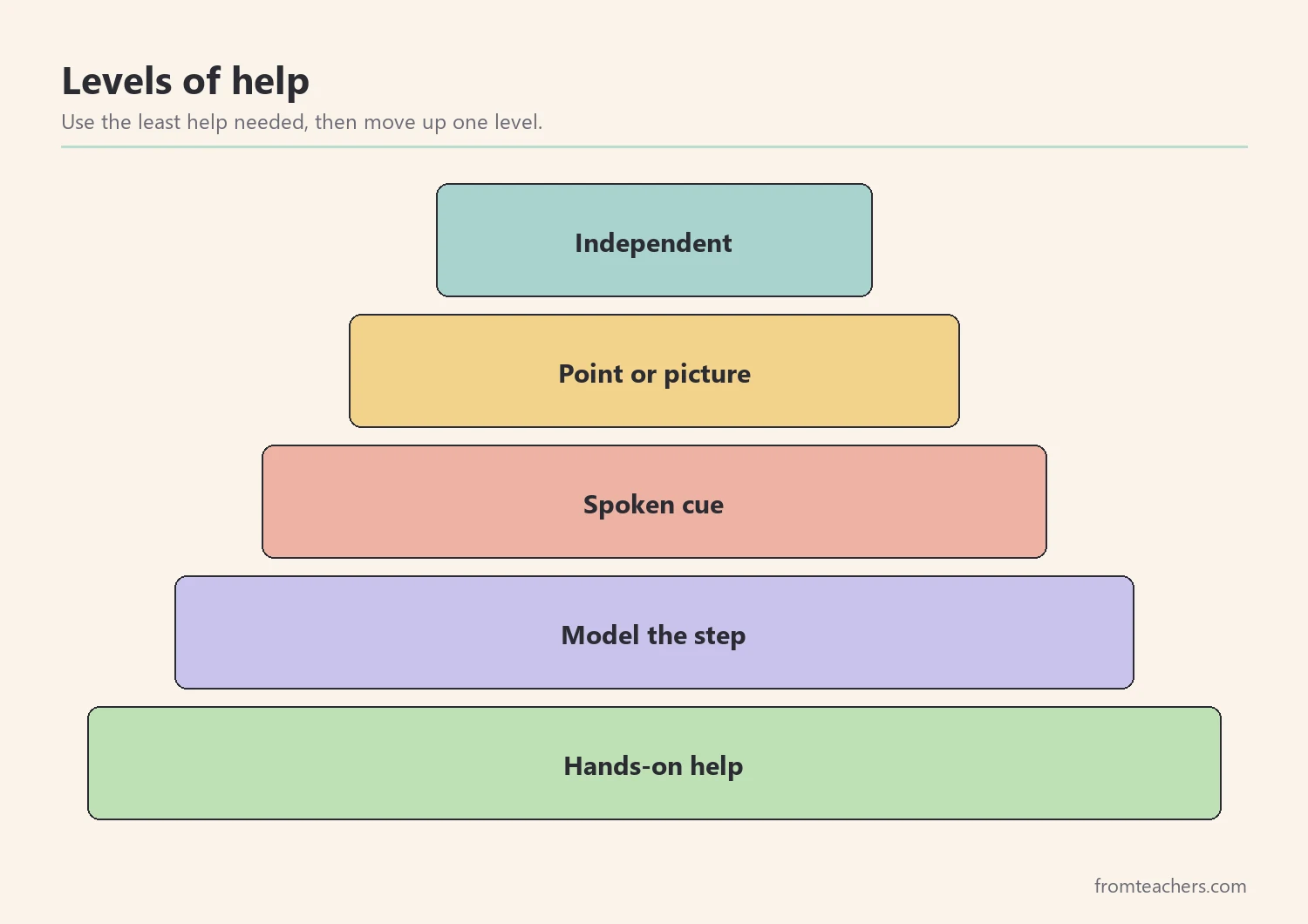
Start by modeling the whole task once while the child watches. Next, do it together, and let the child do as many steps as possible. When the child gets stuck, try a gesture or point to the picture before giving a spoken direction. Only step in with hands-on help when the other levels have not worked.
Also, choose a consistent time for practice. Summer life skills grow faster when they are linked to an existing routine, such as wiping the counter right after lunch or brushing teeth right after breakfast. The routine itself becomes the reminder.
| Skill | Linked routine | First support to try |
|---|---|---|
| Brushing teeth | After breakfast | Point to the mirror checklist |
| Wiping the counter | After lunch | Hand the cloth, then wait |
| Making a sandwich | Lunch on weekdays | Point to the next photo |
For kitchen tasks, keep an adult nearby and choose safe tools for the child’s level, such as a butter knife for spreading. Add new tools only when the child is ready and an adult has taught them directly.
Worked example. Jonah’s mom models the sandwich once. The next day, she points to each photo, and Jonah does the steps. When he freezes at spreading, she points to the photo and waits. After a few seconds, he picks up the knife and spreads.
4. Handle mistakes, frustration, and changes calmly
Next, plan for the hard moments. Mistakes are part of learning summer life skills, and so are frustration and surprises. A calm, predictable response helps the child stay willing to try again.
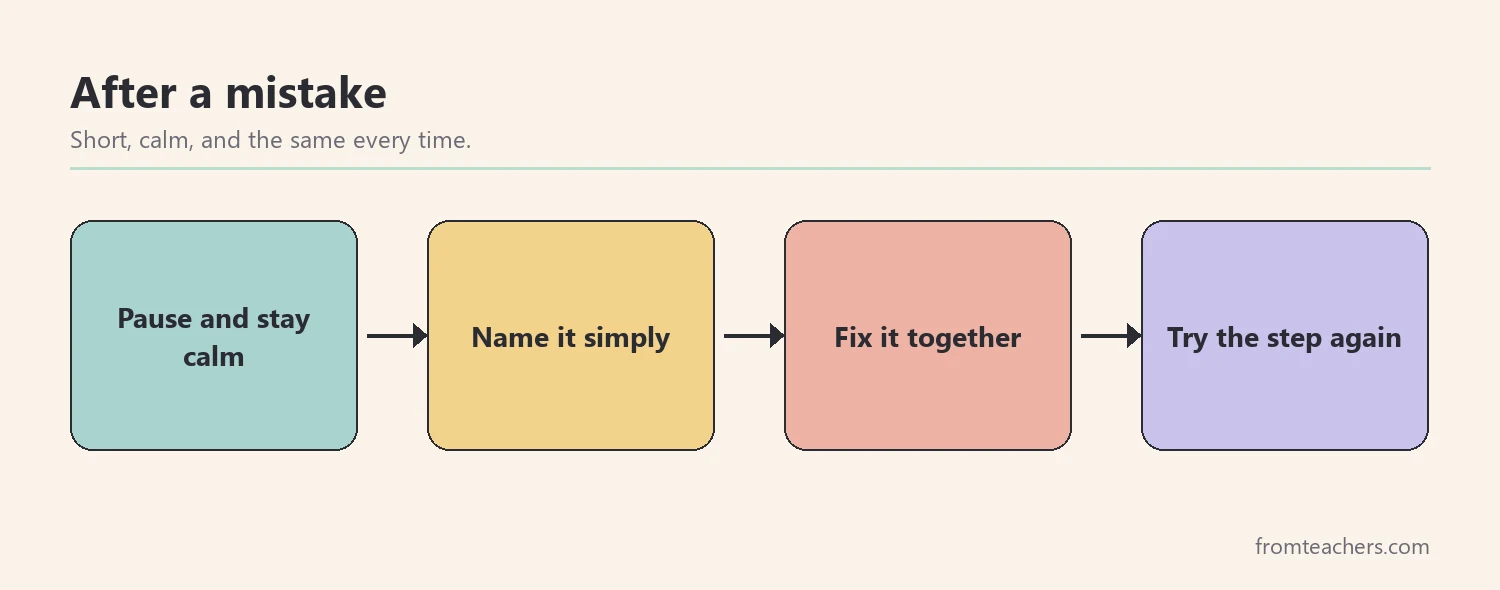
When a mistake happens, such as spilled juice, keep your words short and neutral. “Oops, juice spilled. Let’s get a towel.” Then clean up together and try the step again. This teaches that mistakes can be fixed, which is a life skill in itself.
In addition, notice signs of frustration early, such as sighing, pushing materials away, or repeated errors. Offer a short break, a simpler step, or a choice: “Do you want to spread first or put the plate out first?” Choices give the child some control without dropping the goal.
Preparing for changes in routine
- Tell the child ahead of time when a day will be different, such as a trip or visitors.
- Show the change on a simple schedule with pictures.
- Keep one familiar skill in the day, even if the rest changes.
- Praise flexibility: “You brushed your teeth even at Grandma’s house.”
However, if mistakes repeat at the same step every time, the step may be too big. Split it into two smaller steps, or change the materials, such as using a squeeze bottle instead of a jar.
Worked example. Jonah spreads too much peanut butter and tears the bread. He gets upset. His mom says, “Bread tore. That’s okay. Let’s try a softer spread.” They switch to a squeeze bottle, and the next sandwich works.
5. Track and celebrate summer life skills progress
Finally, track progress in a simple way. Count how many steps of each checklist the child does without help, once or twice a week. These numbers show whether the plan is working and when to reduce support.
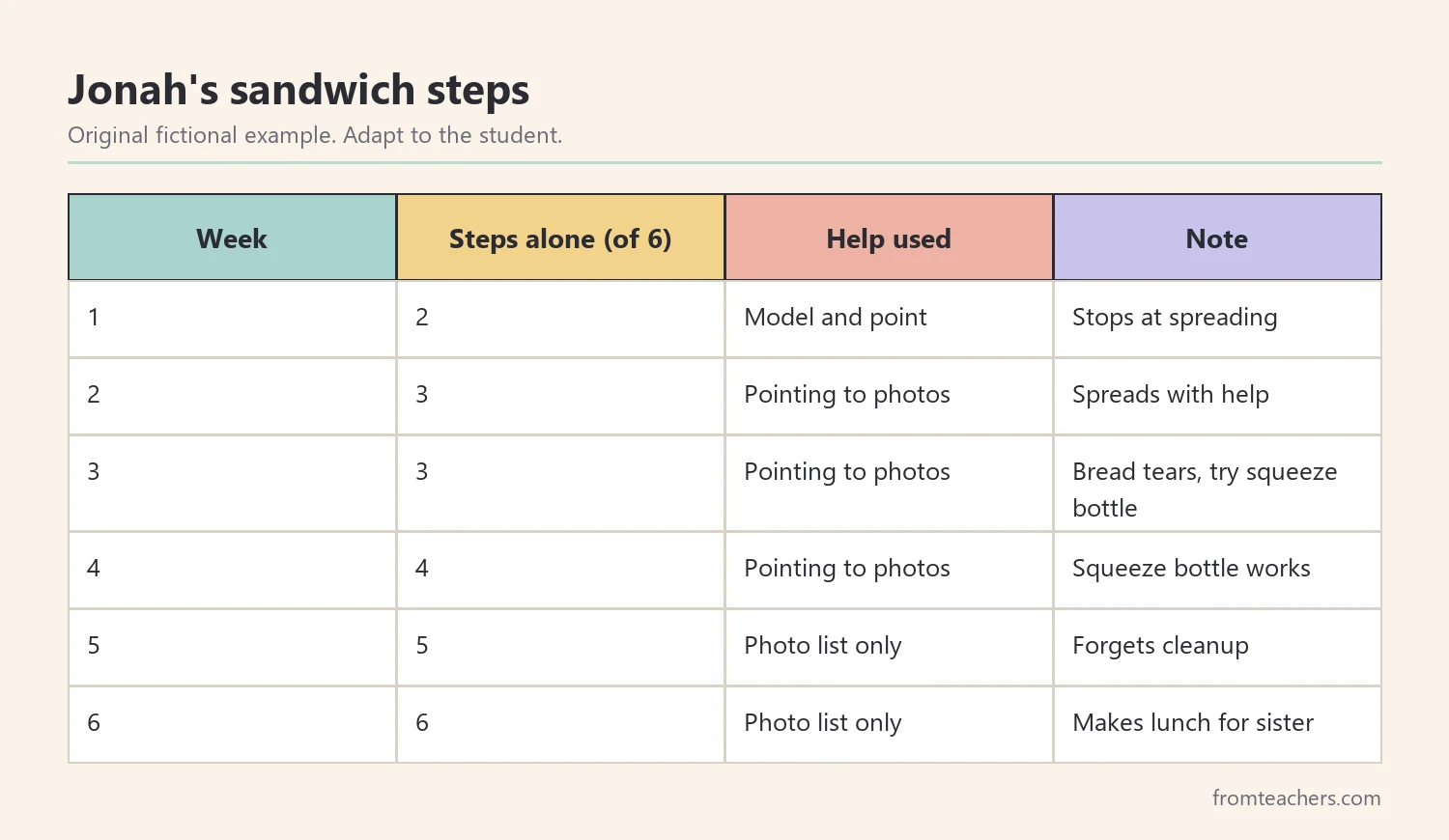
Keep the record easy enough that you will actually use it. A small table on the back of the checklist, with the date and the number of steps done alone, is enough. If more than one adult helps, agree on what counts as “alone” so the numbers mean the same thing every time. For example, pointing to a photo might count as help, while a general “keep going” might not.
Use the record to make decisions. If the number is rising, fade one level of help. If it is flat for two weeks, look for a step that needs to be split, a material that needs to change, or a better practice time.
Also, celebrate real progress. A celebration does not need to be big. Taking a photo of the child’s first independent sandwich, telling a grandparent, or adding a sticker to a summer chart can all mark the moment. Celebrations help children see themselves as capable.
Moreover, share the record with the school before the new year starts. A short summary such as “Jonah makes a sandwich with 6 of 6 steps alone, with a picture checklist” helps the teacher build on summer progress instead of starting over.
Worked example. Over six weeks, Jonah’s independent sandwich steps go from 2 of 6, to 3, 3, 4, 5, and then 6 of 6. In week 3 the number stays flat, so his parents switch to the squeeze bottle. By week 6, he makes lunch for his sister with only the photo checklist.
Common mistakes and how to avoid them
- Choosing too many goals. Fix: start with two or three summer life skills and add more after success.
- Doing the task for the child to save time. Fix: plan practice when you are not rushed, and wait before helping.
- Using different steps every day. Fix: keep one checklist in the same place and the same order.
- Reacting strongly to mistakes. Fix: stay neutral, fix it together, and try again.
- Losing progress at the end of summer. Fix: share the checklist and record with the school.
Questions teachers and parents ask about summer life skills
Which summer life skills should we start with?
Start with skills the child needs every day, such as brushing teeth, dressing, or simple chores. Choose one that is just beyond what the child can do alone now, so success feels close.
How long should practice take each day?
Short practice inside a normal routine usually works best. A few minutes after a meal or before bed, done every day, often helps more than a long session once a week.
What if my child refuses to practice?
Make the task smaller, offer choices, and link it to something the child enjoys. If refusal continues, ask the child’s teacher or therapist about strategies that already work at school.
Can teachers send summer life skills home?
Yes. Teachers can share the checklists and pictures used at school so families can use the same steps. Consistent language and pictures help the child transfer skills between settings.
When should I reduce help?
Reduce help when the child completes the steps with the current level of support for several days in a row. Move one level at a time, and go back a level briefly if the child struggles.
Related reading: Navigating the Path to Adulthood: Building Essential Life Skills, Dignity in Daily Care: Respectful Approaches to Toileting and Personal Hygiene, and How Parents and Teachers Can Team Up for Special Education Success.
A companion resource for building summer independence:
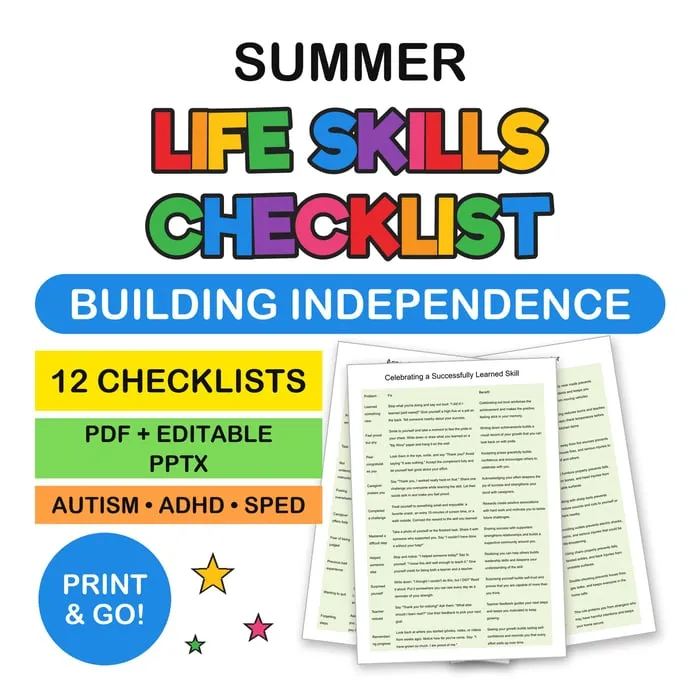
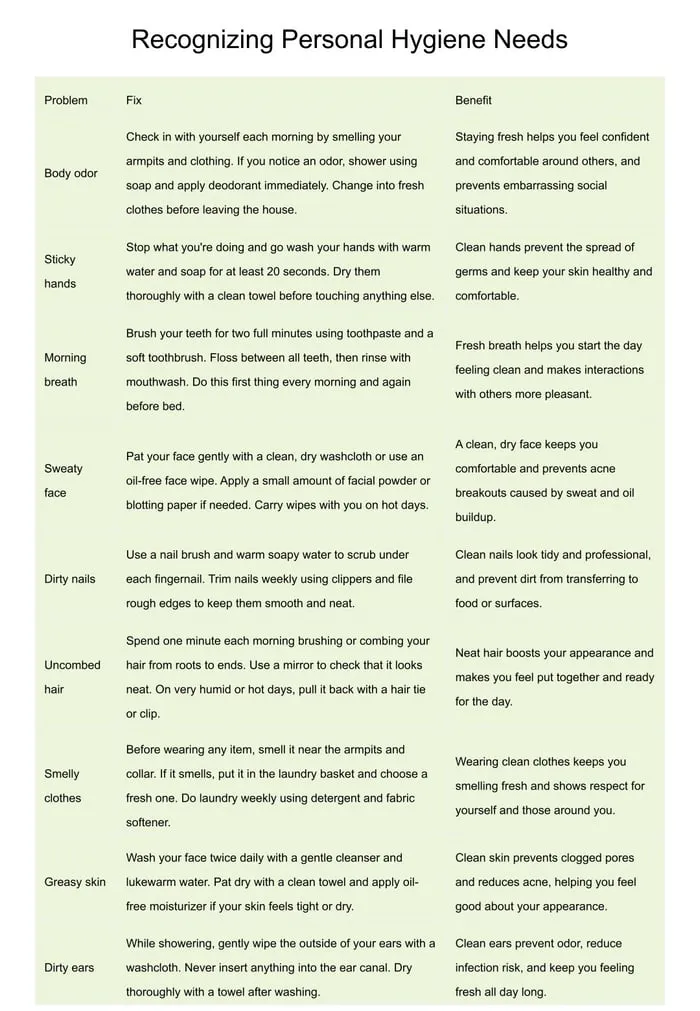
Summer Life Skills Checklist: Building Independence for Special Education: a set of 12 checklists and trackers for parents, caregivers, and life skills teachers, covering hygiene, household chores, kitchen mistakes, routine changes, and celebrating a learned skill. Includes a PDF and an editable PowerPoint version.
Sources and scope
- Individuals with Disabilities Education Act (IDEA): information on IEPs and services for students with disabilities.
- IRIS Center, Vanderbilt University: free modules on evidence-based practices, including teaching skills step by step.
- American Occupational Therapy Association: information on daily living skills and independence.
- Center for Parent Information and Resources: guidance for families of children with disabilities.
This guide covers planning and teaching everyday life skills at home during summer break for children with disabilities. It does not replace individual advice from the child’s IEP team, therapist, or doctor.
Key takeaways
- Summer life skills grow best with two or three clear, daily goals.
- Break each skill into a short checklist placed where the task happens.
- Give the least help needed and fade it one level at a time.
- Respond to mistakes calmly and fix them together.
- Track independent steps, celebrate progress, and share it with the school.






Leave a Comment